Link Building Email Outreach: Templates and Real Examples That Work
Link Building Email Outreach: Templates and Real Examples That Work
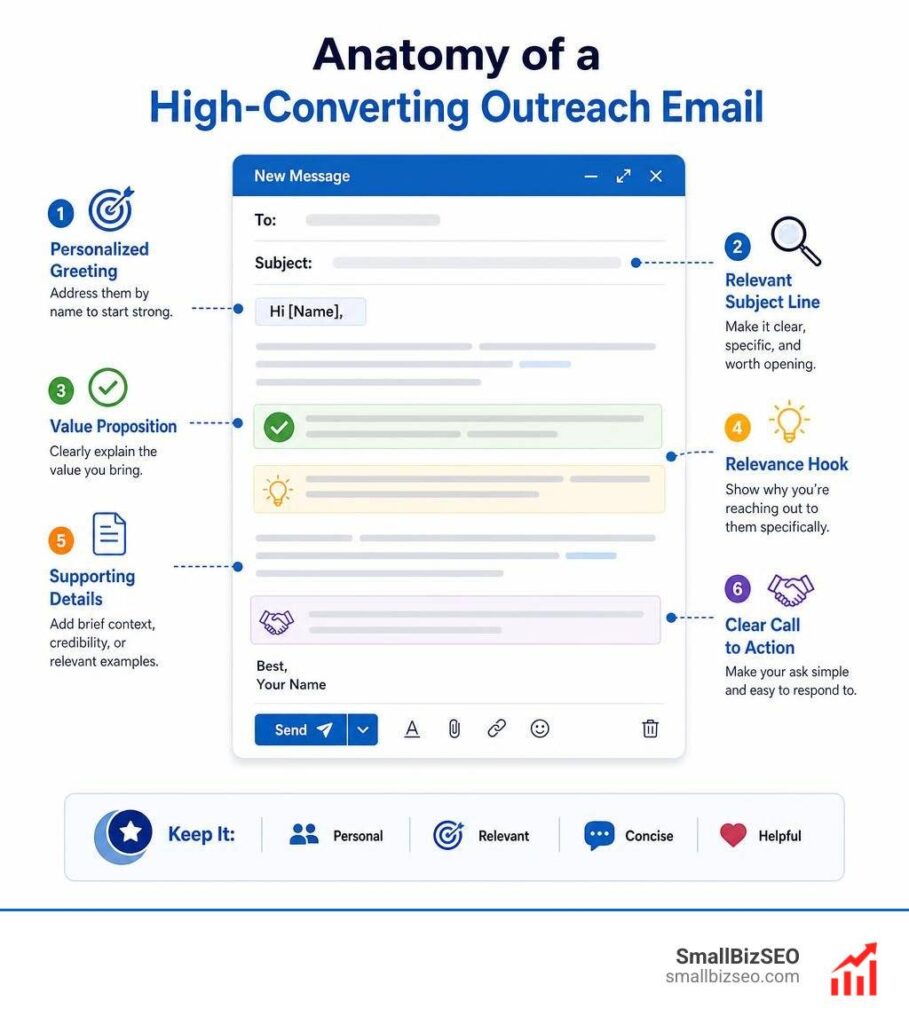
Link building email outreach is the process of contacting website owners, editors, and bloggers by email to earn backlinks to your site — and it remains one of the most effective ways to improve your search rankings.
Here's what you need to know at a glance:
- What it is: Sending personalized emails to relevant websites asking them to link to your content
- Why it works: Quality backlinks signal authority to Google, helping your pages rank higher
- Average results: Expect a 5–15% reply rate and roughly a 1–3% conversion from email to a live backlink
- Key to success: Personalization, a clear value offer, and a short follow-up sequence
- Tools you'll need: An email finder (like Hunter.io), an outreach platform, and a backlink checker
The numbers tell an honest story. From 1,000 outreach prospects, roughly 50 will reply, 25 will respond positively, and about 13 will actually publish a backlink. That's a 1.3% end-to-end success rate — which means volume, targeting, and quality all matter equally.
The good news? Personalized emails perform up to 32% better than generic ones, and a single well-timed follow-up can generate 38% of all your replies. Small improvements in your process compound quickly.
I'm Clayton Johnson, a digital PR and SEO specialist who has spent years running link building email outreach campaigns that connect content to the right audiences and build lasting search authority. In this guide, I'll walk you through exactly how to do it — from finding prospects to writing emails that actually get responses.
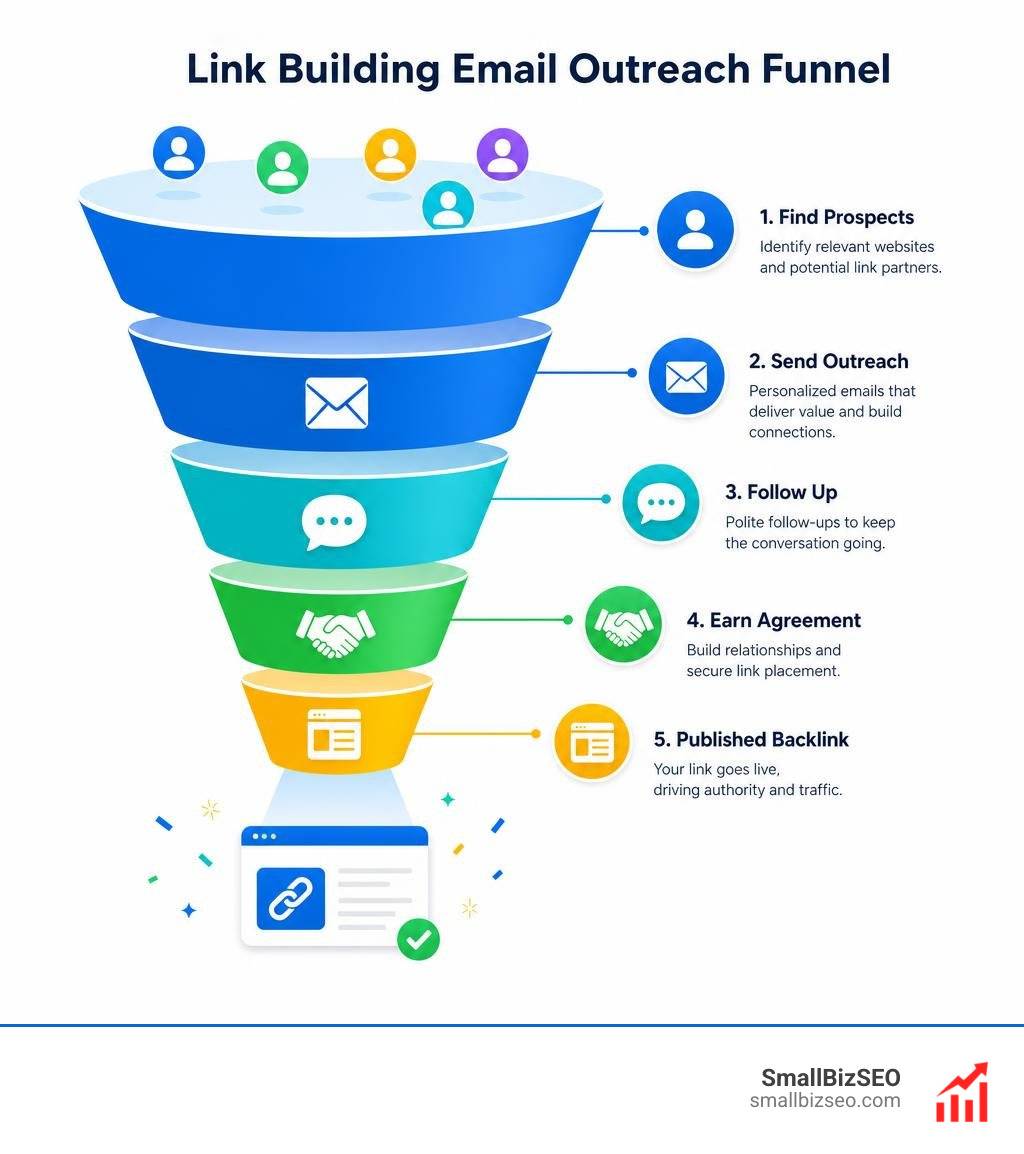
At its core, backlink acquisition is about building digital relationships. When search engines crawl the web, they treat links as votes of confidence. A backlink from a highly authoritative, relevant website tells search engines that your content is trustworthy, which directly boosts your domain authority and search engine rankings.
But links do not just appear out of thin air. Unless you are already a household brand, you have to actively promote your content. This is where What is Email Outreach? becomes the central engine of your off-page strategy.
By directly contacting editors and site owners, you bypass the waiting game and put your linkable assets right in front of the decision-makers. Beyond the obvious SEO benefits, successful outreach also drives targeted referral traffic to your site and establishes your brand as an industry leader. For businesses looking to scale this process efficiently, utilizing professional SEO Services can help streamline the entire workflow, ensuring your campaigns are built on a foundation of high-quality content.
How to Find and Qualify the Right Prospects
Most outreach campaigns fail before the first email is even sent because of poor prospecting. If you pitch a technical guide to a lifestyle blogger, you will get marked as spam.
We recommend building a tiered prospect list based on three key metrics: domain rating (DR), topical relevance, and active publishing.
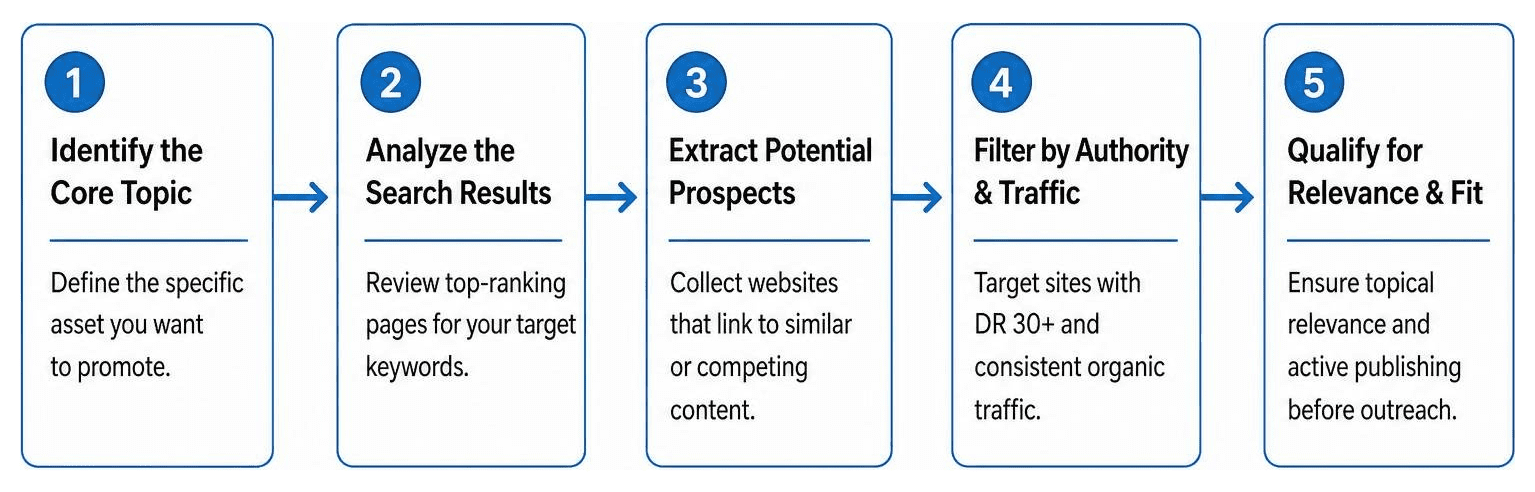
To build a highly qualified list, follow this step-by-step workflow:
- Identify the Core Topic: Start with the specific asset you want to promote.
- Analyze the Search Results: Look at the top-ranking pages for your target keywords. Who is linking to them?
- Filter by Authority and Traffic: Target sites with a DR of 30 or higher and consistent organic traffic. Sites with a DR between 20 and 40 often convert at twice the rate of massive publications because their editorial processes are less complex.
- Run a Competitor Analysis: Use backlink checkers to see where your competitors are getting their links. This is a great shortcut to find sites that are already open to linking to content in your niche. You can also run a Keyword Gap Analysis: What It Is and How to Do It Right to find content topics that your prospects are covering but you have not fully leveraged yet.
Finding Contact Details for Link Building Email Outreach
Once you have a list of target websites, you need to find the right person to contact. Sending your pitch to a generic address like "info@" or "webmaster@" is a quick way to get ignored. You want to reach out to managing editors, content managers, or the specific authors of the posts.
To find these details, we use specialized email lookup tools like Hunter and Voila Norbert. Simply plug in the target domain, and these tools will crawl the web to find verified email addresses. If that fails, checking the team's social media profiles on platforms like LinkedIn or X can yield direct contact details. For a complete breakdown of this process, check out this guide on Link Building Outreach for Noobs.
Anatomy of an Effective Link Building Outreach Email
A successful outreach email is a mix of art and science. Busy editors scan their inboxes in under five seconds, meaning your email must be clear, concise, and immediately present a value proposition.
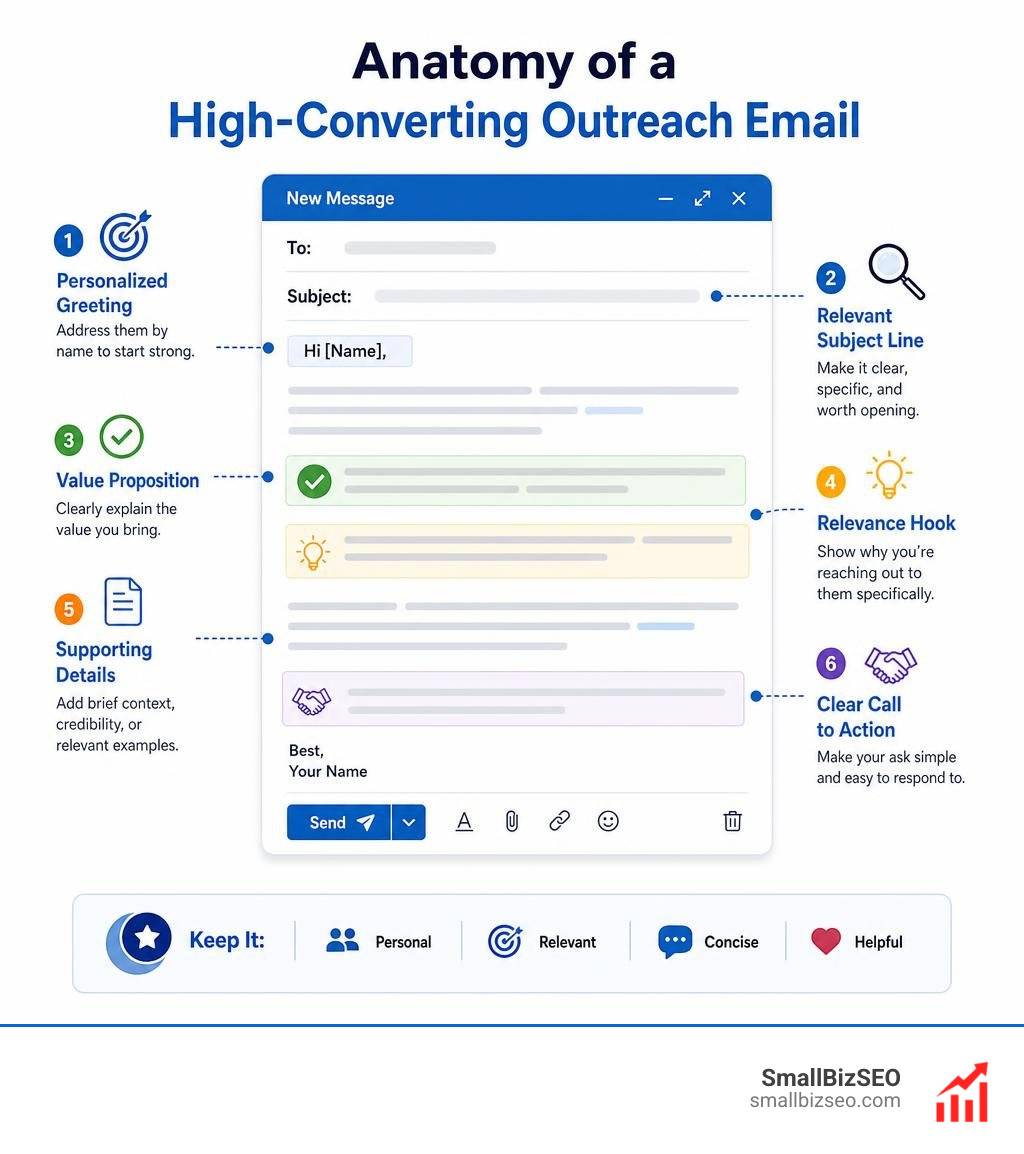
An effective outreach email consists of five core elements:
- A Compelling Subject Line: This is your gatekeeper. Keep it under 60 characters and make it benefit-oriented.
- A Personalized Greeting: Always use the recipient's first name.
- A Concise Body: Keep the total length between 50 and 125 words. State why you are reaching out and what is in it for them within the first two sentences.
- A Clear Call to Action (CTA): End with a single, low-friction question. Instead of asking "Can you add our link?", ask "Would you be open to taking a quick look?"
- A Professional Signature: Include your real name, title, and social links to build trust and show you are a real person.
Writing Link Building Email Outreach That Gets Replies
To write emails that actually get replies, you must avoid sounding like a robot. Editors receive dozens of template-filled pitches every day, and they can spot generic automated copy from a mile away.
Start by building real credibility. Show that you understand their audience and have created something that genuinely fills a content gap. This aligns perfectly with search engine guidelines around expertise and trust. To learn more about aligning your content with these standards, read our guide on How to Optimize Your Content for E-E-A-T and Build Real Search Trust.
Additionally, when drafting your pitch, you can use a proven Email Outreach Template for Link Building as a structural starting point, but always customize the hook and the specific value layer for every single prospect.
Proven Templates for Different Outreach Scenarios
Different link-building strategies require different angles. Here are four highly effective, copy-paste-ready templates that you can adapt for your campaigns.
Template 1: The Guest Post Pitch
This template is perfect for offering high-quality, free content in exchange for an editorial link.
Subject: Pitch: Content ideas for [Site Name]
Hi [Name],
I was reading your recent article about [Topic] and loved your point about [Specific Point].
I'd love to write a free, high-quality guest post for your blog. Here are three topics I think your readers would find incredibly useful:
- [Topic Idea 1]: A deep dive into [Concept]
- [Topic Idea 2]: How to solve [Common Pain Point]
- [Topic Idea 3]: A step-by-step guide to [Process]
I'll handle all the writing and formatting to match your editorial guidelines. Would you be open to exploring one of these ideas?
Best,
[Your Name]
Template 2: Broken Link Building
This angle works because you are helping the site owner fix a broken user experience on their site.
Subject: Broken link on [Site Name]
Hi [Name],
I was searching for some resources on [Topic] and came across your excellent guide: [URL of their page].
It looks like one of the links you referenced is no longer active. The link for "[Anchor Text]" points to a dead page (404 error).
We recently published an updated, in-depth guide on that exact topic here: [Your URL].
If you're planning on updating the page, it might make a great replacement resource for your readers. Either way, hope this helps keep your page clean!
Best,
[Your Name]
Template 3: Resource Page Inclusion
Use this template when pitching your comprehensive guide or tool to curated resource lists.
Subject: Resource suggestion for [Page Title]
Hi [Name],
I stumbled on your resource list while researching [Topic] today: [URL of resource page]. It's an incredibly thorough list of tools.
We recently built a free tool/guide that [explain what it does/solves]: [Your URL].
Given how helpful your page is for [Target Audience], I thought this might make a valuable addition to your section on [Section Name].
Would you be open to taking a quick look to see if it's a good fit?
Best,
[Your Name]
Template 4: Unlinked Brand Mentions
This is the highest-converting outreach strategy because the author already knows your brand and has written about you.
Subject: Quick question about your mention of [Brand Name]
Hi [Name],
I wanted to reach out and say a huge thank you for mentioning [Brand Name] in your recent article about [Topic]: [URL of their page].
We really appreciate the shout-out!
I was wondering if you'd be open to adding a hyperlink to our name so your readers can easily find us if they want to learn more?
Either way, thanks again for the mention, and keep up the great work with your content!
Best,
[Your Name]
Outreach Strategy Comparison
| Outreach Strategy | Typical Reply Rate | Conversion Rate | Best For |
|---|---|---|---|
| Unlinked Brand Mentions | 15–25% | 10–15% | Established brands with existing web mentions |
| Guest Post Pitching | 10–15% | 5–8% | New sites looking to build initial authority |
| Resource Page Inclusion | 8–12% | 3–5% | High-quality tools, templates, and deep-dive guides |
| Broken Link Building | 5–10% | 1–3% | Scaling link acquisition across broad niches |
Technical Setup, Deliverability, and Legal Compliance
If your outreach emails are landing in the spam folder, your templates do not matter. To protect your domain reputation and ensure high deliverability, you must set up your technical infrastructure correctly.
First, never send bulk outreach emails from your primary business domain. If editors mark your emails as spam, it could ruin your company's daily email operations. Instead, register a dedicated outreach domain that is slightly different from your main domain.
Once your outreach domain is registered, configure these three essential authentication protocols:
- SPF (Sender Policy Framework): Specifies which mail servers are authorized to send email on behalf of your domain.
- DKIM (DomainKeys Identified Mail): Adds a digital signature to your emails, proving they were not altered in transit.
- DMARC (Domain-based Message Authentication, Reporting, and Conformance): Uses SPF and DKIM to determine the authenticity of an email message.
After setting up these protocols, run a gradual email warmup process. Start by sending 5 to 10 emails per day, slowly increasing the volume over several weeks to build a positive sending history. If you want to make sure your site and outreach setup meet search engine standards, you can read about How to Pass Google's Own SEO Analysis Audits.
Finally, always stay compliant with legal regulations like CAN-SPAM and GDPR. This means including a clear way for recipients to opt out of future emails, processing opt-outs immediately, and providing a physical business address in your email signature. For a deeper look into cold email deliverability and setup, review this Cold Email Link Building Guide.
How to Follow Up and Measure Campaign Success
Persistence is where most links are won. Busy editors get sidetracked, and a polite follow-up can easily double your reply rate. In fact, our data shows that the first follow-up email generates up to 38% of all campaign replies.
We recommend a simple, three-touch sequence:
- Day 0: Send the initial personalized pitch.
- Day 4–5: Send a gentle bump. Keep it short, threading it to the original email.
- Day 10–12: Send a final "breakup" email, offering one last piece of value and letting them know you won't crowd their inbox anymore.
To understand if your campaign is working, you need to track your metrics closely.
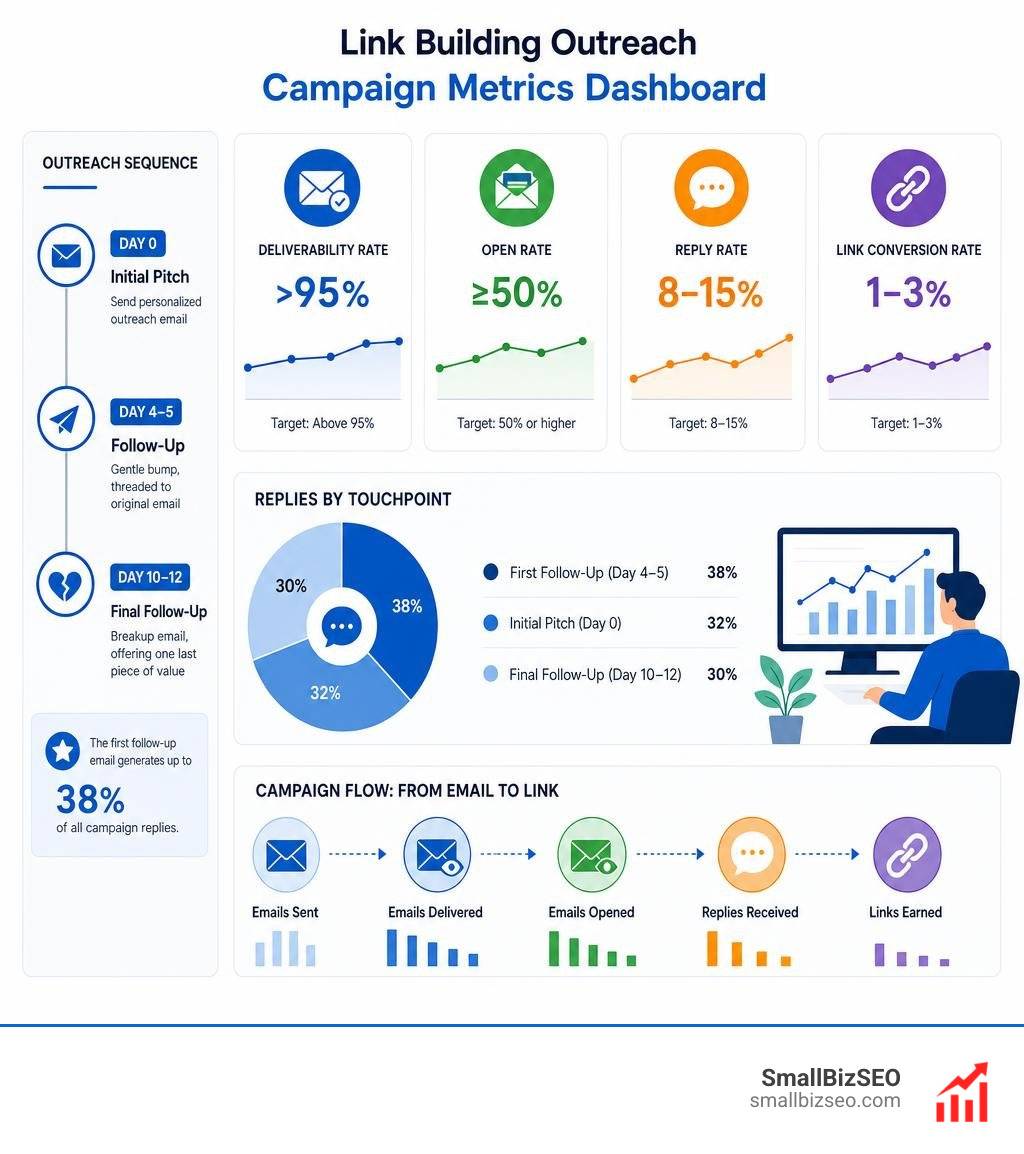
Keep an eye on these four key metrics:
- Deliverability Rate: Should be above 95%. Anything lower indicates technical or domain reputation issues.
- Open Rate: Aim for 50% or higher. If it's lower, your subject lines need work.
- Reply Rate: A healthy target is 8–15%. If you are below 5%, your targeting or value proposition is likely weak.
- Link Conversion Rate: Track how many sent emails turn into live backlinks. A rate of 1–3% is standard across the industry.
To learn more about optimizing your follow-up sequence and boosting your reply rates, explore Link Building Outreach That Earns Real Replies.
Frequently Asked Questions about Link Building Email Outreach
What is a realistic reply rate for link building outreach?
For a well-targeted, personalized campaign, a realistic reply rate is between 8% and 15%. If you are using highly personalized "sniper" approaches, you can see reply rates climb up to 20%. Broad "shotgun" campaigns often drop below 5%, which can put your domain's deliverability at risk.
Should I use my main domain for cold email outreach?
No. We strongly advise against using your primary business domain for cold email outreach. If your domain gets flagged for spam, it can disrupt your everyday business communications. Always use a dedicated outreach domain and warm it up properly before launching campaigns.
How do I handle editors who ask for payment?
Buying links directly violates Google's link spam policies. If an editor asks for a publishing fee, the best approach is to politely decline and offer high-quality content or editorial collaboration instead. Focus on building relationships with sites that value editorial quality over quick payouts.
Conclusion
Mastering link building email outreach is a journey of consistency, relevance, and genuine value exchange. By prioritizing high-quality prospect research, writing personalized pitches, and maintaining a clean technical setup, you can build a steady stream of authoritative backlinks that drive real business growth.
At SmallBizSEO, we help small businesses scale their search authority through our data-driven "Velocity" framework. We combine technical SEO expertise with E-E-A-T-compliant link-building strategies to deliver fast, transparent, and sustainable rankings. Ready to boost your search visibility? Learn more about our specialized Link Building Services and let's grow your digital footprint together.