Find Local SEO Services for Computer Networking Installation
What Does SEO for Computer Networking Installation Help You Achieve?
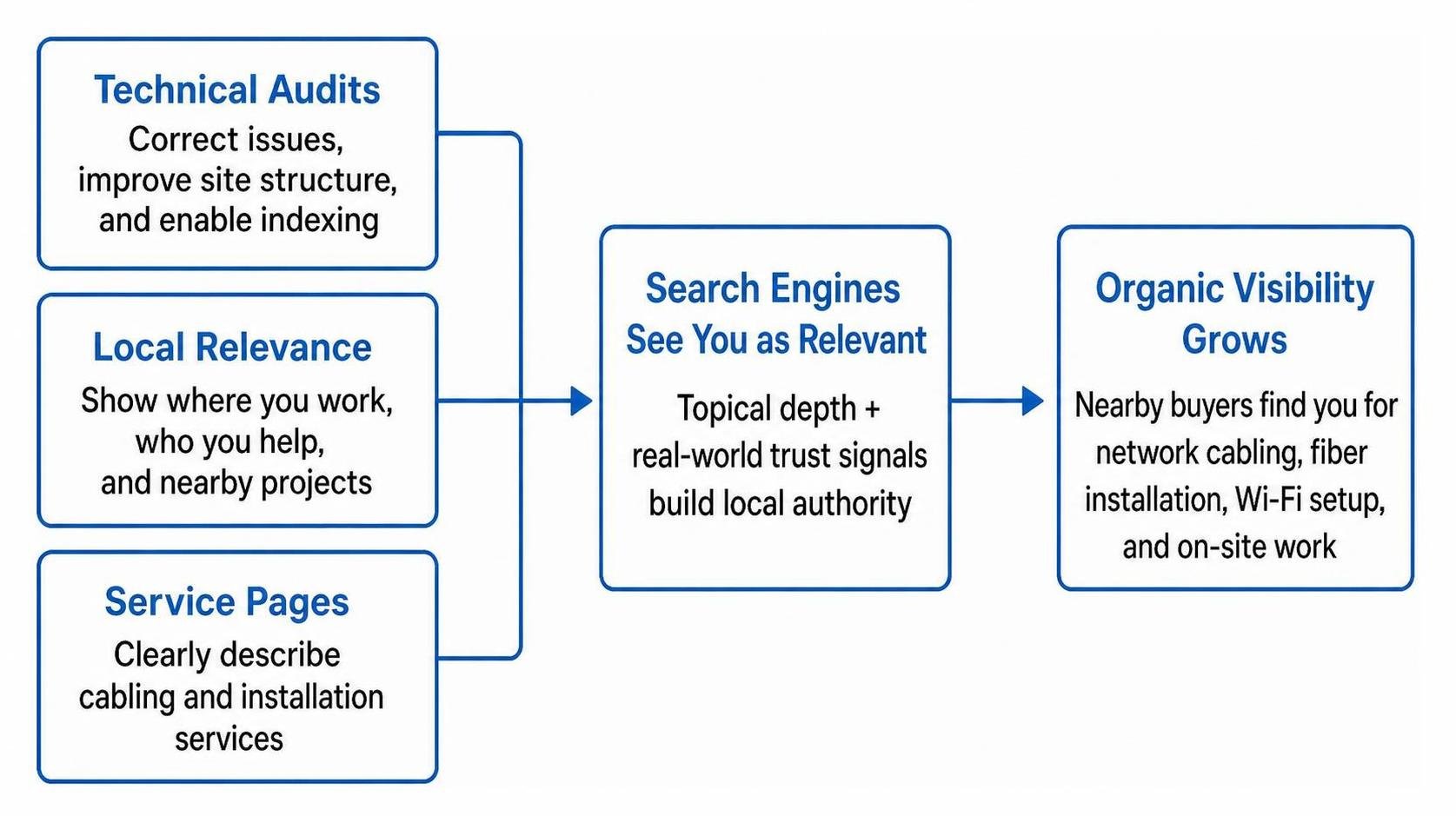
SEO for computer networking installation helps nearby buyers find your company when they need network cabling, fiber installation, Wi-Fi setup, or related on-site work. Start with a page that clearly describes the work you perform, where you work, and how buyers can request a site survey or quote. Add an accurate Google Business Profile and, with client permission, project examples that show what you delivered.
A buyer may search for an installer before an office move, a network upgrade, or a new build. Your website should help them decide whether you fit the job without exposing private network details.
How Can Networking Contractors Build Local Authority and Search Visibility?
Local authority comes from presenting verified capabilities, demonstrating geographical proximity, and maintaining clean technical architecture. When facilities managers or IT directors search for commercial network cabling, they look for verifiable contractor credentials rather than generic marketing promises.
Search engines evaluate your relevance based on topical depth and real-world trust signals. By following standard SEO best practices, networking contractors can build search visibility that accurately reflects their physical deployment capabilities.
How Does SEO for Computer Networking Installation Capture Commercial Buyers?
Commercial buyers evaluate contractors based on physical execution, testing standards, and compliance requirements. IT leaders need to know which services your team actually performs, which may include site surveys, copper or fiber cabling, managed access point deployment, and standards-based test reporting.
Capturing these decision-makers requires direct operational proof on service pages. As detailed in our B2B SEO playbook, landing pages should address the procurement specifications that apply to the work you actually offer. Use the following examples only for capabilities, testing methods, and deliverables your company provides.
| Buyer Question | Examples of On-Page Evidence When Offered | Example Deliverables When Offered |
|---|---|---|
| Can you handle our facility layout and cabling specifications? | Documented copper or fiber capabilities relevant to your services | Site survey notes, cable schedules, or pathway layouts |
| How do you test cable performance? | A clear verification, qualification, or certification process for the applicable work | Relevant test summaries or calibrated test results |
| How is hardware organized and managed? | Rack-build, patch-panel, and labeling practices your team provides | Labeled patch panels, rack elevations, or port-mapping sheets |
| What happens at project completion? | Handover procedures and documentation available for the project | Redacted as-built records, test-summary sign-off, or applicable warranty details |
When presenting project proof online, always protect customer security. Use permissioned, redacted project summaries that detail building square footage and drop counts without publishing network topology diagrams, active IP configurations, password protocols, or facility security measures.
How Can Cable Installers Optimize Google Business Profiles and Local Citations?
For local visibility, use a Google Business Profile only when the business is genuinely eligible to meet customers in person. A staffed location that receives customers may be shown as an address, while a service-area business that does not receive customers should keep its address hidden and define only the areas it actually serves. Choose categories that are verified as available and reflect the services you actually provide, rather than treating any category as mandatory.
Our approach to local SEO centers on maintaining complete consistency across your business name, physical operating address, phone number, and service capabilities. Supplement your primary profile with verified customer reviews that describe specific project scopes, such as warehouse Wi-Fi installation or commercial data closet build-outs.
What Technical SEO Should IT Contractors Prioritize?
Technical SEO helps search engines crawl, index, and understand your installation capabilities with fewer technical barriers. Network installation sites should maintain fast load times and clear mobile responsiveness so commercial buyers can review project scope requirements on any device.
Implement structured data markup across your website to clarify your service offerings:
- LocalBusiness Schema: Defines your business entity, verified operating hours, contact endpoints, and physical dispatch regions.
- Service Schema: Outlines distinct technical offerings, such as commercial structured cabling, fiber optic fusion splicing, or server rack installation.
Maintaining high technical performance and responsive navigation helps search engines understand your commercial capabilities. A focused technical SEO approach can improve crawlability, page experience, and the clarity of service-page signals without promising indexing or AI-search outcomes.
How Can Network Installers Grow Their Pipeline and Generate Leads?
Contractors grow their pipeline by aligning website structure with clear commercial intent. Rather than forcing every technical capability onto an arbitrary standalone URL, build dedicated pages for distinct buyer needs: structured data cabling, fiber optic deployment, wireless network design, and server room cleanups.
Provide clear conversion pathways across every page. Give commercial clients a secure method to input project specifications, such as estimated drop counts, facility square footage, ceiling heights, and approved, secure document uploads for architectural floor plans.
Which SEO Strategies Help Computer Networking Installers Win B2B Contracts?
To attract commercial contract inquiries, target specific, high-intent queries that indicate an active installation project. Buyers searching for terms like "warehouse Cat6A cabling installer," "commercial fiber optic fusion splicing," or "office server rack relocation" may be assembling vendor shortlists.
Contractors can strengthen related service coverage without diluting the core installation topic. Use SEO content services to build and regularly refresh useful supporting pages, connect them with relevant internal links, and keep each page focused on a distinct buyer need.
When describing cable testing, use the terms precisely. The type of test and the report you mention should match the work your company actually offers:
- Verification: Checks basic wiring conditions, such as continuity and wiremap issues. Not every verification tester detects split pairs, so avoid overstating what a basic test proves.
- Qualification: Tests whether an installed link can support a specific application or network speed under the test method used.
- Certification: Measures performance against the chosen applicable cabling standard with suitable calibrated test equipment. See Fluke Networks’ explanation of verification, qualification, and certification.
Accurately articulating these distinctions builds credibility with enterprise procurement teams and sets realistic expectations for project deliverables.
What Content and Link-Building Tactics Support Low-Voltage Infrastructure SEO?
Educational content attracts commercial decision-makers who are researching infrastructure options prior to issuing bid requests. Publish detailed technical comparisons that address real-world engineering trade-offs, such as:
- Cat6 vs. Cat6A for Commercial Deployments: Evaluating distance limitations, alien crosstalk mitigation, and bandwidth overhead.
- Single-Mode vs. Multimode Fiber: Comparing backbone run lengths, transceiver costs, and long-term upgrade paths.
- Wi-Fi 6E/7 Design Considerations: Detailing access point placement, power-over-Ethernet (PoE) budget planning, and structural interference.
Build topical authority with useful comparisons, ongoing page refreshes, and internal links that help buyers move from research to a relevant service page. Earned outreach can support this work when it results in relevant industry, partner, or trade-organization mentions rather than low-quality directory volume.
Pursue earned links by claiming relevant partner directory profiles, participating in recognized industry trade bodies, and sharing genuinely useful technical resources that other organizations may reference.
What Common SEO Mistakes Should Networking Contractors Avoid?
Many networking contractors struggle with search visibility because of avoidable on-page and structural mistakes:
- Grouping Unrelated Capabilities: Combining structured cabling, home audio setup, device repair, and cloud hosting onto a single unfocused page.
- Creating Thin, Duplicate Location Pages: Publishing city landing pages that only swap out municipality names without providing unique regional project context.
- Making Unsupported Technical Claims: Promising universal speeds, zero downtime, or lifetime warranties without defining real-world environmental factors.
- Neglecting Verified Reviews: Failing to ask commercial clients for detailed feedback regarding project timelines, professionalism, and labeling accuracy.
Transforming Search Visibility into Qualified Installation Contracts
Building an effective search presence for network installation requires clear communication, technical accuracy, and consistent local signals. When commercial buyers find landing pages that address their project scope, explain applicable testing standards, and respect enterprise data privacy, the site can support more informed quote inquiries.
Focus on transparent project scoping, accurate Google Business Profile management, and educational content that answers procurement questions. Maintain the pages with ongoing updates, relevant internal links, and earned outreach that reflects real expertise. For help improving SEO for your installation services, book a consultation with SmallBizSEO.