On-Page SEO Techniques for Measurable Growth
On-Page SEO Techniques for Measurable Growth
Why On-Page SEO Is the Foundation of Search Visibility
What is on-page SEO? It's the practice of optimizing the content and HTML elements directly on your webpages to rank higher in search results and attract more relevant organic traffic.
Here's a quick answer:
On-page SEO is the process of improving individual web pages — their content, title tags, headings, URLs, images, and internal links — so search engines can understand them and rank them for the right searches.
The key elements of on-page SEO include:
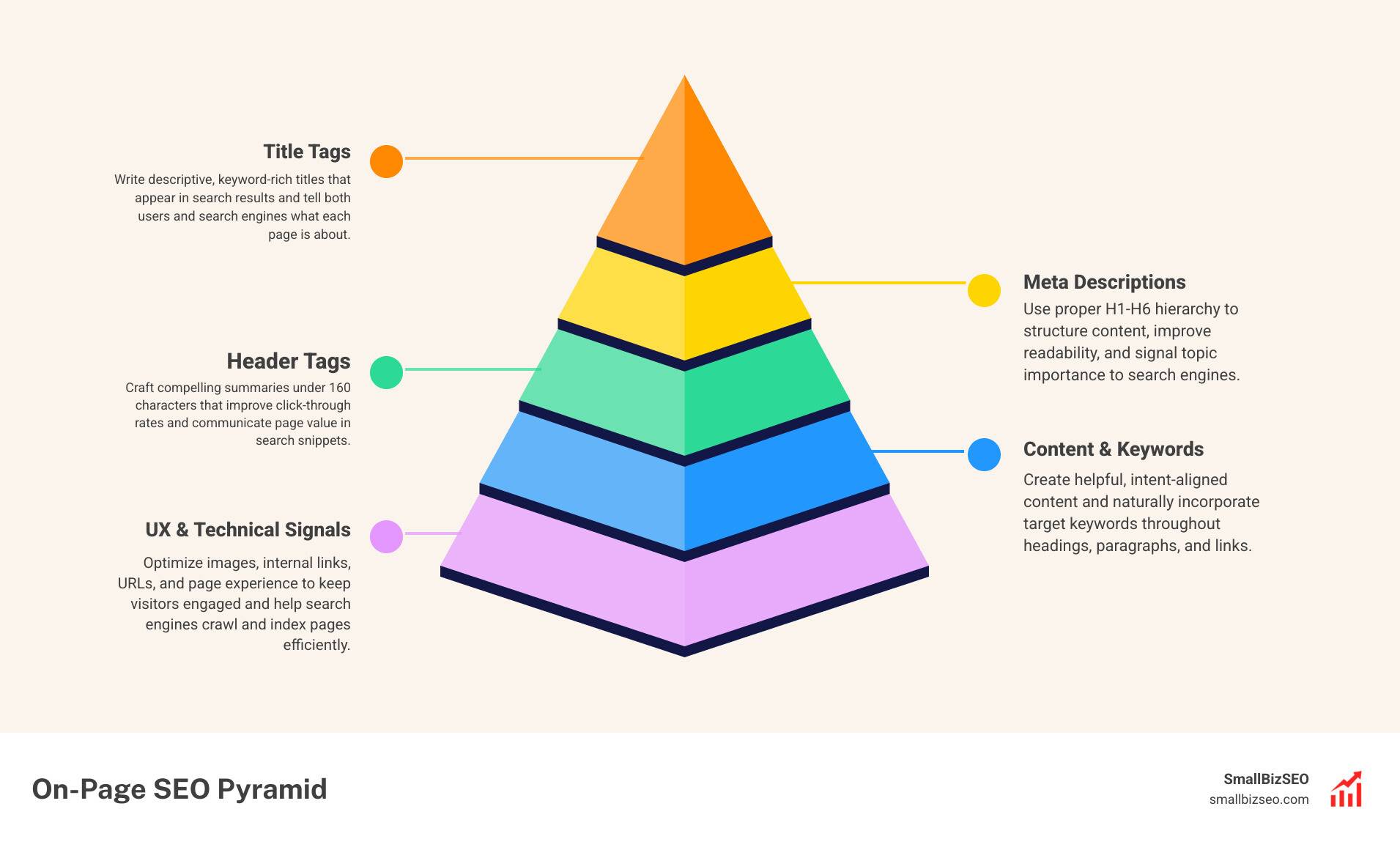
- Title tags — the clickable headline shown in search results
- Meta descriptions — the short summary below the title in search results
- Header tags (H1, H2, H3) — content structure that signals topic hierarchy
- URL structure — short, descriptive page addresses with target keywords
- Keyword optimization — placing the right words naturally throughout your content
- Internal linking — connecting related pages on your site
- Image optimization — compressed files with descriptive alt text
- Content quality — helpful, accurate writing that matches what users are searching for
- User experience — fast load times, mobile-friendly design, easy navigation
Unlike off-page SEO (backlinks, social signals) or technical SEO (crawlability, site architecture), on-page SEO is entirely within your control. You can start improving it today — on pages you've already published.
For small business owners, that matters. You don't need a big budget or a developer. A focused on-page SEO strategy can move rankings, improve click-through rates, and bring in more of the right visitors.
The fastest way to improve your SEO is often to fix the pages you've already launched — not create new ones from scratch.
I'm Clayton Johnson, a digital marketing and SEO specialist focused on building campaigns that drive real visibility and leads — including mastering what is on-page SEO and how it translates into measurable business growth. In this guide, I'll walk you through every element you need to optimize, from quick wins to advanced strategies.
What Is On-Page SEO and Why Does It Matter?
To build a website that consistently attracts qualified leads, we must understand how search engines view our content. When we ask what is on-page SEO, we are looking at the direct signals we send to search crawlers. It is the process of aligning our website's structural code and written content with the exact language our target audience uses.
Without strategic optimization, even the most beautifully designed website remains invisible. Search engines rely on specific cues to index, categorize, and rank pages. By refining these signals, we can dramatically increase organic visibility, boost click-through rates, and improve overall search rankings.
For a complete overview of how these pieces fit into a broader organic strategy, explore our SEO Services Guide or read Search Engine Land's detailed breakdown of What Is On-Page SEO? Key Elements & Best Practices.
The Core Pillars of What Is On-Page SEO
When we break down the practice of On-Page SEO, we focus on three main pillars:
- Content Quality and Relevance: Writing comprehensive, original material that directly answers the user's search intent.
- HTML Elements: Structuring code elements (like title tags, descriptions, and headers) so search engines can easily parse the page.
- Site Architecture and UX: Ensuring the page loads quickly, functions perfectly on mobile devices, and makes navigation effortless.
How to Measure the Success of What Is On-Page SEO
We cannot improve what we do not track. To determine if our optimization efforts are yielding results, we monitor several key performance indicators. We look closely at organic traffic growth, keyword ranking improvements, bounce rates, and dwell time (the duration a user stays on our page after clicking through from search results).
To find out exactly where your website stands today and identify immediate opportunities for improvement, you can request a Detailed SEO Analysis.
On-Page SEO vs. Off-Page and Technical SEO
To get the best results, it helps to understand how on-page optimization fits alongside other search marketing disciplines. SEO is generally divided into three distinct areas:
| Optimization Type | Primary Focus | Key Tasks | Level of Control |
|---|---|---|---|
| On-Page SEO | Content relevance & page-level HTML | Keyword placement, headers, internal links, image alt text | 100% Control |
| Off-Page SEO | Site authority & external reputation | Link building, brand mentions, social signals, digital PR | Indirect Control |
| Technical SEO | Crawlability, indexing & site performance | XML sitemaps, robots.txt, schema markup, Core Web Vitals | 100% Control |
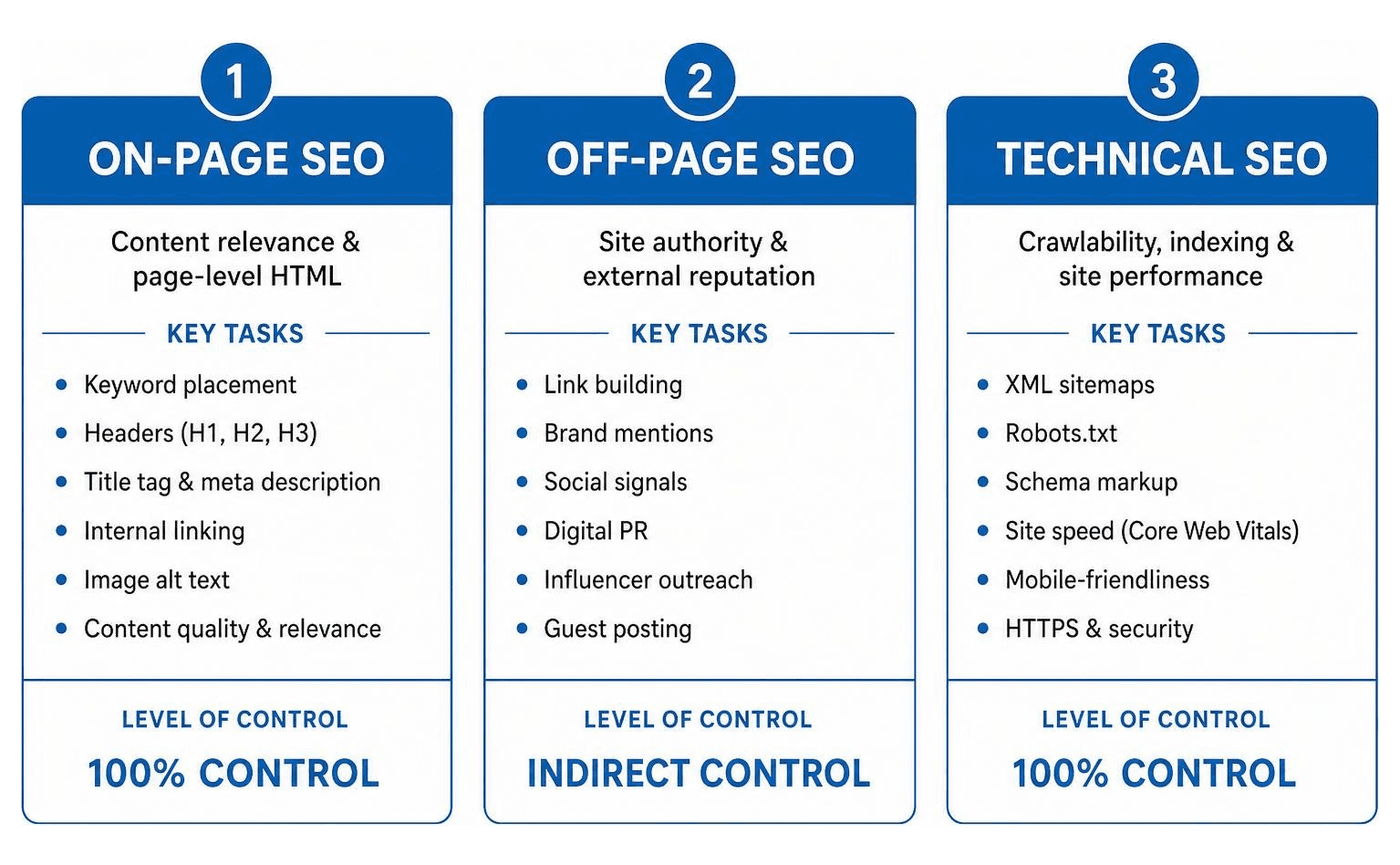
While technical SEO ensures search engines can access your site, and off-page SEO builds your domain's authority, on-page SEO is what actually convinces search engines that a specific page is the absolute best answer to a user's query.
For a deeper dive into these differences, check out our tailored SEO Packages or read Squarespace's guide on On-page SEO: Definition, Strategies, and How To.
Essential On-Page SEO Elements to Optimize

To optimize a page successfully, we must pay close attention to several essential elements. When these pieces work together, they make it easy for both search engines and human readers to digest our content.
Title Tags and Meta Descriptions
Your title tag is the single most important on-page HTML element. It serves as the clickable headline in search results and directly influences search rankings. We recommend keeping title tags under 60 characters to prevent them from being cut off in search snippets.
Meta descriptions do not directly impact search rankings, but they are crucial for driving click-through rates. Keep your meta descriptions under 160 characters and write them as compelling invitations to click. To learn more about crafting titles that win clicks, read On-Page SEO: The Definitive Guide.
Header Tags and Content Structure
Header tags (H1 through H6) organize your content into a clean, logical hierarchy. Every page should feature exactly one H1 tag that includes your primary keyword. Use H2 tags for your main subtopics, and H3 tags for supporting points. This structure makes your content highly readable and helps search crawlers understand how different sections relate to one another.
If you need professional assistance crafting structured, high-performing copy, explore our SEO Content Services.
URL Structure and Internal Linking
URLs should be clean, descriptive, and easy to read. We recommend using short URL slugs (typically 3 to 5 words) separated by hyphens, while completely avoiding numbers, dates, or complex parameters.
Internal linking is another powerful tool. By linking related pages together, we distribute link equity throughout our site and guide users to other helpful resources. To learn how to identify structural opportunities on your site, read our guide on Keyword Gap Analysis: What It Is and How to Do It Right.
Image Optimization and Alt Text
Search engines cannot "see" images the way humans do; they rely on file names and alt text. Always compress your images to keep file sizes small (ideally under 300kb) and save them in modern formats like WebP. Write clear, descriptive alt text under 125 characters to improve accessibility for screen readers and help your images rank in visual search results.
Advanced Strategies: E-E-A-T, AI Search, and UX
As search technology becomes more sophisticated, on-page SEO must evolve beyond simple keyword matching. Today, we must optimize for human trust, artificial intelligence engines, and page performance.
Aligning Content with E-E-A-T Guidelines
Google places immense value on Experience, Expertise, Authoritativeness, and Trustworthiness (E-E-A-T). To signal these traits on your pages, we recommend including clear author bios with professional credentials, quoting recognized industry experts, and citing trustworthy external sources. To build deeper trust with search engines, read our guide on How to Optimize Your Content for E-E-A-T and Build Real Search Trust.
Optimizing for AI Overviews and LLMs
Modern AI search engines and Large Language Models (LLMs) extract specific, self-contained sections of text to answer user queries. To optimize for these systems, we practice "semantic chunking." This means breaking up our content into small, highly focused sections and leading each section with a direct, declarative sentence.
To adapt your content for the future of search, explore our AI SEO Services or read Semrush's guide on What Is On-Page SEO? And How to Do It.
Core Web Vitals and Mobile Friendliness
User experience is a direct ranking factor. Your pages must load rapidly and display beautifully on all mobile devices. We pay close attention to Core Web Vitals, ensuring that Largest Contentful Paint (LCP) occurs within 2.5 seconds. To see how your site measures up against these strict technical standards, check out our guide on How to Pass Google's Own SEO Analysis Audits.
Step-by-Step On-Page SEO Implementation Checklist

Optimizing your website doesn't have to be overwhelming. By focusing on one page at a time, you can systematically improve your search visibility. Here is our straightforward workflow to get you started:
- Select Your Target Page: Choose a high-priority page that you want to optimize for search engines and users.
- Perform Keyword Research: Identify a primary keyword and 2 to 3 closely related variations.
- Analyze Search Intent: Look at the top-ranking pages for your target keyword to understand what type of content searchers expect.
- Optimize Your Metadata: Write a unique, keyword-rich title tag and a compelling meta description.
- Structure Your Content: Organize your page with a single H1 tag and logical H2 and H3 subheadings.
- Incorporate Keywords Naturally: Place your primary keyword within the first 100 words and naturally throughout your subheadings.
- Optimize Images: Compress your image files, use descriptive file names, and write clear alt text.
- Build Internal Links: Link out to other relevant pages on your site, and add links pointing to your newly optimized page.
- Review and Publish: Perform a final quality check for readability, spelling, and mobile formatting.
To ensure your entire site is optimized for maximum visibility, you can request a comprehensive SEO Visibility Audit.
Frequently Asked Questions About On-Page SEO
How often should I update my on-page SEO content?
We recommend reviewing and updating your high-impact pages every 6 to 12 months. Refreshing outdated information, adding new statistics, and refining your keywords signals content freshness to search engines, which helps protect and improve your search rankings.
Do meta descriptions directly impact search rankings?
No, meta descriptions are not a direct ranking factor. However, they act as organic ad copy for your webpages. A well-written, engaging meta description can significantly increase your click-through rate, which sends positive user behavior signals to search engines over time.
What is the most common on-page SEO mistake to avoid?
The most common mistake is keyword stuffing—forcing search terms into your copy so often that it reads unnaturally. Other common errors include duplicate content across multiple pages, missing alt text on images, and ignoring mobile user experience.
Conclusion
Mastering what is on-page SEO is one of the most reliable, cost-effective ways to grow your small business online. Because you have complete control over every element on your pages, making smart, consistent improvements to your content and structure will compound into significant traffic and lead growth over time.
At SmallBizSEO, we help small businesses achieve rapid, sustainable growth through our data-driven "Velocity" framework. We combine transparent, automated reporting with expert on-page strategy to deliver fast, E-E-A-T-compliant rankings that last.
Ready to transform your search visibility and turn clicks into customers? Explore our comprehensive SEO Services today and let's build your growth engine together.