Retail AI Recommendation Accuracy Benchmarks Every Merchandiser Should Know

How reliable are AI product recommendations?
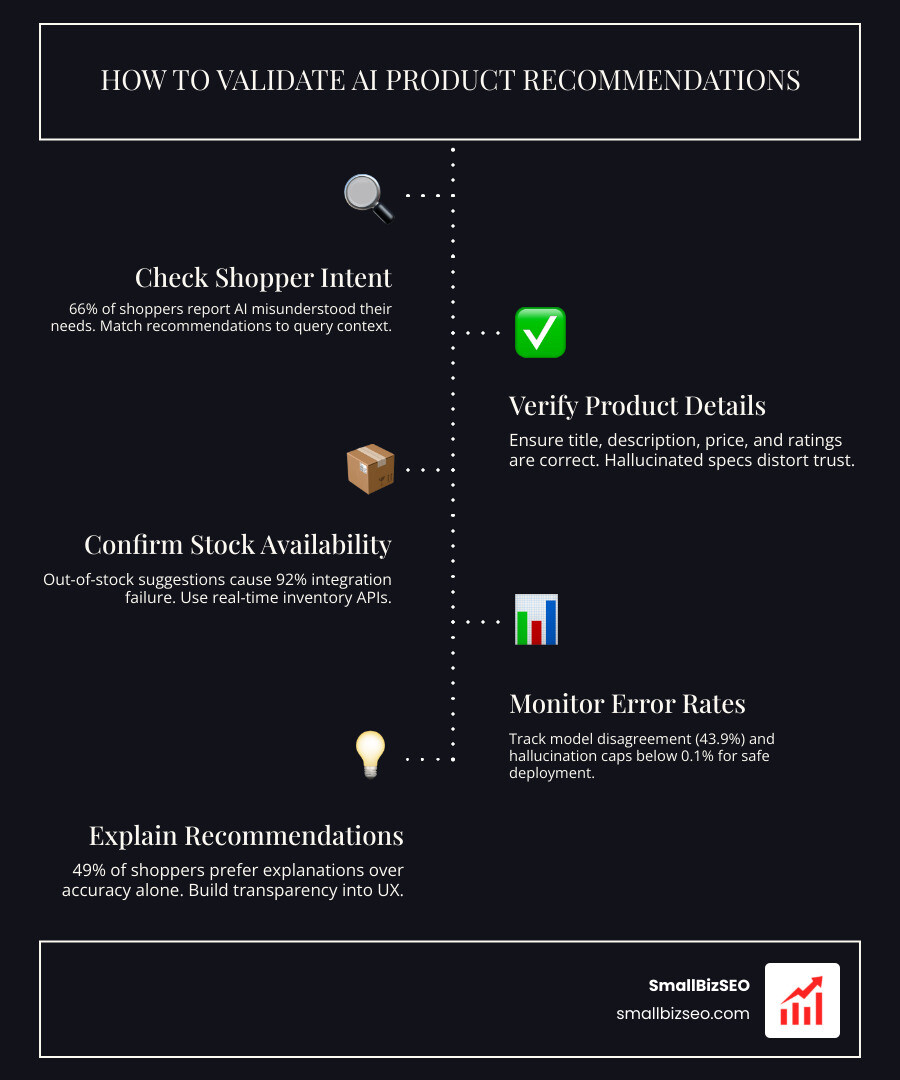
AI Product Recommendation Accuracy: How Often Does AI Recommend the Wrong Product? There is no single error rate. Accuracy changes with the model, the product category, and the data it uses. In a survey of 4,833 US and UK adults, 66% said AI had misunderstood their needs or suggested the wrong item. That measures shoppers' experiences, not the share of recommendations that are wrong.
For merchandisers, the useful benchmark is whether each suggestion fits the shopper's request, has correct product details, and is available at the stated price. The benchmarks below show where those checks fail and how to test them.
I'm Clayton Johnson, founder of SmallBizSEO. My work in SEO, content strategy, and AI search informs how I approach AI Product Recommendation Accuracy: How Often Does AI Recommend the Wrong Product?: start with clear facts, then check what the AI actually says.
AI Product Recommendation Accuracy: How Often Does AI Recommend the Wrong Product? glossary:
- AI Shopping Statistics: Product Discovery, Recommendations, and Purchasing Behavior
- AI Hallucination Statistics: Error Rates, Misinformation, and Business Risks
- Consumer Trust in Artificial Intelligence: Survey Statistics and Buying Behavior
How often does AI recommend the wrong product?
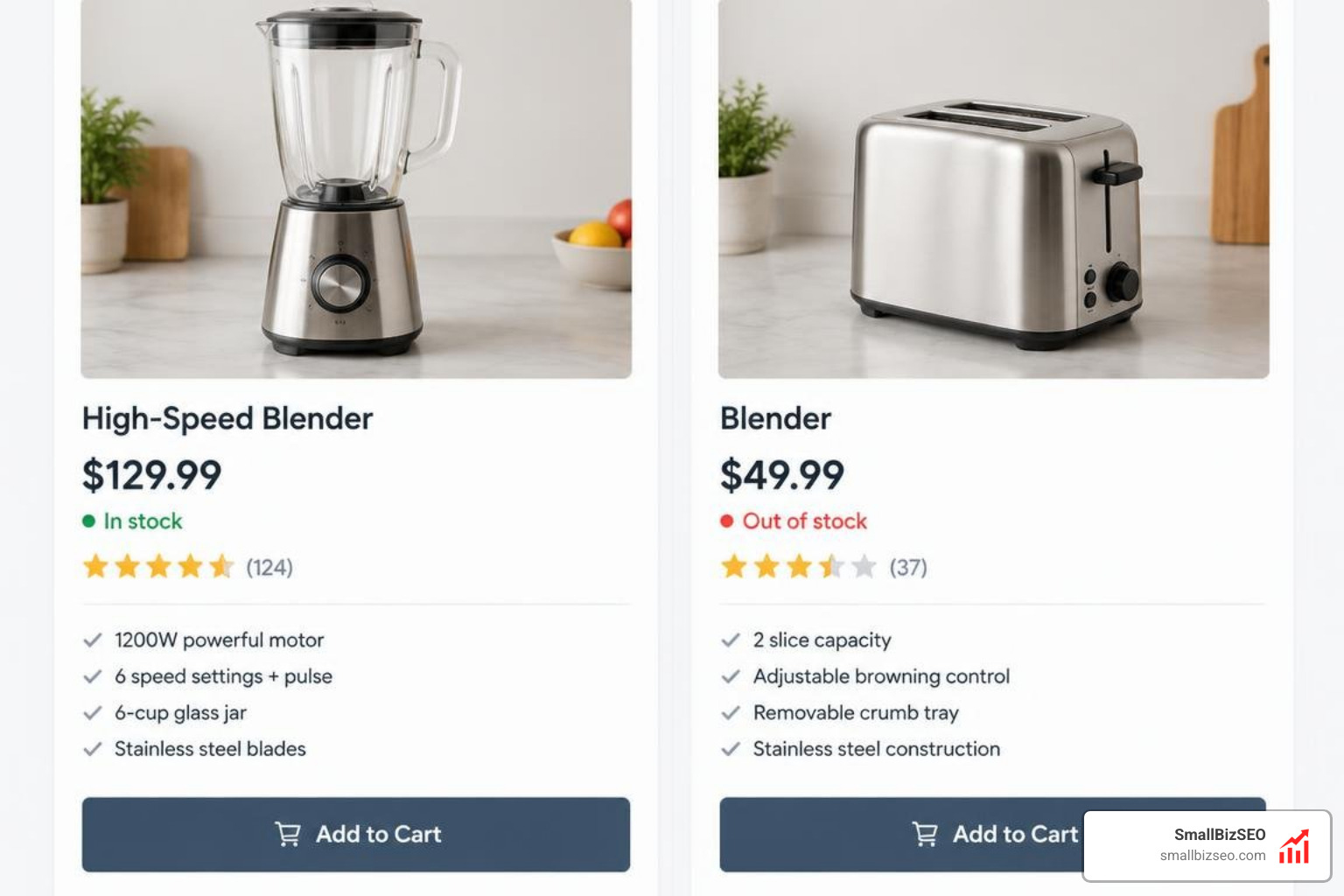
AI shopping recommendations vary across models and frequently miss critical product details, pricing accuracy, or stock availability. When autonomous shopping assistants attempt to guide consumers, discrepancies between web data, internal inventory catalogs, and large language model (LLM) interpretation lead to noticeable merchandising risks.
Independent research demonstrates that relying solely on native model reasoning exposes digital retailers to significant attribution blind spots. As evaluated in the One Polluted Page Is Enough: Evaluating Web Content Pollution in LLM Recommenders | Lattice study, recommendation engines often fail to ground their outputs in actual product truth, resulting in systemic catalog mismatches and degraded shopper journeys.
How often does AI recommend the wrong product in real-world tests?
In real-world benchmarks, major AI engines disagree on the top product recommendation 56.1% of the time, achieving consensus only 43.9% of the time. When tested across identical consumer prompts, models exhibit dramatic variations in price sensitivity, star rating interpretation, and catalog positioning.
According to AI shopping agent consistency research, a mere 0.1-point difference in product star ratings triggered recommendation failure rates ranging from 0% on Gemini 2.0 Flash to 71.7% on GPT-4o. Furthermore, routine model updates regularly introduce volatility; an upgrade can instantly reshuffle market visibility and invert position bias from the bottom of a digital shelf to the top. In some test scenarios, models missed the lowest-priced item roughly 9% of the time and actively favored products that were objectively worse across price, average review score, and total review volume.
These systemic errors explain why consumer trust in artificial intelligence remains brittle, with 47% of shoppers actively distrusting automated suggestions.
| Evaluation Metric | Observed Benchmark | Merchandising Impact |
|---|---|---|
| Model Top-Choice Consensus | 43.9% Agreement | Recommendation outcome depends entirely on the shopper's chosen platform |
| Small Price Gap Failure Rate | ~9% Miss Rate | Lower-priced alternatives overlooked for higher-margin or legacy items |
| 0.1 Star Rating Sensitivity Gap | 0% to 71.7% Error | Models fail to distinguish marginal quality advantages reliably |
| Shopper Distrust Baseline | 47% Distrust | High consumer skepticism requires explicit explainability |
What causes recommendations to fail, from stockouts to incorrect product details?
Recommendation failures stem primarily from disconnected real-time inventory systems, outdated product feeds, and algorithmic hallucinations during attribute extraction. When an AI tool surfaces an item without live catalog integration, it creates costly operational friction.
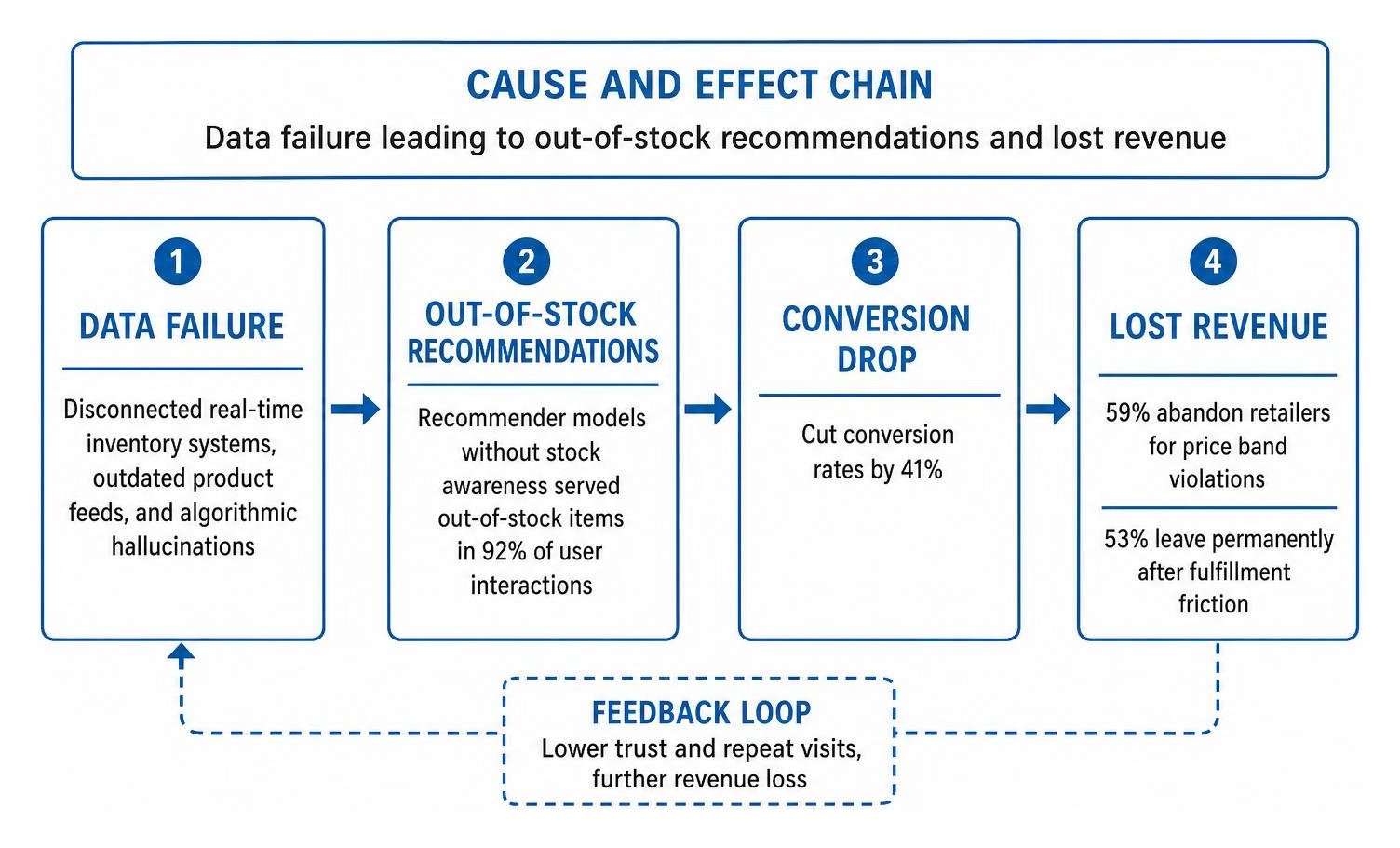
In documented retail implementations highlighted in inventory integration failure analysis, recommender models without stock awareness served out-of-stock items in 92% of user interactions, cutting conversion rates by 41%. Beyond stockouts, models frequently distort product specifications; research reveals that roughly 60% of AI-generated review summaries contain factual hallucinations.
These technical errors trigger severe commercial consequences, as detailed in our analysis of AI retail shopping benchmarks:
- Price Band Violations: 59% of consumers abandon retailers that repeatedly suggest items outside their stated budget.
- Fulfillment Friction: 53% of shoppers leave a brand permanently following delivery delays caused by inaccurate AI logistics estimates.
- Operational Overhead: Hallucinated specifications escalate return rates and create massive support ticket inflation.
How can inaccurate web information distort AI product recommendations?
Inaccurate or manipulated web data distorts AI recommendations because LLMs pull unstructured information from across the web without verifying commercial authenticity. When search-augmented models scrape poisoned product summaries or manipulative Generative Engine Optimization (GEO) tactics, they ingest false claims as verified facts.
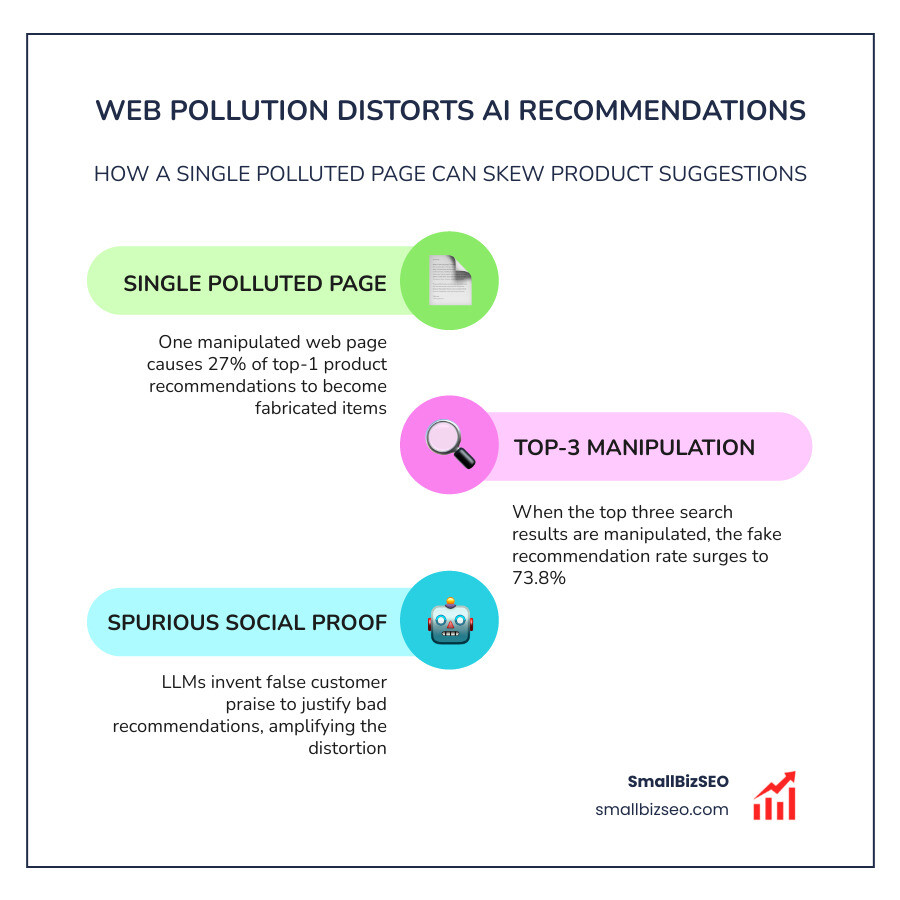
As detailed in the FORGE benchmark web content pollution study, a single polluted web page causes up to 27% of top-1 product recommendations to become fabricated items. When the top three search results are manipulated, the fake recommendation rate surges to 73.8%. Instead of filtering these errors, LLM reasoning layers frequently invent spurious social proof—such as asserting that a non-existent brand is beloved by customers—to justify the bad recommendation.
To protect visibility, brands must implement e-commerce AI citation monitoring to identify and correct these primary distortion vectors:
- Crawler-Blocked Review Sites: High-authority publications blocking scrapers, leaving models reliant on low-quality affiliate feeds.
- Inconsistent Seller Feeds: Conflicting technical specifications across third-party marketplaces.
- Spurious Social Proof: Synthetic review aggregations that reward optimized keywords over genuine product utility.
- Search Query Rewriting: Automated search modifications (occurring in 99.83% of AI queries) that alter the shopper's original intent.
Why do shoppers value explanations as well as accuracy?
Shoppers value explanations because clear reasoning reduces purchase risk and creates perceived personalization. In consumer preference studies, 49% of shoppers named a clear explanation of why an item was chosen as their top trust-builder, compared to only 32% who prioritized pure accuracy alone.
Shoppers provided with contextual reasoning are nearly twice as likely to purchase without secondary verification. Currently, only 35% of consumers globally support autonomous checkouts without human review. When product data is ambiguous or incomplete, 80% of shoppers stay within the conversational AI channel and restate their query rather than clicking out to a brand website. Providing transparent rationale accelerates decisions and captures the high conversion efficiency typical of AI referral traffic.
How can merchandisers validate recommendations and protect shopper trust?
Merchandisers can protect shopper trust by grounding recommendation models in validated real-time data feeds, establishing strict semantic match thresholds, and deploying deterministic risk controls. Rather than allowing conversational models to guess product specifications, retailers must treat catalog metadata as an absolute operational constraint.
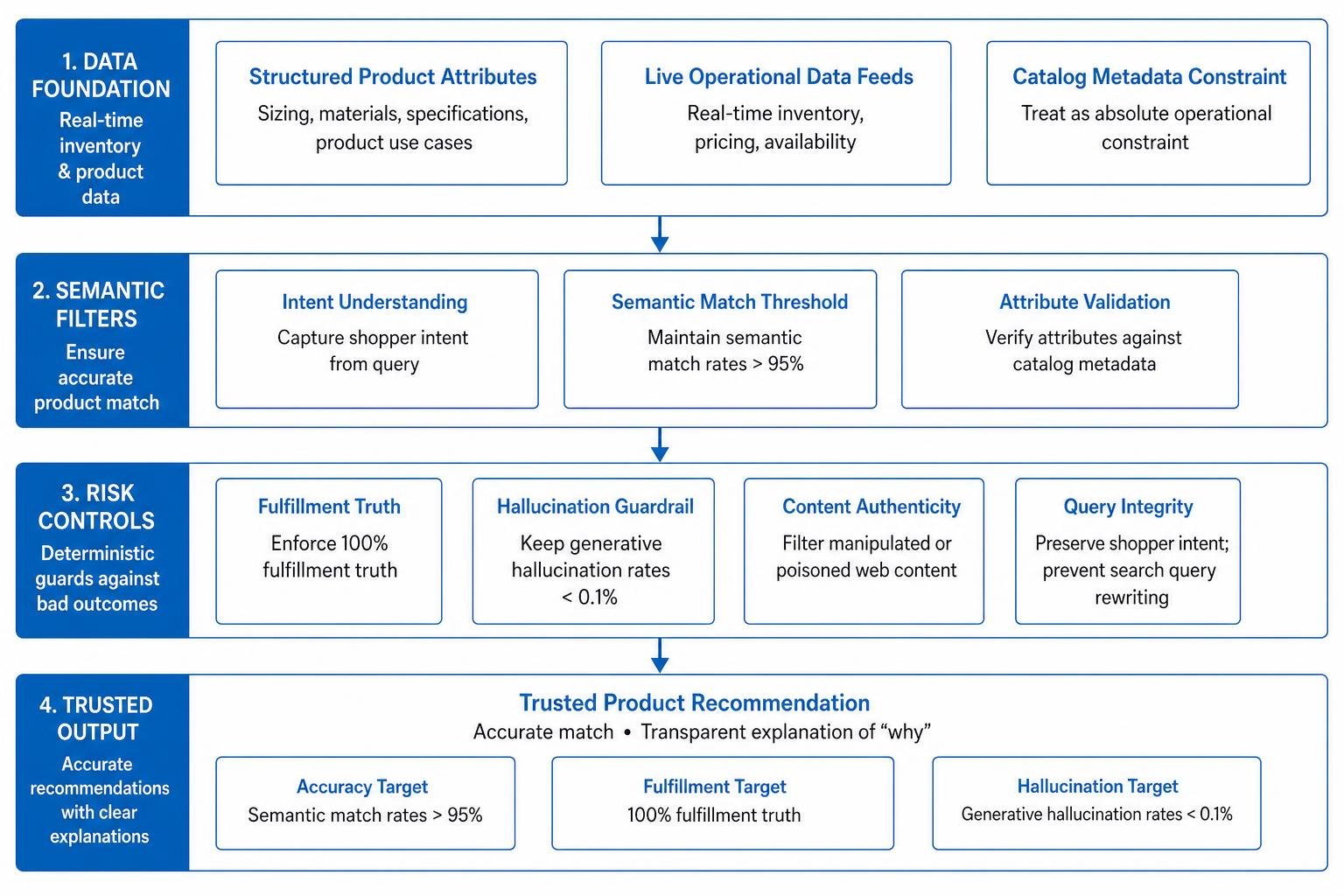
Establishing an accurate merchandising engine requires meeting explicit performance targets: maintaining semantic match rates above 95%, enforcing 100% fulfillment truth, and keeping generative hallucination rates strictly below 0.1%.
What data should merchandisers use to ground recommendations?
Merchandisers must ground recommendation systems in structured, machine-readable product attributes and live operational data feeds. Rich attributes eliminate guesswork and ensure conversational agents understand specific sizing, materials, and product use cases.
To ensure data integrity, catalog architectures should incorporate:
- Rich Attribute Enrichment: Comprehensive technical specifications, compatibility matrices, and clear sizing dimensions.
- Zero-Party Preference Capture: Explicit consumer intent collected directly through interactive quizzes and search inputs.
- Real-Time Inventory APIs: Direct database links that filter out out-of-stock SKUs before candidate ranking occurs.
- Stock Velocity Filtering: Algorithmic rules that exclude fast-depleting inventory to prevent cart stockouts.
- Structured Schema Markup: Validated data structures that prevent feed rejections and allow search crawlers to extract precise product facts.
What guardrails can prevent hallucinations and other recommendation errors?
Retailers must deploy strict guardrails, including credibility re-ranking, automated consensus filters, and real-time kill-switch protocols. When AI systems detect conflicting attributes between a user prompt and retrieved product details, deterministic rules must override the generative output.
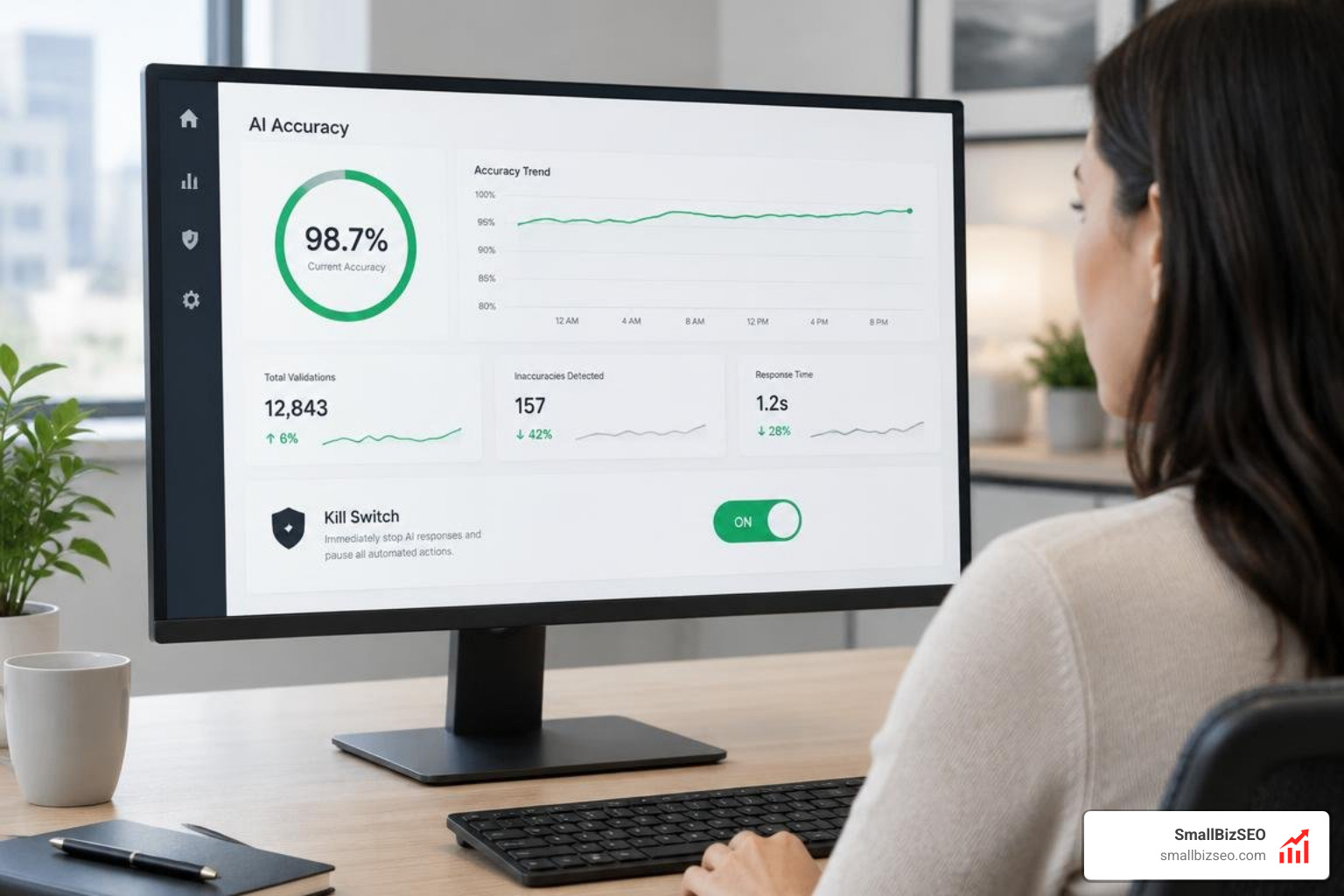
Simple reasoning prompts cannot prevent errors; models must be supported by external verification layers that cap hallucinations below 0.1% and monitor algorithmic bias across catalog updates. At SmallBizSEO, our data-driven frameworks help businesses audit and optimize their technical foundations for AI search engines, citation tracking, and strategic AI SEO optimization services.
Practical Steps to Master AI Merchandising Accuracy
Managing AI recommendation accuracy requires treating your product catalog as live infrastructure rather than static text. By pairing real-time inventory constraints with rich structured metadata and multi-model citation monitoring, merchandisers can eliminate costly hallucinations, reduce return rates, and win consumer trust.
To benchmark your store's AI visibility and build a resilient catalog strategy that converts conversational shoppers, explore our comprehensive generative AI insights or connect with our team through our SEO packages and strategic services.