A Practical Guide to Safely Modifying Existing Google Disavow Files

Preserve the current file before proposing a change
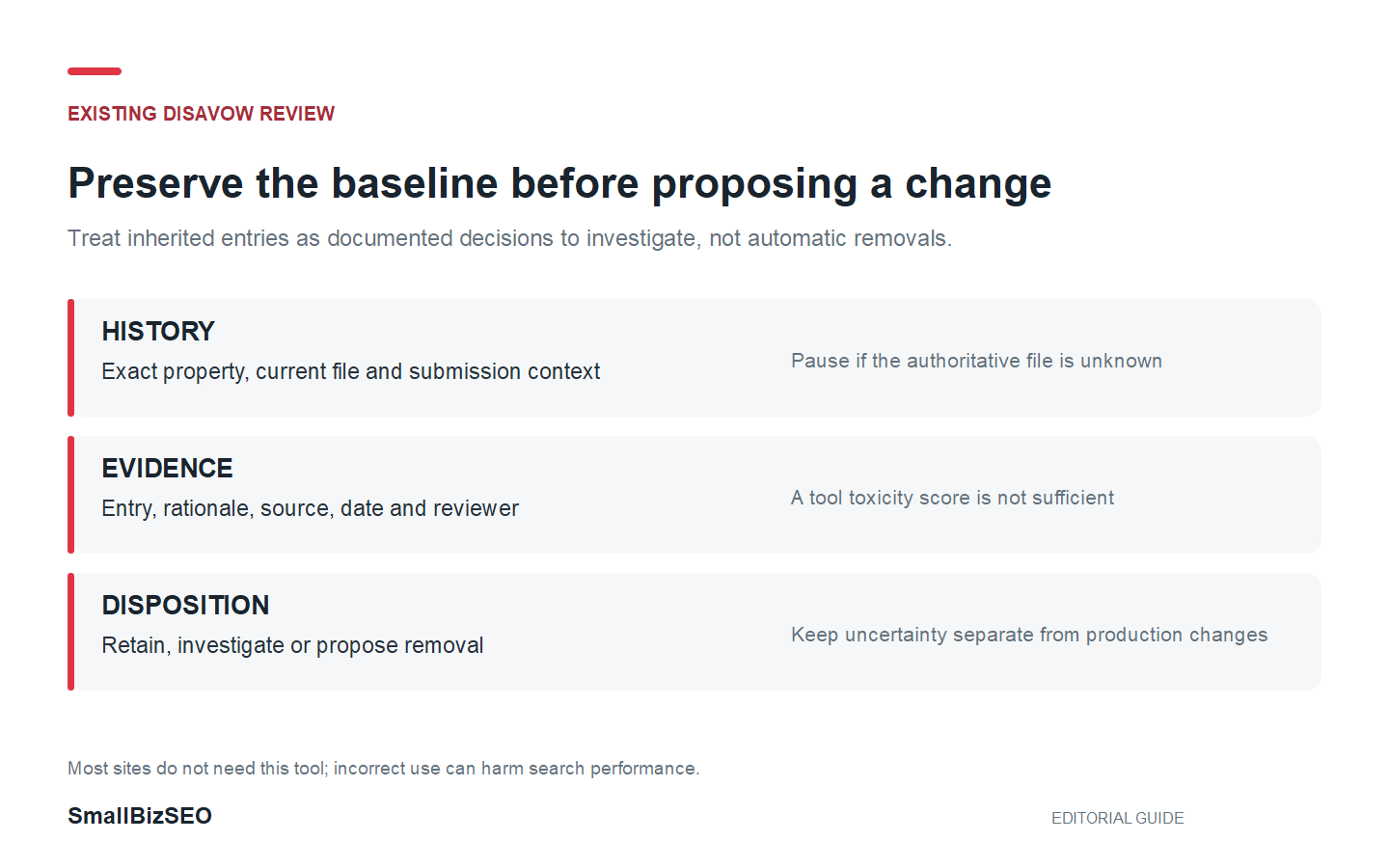
Review an existing disavow file as a set of inherited decisions, not a list to clear or expand automatically. Preserve the current version, establish why it exists, and document the evidence for each proposed change before anyone submits a replacement.
Google warns that incorrect disavow use can harm search performance. Most sites do not need the tool. Its stated conditions involve substantial artificial or low-quality linking that has caused, or is likely to cause, a manual action. An alarming third-party score alone is not that evidence.
This workflow is for reviewing a file that already exists. It is not a recommendation to create one for every website or to reverse an older decision merely because search traffic has changed.
1. Establish the scope and history
Ask the responsible owner for the exact property, current file, date of the last known submission, and any prior review notes. Keep a dated, unchanged baseline separate from the working copy. If the current version cannot be established, pause the proposed replacement rather than guessing which export is authoritative.
- Who created the file, and what problem were they addressing?
- Was there a documented manual action or a known link-building scheme?
- Which entries were added later, and why?
- Are earlier removal attempts, agency reports, or approval records available?
- Who owns the decision to retain, revise, or leave the file alone?
A missing explanation is a research task, not proof that the entry is wrong. Mark uncertain history explicitly so the reviewer does not mistake an assumption for a documented finding.
2. Create a decision ledger
Use one row per proposed change. Record the current entry, the proposed disposition, evidence location, review date, reviewer, and unresolved questions. Separate “retain,” “investigate,” and “propose removal” so an incomplete investigation cannot accidentally become a production change.
For a domain-level entry, consider the scope of the original decision before narrowing it to individual URLs. For a URL-level entry, inspect the actual linking context where safely accessible. A different design, changed ownership, or a now-missing page may be relevant evidence, but none independently proves what the correct historical or current treatment should be.
Do not visit suspicious downloads or bypass security warnings to finish an audit. Preserve the uncertainty and use available records or qualified security help when a source cannot be inspected safely.
3. Compare evidence, not tool labels
Look for the relationship that produced the link: a paid placement, a controlled network, a genuine reference, or an arrangement the business can document. Keep these observations separate from a vendor's score or a reviewer's impression of the site's appearance.
For example, an inherited row might have a dated invoice and a prior agency note explaining its inclusion. A second row might have only a generic “toxic” label. Those are different evidence situations. They should not receive the same automatic decision just because both appear in one file.
If the proposed changes are intended to address a traffic decline, record what other explanations have been investigated. A timing coincidence does not establish that the disavow file caused the decline or that reversing it will restore rankings.
4. Review the complete proposed replacement
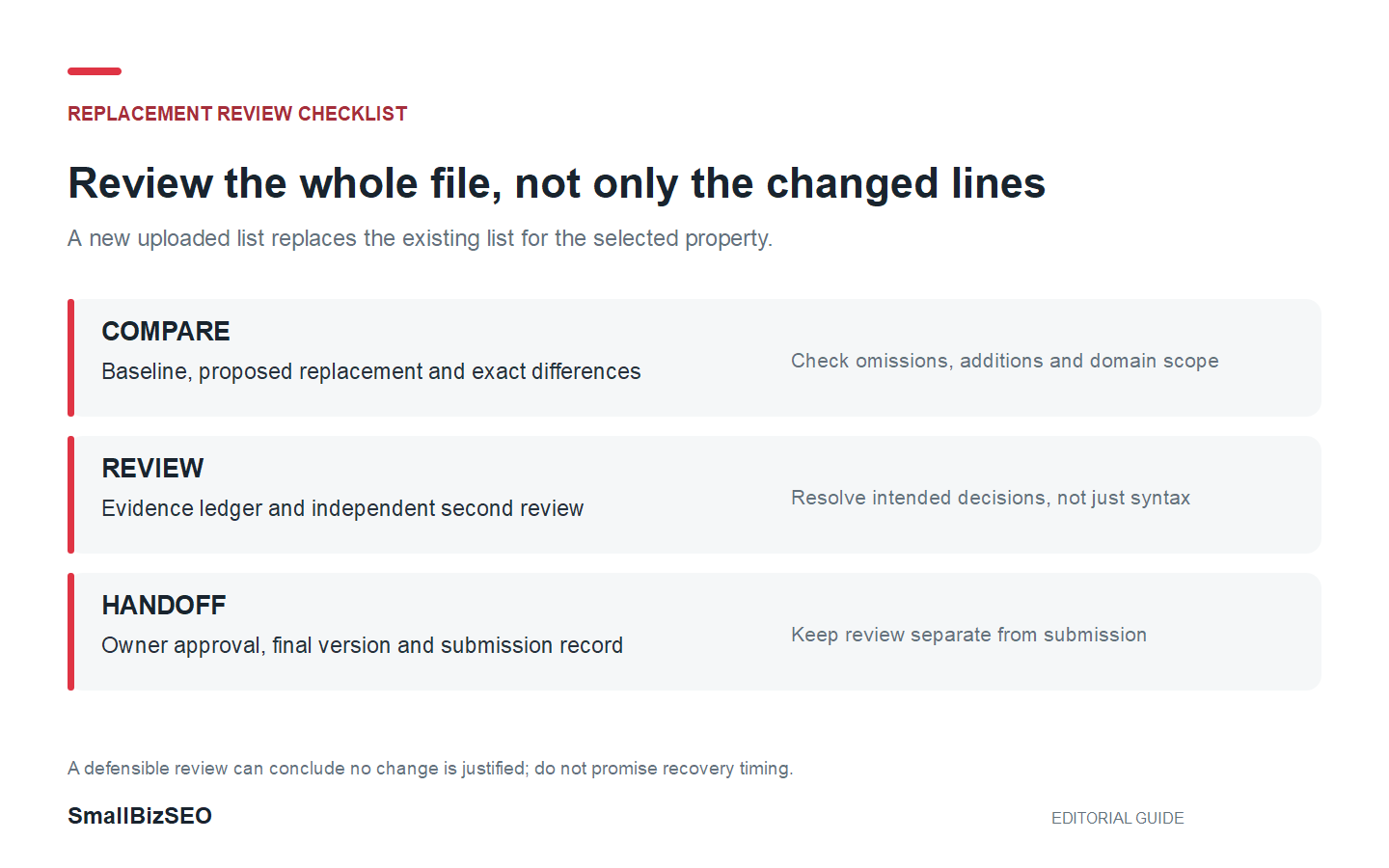
Google's tool replaces the existing list for the selected property when a new list is uploaded. It does not simply append a small change file. The tool does not support Domain properties, and the property scope needs careful checking. Disavowed links can remain visible in the Links report.
Compare the entire proposed file with the preserved baseline. Look for unintended omissions, changed domain scope, duplicated entries, and accidental additions from raw exports. Check the current official format requirements rather than copying a spreadsheet directly into a submission.
Have a second reviewer examine the differences and the evidence ledger. Their job is to confirm the intended decision, not merely that the file opens successfully.
5. Hand off a decision, not a promise
The approval package should contain the baseline, proposed replacement, exact differences, reasons, uncertainties, and the responsible owner. Keep any submission and its confirmation separate from the editorial review record.
If the owner approves a change, preserve the final submitted version and the observed result. Processing is not immediate, and subsequent performance changes still require careful interpretation. Do not promise a recovery date or attribute every movement to the file.
For the underlying concept, see our Disavow Links Tool explanation. A defensible review may conclude that no change is justified. That is a useful outcome when it prevents an unsupported intervention.