SEO Basics Survival Guide for Small Business

SEO Basics Survival Guide for Small Business
How Can Small Businesses Get Started With SEO?
Start with the pages and listings customers are most likely to find. Complete your Google Business Profile if you serve a local area. Make sure each main service has a clear, useful page. Then check that your site works on phones, loads well, and makes it easy to contact you. SEO helps people find your business through search without paying for every click.
You do not need to fix everything at once. Start with what could help a customer choose you, then use Google Search Console to see which searches bring people to your site.
I'm Clayton Johnson, founder of SmallBizSEO. My SEO advice for small businesses draws on my work connecting useful content, search strategy, and digital PR to qualified leads, including how businesses can make their expertise clear in AI-generated answers.
SEO advice for small businesses word roundup:
Which SEO Pillars Deliver Practical Results for Small Businesses?
Small businesses build sustainable search visibility by improving four foundational pillars: local business listings, website technical health, helpful people-first content, and trusted backlink authority.
Organic search accounts for 53% of all online traffic and delivers 44% of total revenue share across industries. Unlike paid advertisements that turn off the second your daily budget runs dry, organic search functions like permanent real estate. For every single click generated on a paid search ad, organic results capture 8.5 clicks.
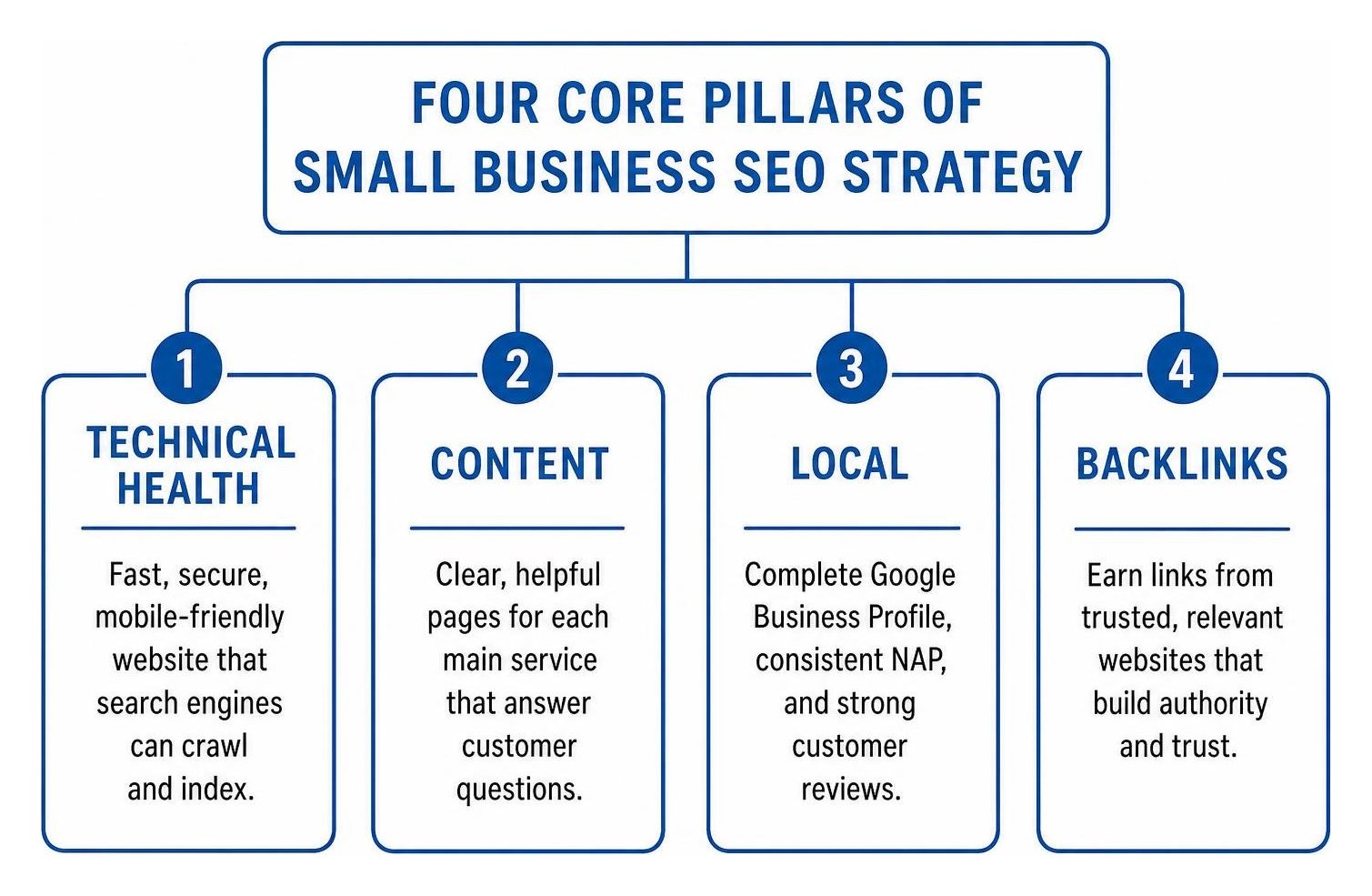
Focusing on solid search fundamentals helps search engines understand what you do, where you operate, and why real humans trust your work.
What Local SEO Advice for Small Businesses Delivers Fast Results?
Claim and fully complete your Google Business Profile, ensure your name, address, and phone number match across all online listings, and consistently gather genuine reviews from satisfied customers.
Almost half of all searches on search engines carry direct local intent, and 72% of consumers who run a local search visit a physical store or contact a business within five miles.
To take full advantage of nearby search demand, use this straightforward local blueprint:
- Optimize Your Google Business Profile: Fill out every single field. Select a precise primary category that reflects your core offering, add relevant secondary categories, list your exact hours, and upload high-resolution photos. Businesses that feature extensive photos regularly see substantial jumps in customer calls and direction requests.
- Standardize Name, Address, and Phone Number (NAP): Search engines verify your business legitimacy by cross-referencing your NAP across directories. Even minor discrepancies—like listing "Suite 100" in one place and "Ste 100" elsewhere—can confuse automated crawlers.
- Build Review Velocity: Between 80% and 90% of customers read online reviews before opening their wallets. Ask for customer feedback right at the point of service delivery, and make it a habit to respond to all reviews within 48 hours.
- Implement Local Schema: Adding structured data to your website tells search bots your operating hours, geo-coordinates, and accepted payment methods directly.
Following an actionable local SEO checklist and our detailed practical local SEO guide helps you dominate map packs and reach neighbors actively looking to hire your team.
How Can Small Businesses Handle Technical and On-Page SEO on a Low Budget?
Fix crawl issues in Google Search Console, make sure pages load quickly on mobile devices, use HTTPS encryption, and write descriptive title tags and meta descriptions for every page.
You do not need a team of enterprise developers to get your technical foundations right. Focus on these core elements:
- Mobile Usability and Speed: Because mobile devices account for the majority of search traffic, search engines evaluate your site through mobile-first indexing. Compress oversized images under 200 KB and remove unnecessary scripts to keep your loading speeds fast.
- Title Tags and Meta Descriptions: Your title tag is the primary headline search engines show in organic listings. Keep it under 60 characters, incorporate your primary service phrase naturally, and write a concise meta description that invites searchers to click.
- Logical Internal Linking: Connect your blog posts and supplementary guides directly to your main service pages. Internal links pass authority across your website, helping search crawlers discover new pages while guiding prospects smoothly toward inquiry forms.
- Site Security: Secure your site with an active SSL certificate. Browsers issue clear security warnings to visitors on non-HTTPS sites, which increases bounce rates immediately.
Small business owners seeking sustainable growth can learn how to balance basic site maintenance with affordable SEO for small business. You can also review realistic diagnostic checkpoints that keep costs low while boosting organic visibility.
Content Strategy and AI Optimization: How Do You Answer Real Search Intent?
Target specific long-tail search queries, address real customer questions thoroughly within topic clusters, and format content with direct answers so generative search engines can cite your brand.
Generic, single-word keywords are dominated by national mega-corporations. Small businesses win organic visibility by answering long-tail phrases that indicate immediate intent. For instance, rather than trying to rank for a broad term, target specific searches like "how to repair frozen pipes quickly."
To structure content for both human readers and modern generative search assistants:
- Adopt Answer-Ready Layouts: Place a concise summary answering the target search query right beneath major headings.
- Build Topic Clusters: Create a comprehensive pillar page for each core service you provide, then publish supporting articles that answer related FAQs. Link all supporting articles back to the main service page.
- Demonstrate Genuine Expertise: Provide original commentary, real project snapshots, and transparent pricing discussions that automated text tools cannot replicate.
Following a proven small business content strategy ensures every piece of content you publish directly supports commercial conversion goals.
Backlinks and Authority: How Can Small Businesses Build Trust Affordably?
Earn authority links naturally by collaborating with local business associations, sponsoring neighborhood events, securing vendor listings from suppliers, and sharing helpful insights on respected industry sites.
Search engines treat backlinks as third-party votes of confidence. A backlink from a reputable neighborhood association or a respected industry directory signals that your business is genuine, active, and trustworthy.
Practical ways to earn authoritative backlinks without huge ad budgets include:
- Supplier and Vendor Listings: Ask the distributors and product manufacturers whose inventory you carry to add your website link to their "Where to Buy" or "Featured Partners" directory.
- Local Sponsorships and Community Boards: Sponsoring a local youth sports league, charity 5K, or business district event frequently earns you a permanent link from a trusted organization website.
- Industry Association Profiles: Claim all profile listings available through local chambers of commerce and specialized trade organizations.
- Helpful Contributions: Share your practical knowledge on niche podcasts or trade blogs that cater to your target market.
Avoid purchasing cheap bulk link packages from spammy websites. Low-quality links can trigger algorithm penalties that remove your web pages from search results entirely.
How Can Small Businesses Measure SEO ROI and Avoid Common Mistakes?
Track organic impressions, clicks, keyword positions, and contact form submissions inside Google Search Console and Google Analytics 4, while avoiding keyword stuffing and duplicate pages.
Search engine optimization is a compounding process. Initial ranking movement typically appears within three to six months as search engines crawl, index, and evaluate updates. Substantial lead and revenue growth generally develops over six to twelve months of consistent implementation.
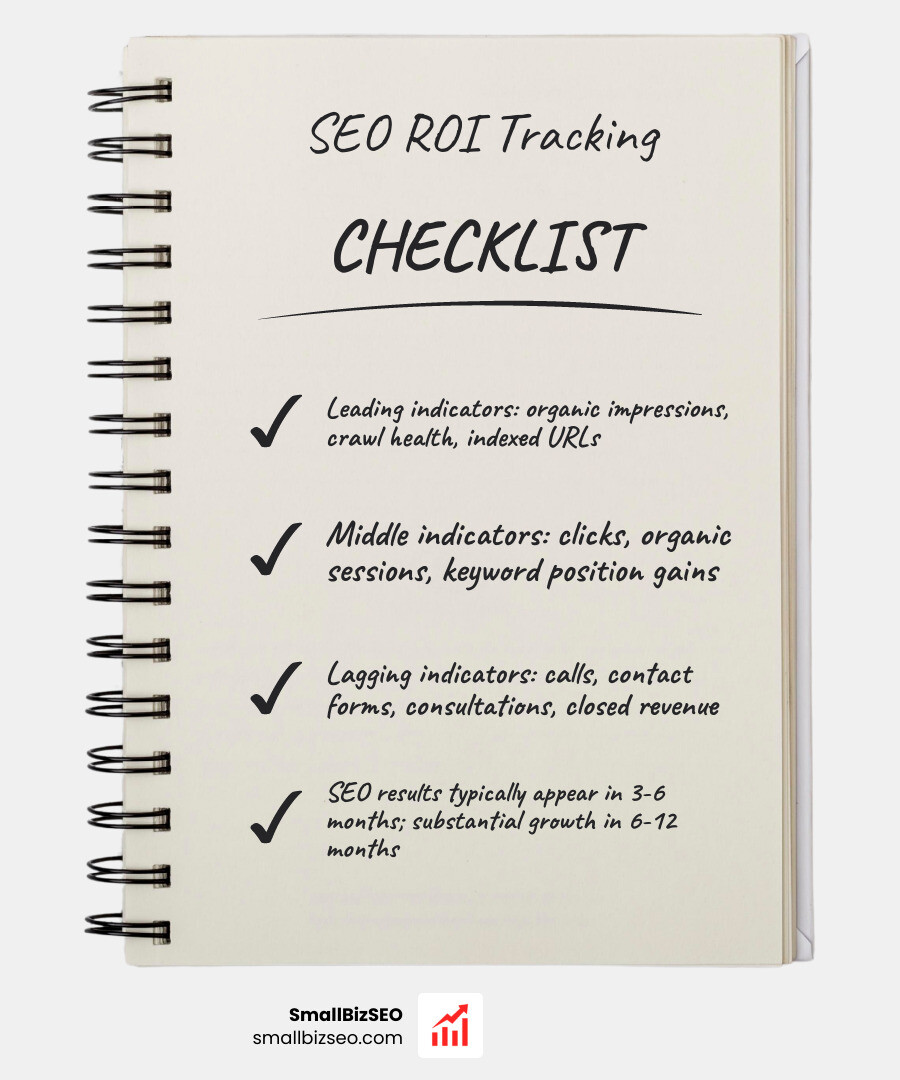
Monitor these vital metrics to verify your campaigns are heading in the right direction:
- Leading Indicators: Organic impressions, newly indexed URLs, and crawl health in Google Search Console.
- Middle Indicators: Clicks, organic search sessions, and average position improvements across high-intent keywords.
- Lagging Indicators: Direct phone calls, submitted contact forms, scheduled consultations, and closed customer revenue.
Steer clear of outdated practices such as stuffing identical keywords into footers or creating near-identical doorway pages for nearby suburbs. Search algorithms prioritize helpful, unique content designed for actual humans over repetitive keyword lists.
DIY vs. Professional Agency: What Is the Best Path for Your Budget?
DIY SEO fits businesses that have internal hours available for weekly updates, while partnering with a dedicated agency suits businesses that need fast execution, deep technical remediation, and custom link acquisition.
| SEO Model | Typical Monthly Investment | Best Suited For | Key Deliverables & Focus |
|---|---|---|---|
| DIY SEO | Free to Low Cost (Software fees) | Early-stage startups with available time | Google Business Profile updates, basic blogging, local citations |
| Consulting / Audit | One-time fixed fee | Established sites needing a roadmap | Technical health audit, competitor analysis, keyword roadmap |
| Full-Service SEO | Ongoing monthly retainer | Growing businesses needing scaled leads | Comprehensive technical fixes, content clustering, link building, GA4 tracking |
If you have the time to learn software tools, write helpful articles, and manage citations, starting DIY is an excellent way to grasp the fundamentals. However, as customer demands grow, partnering with a proven small business SEO company lets you focus on delivering great service while experienced professionals handle site optimization.
Ready to Turn Search Visibility Into Real Business Growth?
Building a reliable stream of organic search leads requires clarity, steady effort, and a technical foundation that search engines respect. By claiming your local profiles, fixing core site errors, publishing genuinely helpful answers, and securing authoritative backlinks, you build a sustainable asset that brings in new clients year after year.
If you are ready to identify missing organic opportunities and fix hidden technical barriers on your website, request a comprehensive SEO visibility audit from our team at SmallBizSEO today. We help your business get found, earn customer trust, and grow steadily.