SEO for AV Production Companies: Turn Event Searches Into Qualified Briefs
How Can SEO Help AV Production Companies Win Qualified Inquiries?
SEO for audio visual production services helps prospective event organizers and production managers discover your business when searching for specific technical capabilities, provided your site clearly presents the services you actually offer, substantiates past work with authentic project details, and provides a clear path to submit an event brief.
Event buyers typically search for specialized capabilities matching their format, such as conference audio visual support or livestream technicians. Organizing pages around real service lines—whether equipment rental, full-service live production, hybrid streaming, or permanent installation—helps searchers quickly assess fit.
I'm Clayton Johnson, founder of SmallBizSEO, where my work focuses on technical SEO, content strategy, and digital PR. This guide outlines how to align your production website with search intent, structure real project evidence, and handle technical and local search factors.
Core Pillars of SEO for Audio Visual Production Services
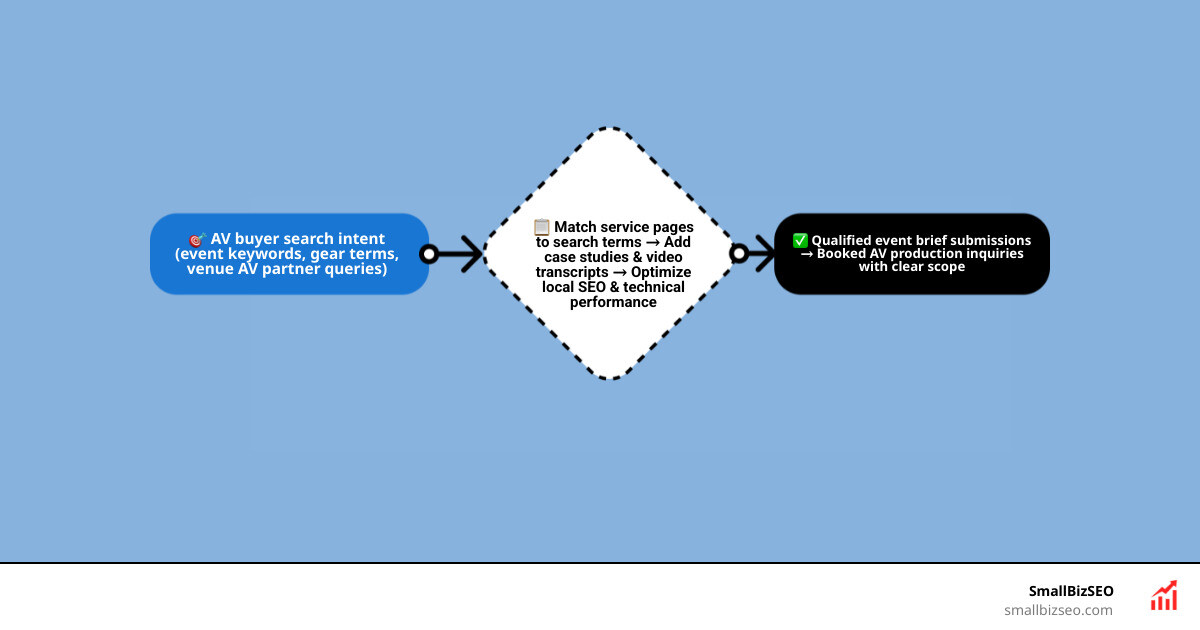
The core pillars of search optimization for AV production companies involve structuring clear pages for each service actually offered, publishing crawlable media and text-based project proof, following Google search guidelines, and maintaining accurate local business profile signals.
Production companies often differ in business models. When planning website architecture, clearly distinguish whether your company provides dry-hire equipment rental, full-service event production, hybrid streaming, or permanent installation. As outlined in the PCMA guide on choosing an AV partner, planners evaluate different partner models depending on whether they need single-source production management, equipment dry hire, or in-house venue coordination. Presenting only the services you genuinely deliver helps searchers evaluate capabilities accurately.
Supporting your site architecture with solid technical SEO practices helps search engines crawl and understand your offerings.
How Do You Structure Service Pages and Keyword Strategy for Audio Visual Production Services?
Structure your website around distinct user intents by creating focused pages for each specific service offered, separating outcome-based event production queries from equipment-focused rental searches.
Search behavior generally falls into two primary categories:
- Event-based searches: Queries used by corporate planners and marketing leads seeking managed delivery (e.g., "conference audio visual support" or "hybrid event live stream crew").
- Equipment-based searches: Queries used by technical directors or venue managers seeking specific gear (e.g., "LED video wall rental" or "wireless microphone package").
Align your content with Google helpful content guidance by addressing specific technical requirements rather than publishing generic placeholder copy. When offering dry-hire gear, maintain distinct equipment-rental pages alongside sound on-page SEO practices.
| Service Category | Primary Buyer Question | Target Page Type | Proof & Evidence Needed | Primary Call to Action |
|---|---|---|---|---|
| Conference AV Support | "Can this team manage audio, lighting, and presentation switching across rooms?" | Dedicated Event Service Page | Room size scope, wireless channel handling, crew roles | Submit Event Brief |
| Livestream Crew | "Do they handle multi-camera broadcast switching, remote feeds, and primary/backup encoding?" | Live Streaming Service Page | Platform integrations, encoder redundancy, crew roles | Check Date Availability |
| LED Wall Rental | "What pixel pitch, panel dimensions, and ground support options are available?" | Equipment Rental Landing Page | Panel dimensions, pitch specifications, rigging types | Request Rental Quote |
| Venue AV Partner | "Is this crew familiar with local ballroom layouts, power tie-ins, and dock logistics?" | Venue Experience Page | Past venue walkthroughs, room footprint documentation | Schedule Site Walk |
How Should AV Case Studies and Media Portfolios Be Optimized as Search Evidence?
Build structured case studies using indexable text that describes the actual brief, scope, constraints, and solutions, while following search engine guidelines for video and media assets.
Search crawlers evaluate web pages primarily through crawlable text, relevant captions, transcripts, and structured markup. Following Google video search guidelines helps crawlers locate and index video assets, though adding VideoObject schema markup does not guarantee rich result inclusion. Furthermore, AI-generated images do not represent genuine portfolio proof; all project illustrations should use real, permitted photos, and any hypothetical example must be explicitly labeled.
Use this structured case-study template for each published project:
- Project Context: Event name (or industry category if under NDA), event type, and general venue setting.
- Actual Role: Specific responsibilities delivered (e.g., lead technical director, audio engineering, dry-hire gear delivery).
- Technical Scope: Quantified inventory and setup scale (e.g., display dimensions, microphone channels, camera chains).
- Site Constraints: Venue-specific challenges encountered, such as limited load-in windows or difficult room acoustics.
- Delivered Solution: Clear summary of how the engineering crew solved the constraints.
- Permitted Imagery: Client-approved photographs of the real setup with accurate descriptive alt text.
- Bounded Outcome: Factual summary of delivery (e.g., successful completion of a multi-day plenary session).
Additional media approaches are detailed in our guide on video SEO tactics to help your brand outrank text only competitors.
What Local SEO Tactics Drive Regional Inquiries for Audio Visual Production Services?
Improve local search visibility by claiming an eligible Google Business Profile category, collecting honest, unincentivized client reviews, and publishing genuine venue experience content.
According to Google local ranking factor guidance, local rankings depend on relevance, distance, and prominence. Production companies should follow these steps:
- Choose Eligible Categories: Select the most accurate currently available primary category for the business, then add secondary categories only when they precisely match services the company genuinely provides.
- Define Realistic Service Areas: Set accurate service radiuses reflecting areas your team physically services.
- Collect Unincentivized Reviews: Request authentic feedback from past event organizers, venue managers, and corporate planners. Do not use scripts demanding specific search keywords in client reviews.
- Publish Genuine Venue Experience Pages: Document technical setups in venues where your crew has genuinely worked, noting room acoustics, power distribution, and load-in dock parameters.
Applying practical local SEO practices helps maintain consistent business information across the web.
What Technical SEO Factors Support Heavy Media and Fast Loading Times?
Support media-heavy pages by selecting a performant self-hosted or third-party video setup, compressing images responsively, and monitoring Core Web Vitals performance.
AV websites frequently display high-resolution photography and video showreels. To prevent slow page loads from affecting user experience:
- Monitor Core Web Vitals: Aim to keep Largest Contentful Paint (LCP), Interaction to Next Paint (INP), and Cumulative Layout Shift (CLS) within recommended thresholds.
- Choose a Performant Video Setup: Use either self-hosted or third-party video delivery after testing accessibility, privacy requirements, and loading performance.
- Compress Images Responsively: Serve images in modern compressed formats scaled to the user's screen size.
- Support Clean Crawling: Maintain clean XML sitemaps and organized site navigation.
Practical Implementation: Turning Search Traffic into Booked Events
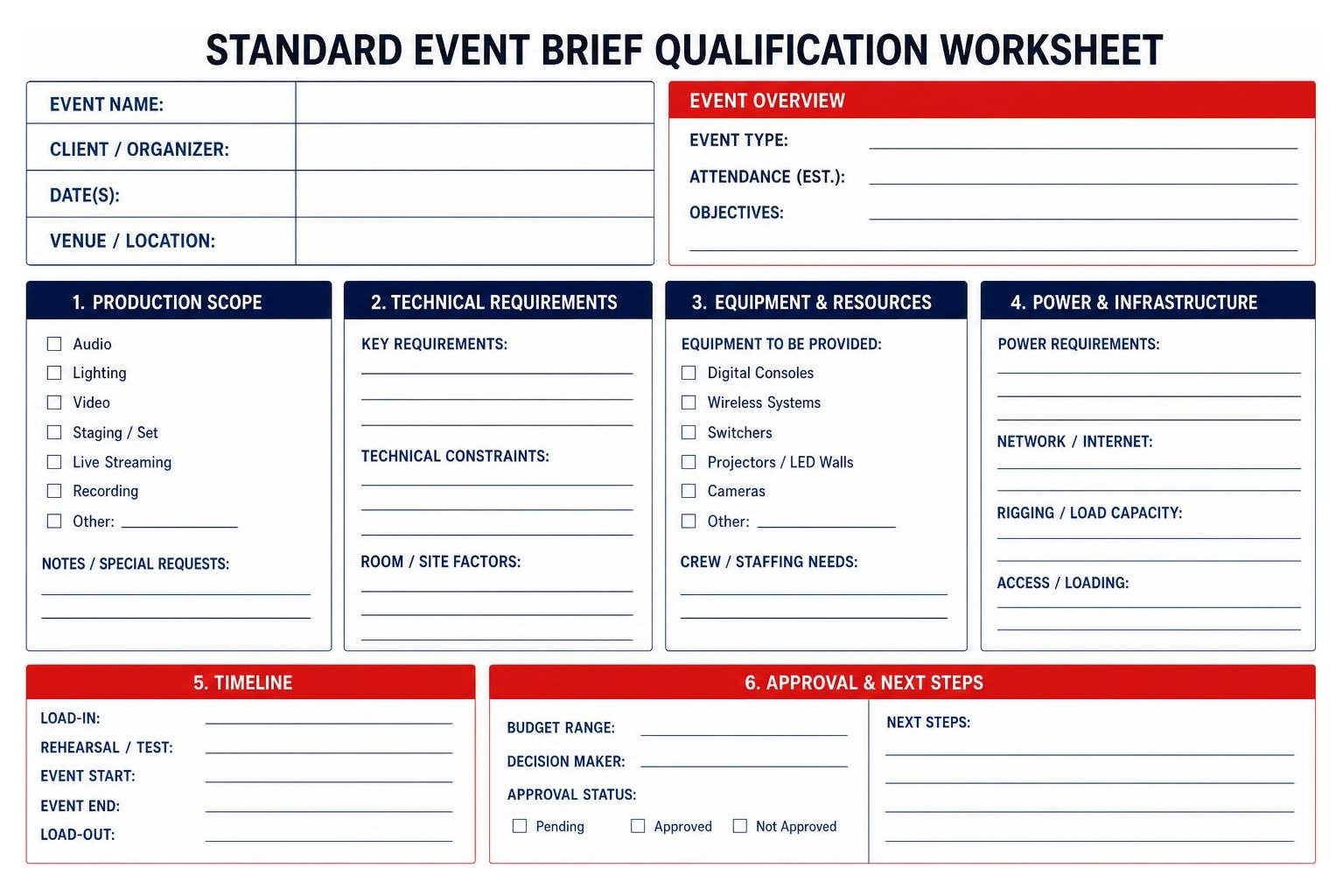
Connect search visibility to business operations by executing an ordered launch checklist, using a structured event brief worksheet to qualify inquiries, and tracking metrics from search impressions through to booked project margins.
Ordered Launch Checklist
Follow this sequence to launch and maintain your search optimization efforts:
- Service Offering Audit: Identify exactly which services your business delivers (equipment rental, full production, livestreaming, or installation) and map corresponding search queries.
- Targeted Landing Pages: Build dedicated pages for each confirmed service category, avoiding generic combined pages.
- Case Study Publishing: Draft indexable case studies using the structured template, including only genuine photos and bounded project outcomes.
- Metadata & On-Page Content: Write clear, descriptive meta titles, headers, and body copy that match search intent.
- Video & Schema Integration: Embed hosted videos, provide accompanying transcripts or summaries, and add VideoObject schema markup where relevant.
- Local Profile Verification: Set accurate Google Business Profile categories and service areas, and establish an unincentivized review collection workflow.
- Inquiry Qualification Integration: Place a structured event brief intake form on relevant service pages.
Usable Event Brief Worksheet
Include these standardized intake fields on service landing pages to gather necessary event specifications:
- Event Date & Duration: Target setup date, rehearsal window, and live show dates.
- Venue / General Location: Venue name, ballroom or hall designation, or general geographic market.
- Room Layout & Count: Number of concurrent breakout rooms, main plenary dimensions, and seating format.
- Audience Scale: In-person attendee count and estimated remote livestream viewers.
- Run of Show Overview: General agenda, keynote presentations, panel sessions, or entertainment segments.
- Streaming & Captioning Needs: Live broadcast destinations, remote presenter feeds, and real-time captioning requirements.
- Crew Scope: Required roles (e.g., technical director, audio engineer, lighting designer, camera operators, stagehands).
- Load-in & Venue Logistics: Dock access windows, freight elevator access, dedicated power tie-ins, and venue coordination requirements to confirm professionally.
How Do You Measure SEO Success Beyond Keyword Rankings?
Measure SEO effectiveness by combining aggregate Google Search Console data with downstream business metrics including qualified briefs, proposal conversion, signed or booked projects, gross margin, and SEO ROI.
Tracking rankings alone does not show commercial return. Use these interconnected metrics:
- Search Console Aggregate Query Data: Track impressions, average positions, and organic clicks across primary service terms.
- Qualified Brief Volume: Number of submitted event worksheets that meet your minimum operational criteria.
- Proposal Conversion Rate: The share of qualified inquiries that receive a proposal.
- Signed or Booked Projects: Track projects that progress from proposal to a signed agreement or confirmed booking as a separate downstream measure.
- Gross Margin: Revenue less direct project costs for completed work.
- SEO ROI: Compare SEO costs with attributed incremental profit, recognizing that attribution is approximate because referrals, repeat business, and other marketing activity can contribute to a project.
Next Steps for Your Production Company's Search Strategy
Developing search visibility for audio visual production requires clear alignment between your actual service offerings, search intent, and credible project evidence. By creating distinct service pages, documenting past productions with structured text and genuine imagery, and capturing detailed project parameters upfront, your website can effectively support your business development efforts.
To discuss a search strategy tailored to your production capabilities, schedule a consultation at SmallBizSEO Booking or explore our available SEO packages.