SEO for Coaches: Help the Right Clients Assess Your Fit

How Can SEO Help Coaching Clients Find the Right Fit?
SEO for business and personal coaching helps your practice appear when people search for support with a goal or challenge. Start by naming the clients you help, creating a clear page for each distinct coaching offer, and answering the questions people ask before booking. Make your experience, approach, and next step easy to find. That gives visitors a way to decide whether your coaching fits their needs.
A business owner seeking help with team leadership and someone considering personal coaching may need different answers. Your pages should reflect those differences rather than speak to everyone at once.
Clayton Johnson, founder of SmallBizSEO, approaches SEO for business and personal coaching by helping the right people find clear answers and assess fit before they inquire. Coaching can support goal setting and professional development, but it is not a substitute for mental-health treatment, does not diagnose conditions, and should not promise health, income, or other outcomes.
How Do You Build an SEO Strategy for Business and Personal Coaching?
To build an effective coaching SEO strategy, match the specific searches of your ideal clients to distinct service pages and helpful educational resources, ensuring every page provides a low-friction path to an introductory discovery call.

A sustainable search presence begins with understanding how searchers seek out professional guidance. Rather than attempting to rank a single homepage for broad terminology, a modern coaching practice structures its digital presence across clear topic clusters and specialized service offerings.
Coaching SEO encompasses multiple technical and creative layers. To see how foundational architecture, topical relevance, on-page content, and external authority interact, review a practical guide to the 4 types of SEO to establish a balanced baseline across all organic search pillars.
What Makes SEO for Business and Personal Coaching Different from SEO for Traditional Businesses?
Coaching SEO depends on trust, clear professional boundaries, and relationship-based client acquisition rather than quick transactions.
Unlike standard e-commerce or local retail stores where customers make rapid purchase decisions based on price or product availability, coaching is a high-consideration, personal investment. Prospective clients often conduct searches when facing professional bottlenecks, career inflection points, or personal growth challenges. Consequently, coaching websites must prioritize clarity, empathy, and demonstrable credentials over sales pressure.
Ethical positioning matters. The ICF Code of Ethics applies to ICF professionals within the scope defined by ICF; it is not a universal regulation for every coach. Coaches should clearly explain their role, agreements, confidentiality practices, and financial arrangements, and distinguish coaching from therapy, counseling, or medical treatment. Coaching is not a substitute for mental-health treatment, and site copy should not diagnose conditions or promise outcomes. Google’s helpful content guidance likewise supports people-first content that shows real experience, transparent qualifications, and clear boundaries without implying ranking guarantees.
How Do You Choose and Map Keywords for Business and Personal Coaching?
Group target search queries by the prospective client's immediate situation, specific trigger events, and underlying intent, then align each query cluster to a dedicated service landing page or informational guide.
Clients rarely begin their search journey by typing the name of a coaching framework. Instead, they search using symptom-driven or trigger-based phrases that describe their current hurdle. Applying these principles to your content is easier when you understand demystifying SEO fundamentals from keywords to content optimization, which explains how to map conversational intent to structured page elements.
| Coaching Topic | Example Query | Likely Intent | Target Page | Evidence to Validate | Next Action |
|---|---|---|---|---|---|
| Executive leadership coaching | "Managing former peers after promotion" | Problem evaluation | Executive coaching service page | Review current search results and query/page data in Google Search Console | Explain leadership-transition scope and invite a fit call |
| Small business coaching | "How to delegate operations as a founder" | Solution research | Small business coaching service page | Review the current results, competing page types, and Search Console data | Show the working method, scope, and pricing process |
| Career transition coaching | "Returning to work after an extended career break" | Informational or service research | Career transition coaching page or guide | Validate intent from the current results and follow-up queries | Clarify who the service is for and not for |
| Personal coaching versus therapy | "Personal coaching vs therapy" | Informational | Scope and boundaries guide | Confirm the question appears in current search results | State that coaching is not mental-health treatment and link to appropriate support where needed |
| Coach credentials and fees | "What credentials should a coach have" or "coach fees" | Research, not automatically commercial | Credentials and engagement page | Review current result types and Search Console performance | List actual qualifications and fees or the scoped pricing process |
Specific problem-focused queries can reveal a clearer situation, but wording alone does not establish commercial intent. Review current search results, the types of pages ranking, and your own Google Search Console query and page data before deciding whether a query belongs on a service page, an educational guide, or both.
What Should Coaching Service Pages and Content Include?
Every service page should define the intended client profile and who the service is not for, state the goals and scope, explain the method and format, show actual qualifications, and describe fees or a scoped pricing process. It should also explain confidentiality boundaries and avoid asking for sensitive health details in public forms.
A collection of articles without a clear plan can make it harder to build topical coverage or evaluate what is working. Instead of publishing ad-hoc articles, build an editorial content strategy around the questions your prospective clients need answered. Use structured briefs that reflect the purpose, evidence, and next step for each page.
Reusable Coaching Service-Page Brief
Use this standard template to structure any new coaching offer page:
- Primary Headline, Audience, and Not-For Statement: State the coaching specialty, who it serves, and who should seek a different type of support.
- Goals and Scope: Describe the practical goals, the boundaries of the service, and that coaching is not mental-health treatment or diagnosis.
- Approach, Format, and Process: Outline the working format, session cadence, and practical tools used.
- Actual Qualifications and Ethics: Display verified certifications, relevant experience, and applicable professional commitments.
- Fees or Scoped Pricing Process: Publish fees where appropriate or explain how scope and pricing are determined before engagement.
- Confidentiality Boundaries: Explain how client information is handled and any limits that apply.
- Public Fit Inquiry: Request only basic contact details and a high-level goal; do not request sensitive health information in a public form.
Illustrative Hypothetical Offer-Page Example
To illustrate effective page design, consider this hypothetical example for an executive coaching practice focused on newly promoted senior leaders (no guaranteed results implied):
- Page Title: Executive Transition Coaching for New Senior Leaders
- Direct Fit Statement: Designed for recently promoted directors and vice presidents navigating organizational complexity and team leadership shifts.
- Scope & Delivery: A structured engagement incorporating 360-degree stakeholder feedback, personalized strategy discussions, and operational delegation frameworks.
- Trust Elements: Detailed practitioner biography displaying verified professional accreditations, formal ethics commitments, and anonymized case examples detailing the problem-solving process.
- Fit Step: An integrated calendar allowing visitors to schedule a brief preliminary fit assessment.
When showcasing real client experiences, obtain explicit written consent that covers the context, timeframe, permitted attribution, and any limits on what can be shared. Anonymization alone is not permission. Focus on the process and scope of the work, not promises of personal, health, income, or performance outcomes.
How Do You Build Authority, Improve Local Visibility, and Get More Inquiries?
Establish a sound technical foundation, earn relevant industry backlinks, use accurate geographic listings where applicable, and monitor discovery activity to support a disciplined marketing program.
How Should Coaches Handle Local SEO for In-Person and Virtual Services?
In-person practices should optimize verified map profiles within their physical service areas, while fully virtual practices must focus on broader organic search visibility without misrepresenting physical office locations.
For practitioners meeting clients at a physical commercial office or within defined geographic regions, local SEO optimization and small business growth provides a framework for managing map visibility and local citations.
Adhere strictly to official Google Business Profile guidelines when configuring your listing:
- In-Person Commercial Practices: Maintain consistent Name, Address, and Phone (NAP) details matching your public commercial premises where you conduct in-person meetings.
- Service-Area Practices: If operating from a private office or home setting while traveling to meet local clients on-site, specify your service area and hide your private physical address.
- Virtual & Online-Only Practices (Eligibility Caveat): Businesses that operate entirely online without in-person customer contact are not eligible for a Google Business Profile listing. Avoid using virtual mailboxes, PO boxes, or rented mailing addresses to simulate a local presence. Focus instead on organic niche content and national-level search authority.
Practical 5-Page Launch Plan and Review Checklist
Start with a focused structure, then include only the service pages that match the coaching services you actually offer:
- Core Homepage: Clarify your coaching philosophy, client categories served, and central value proposition.
- Primary Service Page: Create a page for one coaching service you actually offer, such as executive, business, career, or personal coaching.
- Additional Service Page, if Needed: Add a separate page only when another real service has a distinct audience, scope, or search intent.
- About, Credentials, and Boundaries Page: Detail professional background, verified qualifications, ethical commitments, confidentiality boundaries, and what coaching does not provide.
- Fit Assessment and Contact Page: Offer a streamlined inquiry form that requests only essential contact details and a high-level goal.
Ongoing Site Review Checklist
- Mobile Navigation & Scheduling: Verify discovery call forms and scheduling embeds function smoothly on mobile devices.
- Page Delivery & Performance: Compress media assets and eliminate unnecessary scripts to maintain fast page loading.
- Schema Markup Implementation: Add clean Organization, Person, and Service structured data. Note that schema markup and AI search engines offer no ranking guarantees; they simply help search engines parse page context.
- Crawl Health & Indexation: Audit Google Search Console periodically for crawl errors, redirect issues, and valid indexation across core pages.
How Can You Track Inquiries and Decide Whether to Get SEO Help?
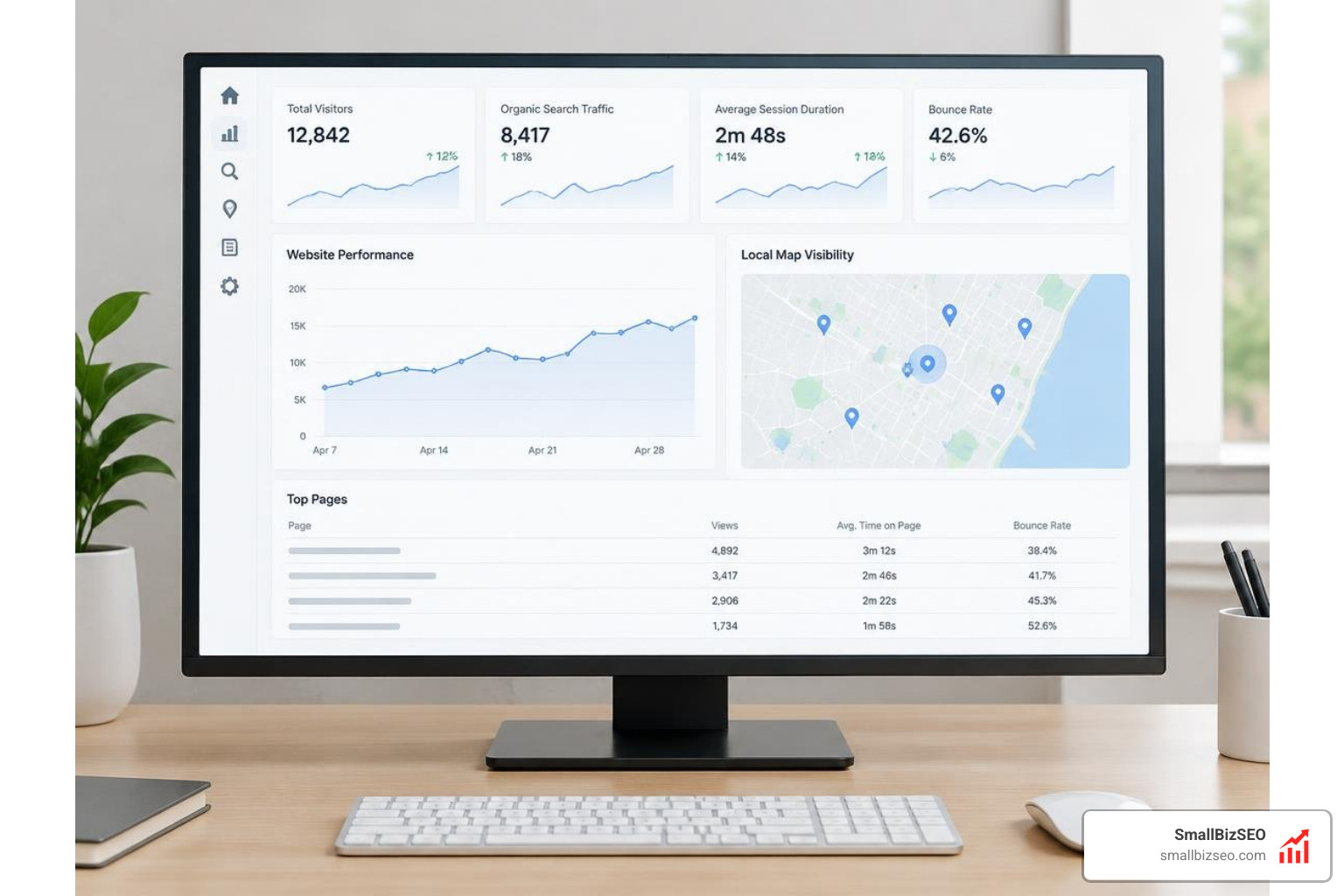
Evaluate search performance with actual Google Search Console query and page data alongside on-site conversion behavior in web analytics and scheduling software.
Google Search Console can show organic impressions, clicks, queries, and landing pages, but those signals need context from the current data and search results. Web analytics platforms and scheduling tools can help connect qualified visits, discovery calls, and later engagement records while preserving the limits of attribution.
Reviewing clear SEO metrics every small business owner needs to track monthly can help separate early search visibility from active inquiries. Qualified calls and client fit are useful operating indicators, but they are not financial ROI on their own. To calculate ROI, compare documented SEO costs, including tools, agency fees, and internal time, with attributed revenue and margin from engagements, while stating the limits of the attribution method.
A Practical Next Step for Coaching SEO
Organic search can become a durable marketing channel that reduces reliance on continuous social media output, but results vary by offer, competition, site quality, and follow-through. Mapping pages to real client questions, creating service pages for actual offerings, and maintaining a technically sound website can make it easier for prospective clients to understand your scope and decide whether to inquire.
For help applying these principles, book a consultation with SmallBizSEO or review SmallBizSEO’s SEO packages.