SEO for Topical Authority: The Complete Guide to Owning Your Niche

SEO for Topical Authority: The Complete Guide to Owning Your Niche
Why SEO for Topical Authority Is the Smartest Way to Compete in Search
SEO for topical authority is the practice of building deep, comprehensive content around a specific subject so that search engines — and AI systems — recognize your site as the go-to expert in your niche.
Here's the quick version of what you need to know:
What is topical authority in SEO?
- It means covering a topic so thoroughly and consistently that Google trusts your site over competitors
- It is built through interconnected pillar pages, cluster articles, and strategic internal linking
- It is not the same as Domain Authority — a site with few backlinks can outrank giants by owning a narrow topic
- It helps you rank for more keywords, appear in AI Overviews, and stay ranked longer
- Most sites start seeing results within 8–12 weeks of publishing a well-linked content cluster
Think of it this way: Google used to rank individual pages that targeted the right keywords. Now it increasingly features sites that own entire topics. That shift changes everything about how small businesses should approach SEO.
A specialist retailer with a low domain rating can outrank a major marketplace simply by covering its niche more completely. A single well-structured page on a health topic can rank for over 2,500 keywords when it sits within a strong topical cluster. These aren't flukes — they're the direct result of topical authority working as intended.
I'm Clayton Johnson, a digital PR and SEO strategist who has spent years helping businesses build search visibility through smarter content architecture — including SEO for topical authority strategies that drive sustainable, compounding organic growth. In this guide, I'll walk you through exactly how it works and how to build it for your own site.
What is Topical Authority and Why Does It Matter?
At its core, topical authority represents the depth of expertise and credibility your website demonstrates on a specific subject. Unlike Domain Authority, which relies heavily on your backlink profile and domain age, topical authority is entirely about content comprehensiveness and semantic coverage.
When we focus on building topical authority, we align our content with Google's E-E-A-T (Experience, Expertise, Authoritativeness, and Trustworthiness) guidelines. Instead of writing isolated blog posts that target scattered keywords, we create a structured library of resources that satisfies every possible search intent within a specific niche. This comprehensive coverage builds immense user trust and signals to search engines that we are the primary source of truth for that vertical.
| Feature | Domain Authority (DA) | Topical Authority |
|---|---|---|
| Primary Focus | Overall backlink strength and site age | Subject-matter depth and content coverage |
| Metric Type | Third-party proxy metric | Algorithmic concept evaluation |
| How to Build | Link acquisition campaigns | Comprehensive clusters and structured internal links |
| Search Engine Value | General domain trust | Contextual expertise and intent satisfaction |
By shifting our focus toward semantic depth, we can establish a competitive moat that protects our rankings. To understand how this fits into Google's quality framework, explore our guide on How to Optimize Your Content for E-E-A-T and Build Real Search Trust.
How Search Engines Evaluate SEO for Topical Authority
Search engines have evolved from basic keyword-matching machines into highly sophisticated semantic engines. This evolution began with the Hummingbird update, which introduced natural language processing to understand the context behind a user's query. Today, Google's Helpful Content System and core ranking algorithms evaluate websites based on how thoroughly they cover a topic's entire concept space.
To measure this, search engines analyze entity relationships within the Knowledge Graph. Google's internal systems assess a "site focus score" and "site radius" to determine your topical concentration. If your site publishes content across too many unrelated topics, your site radius expands, diluting your perceived expertise. Conversely, keeping your content tightly focused signals high topical density. To dive deeper into how algorithms process these connections, read more about Topical Authority: What It Is, How Google Measures It, and How to Build It.
Semantic Search and Entity Recognition
Modern search engines do not just read words; they identify "entities" (people, places, things, and concepts) and map the semantic relationships between them. Semantic SEO relies on natural language processing to analyze word co-occurrence. When we write about a topic, search engines expect to see specific related terms.
To stand out, we must focus on "information gain"—adding unique data, original research, or expert insights that go beyond the consensus of existing search results. We can also make our topical connections explicit to search engine crawlers by implementing structured data and schema markup, which translates our content hierarchy into a machine-readable format.
The Role of E-E-A-T and AI Search Visibility
E-E-A-T signals serve as the ultimate quality filter for search engines. Demonstrating genuine experience and trustworthiness is no longer optional, especially with the rise of AI Overviews and Large Language Models (LLMs). AI search platforms use entity-based mapping and topical clusters to verify factual accuracy, pulling answers from sources that cover subjects from multiple angles.
When a user submits a query, AI engines often perform a "query fan-out," expanding the search into multiple sub-queries. Websites with deep topical coverage are disproportionately cited in these AI-generated answers because they provide the comprehensive context the LLM needs. To make sure your site is fully optimized for these systems, you can Optimize E-E-A-T Signals Today.
The Blueprint: Building Topical Authority Through Content Clusters
To build SEO for topical authority, we must organize our content architecture using a hub-and-spoke (or topic cluster) model. This structure consists of a central pillar page that covers a broad topic comprehensively, linked to multiple satellite (or cluster) articles that dive deep into specific subtopics.
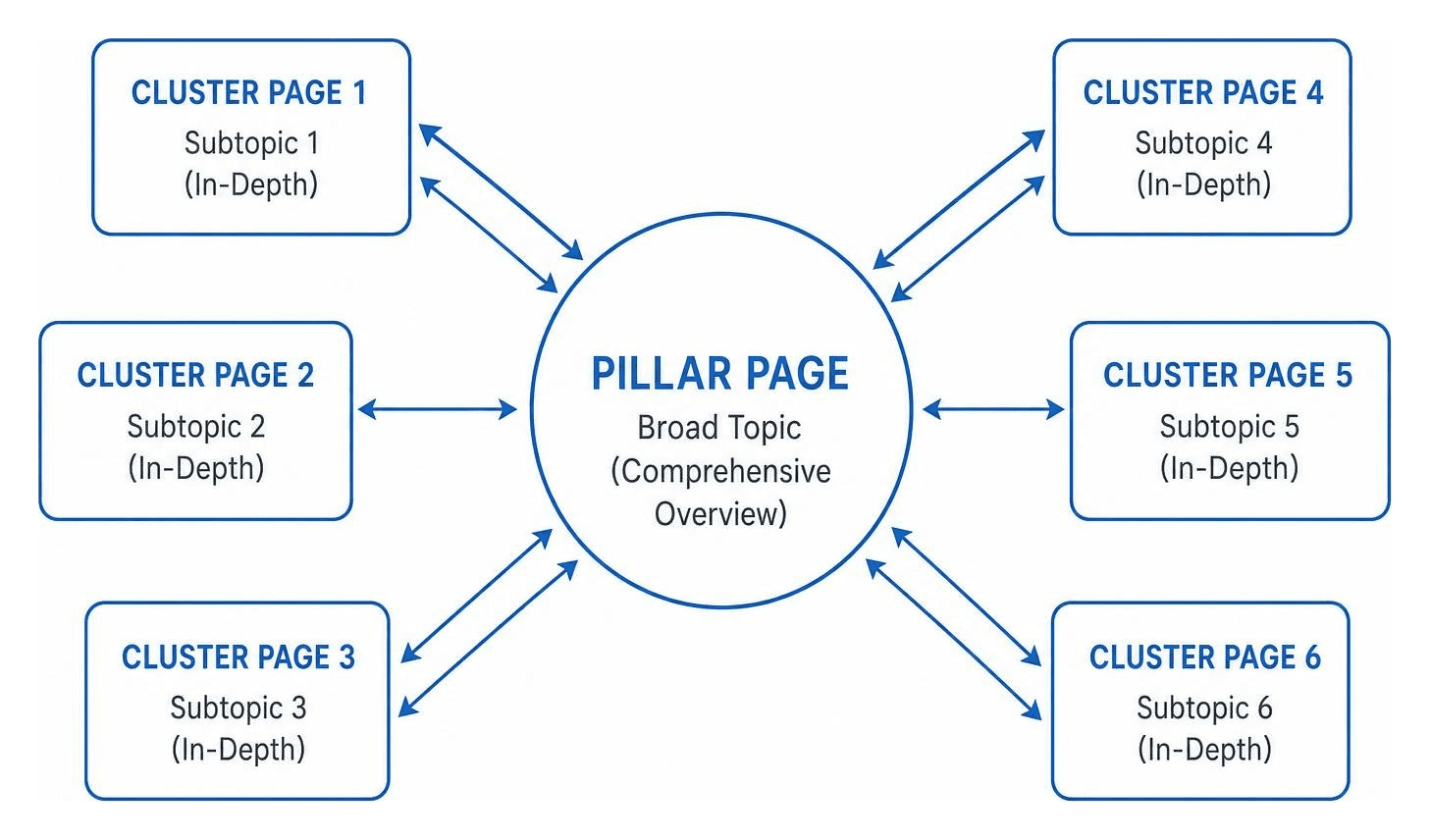
This clean, interconnected architecture helps search engine crawlers navigate our site efficiently, distributing link equity and proving our semantic depth. If you need help designing this structure for your business, check out our SEO Content Services.
Strategic Keyword Mapping: The Foundation of SEO for Topical Authority
Our strategy begins with concept hierarchy mapping rather than traditional keyword research. Instead of simply chasing high-volume keywords, we map out the entire concept space of a topic. We start by identifying the core entity, then scrape "People Also Ask" (PAA) data and analyze competitor gaps to find every relevant subtopic.
Once we have our list of concepts, we group them by user intent to prevent cannibalization. We balance search volume with keyword difficulty, prioritizing highly relevant, long-tail queries that our competitors have overlooked. To streamline this process, you can learn How to Use Ahrefs for Keyword Research Without Losing Your Mind and discover how to execute a Keyword Gap Analysis: What It Is and How to Do It Right.
Creating High-Value Pillar Pages and Satellite Articles
With our map in hand, we execute the content. Our pillar pages serve as comprehensive guides, spanning 1,500 to 3,000 words to cover the broad topic. We then develop supporting satellite articles (typically 1,200 to 2,500 words) targeting specific long-tail keywords.
Every piece of content must provide real value. We can achieve this by integrating original research, personal experience, and expert interviews. To maintain our rankings, we also need to prioritize content freshness, regularly updating our articles with new data and insights. Our structured Content Planning Process ensures that every article we publish supports our overall topical goals.
Strategic Internal Linking and Schema Markup
Internal linking is the glue that holds our topic clusters together. We place contextual links within the body of our articles, using descriptive, keyword-rich anchor text that clearly defines the relationship between pages. Every satellite article must link back to the parent pillar page, and the pillar page should link out to each cluster post.
To reinforce these connections for search crawlers, we use isPartOf and hasPart schema markup. This technical implementation optimizes our crawl budget and ensures search engines index our entire cluster quickly. For more on-page best practices, read our guide on On-Page SEO.
Measuring and Tracking Your Topical Authority Over Time
Building topical authority is a long-term investment, which means we must track our progress using concrete performance metrics. We monitor our topic share (our visibility within a specific niche), our content coverage ratio (the percentage of subtopics we have covered), our ranking breadth, and our AI citation rate.
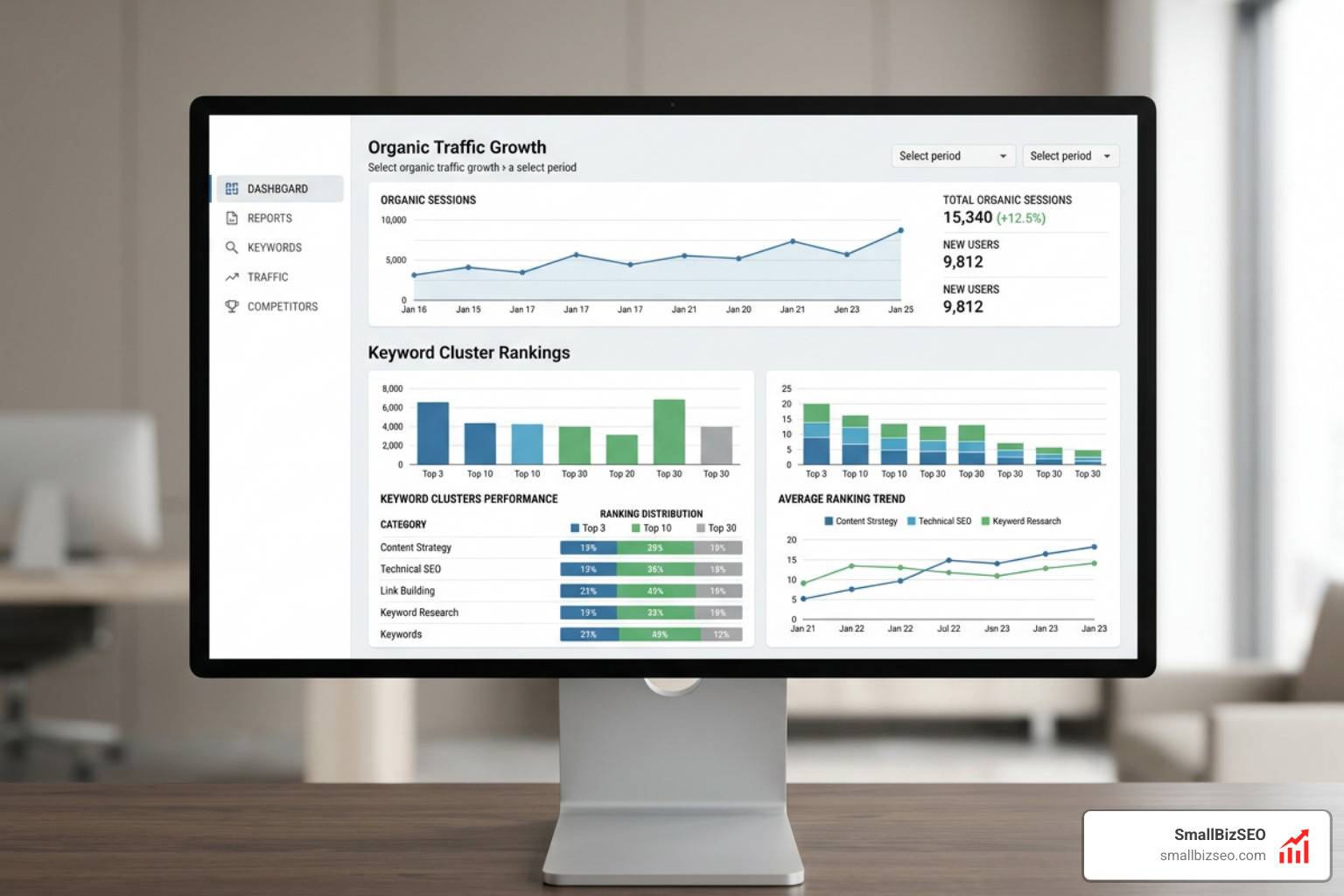
To get a complete view of your site's progress, you can refer to the comprehensive framework in Topical Authority: How to Build It for SEO (2026).
Key Metrics to Monitor in Google Analytics and Search Console
We rely on Google Analytics and Search Console to track the real-world impact of our topical strategy. Key metrics to monitor include:
- Organic Traffic and Impressions Growth: Steady upward movement across our entire cluster.
- Average Position: Improved average rankings for our target keywords.
- Non-Targeted Keyword Rankings: The "halo effect" where our pages begin ranking for keywords we did not explicitly target.
- Competitor Overlap: How much search share we are winning back from larger competitors.
As your topical footprint grows, you can look Beyond Content Optimization to scale your search presence even further.
Common Mistakes to Avoid in SEO for Topical Authority
Even the best content strategies can stumble if they fall into common traps. When building topical authority, avoid these frequent mistakes:
- Thin Content: Publishing shallow, repetitive articles that fail to provide real information gain.
- Off-Topic Publishing: Writing about unrelated subjects, which dilutes your site focus score.
- Poor Internal Linking: Leaving pages orphaned or failing to use bidirectional linking within clusters.
- Keyword Cannibalization: Creating multiple pages that target the same search intent.
- Volume Over Depth: Prioritizing a high publishing frequency over deep, expert-level coverage.
To keep your site's architecture clean and effective, read our guide on how to identify and fix Keyword Cannibalization.
Frequently Asked Questions about Topical Authority
How long does it take to build topical authority?
Most websites begin to see the first signs of ranking improvements and impressions growth within 8 to 12 weeks after publishing a well-linked content cluster. To fully establish topical authority and dominate a competitive niche, expect a timeline of about 3 to 6 months as the compounding effects of your content take hold.
Can a small website with low Domain Authority outrank large competitors?
Absolutely. Search engine trust is highly niche-specific. A specialized, small website with 25 to 30 deeply interlinked articles on a narrow subject can easily outrank a massive, generalist competitor with a high domain rating but shallow topical coverage.
Does topical authority replace the need for backlinks?
No, but it makes your link-building campaigns significantly more efficient. While backlinks remain a key ranking factor, building strong topical authority ensures that any links you do earn flow naturally through your cluster, maximizing their impact across all your interconnected pages.
Dominate Your Niche with a Velocity-Driven SEO Strategy
Establishing SEO for topical authority requires a deliberate, data-driven approach to content and technical architecture. At SmallBizSEO, we help small businesses build sustainable search visibility using our proprietary "Velocity" framework. We combine technical SEO, content strategy, and authoritative link-building to deliver fast, E-E-A-T-compliant growth backed by transparent, automated reporting.

Ready to stop chasing individual keywords and start owning your entire niche? Explore our comprehensive SEO Services Guide to learn how we build authority that lasts, or take the next step and Partner with SmallBizSEO for Expert SEO Services today.