How to Choose a Car Dealer SEO Company for Ongoing Growth
Why Choosing the Right Car Dealer SEO Company Matters
Choose a car dealer SEO company that can explain its ongoing work, ownership model, approval process, and measurement approach—not just its ranking goals. Compare its proposal with your dealership’s platform, OEM requirements, inventory process, and internal capacity before signing.
Dealer SEO must balance durable model and category pages with useful Vehicle Detail Pages. A practical program keeps public business information accurate, maintains helpful inventory paths, publishes evidence-based content, and makes the dealership easy to contact.
SmallBizSEO helps businesses evaluate SEO work through technical evidence, content quality, and transparent reporting. This guide focuses on the questions a dealership can use to assess an ongoing service relationship without mistaking rankings for business results.
Managing Inventory Changes Without Losing Useful Pages
Auto dealership websites often need to serve both inventory operations and shoppers who are comparing vehicles, financing options, service, and local dealers. An ongoing SEO service should prioritize the pages and tasks that improve real shopper decisions, rather than relying on broad claims about where every dealership’s traffic comes from.
Vehicle Detail Pages can be valuable when they provide accurate, useful information about a specific in-stock vehicle. Because inventory changes, the SEO plan also needs durable model and category hubs, clear internal links, and a documented process for sold pages so shoppers and search engines are not sent to irrelevant destinations.
A service proposal should identify the current technical constraints, including inventory feeds, analytics tags, chat tools, and third-party scripts, then explain how each change will be reviewed and measured. That is more useful than assuming a particular vendor model will produce the same result for every dealership.
How to Choose a Car Dealer SEO Company for Ongoing Growth
A car dealer SEO company should be evaluated on the ongoing work it can document: technical implementation, inventory-page decisions, useful content, local visibility, measurement, and approvals. The right fit depends on a dealership’s platform, OEM requirements, market, internal team, and contract terms—not on a blanket claim that one provider type is always better.
| What to verify | Questions for a prospective provider |
|---|---|
| Scope and ownership | Who owns analytics, Search Console, Business Profile access, content, and technical recommendations? |
| Exclusivity | Is category or market exclusivity offered, and are its geography, vehicle brands, duration, and exceptions written into the contract? |
| Platform and OEM limits | Which changes can be made now, which need OEM or vendor approval, and who is responsible for implementation? |
| Ongoing delivery | What content, refresh, technical, local, and outreach work is planned each month? |
| Reporting | Which funnel stages are reported, how is CRM matching handled, and what attribution limits are disclosed? |
What Should the Service Agreement Cover?
A useful agreement sets expectations before work begins. It should name the dealership owner for each approval, list required access, document OEM or platform limits, state any exclusivity as a negotiated contract term, and separate included work from exclusions or extra projects. Ask for a monthly record of completed content, page refreshes, technical changes, outreach activity, and the evidence behind each recommendation.
What Might an Illustrative Monthly Work Plan Include?
An illustrative recurring work plan can clarify responsibilities without promising a fixed volume of deliverables:
| Workstream | Dealership approval | Agency owner | Evidence to review |
|---|---|---|---|
| Model guide | Confirms model claims, offers, and source materials | Drafts or refreshes the guide and internal links | Published or refreshed URL, approval record, and change summary |
| Inventory refresh | Confirms sold status, alternatives, and replacement fit | Reviews inventory-page decisions and internal links | Decision log, updated URL list, and sitemap or link updates when applicable |
| Service FAQ | Confirms service policies and customer-facing details | Writes or updates useful answers | Approved FAQ copy and published URL |
| Earned trade outreach | Approves relevant publications and partnership context | Develops useful assets and outreach opportunities | Outreach record, placement status, and any qualified sponsorship disclosure |
| Measurement | Confirms permitted CRM fields and attribution rules | Reconciles agreed funnel stages and reporting | Report notes on calls, bookings, attended visits, sales, service outcomes, and known limits |
A specialist may bring automotive experience, while a broader SEO partner may fit a dealership that needs integrated support across several business units. Either model can work when the provider can explain the implementation path inside the current website and approval process. For related support, see automotive SEO services and SEO packages.
How Should Dealerships Handle Inventory Pages, Model Hubs, and Structured Data?
Dealerships need both durable model or category hubs and useful Vehicle Detail Pages. Hubs can answer ongoing questions about a make, model, body style, financing option, or service, while VDPs help shoppers assess a specific in-stock vehicle when the page is accurate and genuinely helpful. Compare proposals from a top automotive SEO company or another automotive SEO company by the documented work, implementation path, and approval plan—not by broad superiority claims.
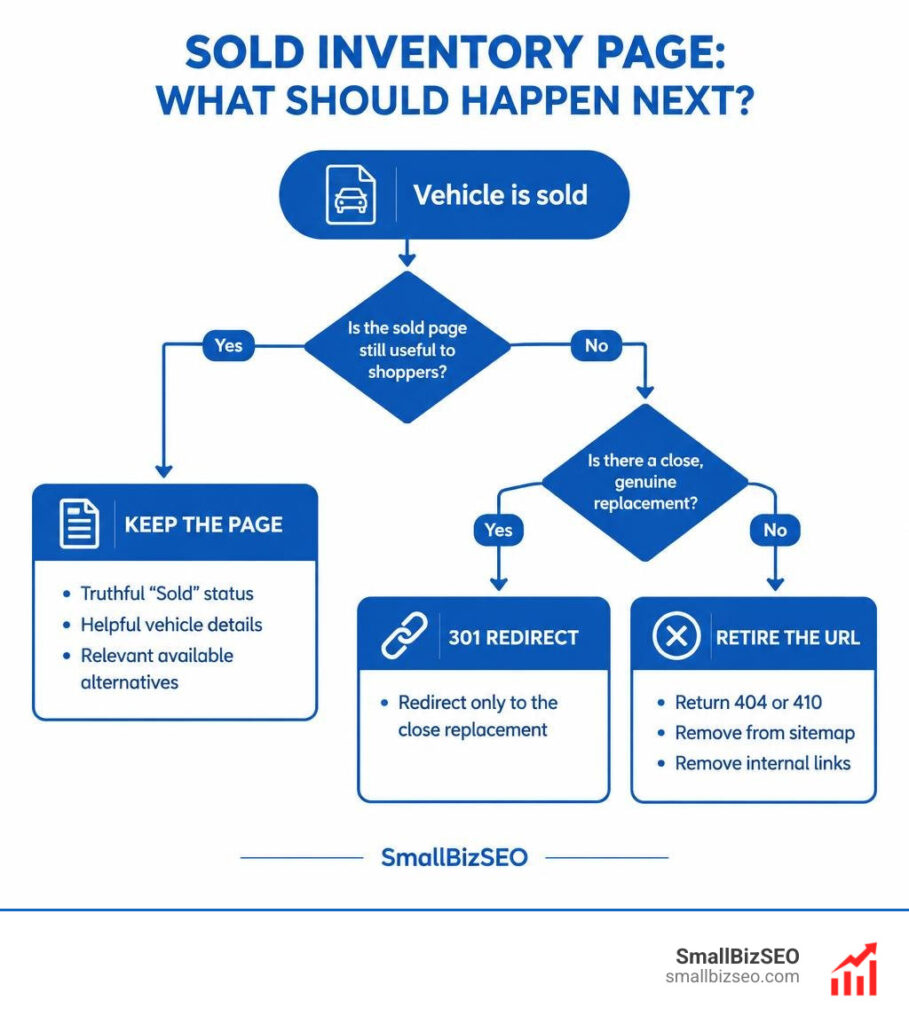
When a vehicle sells, first test whether the existing page can remain useful and truthful before considering a redirect:
- Assess the sold page first. Retain it only if a clear sold status, useful vehicle details, and relevant available alternatives still help the shopper.
- Consider a permanent redirect next. Use one only when another page meets essentially the same shopping need. A different VIN by itself does not make a vehicle an equivalent replacement.
- Retire the URL when neither option fits. Serve a 404 or 410, then remove the retired address from sitemaps and internal links. Avoid generic home-page redirects and never make unavailable inventory appear available.
For Google Search, there is no special AI file or schema markup that guarantees inclusion in AI features. Focus on crawlable, people-first pages, accurate visible information, internal links, and structured data that matches the page. Google’s guidance on AI features says no additional AI-specific requirements or special markup are needed. Use AutoDealer structured data to describe the dealership as a business, not as a shortcut for inventory eligibility. Where the page truly represents a vehicle and an offer, use accurate visible Vehicle and Offer details only when they are applicable to the page and supported by the dealership’s platform.
What Local SEO Practices Are Appropriate for a Dealership?
Local SEO should improve the accuracy and usefulness of the dealership’s public information. Create a separate department Business Profile only when that department is a distinct, eligible operation with its own customer-facing identity and details; do not create blanket nested profiles just to capture more queries. It should complement, rather than substitute for, paid advertising supported by dealer SEO.
Ask customers for honest feedback after a real experience, using a neutral email, receipt link, or QR code. Do not offer incentives, screen for positive reviewers, or pressure people to post while they are on site. Keep hours, services, photos, and contact details current, and use a local SEO company only when its work aligns with the dealership’s actual operations.
What Ongoing Content and Outreach Should a Provider Deliver?
Ongoing work should include expert buyer guides, model comparisons, service FAQs, and updates that reflect real inventory, specifications, pricing context, and dealership policies. Each asset should link to the most relevant inventory or service pages and use original dealership photos when available rather than fabricated inventory visuals.
A practical program can combine SEO content services with documented technical improvements and link-building services. Useful assets and earned outreach to relevant local or trade publications are more credible than manufactured mentions. For a service-department workstream, a local SEO company can coordinate with auto repair search engine optimization when that scope matches the dealership’s operations. When a dealership pays for a sponsorship link, the link should be appropriately qualified and the sponsorship should make sense for the audience.
Evaluating Automotive SEO Service Scope, Measurement, and Red Flags
A credible car dealer SEO company reports progress against a privacy-conscious funnel, not a list of rankings alone. Ask how it connects tracked calls and test-drive bookings to attended appointments, vehicle sales, or service outcomes when the dealership has consent and lawful access to the data. The process should explain CRM matching, duplicate handling, offline attribution limits, and what is not collected. A provider does not need raw credit-application data or other sensitive financial information to report useful performance.
What Should a Dealership Ask Before Hiring an SEO Provider?
Use a buyer worksheet during discovery:
- Business owner: Who can approve content, offers, photos, and technical changes?
- Platform and OEM limits: Which templates, feeds, integrations, and schema fields can the provider change?
- Access: Which accounts can be shared securely, and which actions require dealership staff?
- Contract scope: What is included each month, what is excluded, and what requires a separate estimate?
- Proof of delivery: Will the monthly report show published or refreshed content, completed fixes, outreach activity, and next actions?
- Measurement limits: Which calls, bookings, attended visits, sales, and service outcomes can be matched reliably, and which cannot?
What Red Flags Matter During Vetting?
Be cautious when a provider will not explain its scope, ownership model, data practices, or implementation path. Other warning signs include unrealistic ranking promises, syndicated content without local evidence, unclear rights to website assets, unsupported claims about AI-search results, and reporting that never connects work to business outcomes. A professional SEO company should be able to document its work and its dependencies.
A good provider can show relevant examples, explain what it changed and why, and identify what depends on dealer approvals or third-party systems. For a broader service comparison, assess the provider’s proposal against the documented scope and approval process.
How Should Costs, Timelines, and Results Be Discussed?
Pricing, timelines, and outcomes vary with the dealership’s existing site, inventory technology, content backlog, market, approval process, and scope of work. A responsible proposal explains the planned work, dependencies, and reporting cadence rather than promising a fixed ranking, lead volume, or timeline.
Ask for a phased plan that identifies early technical or content priorities, the evidence used to choose them, and the milestone that would justify the next investment. A plan to accelerate showroom foot traffic should state its dependencies and measurement limits.
Next Steps for Your Dealership's Search Strategy
Evaluating an automotive SEO partner comes down to a clear scope, sound implementation, accurate public information, and transparent measurement. Start by documenting inventory decisions, platform limits, access, approvals, and the outcomes the dealership can responsibly measure. To identify technical hurdles and prioritize next steps, book a consultation.