The Checklist for Onsite and Off-Page SEO Analysis

The Checklist for Onsite and Off-Page SEO Analysis
Executing a Modern Onsite SEO Analysis
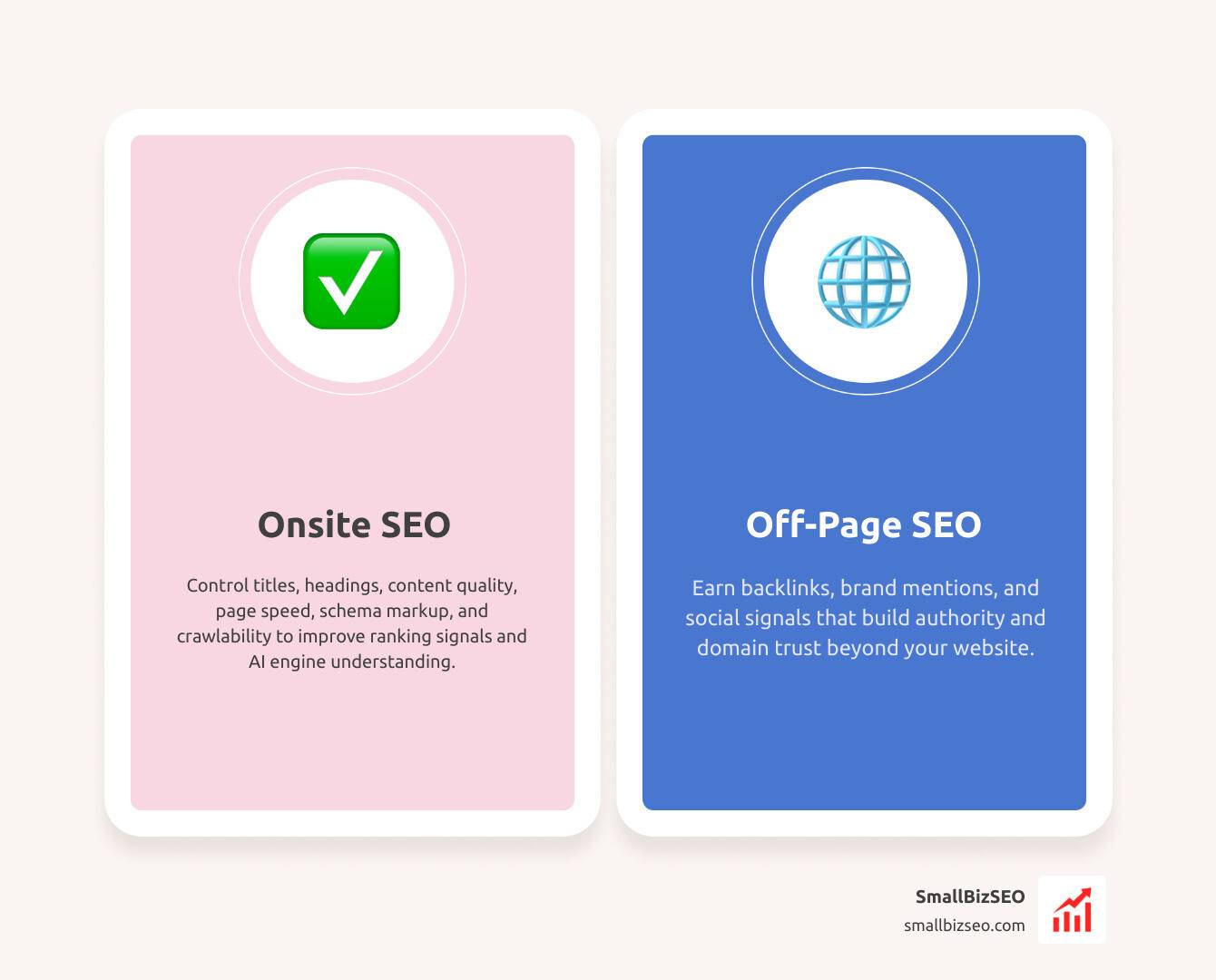
Onsite SEO analysis is the process of reviewing everything on your website — titles, headings, content, speed, links, and code — to find what's stopping you from ranking higher in search results.
Here's what a complete onsite SEO analysis covers:
- Meta tags — title tags and meta descriptions that tell search engines what each page is about
- Heading structure — proper use of H1, H2, and H3 tags to organize your content
- Content quality — word count, readability, keyword use, and duplicate content issues
- Technical health — page speed, mobile usability, broken links, and crawlability
- Schema markup — structured data that helps both Google and AI engines understand your content
- Indexing and crawlability — whether search engines can actually find and read your pages
These are the factors you can control directly on your own site — and fixing them can meaningfully move your rankings.
The stakes are higher than most small business owners realize. Search isn't just Google anymore. Around 40% of searches now happen in AI engines like ChatGPT, Gemini, and Perplexity. That means your website needs to satisfy two audiences at once: traditional search crawlers and the large language models deciding which brands to cite in their answers.
One business found 47 technical issues they didn't know existed, fixed them in a week, and saw a 34% increase in organic traffic within a month. Those kinds of wins aren't rare — they're what happens when you actually look under the hood.
And yet, most small business websites are flying blind. No audit. No prioritized fix list. No idea what's broken or why traffic is flat.
This guide changes that.
I'm Clayton Johnson, a digital PR and SEO strategist who has spent years helping businesses improve their search visibility through systematic onsite SEO analysis and targeted optimization campaigns. In the sections below, I'll walk you through everything — from core on-page factors to technical checks to AI readiness — so you can build a clear, actionable plan.
Discover more about onsite SEO analysis:
To run a highly effective onsite SEO analysis, you must look beyond basic keyword insertion. Modern search algorithms rely on sophisticated semantic models to determine whether a webpage truly answers a user's query. For businesses in highly competitive markets like New York, NY, standing out requires a granular review of both code and content.

When we perform a Detailed SEO Analysis, we evaluate how search engines crawl, render, and interpret each page. If you are operating a local business, aligning your on-page elements with local intent is critical to uncover hidden technical roadblocks that stall local keyword growth.
The Core Components of Onsite SEO Analysis
A comprehensive onsite audit must dissect several foundational on-page elements to ensure they align with search engine guidelines. When optimizing your On-Page SEO, pay close attention to these core components:
- Meta Titles and Descriptions: Your title tags should be between 30 and 65 characters, and meta descriptions should fall between 120 and 170 characters. They must be unique, contain your primary keyword, and entice users to click.
- Heading Hierarchy: Every page must have exactly one unique H1 tag containing the primary topic. Subsequent subheadings (H2, H3, H4) must follow a logical nested structure to help search bots understand your content hierarchy.
- Content Quality and Depth: Industry studies show that pages optimized for specific keywords rank 67% higher than generic pages. Ensure your content length is appropriate for the search intent (typically at least 300 words for basic pages, and much more for competitive topics) and free of duplicate text.
- Schema Markup: Structured data (JSON-LD) acts as a direct translator for search engines, helping them display rich snippets, local business info, and product details directly in search results.
Off-Page SEO Analysis and How It Differs
While onsite analysis focuses on what is happening directly on your domain, off-page SEO analysis examines external trust signals. Proper off-page analysis evaluates:
- Your Backlink Profile: The quantity, quality, and relevance of other websites linking to yours. There is a direct correlation between high-quality editorial backlinks and organic search traffic.
- Brand Mentions: How often your business is mentioned across the web, even without a direct link.
- Domain Authority and Trust Signals: Metrics that indicate how reputable your site is compared to competitors.
To get the full picture of your online footprint, local businesses in competitive regions often build authoritative local citations and high-quality backlink profiles that complement their onsite optimization.
Traditional Search vs AI-Powered Search Visibility
Search is undergoing a massive shift. Today, traditional search engine indexing lives alongside generative AI answer engines. If your business only optimizes for standard blue-link results, you risk becoming invisible to a massive portion of your audience.
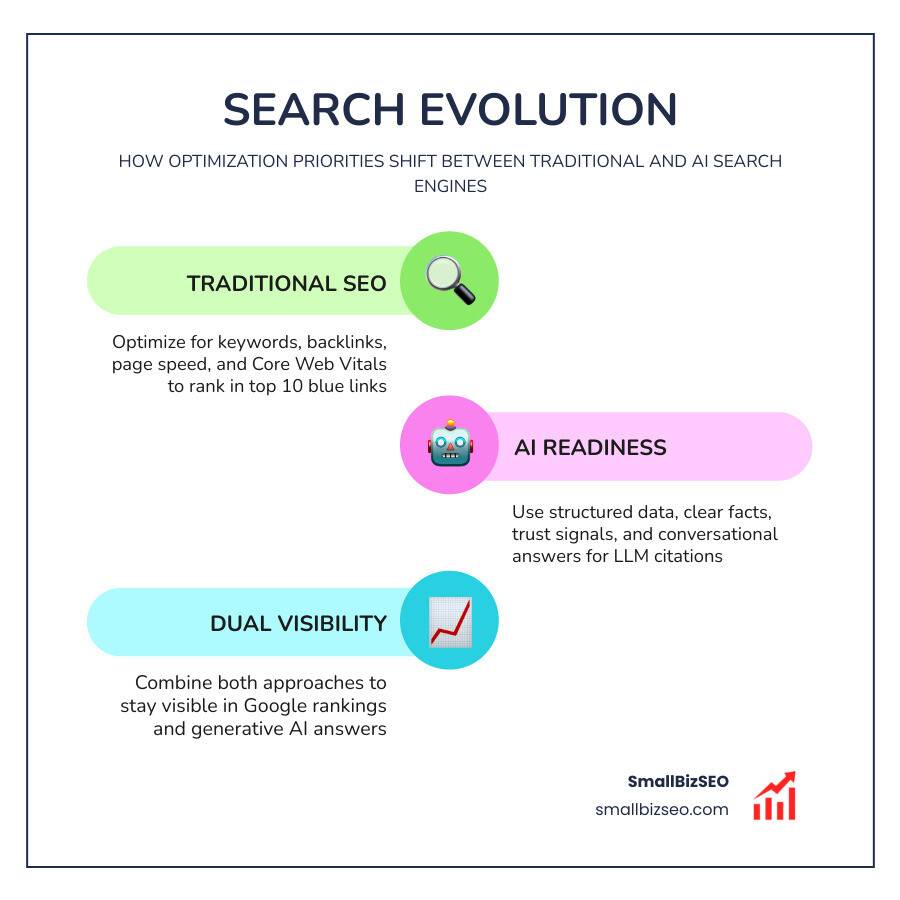
| Optimization Factor | Traditional Search Engines (Google) | AI Search Engines (ChatGPT, Gemini, Perplexity) |
|---|---|---|
| Primary Goal | Rank in top 10 organic search results | Get cited as a trusted source in conversational answers |
| Key Signals | Keywords, backlinks, page speed, Core Web Vitals | Highly structured data, clear facts, trust signals, brand authority |
| Content Structure | Standard HTML, headers, keyword density | Conversational answers, clear definitions, JSON-LD schema |
| Technical Files | robots.txt, XML sitemaps | robots.txt, XML sitemaps, llms.txt |
To stay ahead of these changes, you must understand How to Pass Google's Own SEO Analysis Audits while simultaneously preparing your site for AI-driven discovery.
Optimizing for LLM Citations and AI Readiness
Surprisingly, a page that ranks #1 on Google might score a 0/100 for AI-readiness. Large Language Models (LLMs) do not read websites the same way traditional web crawlers do. They look for structured facts, clear question-and-answer formats, and explicit trust signals.
To make your site AI-ready:
- Implement Robust Schema Markup: Use JSON-LD to clearly define your entity, products, authors, and local business details.
- Provide Clear, Unambiguous Facts: LLMs favor content that states facts directly rather than using flowery or vague language.
- Deploy an llms.txt File: This emerging standard provides a clean, text-only directory of your site's content specifically formatted for AI agents and LLM crawlers to ingest efficiently.
The Impact of AI Visibility on Traffic
AI search platforms rely on brand mentions, citation frequency, and sentiment analysis to decide which businesses to recommend. If an AI engine prompts a user with a solution and your competitor is cited while you are left out, you lose that lead entirely. Tracking your "share of voice" across ChatGPT, Gemini, and Perplexity is now just as important as tracking your traditional keyword rankings.
Technical SEO and Page Experience Evaluation
Technical SEO is the foundation upon which your on-page content rests. If search engines cannot crawl your pages, or if your site takes too long to load, your content will not rank—no matter how well-written it is.

Using tools like Google's PageSpeed Insights allows you to run real-time checks, giving you immediate insight into your technical health.
Core Web Vitals and Mobile Usability
Google uses Page Experience signals as a direct ranking factor. Your site must load quickly and be entirely mobile-friendly:
- Largest Contentful Paint (LCP): Measures loading performance. Target LCP to occur within 2.5 seconds of when the page first starts loading.
- Interaction to Next Paint (INP): Measures page responsiveness. A good score is under 200 milliseconds.
- Cumulative Layout Shift (CLS): Measures visual stability. Pages should maintain a CLS of less than 0.1.
- Mobile Usability: Ensure your site uses a responsive viewport, text is large enough to read without zooming, and tap targets (buttons and links) are spaced far enough apart to prevent accidental clicks.
Crawlability, Indexing, and Site Architecture
To ensure search engines can properly index your pages, your site architecture must be clean and logical:
- Robots.txt & XML Sitemaps: Your robots.txt file must allow access to all important pages, and your XML sitemap must be updated and submitted to Google Search Console.
- Canonical Tags: Use canonical tags on every page to prevent duplicate content issues, especially if you run an e-commerce site with product variations.
- Redirect Chains: Eliminate redirect loops and chains (e.g., Page A redirecting to Page B, which redirects to Page C), as these waste search crawl budget and slow down your site.
Prioritizing Issues and Choosing Your Toolset
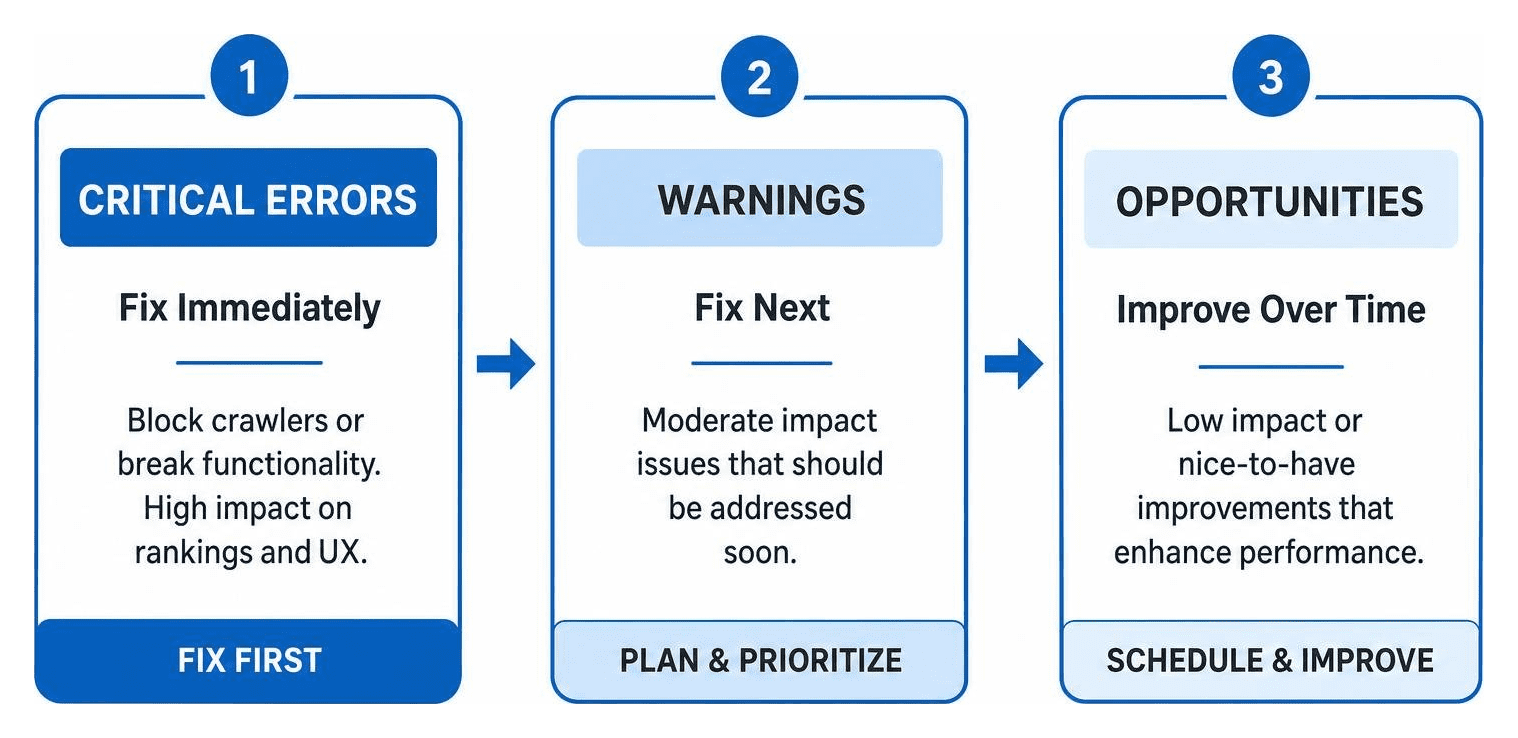
An onsite SEO analysis will often uncover dozens of issues. Trying to fix everything at once is overwhelming. You must learn to categorize and prioritize your findings to maximize your return on effort.
When organizing your optimization tasks, run a Keyword Gap Analysis: What It Is and How to Do It Right alongside your technical audit. This helps you identify which pages have the highest potential to drive traffic once fixed.
Choosing the Right Tools for Onsite SEO Analysis
There are various tools available depending on your budget and technical comfort level:
- Free Tools: Excellent for quick, page-level checks. You can use specialized developer repositories like GabrielNathanael/SEO-analyzer-next-js for lightweight, raw HTML parsing, or run your site through the Site Analyzer - Site OptimizR to get a snapshot of your current optimization state.
- Paid Suites: For comprehensive, site-wide audits, platforms like the On-Page SEO Checker offer advanced competitor benchmarking, keyword tracking, and automated crawling capabilities.
Creating an Actionable Optimization Roadmap
Once your audit is complete, build a structured roadmap. Address critical errors (like 404 pages, broken links, and non-indexed URLs) first. Next, move on to warnings (like missing meta descriptions or slightly slow load times). Finally, focus on opportunities (like adding schema markup or improving internal link anchor text).
If you are planning to update your site's structure or design, always consult a Website Redesign Checklist: SEO Best Practices to avoid losing your hard-earned keyword rankings.
Frequently Asked Questions about Onsite SEO
What are the most common onsite SEO issues found during audits?
The most common issues include broken internal links (404 errors), images missing descriptive alt text, duplicate or missing title tags, and thin content pages that provide little value to searchers.
How often should a business run an onsite SEO audit?
Most businesses should run an automated onsite audit monthly. However, you should trigger a new analysis immediately following major content updates, a website redesign, or a confirmed search engine algorithm update.
Can onsite SEO tools help improve visibility in AI search engines?
Yes. Modern onsite SEO tools evaluate structured data, factual accuracy, and crawlability signals (like llms.txt files) that AI engines rely on to find, verify, and cite brands in conversational search results.
Conclusion
Conducting a thorough onsite SEO analysis is the single best way to reclaim lost organic traffic and prepare your business for the future of search. Proper on-page optimization can improve your search rankings by 25% to 50% and significantly boost your inbound leads.
At SmallBizSEO, we help businesses navigate this changing landscape. Our proprietary "Velocity" framework delivers rapid search engine rankings and E-E-A-T-compliant growth through transparent, automated reporting. Whether you need expert technical SEO, a content strategy overhaul, or local visibility in the competitive New York, NY market, our team is here to help.
Ready to see where your website stands in both Google and AI search engines? Get a clear, actionable roadmap today with our SEO Visibility Audit.