The Conversion Power of AI Referral Traffic Versus Google Search
The Conversion Power of AI Referral Traffic Versus Google Search
Do AI Search Visitors Convert Better Than Google Visitors?
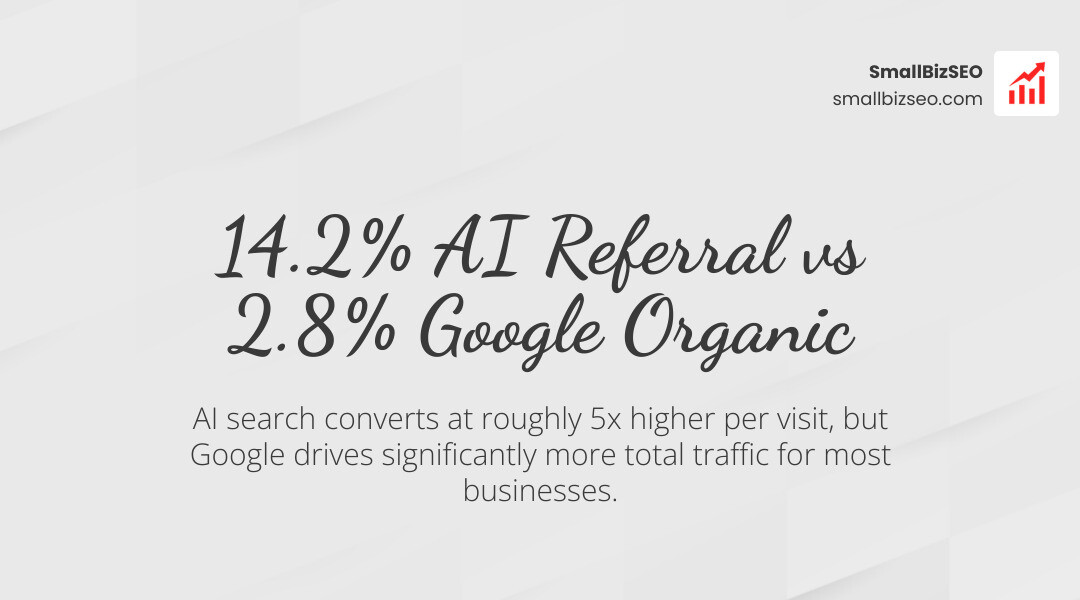
AI referrals can convert at a higher rate than Google organic visits, but they usually bring far fewer visitors. One reported comparison puts AI referrals at 14.2% and Google organic at 2.8%. That is roughly five times higher per visit, not five times more customers. Results vary by platform, business, and what counts as a conversion.
AI users may click after getting an answer and comparing options. Google visitors may still be at the start of that research. To judge which channel helps your business, compare conversions and total leads, not rates alone.
I'm Clayton Johnson, founder of SmallBizSEO. My work in SEO, content, and AI search shapes this guide to AI Search Conversion Rates: How Does AI Referral Traffic Compare to Google? Let's start with what the numbers can, and cannot, tell us.
Explore more about AI Search Conversion Rates: How Does AI Referral Traffic Compare to Google?:
- AI Search Visibility by Industry: Which Businesses Appear Most Frequently in AI Answers?
- How Frequently Do AI Search Engines Change Their Recommendations? Citation Consistency Statistics
- AI-Generated Content Statistics: How Much of the Internet Is Created by AI?
AI Search Conversion Rates: How Does AI Referral Traffic Compare to Google?
To evaluate real conversion impact, compare conversion rates alongside traffic volume, bounce rates, and session value. A higher percentage alone does not automatically translate to greater overall sales.
When examining traffic channels across modern analytics platforms, AI referral traffic functions like a specialized, high-intent recommendation stream rather than a traditional discovery engine. Where Google organic search casts a wide net across top-of-funnel learners, AI platforms compress the evaluation phase before a user ever clicks a link.
| Platform | Average Conversion Rate | Pages Per Session | Session Duration Multiplier | Revenue Per Visitor |
|---|---|---|---|---|
| Claude | 16.8% | 3.4 | 4.3x | $19.20 |
| ChatGPT | 14.2% | 2.3 | 4.1x | $18.04 |
| Perplexity | 12.4% | 2.8 | 3.8x | $16.50 |
| Google Organic | 2.8% | 1.2 | 1.0x | $2.56 |
Academic evaluations, such as the Frontiers: ChatGPT Referrals to E-Commerce Websites: How Do LLMs Compare Against Tradition study, confirm that generative models pre-filter options for users. When an AI engine provides a direct citation, it transfers cognitive trust to the cited brand, drastically reducing on-page friction and bounce rates.
AI Search Conversion Rates: How Does AI Referral Traffic Compare to Google Across Key Platforms?
Benchmark studies show higher conversion percentages for AI referrals than for Google organic, though exact numbers vary by engine and industry.
While Google organic averages around 2.8% across industries, platform-specific AI referrals demonstrate consistent advantages:
- Claude: Leads top-tier conversion performance with benchmarks reaching 16.8%.
- ChatGPT: Averages a 14.2% conversion rate and accounts for roughly 87.4% of total AI referral volume across major business sectors.
- Perplexity: Delivers conversion rates averaging 12.4%, with deep research queries converting up to 11 times higher than standard search traffic.
- Global E-Commerce: AI referrals convert at 11.4% compared to 5.3% for standard organic search.
Industry data compiled in the GEO/AEO Benchmarks: The Data on AI Search Impact highlights that while AI traffic represents only about 1% of total web visits, its impact on pipeline value is disproportionate. However, citations remain volatile; understanding why generative search engines change their brand picks helps explain why visibility across these engines fluctuates over time.
Why Does AI Search Traffic Convert 4x to 23x Higher Than Traditional Search?
AI referrals convert at higher rates because users arrive pre-educated with specific context and clear purchasing intent.
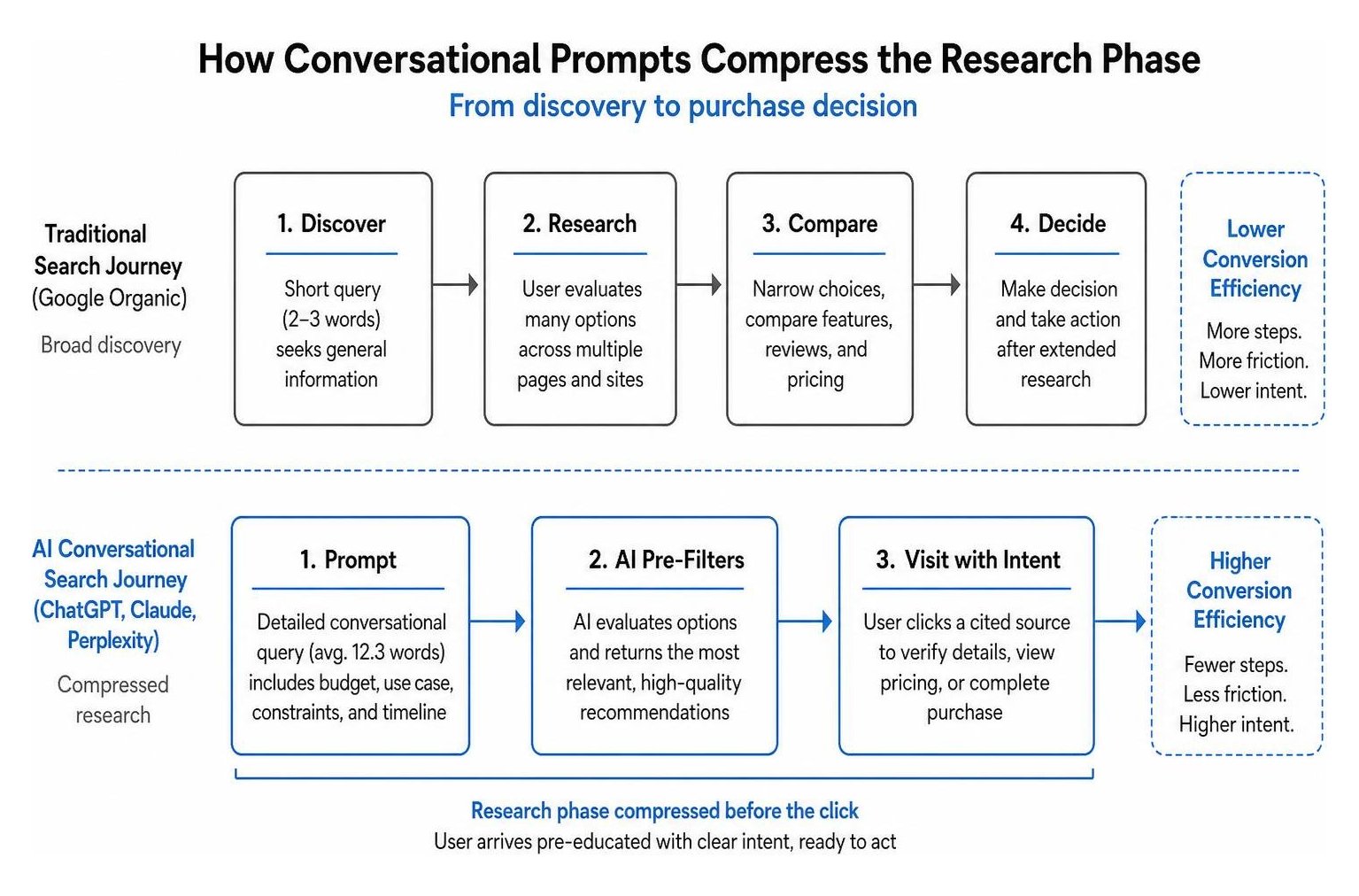
The primary behavioral driver is query complexity. Traditional search queries average two to three words, representing broad exploratory searches. In contrast, conversational AI queries average 12.3 words. A user asking an AI assistant for a solution specifies their exact budget, use case, technical constraints, and timeline.
By the time the model generates an answer, it has already filtered out irrelevant options. The user visits your website not to learn the basics, but to verify pricing, read implementation details, or complete a purchase. Research on why traditional A/B testing breaks in an AI-driven environment shows that AI visitors convert in an average of three days compared to eight days for standard search visitors. Specific sectors benefit even faster, as seen in data showing why certain industries get cited twice as often.
AI Search Conversion Rates: How Does AI Referral Traffic Compare to Google on User Intent and Journeys?
AI search synthesizes multi-step research into a single conversational session, bringing visitors to your site much further along in the buyer journey.
In traditional Google search, a prospect opens ten browser tabs, skims long-form blog posts, navigates around popups, and experiences search fatigue. In AI search, the engine compares alternatives, synthesizes feature tables, and provides a direct recommendation.
Although over 60% of AI queries end without a click (zero-click searches), the brand visibility generated by citations creates strong downstream benefits. Businesses cited within AI answers experience a 35% lift in organic click-through rates and a 91% lift in paid ad clicks. Modern LLM visibility tools confirm that earning citations serves as both a direct traffic source and a powerful trust accelerator for all other acquisition channels.
How Can Businesses Capture High-Converting AI Discovery and Manage Its Risks?
Capturing high-converting AI traffic requires tracking referral signals across analytics, publishing structured and citable assets, and maintaining balanced optimization efforts across all search engines.
Because generative search algorithms update continuously, relying exclusively on AI citations presents volatility risks. A strategic approach balances foundational search engine optimization with generative engine optimization (GEO).
How Can Businesses Address the Noreferrer Tracking Gap and Attribution Blindspots?
Because AI platforms often hide tracking parameters, identifying referral traffic requires analyzing direct traffic lift, branded search trends, and self-reported customer feedback.
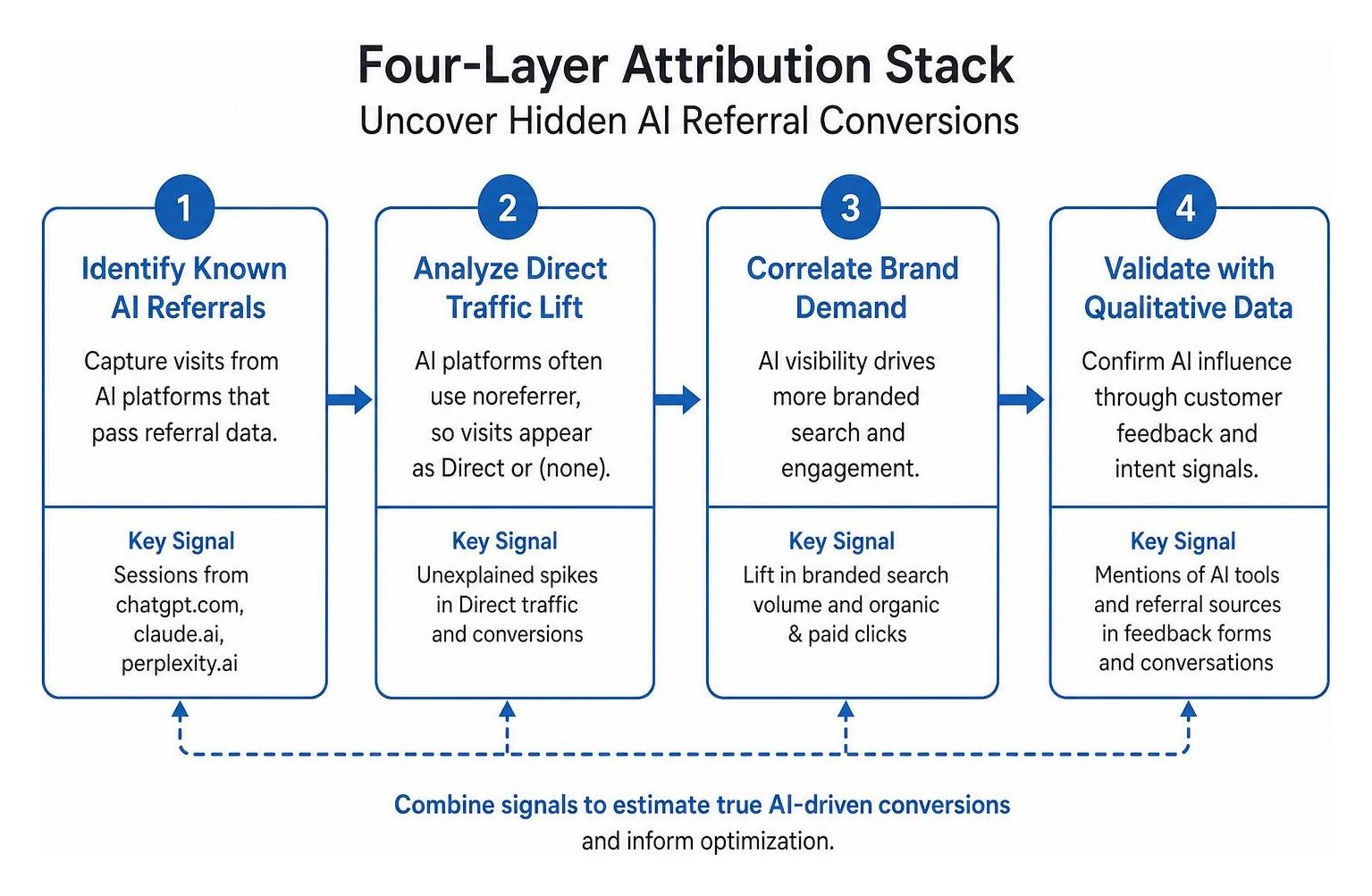
A major hurdle in measuring AI search value is the noreferrer attribute. When paid users click citations in tools like ChatGPT, tracking data is stripped, causing visits to appear in Google Analytics as Direct or (none). Google AI Overviews also pass no unique referral tag.
To uncover your true AI impact:
- Configure Custom GA4 Channels: Build regex filters to isolate identifiable traffic from domains like
chatgpt.com,claude.ai, andperplexity.ai. - Perform Excess Conversion Rate Analysis: Monitor your Direct traffic channel. If Direct visits exhibit unexplained conversion rate spikes, you are likely capturing unflagged AI traffic.
- Track Branded Search Correlation: Measure lifts in branded Google queries following periods of high AI citation activity.
- Deploy Self-Reported Attribution: Add an open-text "How did you hear about us?" field on checkout and lead capture forms.
- Extend Attribution Windows: Expand conversion tracking windows to 60 to 90 days to capture multi-touch research cycles, and run an AI SEO audit to track signals that matter.
How Can Businesses Structure Content for Generative Engine Citations and Clicks?
To earn citations and referral clicks, position direct answers at the top of your pages, back them with primary data, and use clean, parseable formatting.
Generative engines favor factual, concise information over conversational filler. Implementing structured content patterns ensures that large language models easily extract your data when answering user prompts.
- Apply the Inverted Pyramid: Place clear, direct answers in the first 100 to 200 words of every major heading.
- Use Evidence Blocks and Tables: Present comparisons, specifications, and data points in HTML tables and bulleted lists.
- Publish Proprietary Assets: Offer interactive calculators, downloadable templates, and original data studies that AI models cannot fully replicate in text.
- Implement Schema Markup: Use structured data types like
FAQPage,Article, andOrganizationto clarify entity relationships. - Maintain Freshness: Update key statistics and service pages regularly, as models heavily favor recently verified data.
- Adopt Machine-Readable Protocols: Provide clean site architecture and deploy an
llms.txtfile to guide AI parsers toward core technical resources.
Our guide on generative AI SEO services and GEO details how these structural adjustments improve both traditional rankings and AI citation rates.
Building a Resilient Multi-Engine Search Strategy
Small businesses should pursue both Google organic rankings and AI engine visibility, shifting resources based on measured revenue and pipeline growth.
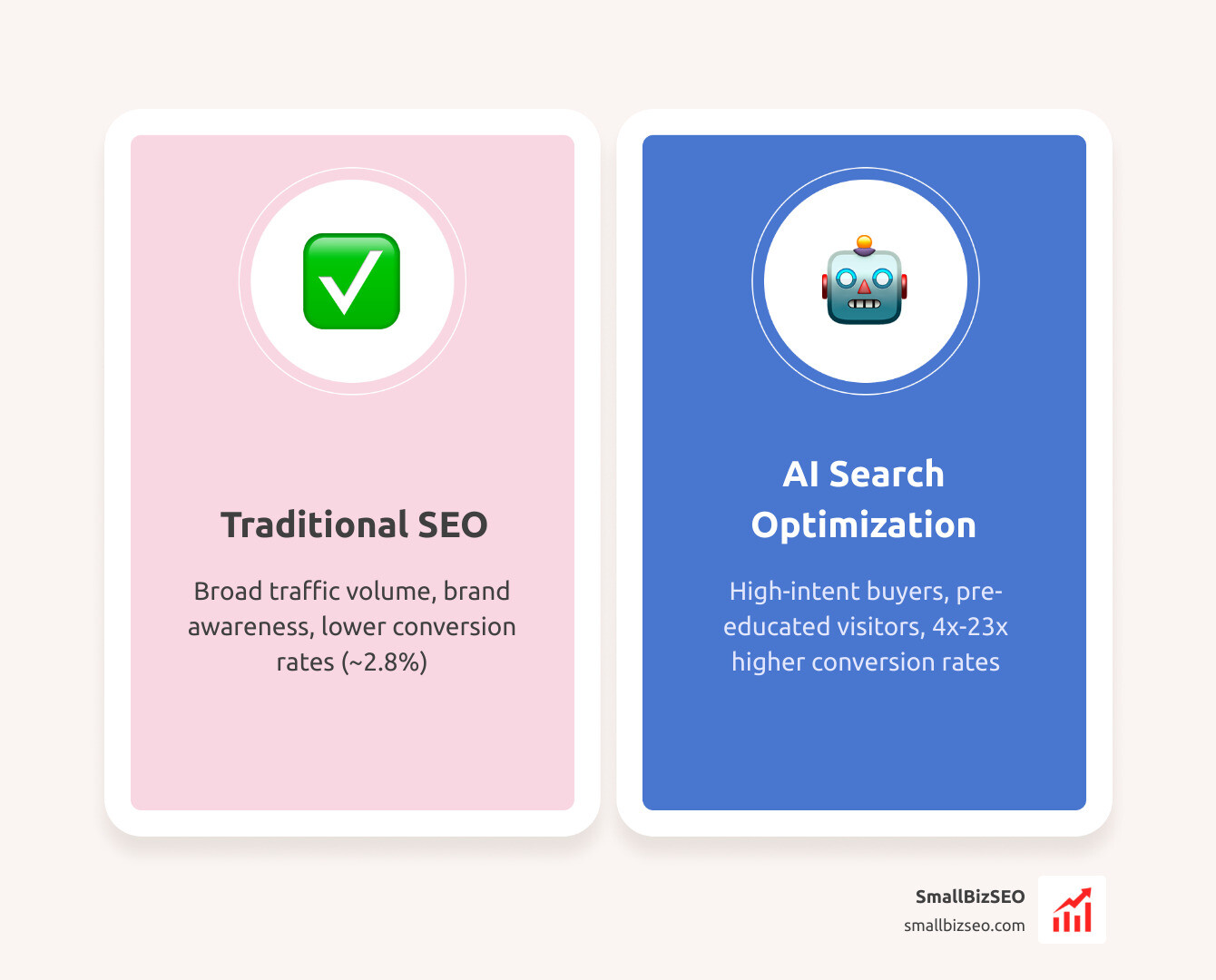
At SmallBizSEO, our data-driven Velocity framework treats search as a multi-layered ecosystem. Google search delivers the broad volume needed to build brand awareness, while AI search delivers the high-intent, pre-educated buyers who convert at top rates.
By building authoritative content, maintaining technical health, and optimizing for both search algorithms and generative models, businesses can protect their organic pipeline while capturing the most lucrative conversion channel available. Explore our comprehensive AI SEO services to align your website with modern search visibility and maximize your return on investment.