How Much of the Internet Is Actually Created by AI in 2026?

How Much of the Internet Is Actually Created by AI in 2026?
AI-Generated Content Statistics: How Much of the Internet Is Created by AI?
Researchers estimate that between 30% and 40% of text on active web pages originated from artificial intelligence models. However, this range represents an academic estimate derived from sampled web crawls rather than a definitive census of the entire internet. Anyone searching for AI-Generated Content Statistics: How Much of the Internet Is Created by AI? will find that the answer depends heavily on which pages, domains, and time periods a study examines.
When analyzing massive datasets like Common Crawl, which contains hundreds of billions of pages across tens of billions of indexed URLs, researchers face immense technical hurdles. The sheer volume of unstructured data means that any single percentage reflects a snapshot of specific crawled segments.
For business owners and digital strategists, understanding these proportions is critical when scaling AI content while balancing human quality. Rather than assuming every corner of the web is flooded with synthetic copy, we must look at the specific domains, niches, and publication windows where automation concentrates.
What Do the Key Findings on AI-Generated Content Statistics Show?
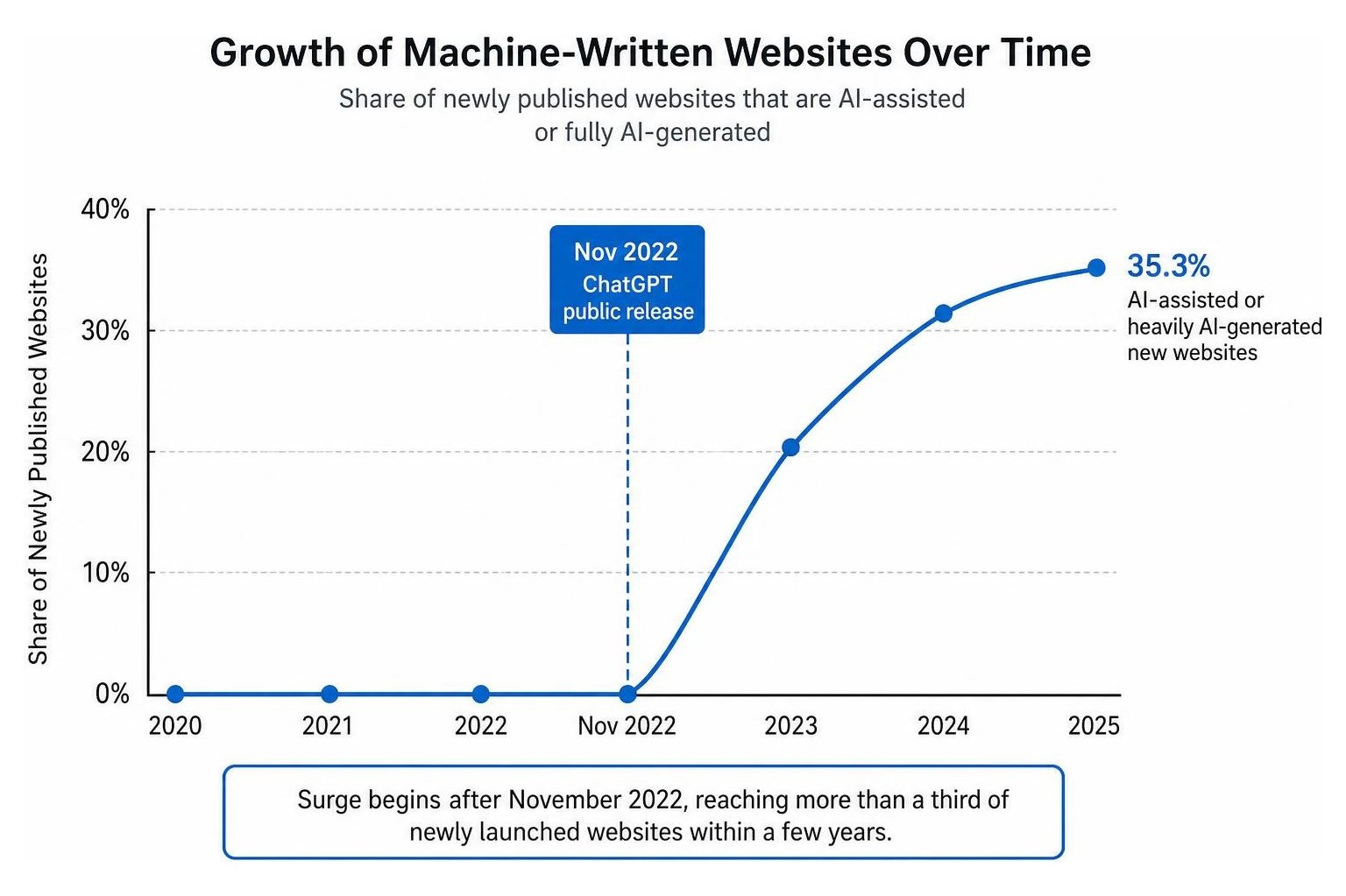
Recent empirical studies show that approximately 35.3% of newly published websites are either fully generated or heavily assisted by automated writing tools, with 17.6% operating entirely without human authorship.
The distribution of automated publishing is uneven across industries:
- Automated News Portals: Tracking projects have identified at least 1,254 independent news sites operating with zero human editorial involvement, publishing hundreds of synthetic articles daily to capture programmatic ad revenue.
- Product Catalogs: E-commerce platforms frequently deploy automated systems to generate high-volume product descriptions and boilerplate category content.
- Informational Search Results: High-volume informational queries increasingly surface machine-drafted explainers and programmatic affiliate content.
| Research Study / Organization | Estimated Metric | Primary Dataset & Scope |
|---|---|---|
| Stanford & Imperial College Study | 35.3% AI-assisted / 17.6% fully AI | Newly published websites sample |
| Linguistic Marker Analysis (Spennemann) | 30% to 40% of active web text | Google Scholar & indexed web crawl |
| Pew Research Center | 1 in 10 English web pages | Broad post-launch English web sample |
| Copyleaks Dataset Analysis | 1.57% fully AI-generated | 1 million high-authority web pages |
How Did Machine-Written Sites Surge After ChatGPT Launched?
The public release of ChatGPT marked a sharp turning point, taking the share of machine-authored web content from essentially zero to more than a third of newly launched sites within just a few years.
Before large language models became widely accessible, generating coherent, long-form content required custom neural networks or rule-based templates that were costly to maintain. Once consumer-ready interfaces made mass text generation accessible at negligible marginal cost, production friction disappeared entirely.
As highlighted in 'Dead internet' theory research from Stanford, this structural shift transformed how websites are built from the ground up. Navigating this surge requires updating your search engine optimization for the AI era to ensure original human expertise still stands out amid millions of automated pages.
How Do Researchers Measure Synthetic Text Across the Open Web?
Scientists measure synthetic text by combining automated classifiers, historical Wayback Machine snapshots, and statistical linguistic markers across large-scale web scrapes.
Measuring internet-wide text requires distinct detection techniques:
- Classifiers and Specialized Detectors: Tools like Pangram v3 analyze token predictability, perplexity, and burstiness to assign probability scores to long-form prose.
- Longitudinal Archive Analysis: Researchers sample historical archives to compare pre-automation linguistic baselines against contemporary publications.
- Live Web Monitoring: Continuous crawling pipelines track emerging domains to evaluate how rapidly new sites publish and rewrite existing text.
Which Language Patterns Can Help Detect AI-Written Text?
Researchers track specific vocabulary choices and structural quirks that large language models favor over natural human writing patterns.
A prime example comes from research on the quantification of AI-generated content on the internet, which analyzed sudden statistical spikes in specific lexical choices. Words like "delve" and phrases like "delve into" or "testament to" showed sharp upward trajectories across digital publications, appearing on over 167 million active pages during peak adoption waves.
While tracking these phrases helps identify macro trends across millions of URLs, keyword frequency alone cannot definitively prove whether an individual article is machine-written. Human authors also use these words naturally. When conducting an audit, tracking signals that matter during an AI SEO audit requires examining broader structural elements rather than penalizing isolated vocabulary choices.
How Do Studies of AI-Generated Content Reach Different Estimates?
Discrepancies between major studies arise because researchers analyze fundamentally different data samples, apply conflicting definitions of synthetic writing, and use varying detection thresholds.
- Sample Composition: A study examining freshly registered domains will encounter far higher automation rates than an analysis of established, high-authority news sites.
- Definition of AI Content: Some researchers classify any page containing machine-assisted drafting as synthetic, whereas other datasets (such as Copyleaks' 1.57% estimate) look strictly for completely unedited, automated text.
- Detection Sensitivity: As highlighted by recent study findings on AI-written web content prevalence, conservative classifiers prioritize minimizing false positives, resulting in lower reported figures compared to broader probabilistic language models.
How Does AI Proliferation Affect Web Quality and Linguistic Diversity?
The rapid expansion of automated text reduces the stylistic variety of search results and creates an emotionally uniform reading experience across the web.
When search engines crawl millions of pages optimized solely for keyword coverage, readers encounter repetitive prose that lacks personal perspective, direct experience, and distinctive brand voice. Search engines have responded by adjusting ranking systems to reward experience and verifiable technical expertise.
Does AI Writing Make Web Content More Alike?
Recent academic measurements reveal that machine-generated websites exhibit pairwise semantic similarity scores 33% higher than human-written sites, alongside positive sentiment scores that are 107% higher.
This uniformity stems from two core design features of commercial language models:
- Algorithmic Convergence: Models predict the most probable sequence of words, naturally gravitating toward safe, generic phrasing that flattens quirky, regional, or highly creative prose.
- Safety Guardrails and Tone Conditioning: Reinforcement learning encourages helpful, polite, and cheerful phrasing, stripping away the natural skepticism, sarcasm, or directness typical of human commentary.
To protect user experience and search performance, organizations are adopting clear responsible AI use policies and anti-spam measures that preserve original thought and authentic tone.
Could Synthetic Data Loops Cause Model Collapse?
When future AI models train on web data saturated with previously generated machine text, they risk entering autophagous loops that degrade model accuracy and linguistic nuance over time.
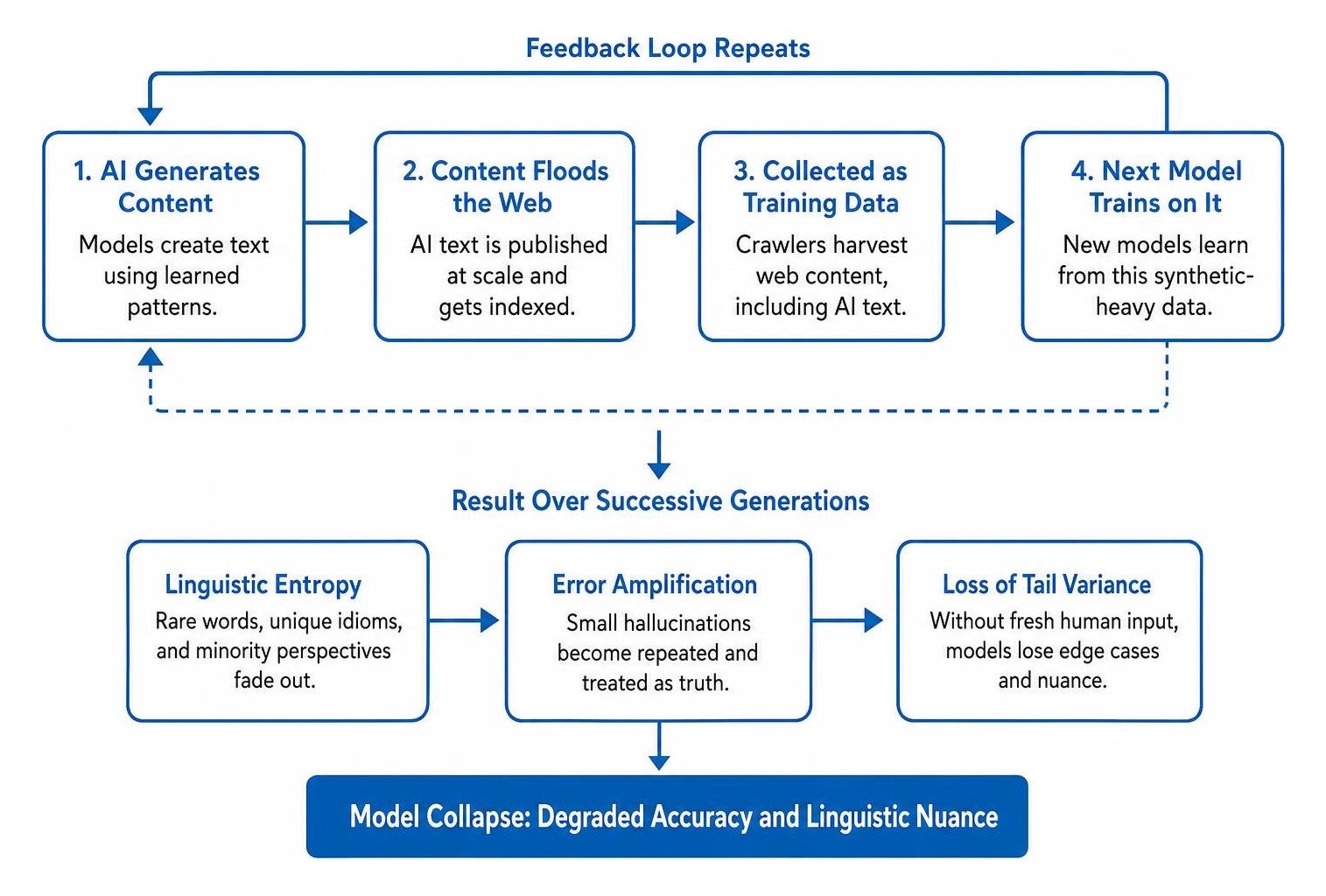
This cycle introduces structural risks to the broader information ecosystem:
- Linguistic Entropy: Rare vocabulary, unique idioms, and minority perspectives are progressively filtered out across successive model generations.
- Error Amplification: Subtle factual hallucinations become codified as factual consensus when repeated across thousands of synthetic scraping sources.
- Loss of Training Tail Variance: Without continuous infusions of fresh human insight, foundation models lose the ability to reason through complex edge cases.
Is the Dead Internet Theory Becoming Reality?
While nonhuman traffic and automated content now represent a substantial share of online activity, the internet is not completely automated; rather, human activity and machine processes increasingly run parallel to one another.

The "dead internet theory" originally emerged as an online concept suggesting that authentic human interaction had been replaced by autonomous agents. Today, while bots and synthetic publishers generate enormous digital volume, real users still drive online communities, commerce, and creative work.
How Does Automated Bot Traffic Compare With Human Digital Footprints?
Industry telemetry shows that nonhuman traffic accounts for roughly one-third to nearly half of all internet requests, with automated bots officially outnumbering human visitors across global traffic networks.
According to infrastructure metrics from Cloudflare and Imperva:
- Automated Web Requests: Bots generate between 33% and 51% of all routine HTTP requests, handling search engine indexing, price scraping, and automated security scans.
- Traffic vs. Content Distinction: High bot traffic volumes reflect automated network requests rather than the proportion of static text written by machines.
- Crawling Volume: Large language model web scrapers represent one of the fastest-growing segments of automated traffic, continuously ingesting digital text to fuel generative search indexes.
For businesses looking to capture organic visibility, following a practical guide to securing AI SEO returns helps ensure technical infrastructure remains accessible to valuable generative engines without wasting crawl budget on malicious scrapers.
How Reliable Is AI-Generated Web Content?
Empirical audits indicate that machine-generated websites do not necessarily contain higher rates of intentional falsehoods, but they produce significantly more unverifiable claims, vague generalizations, and hallucinated citations.
Because automated models generate text based on statistical likelihood rather than empirical truth, they frequently present inaccurate assertions with complete confidence. For businesses adopting generative AI SEO services and GEO strategies, rigorous human-in-the-loop editorial review remains essential to protect brand reputation and search rankings.
Frequently Asked Questions About AI Content on the Internet
What percentage of newly created websites are made by AI?
Academic estimates indicate that roughly 35% of newly created websites are generated or heavily assisted by automated tools, with approximately 17% built entirely without human intervention. These figures vary based on the specific industry and domain registry analyzed.
How does synthetic text affect future AI model training?
When language models train on synthetic web data, they enter an autophagous feedback loop. Over successive training cycles, this can cause model collapse, reducing linguistic diversity, flattening stylistic variance, and amplifying subtle factual errors across the web.
Are AI-generated web pages more factually inaccurate than human content?
Studies show that AI-written pages do not necessarily have higher rates of outright lies, but they contain far more unverifiable statements, circular reasoning, and fabricated references. Editorial oversight and human fact-checking are essential to ensure published material remains accurate and trustworthy.
The Strategic Path Forward for Web Content
Navigating an increasingly automated digital landscape requires clarity, precision, and verified data. While machine-generated content now represents a substantial share of active web pages, search engines and real audiences continue to prioritize authentic human experience, original research, and distinct perspectives.
At SmallBizSEO, we help businesses build resilient organic growth strategies using our data-driven Velocity framework. By combining technical precision with high-value, E-E-A-T-compliant editorial standards, we ensure your brand cuts through automated web noise and maintains commanding visibility across traditional and generative search platforms.
To explore more data and understand where business automation is heading, explore these 50 essential generative AI statistics every business owner should know.