The Cost of Artificial Intelligence: AI Software Pricing and Spending Benchmarks

What does artificial intelligence really cost?
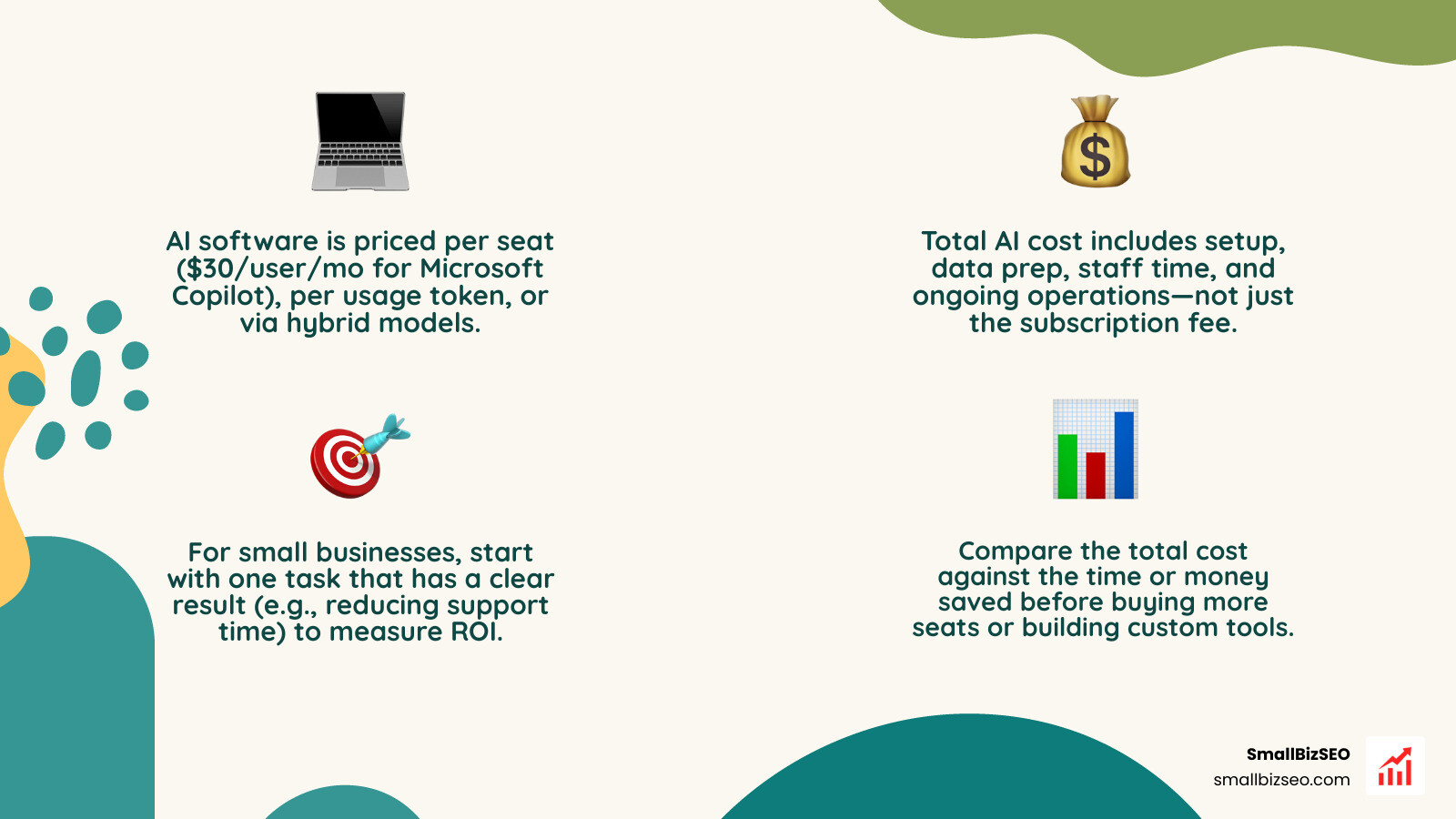
AI software can cost a monthly fee per user, a variable fee based on usage, or both. For example, Microsoft 365 Copilot lists at $30 per user per month on top of an eligible Microsoft 365 plan. But the subscription is only part of the bill. A useful AI budget also covers setup, data preparation, staff time, and ongoing review. Custom tools may add API and computing costs.
For a small business, the best starting point is one task with a clear result, such as reducing support time. Compare the total cost with the time or money that task saves before buying more seats or building a custom tool.
I'm Clayton Johnson, a digital marketing and SEO strategist who works with businesses on digital growth and AI-driven discovery. In The Cost of Artificial Intelligence: AI Software Pricing and Spending Benchmarks, I'll use that experience to help you assess what AI may cost and whether it earns its place in your budget.
What are the main AI software pricing models and spending benchmarks?
AI software is commonly priced per seat, by usage, or through a mix of both. The right model depends on how predictable usage and costs need to be.
When evaluating software vendors, organizations encounter four primary pricing architectures: seat add-on surcharges, consumption-based billing, bundled tiers, and outcome-based pricing.
According to the AI Pricing Report | Enterprise Buyers Surveyed, 89% of buyers blow past their initial budget forecasts. Why? Because while seat-based licenses offer clean predictability, variable token usage and hidden compute spikes quickly derail standard accounting. In fact, 68% of enterprise leaders prioritize cost predictability over a low entry sticker price.
| Pricing Model | Billing Mechanism | Typical Price Range | Predictability Level | Primary Cost Risk |
|---|---|---|---|---|
| Seat Add-On Surcharge | Fixed monthly fee per user added to base licenses | $20 – $50 per user / month | High | Shelfware and low adoption rates |
| Consumption-Based | Pay-as-you-go per token, API call, or credit | $0.001 – $0.06 per 1k tokens | Low | Runaway queries and looping workflows |
| Hybrid Model | Base monthly subscription plus tiered usage credits | $500 – $10,000+ base / month | Moderate | Unplanned overage penalties |
| Outcome-Based | Fee tied directly to business results or resolutions | $1 – $5 per resolved ticket/lead | Moderate | Attribution and measurement disputes |
Understanding how AI impact on software pricing models affects your bottom line helps you avoid unexpected bills. When adding AI capabilities to your marketing workflows, selecting what are AI SEO tools with transparent pricing ensures you achieve measurable organic growth without surprise invoices.
How do major platforms price ChatGPT, Gemini, and Microsoft Copilot?
Leading commercial platforms rely heavily on subscription tiers paired with enterprise usage agreements. Microsoft 365 Copilot lists at a standard $30 per user per month add-on surcharge. Meanwhile, ChatGPT Enterprise and Google Gemini Advanced package enterprise-grade security, administrative consoles, and expanded context windows into custom annual commitments.
As detailed in the Enterprise GenAI Cost Benchmark | VendorBenchmark, companies negotiating large platform renewals routinely achieve discounts between 14% and 32% on commitments with major LLM providers. Securing tier volume discounts and overage caps before rollouts prevents massive billing creep.
Why do organizations exceed AI budgets under consumption-based pricing?
Consumption-based models bill based on input and output tokens, dynamic vector queries, and API calls. When autonomous agents enter recursive reasoning loops or employees begin pasting massive spreadsheets into LLM prompts, costs escalate quickly.
The problem is compounded because, as noted by researchers examining why it's nearly impossible to budget for AI spending, IT departments shoulder 67% of budget risk while product teams drive usage. Without real-time spending caps and prompt limits, monthly charges can surge unexpectedly.
What infrastructure and operating expenses add to AI costs?
AI infrastructure and operating costs include compute, data preparation, system integration, and ongoing model management—not just software licenses.

Many teams assume buying a software license is their primary expense. In reality, ongoing operations consume the bulk of the budget. Data outlined in What Does an AI Rollout Actually Cost? | NSSG Insights shows that enterprise AI operating budgets are typically divided into:
- 40% cloud compute and hosting infrastructure
- 30% development talent and internal operations
- 20% data management, cleaning, and labeling
- 10% model maintenance, testing, and compliance
Connecting modern AI systems into legacy ERP and CRM databases routinely adds months to project timelines, inflating deployment budgets by 20% to 50%. Businesses seeking reliable visibility often conduct an AI SEO audit to benchmark digital assets before committing large budgets to custom software development.
How do LLM development costs compare with traditional software costs?
Traditional software follows a predictable build-and-maintain lifecycle. Large language models (LLMs), however, experience performance degradation and knowledge drift over time. Retraining and continuous fine-tuning cycles typically demand 15% to 30% of the original development cost each year.
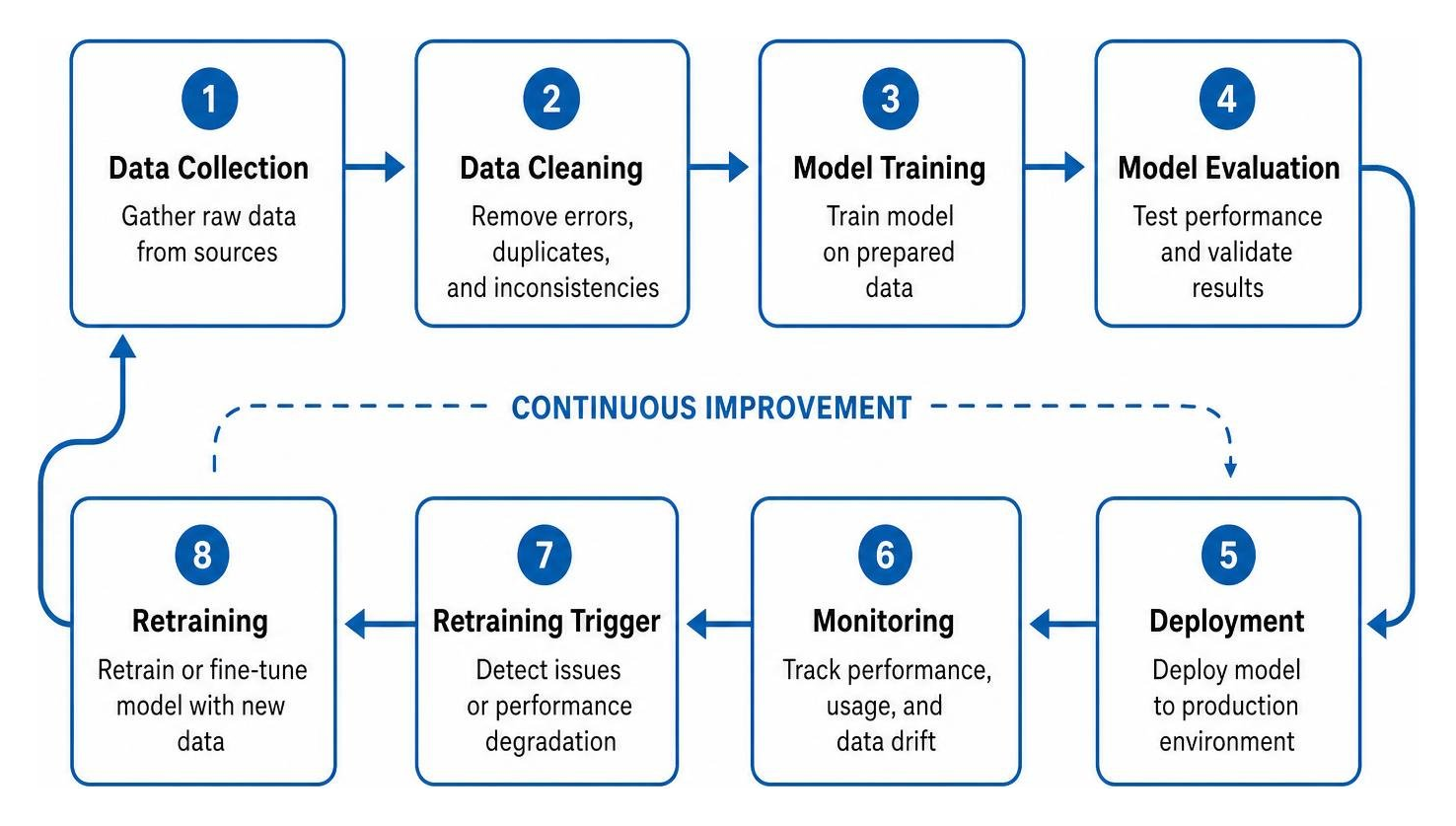
While the raw cost per unit of compute is falling—a trend documented in the plunging price of thought—the total volume of organizational queries is surging. For organizations looking to protect brand search presence across LLM answers, deploying strategies from an AI SEO company provides sustained search visibility without building custom foundational models from scratch.
What environmental costs come with AI infrastructure?
The computational power required to train and run massive neural networks carries a major physical footprint:
- Electricity Consumption: A standard generative AI search query uses roughly 10 times as much electrical power as a traditional web search. Data centers globally consume more electricity than entire industrialized nations.
- Grid Impact: Projections indicate data centers will consume roughly 8% of total power grid capacity in major economies, up from 3% just a few years ago. Tech giants are even investing heavily in dedicated power infrastructure, including multi-billion-dollar nuclear plant recommissioning projects.
- Cooling Water Requirements: Data center server cooling consumes billions of gallons of water annually.
- Electronic Waste: Accelerating GPU hardware replacement cycles creates a continuous stream of specialized electronic waste that requires responsible recycling and lifecycle tracking.
What are AI cost, automation ROI, and compliance benchmarks by industry?
AI spending and payback vary by industry, depending on integration needs, labor costs, expected savings, and compliance requirements.
Different sectors face vastly different financial realities when deploying artificial intelligence:
| Industry Sector | Average Annual AI Spend | Primary Cost Drivers | Typical Payback Period |
|---|---|---|---|
| Healthcare | $300,000 – $1,000,000+ | EHR integration, HIPAA compliance, clinical validation | 18 – 24 months |
| Financial Services | $400,000 – $900,000+ | Algorithmic auditing, fraud detection, security | 12 – 18 months |
| Manufacturing | $400,000 – $800,000+ | IoT sensor connectivity, predictive maintenance | 9 – 15 months |
| Retail & E-commerce | $150,000 – $450,000 | Dynamic pricing, catalog search optimization | 6 – 12 months |
As explored in AI software cost: enterprise pricing benchmarks for manufacturing leaders, smart manufacturing teams allocate 46% of their budgets to automated workflows and 41% to hardware integration to cut costly factory downtime.
How can organizations calculate AI ROI in finance, healthcare, and customer support?
To measure return on investment, organizations compare initial build and operating fees against direct labor savings, speed, and error reduction. Deploying custom autonomous agents typically costs between $40,000 and $150,000 per build.
In customer support, automation creates immediate value by deflecting high-volume tier-1 tickets at a fraction of the cost of full-time staff. Similarly, businesses using AI SEO services drive measurable revenue growth by optimizing organic reach across conversational search engines. In corporate finance, 42% of executives now formally evaluate employee AI productivity metrics to quantify workflow speed improvements.
How do global regulations affect AI software costs?
Evolving compliance mandates, such as the EU AI Act, introduce significant legal, administrative, and testing overhead. Organizations operating high-risk algorithmic models must budget for continuous auditing, bias testing, and risk-mitigation frameworks.
Following a clear anti-spam responsible AI use policy protects organizations from costly regulatory penalties and brand degradation while maintaining high technical standards.
How can organizations control AI budgets?
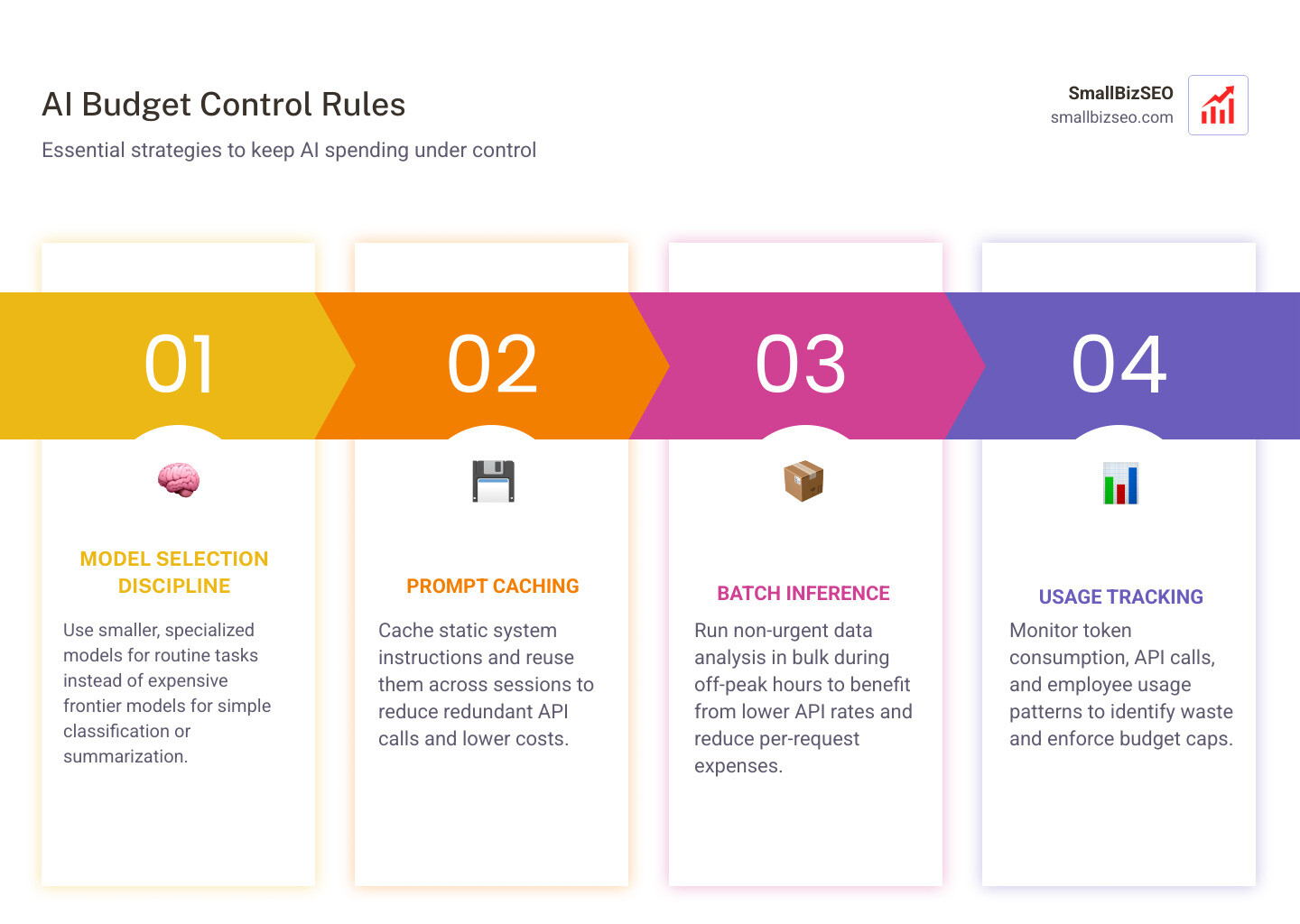
Set clear budgets, choose models that fit each task, track usage, and apply controls such as prompt caching and batch inference.
Controlling artificial intelligence spending requires active financial governance. Applying proven strategies for managing AI costs in the enterprise can reduce operational waste by 35% to 55%.
Follow these essential rules to keep software expenditures under control:
- Apply Model Selection Discipline: Never route simple data classification or summary tasks to expensive flagship frontier models. Use smaller, specialized models for routine operations.
- Implement Prompt Caching and Batching: Cache static system instructions and run non-urgent data analysis in bulk off-peak batches to take advantage of lower API rates.
- Set Hard Monthly Usage Caps: Establish automatic credit thresholds across all internal development tokens to prevent unexpected billing spikes.
- Audit Seat Licenses Quarterly: Reclaim unused Copilot and software seats from inactive employees rather than paying blanket recurring subscriptions.
- Double Your Initial Data Preparation Estimates: Budget for rigorous data cleaning and pipeline hygiene upfront to prevent expensive downstream re-engineering.
What should organizations know about AI software costs and spending?
AI budgets should account for licenses, usage, infrastructure, integration, staffing, and compliance—not software prices alone.
What is the median monthly spend for enterprise AI software?
The median spend across enterprise organizations is approximately $26 per employee per month, with overall enterprise AI spending averaging roughly $85,000 monthly. Technology and financial services firms spend significantly higher due to intensive custom software engineering and automated client operations.
How does open-source AI deployment compare in cost to commercial LLM APIs?
For low-to-medium usage volumes, managed commercial APIs remain far more cost-effective because you avoid hardware overhead. However, when an organization's monthly API consumption crosses roughly $200,000 to $500,000, self-hosting open-weight models (such as Llama or Mistral) on dedicated GPU cloud infrastructure becomes financially viable.
Why do data preparation and integration inflate AI budgets so significantly?
Unstructured, messy corporate data cannot be fed directly into an LLM or retrieval-augmented generation (RAG) system. Data preparation, schema standardization, and metadata labeling routinely consume 30% to 50% of an entire rollout budget. Without clean data pipelines, AI models deliver hallucinated answers and unreliable results.
Making smart, sustainable AI investments
Future AI costs will depend on software pricing, infrastructure demand, and the resources needed to deploy and manage AI.
Over the coming decade, hundreds of billions of dollars will continue flowing into data center infrastructure, specialized silicon, and software architectures. Success requires a practical balance: avoiding over-hyped tools with unclear returns while actively adopting automated systems that deliver measurable operational efficiency.
At SmallBizSEO, our data-driven Velocity framework helps growing businesses turn digital disruption into a durable competitive advantage through transparent, performance-focused growth. By establishing realistic budgets, calculating the true total cost of ownership, and prioritizing measurable business outcomes, your organization can capture the full power of artificial intelligence without overspending.