Track and Attribute Inbound Referral Traffic From Generative AI Bots

Track and Attribute Inbound Referral Traffic From Generative AI Bots
What share of website traffic comes from AI assistants?
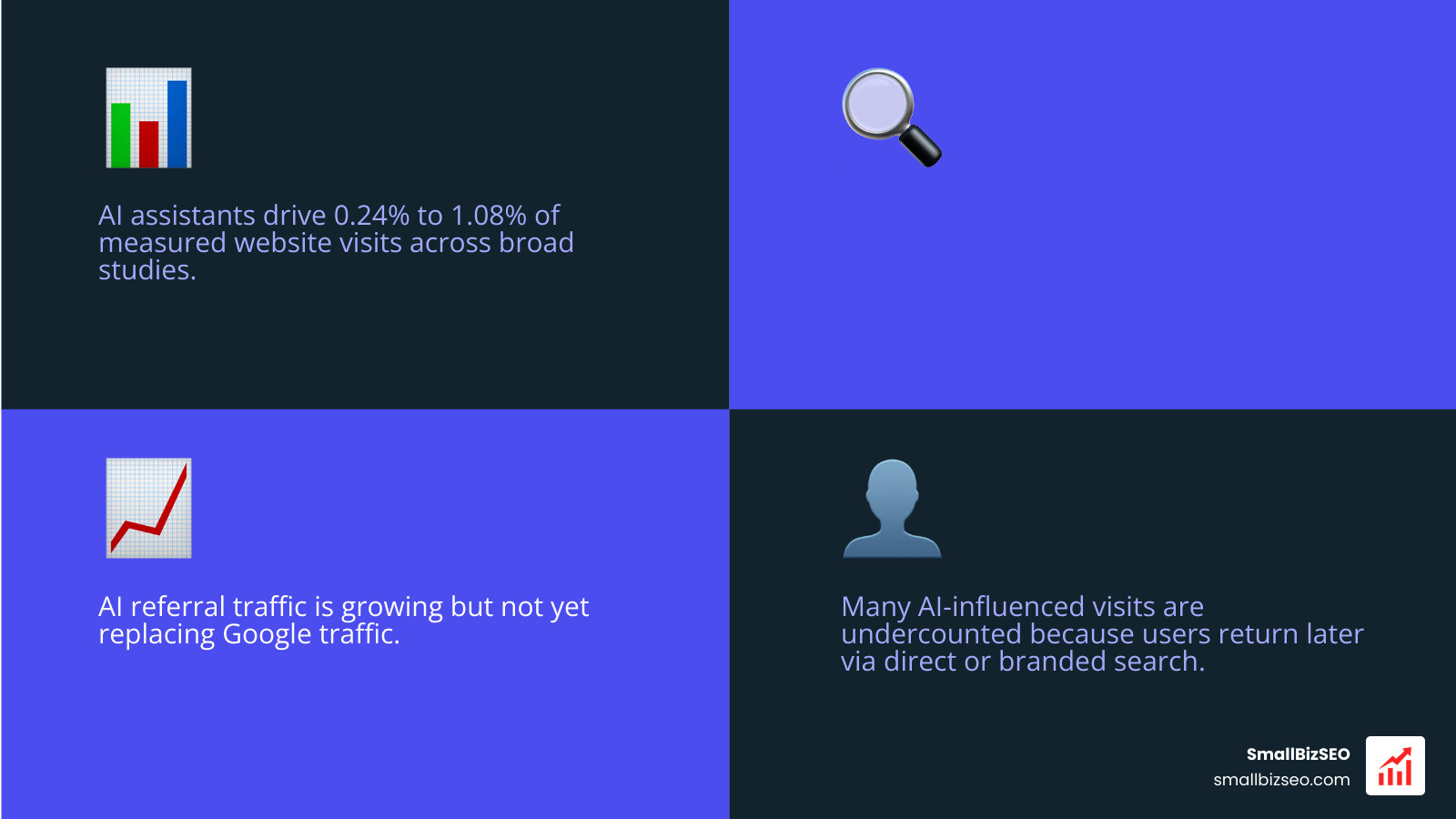
For AI Search Traffic Statistics: How Much Website Traffic Comes From AI Assistants?, the useful answer is about 0.24% to 1.08% of website visits in broad studies that measure identifiable AI referrals. The estimates differ because they cover different sites and periods. In one study of nearly 76,000 sites, Google drove about 40% of visits, while AI assistants drove 0.24%.
AI referrals are growing, but they are not replacing Google traffic. They are also easy to undercount: someone may see your business in an AI answer, then visit later by typing your address or searching for your name.
I'm Clayton Johnson, founder of SmallBizSEO, where I work on SEO and helping businesses become easier to find in AI-generated answers. My approach to AI Search Traffic Statistics: How Much Website Traffic Comes From AI Assistants? is to separate visits analytics can identify from the wider influence AI answers may have.
Explore more about AI Search Traffic Statistics: How Much Website Traffic Comes From AI Assistants?:
- AI Search Visibility by Industry: Which Businesses Appear Most Frequently in AI Answers?
- How Frequently Do AI Search Engines Change Their Recommendations? Citation Consistency Statistics
- Consumer Trust in Artificial Intelligence: Survey Statistics and Buying Behavior
What is changing about website traffic from AI assistants?
AI assistants represent a growing, highly engaged share of inbound discovery, even while traditional organic search still drives the vast majority of web traffic. While conversational tools generate an estimated 45 billion monthly search sessions globally, direct referral links from these tools represent roughly 1% to 6% of total site sessions depending on the industry and measurement framework.
The broader discovery shift is creating two parallel dynamics online. On one hand, traditional search engines continue to supply the foundational volume of top-of-funnel traffic. On the other hand, conversational interfaces act as powerful discovery filters. Users increasingly rely on AI platforms to summarize complex topics, compare software, and evaluate consumer products before they ever click an outbound link.
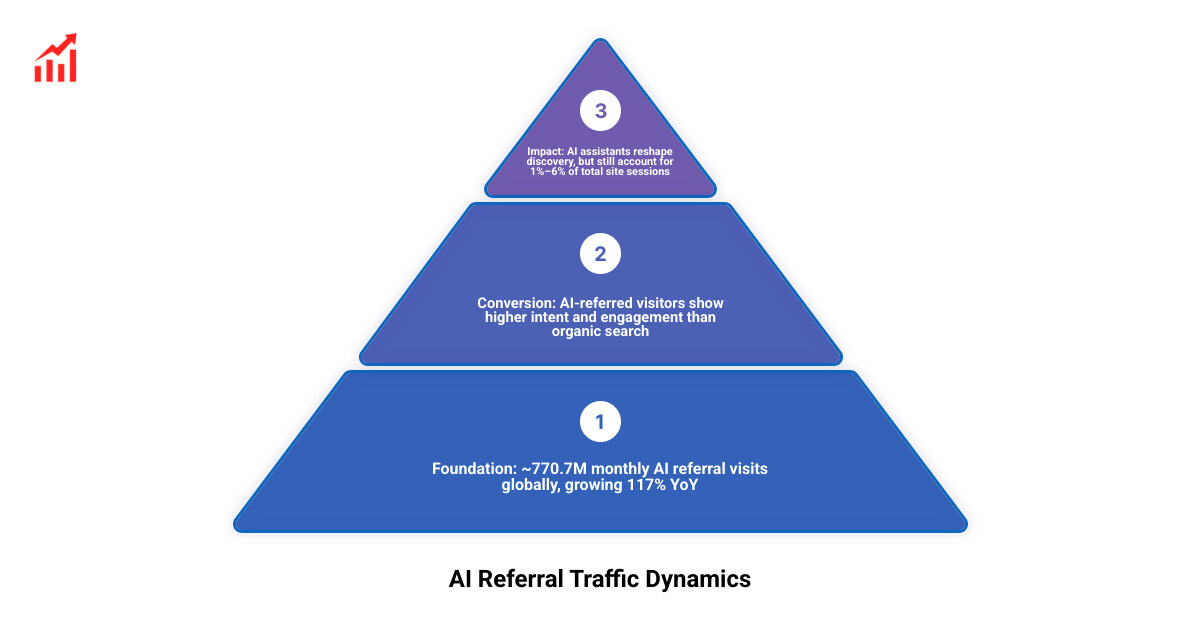
This evolution means raw session volume alone no longer tells the full story. Even when overall referral percentages look modest, the visitors arriving through conversational assistants bring much higher intent than standard web surfers.
AI Search Traffic Statistics: How Much Website Traffic Comes From AI Assistants?
Direct referral data shows that AI platforms send an average of 770.7 million referral visits per month worldwide to websites across the globe, expanding by 117.4% year-over-year. Across cross-industry analyses evaluating billions of interactions, AI platforms generate between 1.08% and 6.2% of total website sessions, representing a 5,580% surge in session volume from early baselines.
While industry discussions warn that the AI search reckoning is dismantling open web traffic, broader generative AI statistics indicate that conversational engines function primarily as high-intent referral channels. These AI search traffic statistics show how much website traffic comes from AI assistants, and the numbers are rising quickly.
| Platform | Share of AI Referrals | Annual Traffic Growth Rate | Primary User Search Intent |
|---|---|---|---|
| ChatGPT | 68.4% | +75% | Research, Technical, Commercial Investigation |
| Google Gemini | 14.7% | +194% | General Knowledge, Product Comparison |
| Perplexity AI | 8.2% | +115% | Direct Citations, Academic, Real-Time News |
| Microsoft Copilot | 5.1% | +196% | Enterprise, Productivity, B2B Research |
| Claude | 3.6% | +191% | Coding, Long-Form Analysis, Document Review |
AI Search Traffic Statistics: How Much Website Traffic Comes From AI Assistants by Platform?
ChatGPT remains the dominant referral source among conversational assistants, driving 68.4% of all AI-generated referral visits. However, its market share has contracted by 15.8 percentage points as competing assistants expand their web-browsing integrations.
According to data compiled in the State of Web report, Google Gemini has climbed into second place with a 14.7% referral share after gaining 10.6 percentage points over a multi-year period. Microsoft Copilot, Gemini, and Claude are currently expanding their traffic volume at the fastest clip, each registering annual growth rates above 190%.
Which Industries Receive the Largest Share of AI Referral Traffic?
B2B SaaS receives 11.8% of its total website sessions from conversational AI tools, ranking as the most heavily impacted sector online. In contrast, local service businesses experience only 1.4% of their traffic from AI assistants.
To understand why certain industries get cited by AI models twice as often, look at how consumers research complex purchases. Groundbreaking AI shopping data shows that retail marketplaces saw monthly AI-driven visits jump from 33.2 million to 89.9 million in a single twelve-month span. AI referral traffic to specialized beauty websites surged 312.5% year-over-year, while fashion sites logged a 278.2% increase. Meanwhile, media and publishing websites experienced a 47.3% decline in organic search sessions as informational queries were answered directly in generative summaries.
AI Search Traffic Statistics: How Much Website Traffic Comes From AI Assistants Compared to Google?
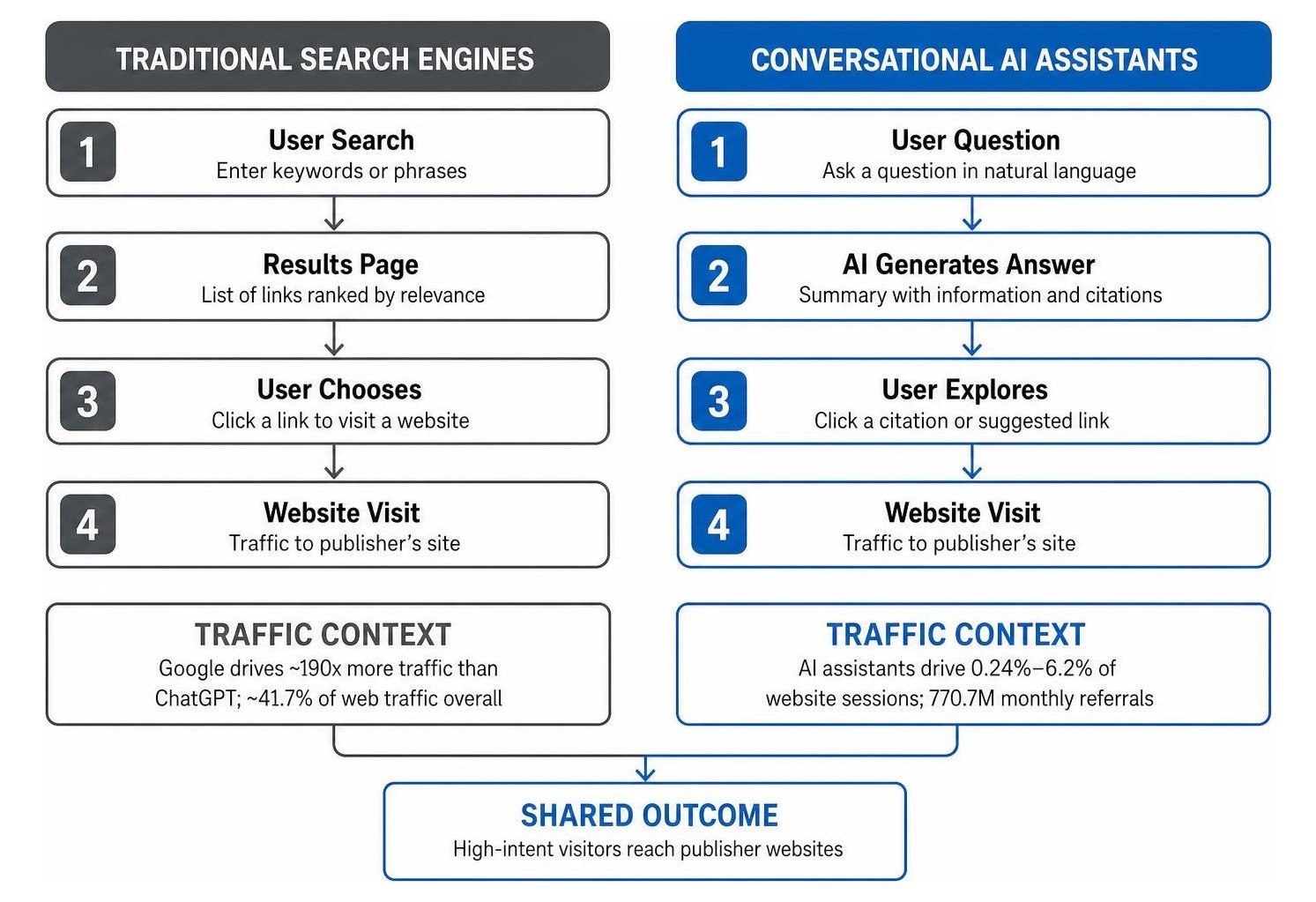
Traditional search engines continue to deliver the lion's share of web visitors, with Google sending approximately 190 times more traffic to websites than ChatGPT across broad publisher samples. While traditional search engines drive roughly 41.7% of all web traffic—with Google alone responsible for nearly 40%—conversational assistants account for between 0.24% and 6.2% depending on the industry vertical.
Recent research on AI search discovery demonstrates that roughly 83% of global AI assistant usage occurs within mobile apps. Consumers increasingly treat assistants as personalized research advisors while relying on traditional search engines for navigational tasks, local services, and quick transactional lookups.
How can businesses adapt to AI-driven discovery?
To capture high-value visitors from generative platforms, businesses must track AI referral metrics independently from organic search, build authoritative content formats that large language models cite, and evaluate channels based on revenue potential rather than raw click volume.
| Performance Metric | AI-Referred Visitors | Google Organic Visitors | Strategic Impact |
|---|---|---|---|
| Visitor-to-Lead Conversion | 4.7% | 1.9% | AI traffic converts at 2.5x higher rates |
| Retail Checkout Lift | +54% higher conversion | Baseline | Pre-qualified intent reduces funnel friction |
| Pages Viewed Per Visit | +23% to +50% | Baseline | Visitors explore deeper product architecture |
| Average Session Duration | 6 min 12 sec | 3 min 45 sec | Higher engagement with long-form assets |
| Funnel Stage Upon Arrival | Middle to Bottom Funnel | Top to Middle Funnel | Requires concise, action-ready landing pages |
Why do AI-referred visitors deliver higher conversion rates?
Visitors arriving from AI assistants convert at 4.4 times the rate of standard organic search visitors because conversational models synthesize research before recommending a brand. When a user finally clicks an embedded citation, they have already completed their preliminary evaluation.
In one documented study by a prominent search software company, AI search referrals accounted for only 0.5% of total website visits but generated 12.1% of all new product signups. Similarly, retail platforms report that shoppers arriving from conversational tools convert at a 54% higher rate and browse 23% more pages per session than visitors entering through conventional channels.
How do zero-click AI Overviews affect search clicks and brand mentions?
When generative summaries appear at the top of traditional search results, organic click-through rates for the top-ranking position fall from 8.7% to 3.6%—representing a 58.6% drop in immediate clicks. Across the broader web, zero-click searches have expanded to roughly 68% to 74% of all informational queries.
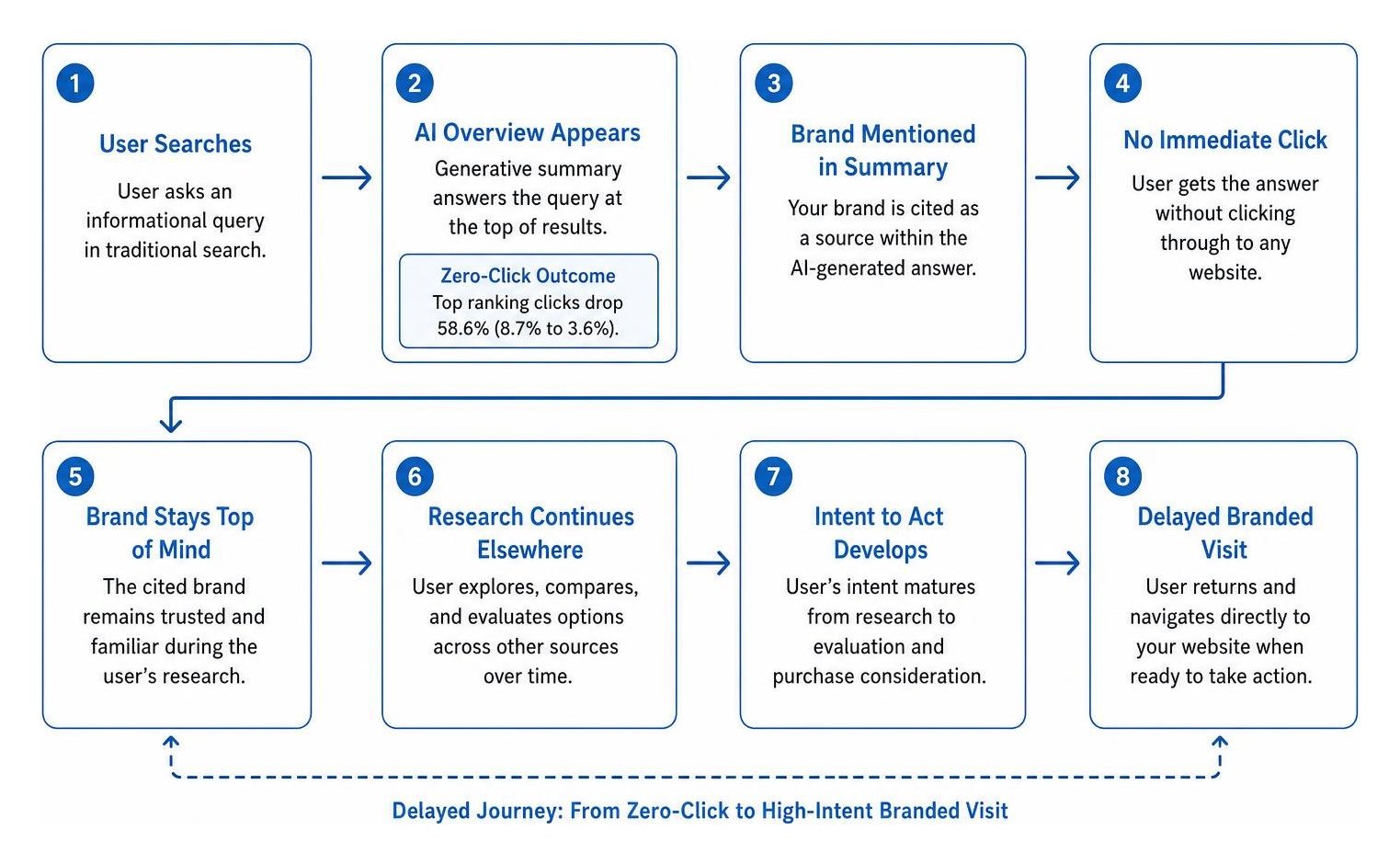
Despite this drop in immediate clicks, appearing as a named source inside generative answers creates substantial downstream brand equity. To maximize your chances of inclusion, focus on these primary citation drivers:
- Primary Data Publishing: Large language models heavily favor original research, benchmark statistics, and proprietary datasets within the first 200 words of a page.
- Third-Party Earned Media: Independent news coverage, trade publications, and authoritative community discussions drive the majority of generative model citations.
- Structured Content Blocks: Clear comparison tables, concise definition capsules, and schema markup make it easier for retrieval engines to extract answers.
- Strong E-E-A-T Signals: Verifiable author credentials, transparent citations, and technical depth build the topical trust required for automated recommendations.
When an AI engine cites a business, brand website visits increase between 1.5 and 2.5 times above baseline levels within the following seven days. Approximately 20.5% of these users visit the site within an hour of the conversation, while 42% arrive within 24 hours via direct or branded search.
How can businesses overcome technical attribution gaps to track AI referrals accurately?
More than 97% of website visits that follow an AI brand recommendation lack UTM tracking parameters, causing standard analytics platforms to misclassify those visitors as direct traffic or general organic search.
To build an accurate view of conversational search traffic, marketing teams should adopt a multi-layered measurement framework:
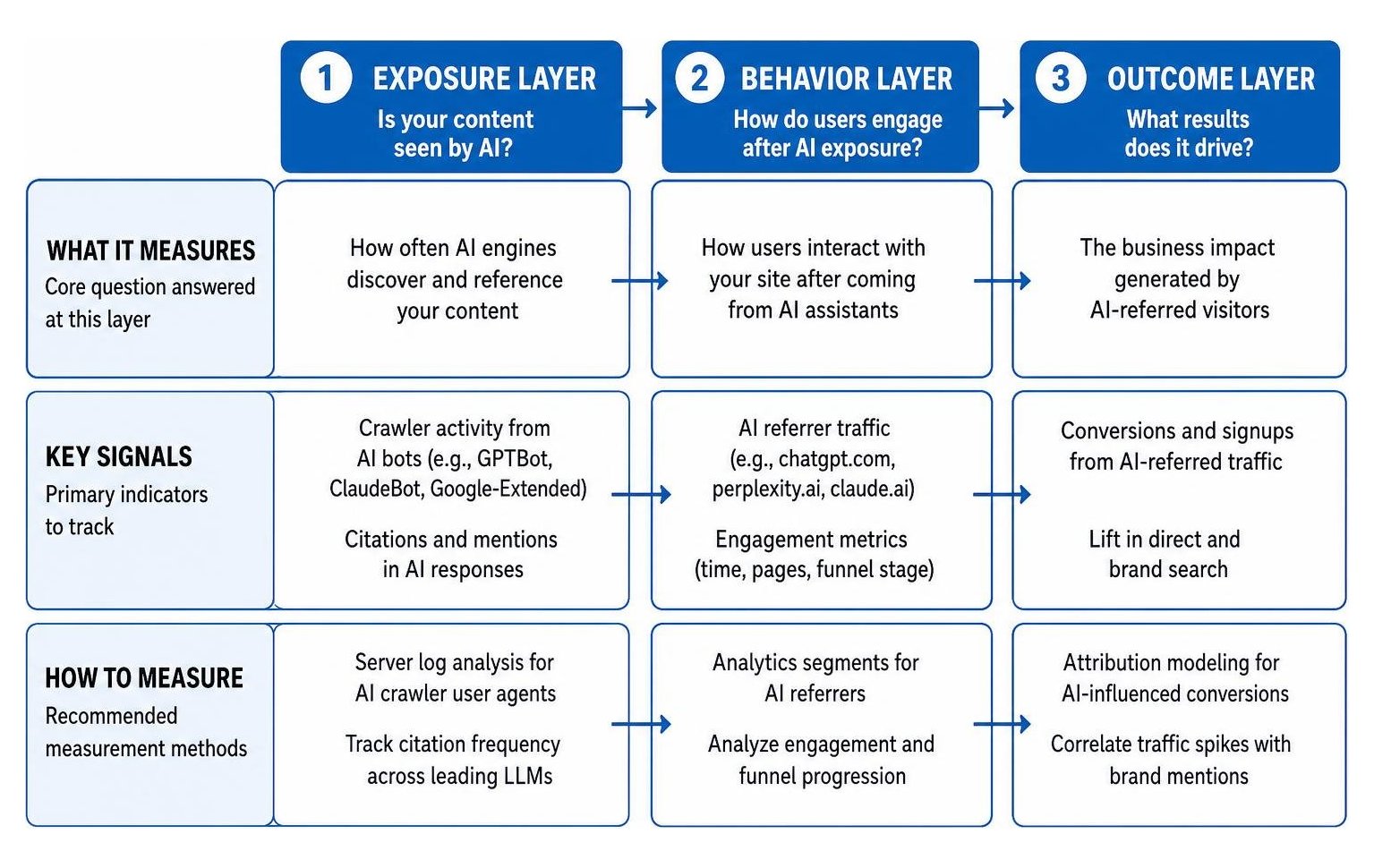
- Maintain AI Referrer Filters: Configure custom analytics segments that isolate traffic from known conversational domains like chatgpt.com, perplexity.ai, and claude.ai.
- Monitor Server Crawler Logs: Track user-agent requests from indexing crawlers such as GPTBot, ClaudeBot, and Google-Extended to measure how frequently assistants index your content.
- Correlate Direct Spikes with Brand Mentions: Match sudden increases in direct traffic, brand queries, and homepage visits against known citation appearances across leading LLMs.
- Conduct Regular Technical Visibility Reviews: Perform a comprehensive AI SEO audit to ensure your technical infrastructure and content hierarchy remain accessible to generative engines.
Turning Conversational Discovery Into Measurable Growth
AI search traffic may represent a modest slice of total web visits today, but its outsized conversion rates prove that search behavior is undergoing a permanent transformation. Winning in this environment requires small businesses to optimize for both traditional search ranking signals and conversational citation models.
At SmallBizSEO, we help growth-focused companies build visibility across both search engines and generative models using our dedicated AI SEO services. By combining technical optimization, authoritative content structures, and multi-touch attribution, we ensure your business remains the answer when prospective customers ask conversational assistants for recommendations.