The Ultimate Guide on How to Do Blog SEO Like a Pro
The Ultimate Guide on How to Do Blog SEO Like a Pro
Why Blog SEO Is the Smartest Investment a Small Business Can Make
Knowing how to do blog SEO well is one of the highest-leverage skills a small business owner can develop. Here is a quick overview of the core steps:
- Choose one target keyword with clear search intent
- Structure your content with a single H1, logical H2s and H3s, and direct answer blocks
- Optimize on-page elements — title tag, meta description, and URL slug
- Build topical authority through internal linking and consistent publishing
- Add technical foundations — schema markup, fast load times, and proper indexing
- Track and refresh your posts using Google Search Console data
Most blog posts never get a single visitor from Google. In fact, 96.55% of all web pages receive zero organic traffic. That is not because blogging does not work — it is because most blogs skip the fundamentals.
The search landscape has also shifted. 58% of Google searches now trigger an AI Overview for informational queries, and 34% of blog traffic arrives via AI chatbot referrals like ChatGPT and Perplexity. That means getting found today requires writing for both traditional search engines and AI systems simultaneously.
The good news? The same practices that help Google understand your blog also help AI tools cite it. Clarity, structure, and genuine depth are what win — not tricks or shortcuts.
I'm Clayton Johnson, a digital PR and SEO specialist who has spent years helping businesses grow their search visibility through smart content and link-building strategies — including mastering how to do blog SEO in ways that drive real, compounding organic traffic. In the sections below, I'll walk you through every piece of the system, step by step.
Essential how to do blog seo terms:
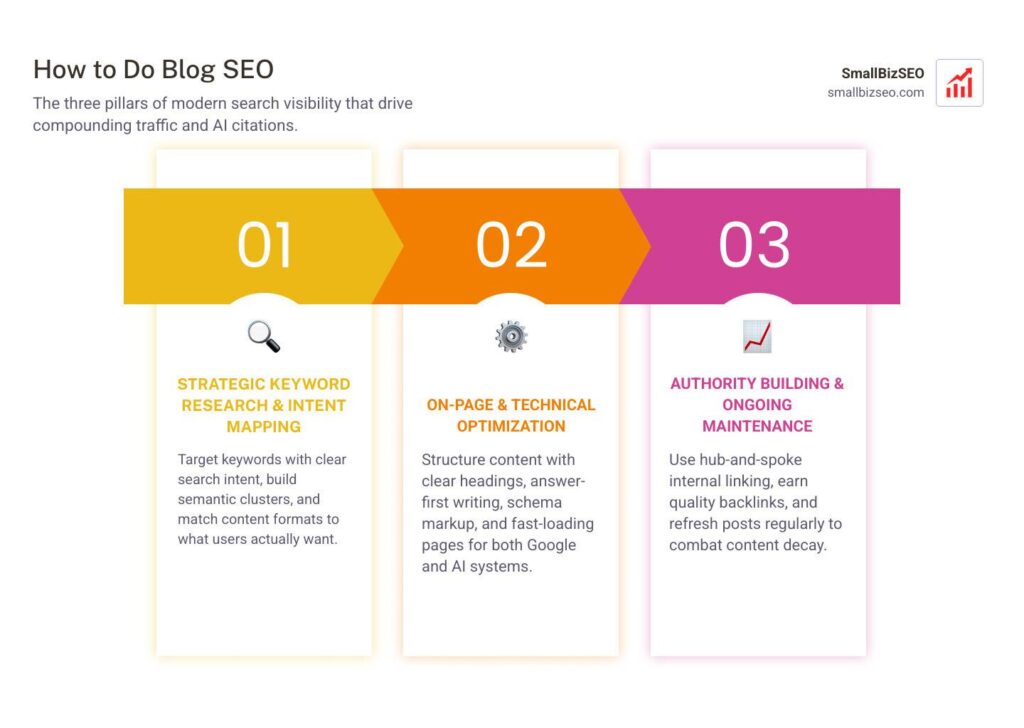
How to Do Blog SEO: The Core Pillars of Modern Search Visibility
Blog SEO is the practice of creating, structuring, and optimizing blog content so it is easy for both traditional search engines and AI engines to discover, crawl, index, and trust. Unlike paid ads that stop delivering leads the moment you turn off the budget, a well-optimized blog post acts as a compounding asset. Google sends over 396,000 visitors per month to top-tier industry blogs because they treat search visibility as a system, not a one-time checklist.
In the modern search ecosystem, we must optimize for two distinct audiences:
- Traditional search crawlers: Systems like Googlebot that look for keyword relevance, site speed, and authoritative backlinks.
- Large Language Models (LLMs): Systems like ChatGPT, Perplexity, and Claude that retrieve information to synthesize direct answers.
To win on both fronts, we rely on the core rules outlined in The new SEO rules for bloggers: Why clarity matters in AI search. Instead of trying to trick algorithms with keyword stuffing, we focus on extreme clarity. Search engines now utilize "query fan-out" to explore related subtopics and build complete answers. This means your blog posts must be written simply enough for a toddler to follow, forgiving enough for a distracted adult to skim, and structured cleanly enough for an LLM to parse.
When you publish highly structured, clear content on your Blog, you feed both search engines and AI models the exact data they need to recommend your business. This is the heart of modern SEO.
Strategic Keyword Research and Intent Mapping
Before writing a single sentence, you must know what your audience is searching for and why. Starting a blog post based on a hunch is like opening a store without a sign.
Successful SEO Content Marketing starts with a systematic Content Planning Process. We begin by identifying high-value topics and mapping them directly to user needs.
How to Do Blog SEO Keyword Research and Intent Mapping
Every great blog post targets one primary keyword and a handful of closely related secondary keywords. Your primary keyword represents the main topic, while secondary keywords cover natural subtopics.
When researching keywords, look for three main metrics:
- Search Volume: How many people search for this term monthly.
- Keyword Difficulty: How hard it will be to outrank the current top results. For newer blogs, target low-difficulty terms (usually under 30).
- Long-Tail Potential: Long-tail keywords (longer, more specific phrases) make up over 91% of all searches and convert at 2.5 times the rate of broad head terms.
Once you have your primary and secondary terms, organize them into semantic clusters. This ensures your article covers a cohesive topic thoroughly without diluting its focus. For a deeper dive into this step, see our Beginners Guide to Keyword Content Optimization.
Mapping Search Intent and Content Formats
The most critical decision in blog optimization happens before you write: identifying and matching search intent. If your target audience wants a quick list of tips and you write a 5,000-word philosophical essay, search engines will ignore your page.
Search intent generally falls into three categories for bloggers:
- Informational: The user wants to learn something (e.g., "how to fix a leaky sink").
- Commercial: The user is comparing options before buying (e.g., "best plumbing tools").
- Transactional: The user is ready to buy or hire (e.g., "hire local plumber").
To validate intent, perform a manual SERP (Search Engine Results Page) analysis. Search your target keyword in an incognito window and look at the top five results. Are they listicles, step-by-step guides, videos, or product pages? Match that dominant format. If the top results are listicles, write a listicle. If they are in-depth guides, write a guide. Documenting these requirements in your Strategic Content Calendar ensures every piece of content you produce serves a clear purpose.
On-Page Optimization and Content Architecture
On-page SEO is where your keyword research meets the page. It is the process of structuring your content so that search engines can easily index your ideas and AI tools can quickly extract quotes.
| Optimization Element | Traditional Search Focus | AI / LLM Search Focus |
|---|---|---|
| Heading Structure | Sequential hierarchy (H1, H2, H3) for crawlability | Clear question-based headings to identify topic blocks |
| Answer Placement | Scattered throughout the body to increase time-on-page | Front-loaded "answer capsules" in the first 30% of the page |
| Fact Density | General explanations and keyword density | Verified statistics, expert quotes, and inline citations |
| Media Elements | Text accessibility via basic alt tags | Rich contextual images and embedded educational videos |
Writing successfully for modern platforms requires balancing readability for humans with machine-readability for search bots. For more on this, check out our guide on On-Page SEO and our walkthrough on SEO-Friendly Content Writing.
How to Do Blog SEO Content Structuring for Humans and AI
To make your posts highly readable, use a strict heading hierarchy. A page should have only one H1 tag (your post title), followed by logical H2s for main sections, and H3s for sub-points. Research shows that pages with properly sequenced headings are 2.8 times more likely to be cited in ChatGPT than those with messy structures.
Additionally, employ "answer-first" writing. Do not bury the main answer under paragraphs of introductory fluff. Instead, write a concise, 40-to-60-word "answer block" directly beneath your H2 headings. This makes it incredibly easy for Google to pull your text into a Featured Snippet or for an AI tool to cite you. Use short sentences (under 20 words), short paragraphs (2 to 3 sentences maximum), and bulleted lists to break up the text. Aim to include a visual break—such as an image, table, or callout box—every 250 to 300 words.
For advanced strategies on structuring your content to capture maximum search real estate, consult Blog Post SEO: A Signal-First Optimization System That Drives Clicks, Not Just Rankings.
Optimizing Meta Tags, URLs, and Headings
Your metadata is your "click pitch" on the search results page. To maximize your click-through rate (CTR), optimize these three critical elements:
- Title Tags: Keep your title tags under 60 characters and place your primary keyword near the beginning. Adding numbers (e.g., "7 Steps") can boost clicks by 36%.
- Meta Descriptions: Keep these under 155 characters. While they are not a direct ranking factor, a compelling description that clearly communicates the benefit of clicking can significantly increase your CTR.
- URL Slugs: Keep your URLs short, clean, and evergreen. Use hyphens to separate words, include your primary keyword, and avoid dates or numbers (e.g., use
/blog/how-to-do-blog-seoinstead of/blog/10-steps-to-do-seo-in-july).
Technical SEO Foundations and Schema Markup
You can write the most brilliant blog post in the world, but if search engines cannot crawl it or if your page takes ten seconds to load, it will never rank.
Crawlability, Indexing, and Core Web Vitals
To ensure your blog is technically sound, start by verifying that your page is indexed. Use Google Search Console to submit your XML sitemap and inspect individual URLs to confirm they are crawlable.
Next, pay close attention to your Core Web Vitals, which measure user experience:
- Largest Contentful Paint (LCP): Your main content should load in under 2.0 seconds.
- Interaction to Next Paint (INP): Your site should respond to user clicks in under 150 milliseconds.
- Cumulative Layout Shift (CLS): Your page elements should remain stable as they load, keeping CLS under 0.05.
Finally, pay attention to site architecture. Always host your blog in a subfolder (e.g., smallbizseo.com/blog) rather than a subdomain (e.g., blog.claytonjohnson.net). Case studies show that moving a blog from a subdomain to a subfolder can boost organic traffic by up to 98% because search engines consolidate your domain authority more effectively.
Structured Data and Schema for AI Search
Structured data (schema markup) is code you add to your website to help search engines understand your content. It translates your human-readable text into a structured format that machines can easily interpret.
For blog posts, implement the following schema types using JSON-LD:
- Article or BlogPosting Schema: Tells search engines who wrote the post, when it was published, and what it is about.
- FAQPage Schema: Outlines the questions and answers in your post, helping you win rich snippets on Google.
- BreadcrumbList Schema: Clarifies your site structure and helps search engines display clean navigation paths in search results.
Using schema ensures maximum entity clarity, making it easier for AI search engines to accurately associate your brand with specific topics.
Building Topical Authority, Internal Links, and Backlinks
To rank for competitive search terms, your blog must prove that it is an authority on the topic. You cannot write a single post about a topic and expect to rank; you must build a network of helpful, interlinked content.
When planning this network, be careful to avoid Keyword Cannibalization, which occurs when multiple pages on your site target the exact same keyword and compete against each other.
The Hub-and-Spoke Internal Linking Model
The most effective way to organize your blog content is the hub-and-spoke model.
- Pillar Pages (The Hub): A broad, comprehensive guide targeting a highly competitive search term (e.g., "The Ultimate Guide to SEO").
- Spoke Content: Shorter, more specific articles that target long-tail keywords related to the pillar (e.g., "How to Optimize Image Alt Text" or "What Is Schema Markup").
Link your spoke articles up to your pillar page, and link your pillar page down to your spoke articles. Use descriptive, keyword-rich anchor text (like "on-page SEO checklist") instead of generic phrases like "click here." This passes link equity throughout your site, helps search engines crawl your content efficiently, and keeps users on your site longer.
E-E-A-T and Off-Page Link Building
Google evaluates content quality using the E-E-A-T framework: Experience, Expertise, Authoritativeness, and Trustworthiness. To build trust:
- Include a verifiable author bio with your credentials.
- Cite primary sources, official reports, or academic papers for all data points.
- Avoid generic, repetitive summaries. Pages that repeat existing information without adding original data, unique case studies, or perspective often experience ranking declines of 15% to 40% after major core updates.
To boost your authoritativeness off-page, focus on building high-quality backlinks. Focus on acquiring links from reputable sites in your niche. A healthy distribution strategy involves pointing about 70% of your backlinks to your homepage using branded anchor text, and 30% to your service pages and high-value blog posts.
Post-Publishing Maintenance, Tracking, and Common Pitfalls
Your SEO work does not end when you click "Publish." In fact, some of the most significant traffic gains come from optimizing your existing posts over time.
Measuring Success with Search Console and Semrush
We recommend tracking your performance using two primary tools:
- Google Search Console (GSC): Monitor your organic impressions, clicks, average position, and click-through rates. Look for pages with high impressions but low click-through rates; this often indicates that your title tag or meta description needs improvement.
- Semrush: Use this to track your keyword rankings over time, analyze competitor content gaps, and monitor your overall search visibility.
Systematic Content Refreshes and Avoiding Common Mistakes
Blog posts lose an average of 37% of their organic traffic within 18 months of publication if they are not actively maintained. Set a schedule to perform systematic updates on your top-performing posts. Update outdated statistics, replace broken links, and add answers to new questions that have appeared on search results pages.
When writing and updating, avoid these common mistakes:
- Keyword Stuffing: Repeating your target keyword excessively. This makes your content unreadable for humans and can reduce your AI search visibility by 10%.
- Fake Freshness: Changing the publication date of a post without making any meaningful content updates. Search engines and readers will notice this.
- Ignoring Mobile Layouts: Over half of your readers are on mobile devices. Ensure your font sizes are legible, your paragraph spacing is clean, and your buttons are easy to click on a mobile screen.
Frequently Asked Questions about Blog SEO
How long does it take for a blog post to rank?
Most blog posts take 3 to 6 months to reach their peak ranking. For brand-new websites with low domain authority, competitive terms can take 6 to 12 months, while highly specific, low-competition long-tail keywords can sometimes rank within 30 to 60 days.
How long should an SEO blog post be?
There is no magic word count that guarantees a ranking. Your post should be exactly as long as it needs to be to fully satisfy the user's search intent. While the average page-1 Google result contains around 1,500 words, you should analyze the top-ranking competitors for your specific keyword to calibrate your content depth.
Can AI write my blog posts for me?
AI tools are excellent drafting partners for generating outlines, brainstorming title variations, or summarizing research. However, unedited AI content reads like every other AI draft on the web. To rank well and earn citations, your content must include original data, expert insights, and a unique editorial voice that AI cannot replicate.
Scale Your Organic Traffic with Expert Blog Optimization
Mastering how to do blog SEO takes time, consistency, and a structured process. If managing keyword research, content writing, technical audits, and link building stretches your team too thin, we are here to help.
At SmallBizSEO, we provide technical SEO, content strategy, and link-building services designed specifically for small businesses. Our data-driven "Velocity" framework is built to deliver fast rankings and E-E-A-T-compliant growth, backed by transparent, automated reporting so you always know exactly how your investment is performing.
Let us handle the technical details and content execution so you can focus on running your business. Explore our SEO Content Services today, and let's start building a compounding source of organic leads for your brand.