The Ultimate Guide to SEO Visibility Audit Recommendations That Actually Work

The Ultimate Guide to SEO Visibility Audit Recommendations That Actually Work
Why SEO Visibility Audit Recommendations Are the Fastest Way to Fix a Broken Site
SEO visibility audit recommendations give you a prioritized list of fixes — from crawl errors to content gaps — that directly improve how Google and AI search engines find, rank, and cite your website.
Here are the most impactful recommendations from a standard SEO visibility audit:
- Fix crawl blocks first — Check your robots.txt file and remove any accidental Disallow rules blocking search engines or AI crawlers
- Resolve indexation issues — Cross-reference your XML sitemap against Google Search Console to find pages that should be indexed but aren't
- Clean up canonical tags — Every indexable page needs a self-referencing canonical pointing to its exact preferred URL
- Improve Core Web Vitals — Aim for LCP under 2.5 seconds, INP under 200ms, and CLS under 0.1 using real user field data
- Optimize content for AI retrieval — Write direct, self-contained answers in your first paragraph and add FAQ sections to key pages
- Strengthen authority signals — Add named author bylines, credentials, and build quality backlinks (only 5% of web pages currently have any)
- Audit structured data — Validate your schema markup and make sure it matches visible page content
These fixes matter more than ever. With 40% of searches now happening in AI engines like ChatGPT and Perplexity, your site needs to satisfy both traditional search crawlers and AI retrieval systems — two audiences with overlapping but distinct requirements.
The stakes are real. A site that ranks on page one of Google can still score zero for AI readiness if its content isn't structured to be extracted and cited. And 96.55% of web pages get zero organic traffic — mostly because of fixable issues that a proper audit would catch.
I'm Clayton Johnson, a digital SEO strategist who uses digital PR and technical optimization to help businesses close the gap between where they rank and where they should rank — including building complete SEO visibility audit recommendations frameworks for clients across industries. In the guide below, I'll walk you through every layer of a modern audit, from crawl health to AI citation readiness, so you know exactly what to fix and in what order.
What is an SEO Visibility Audit and Why Does It Matter?
An SEO visibility audit is a comprehensive diagnostic review of your website’s technical health, content depth, and authority signals. It evaluates how effectively search engines and AI engines can discover, crawl, render, and index your pages.
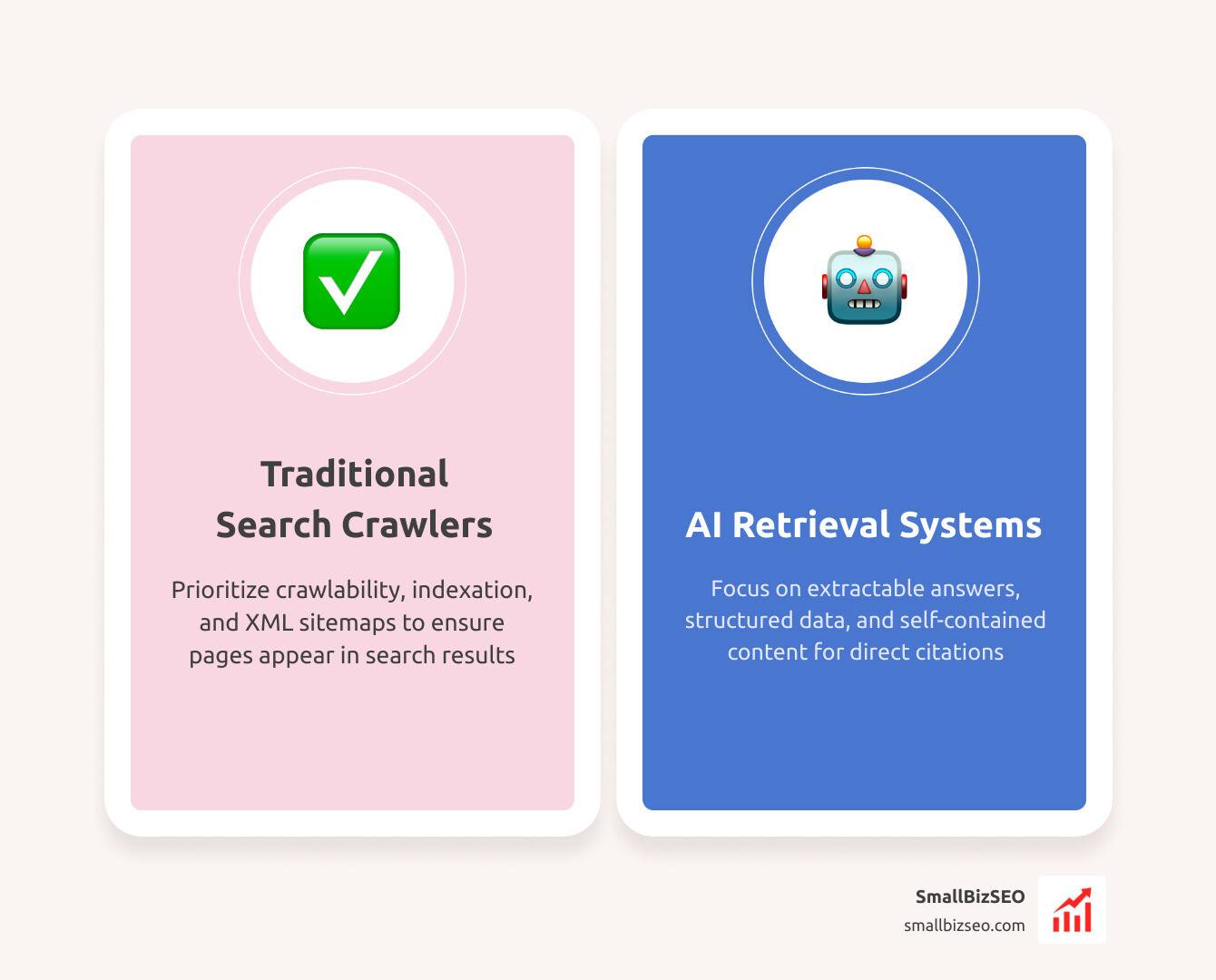
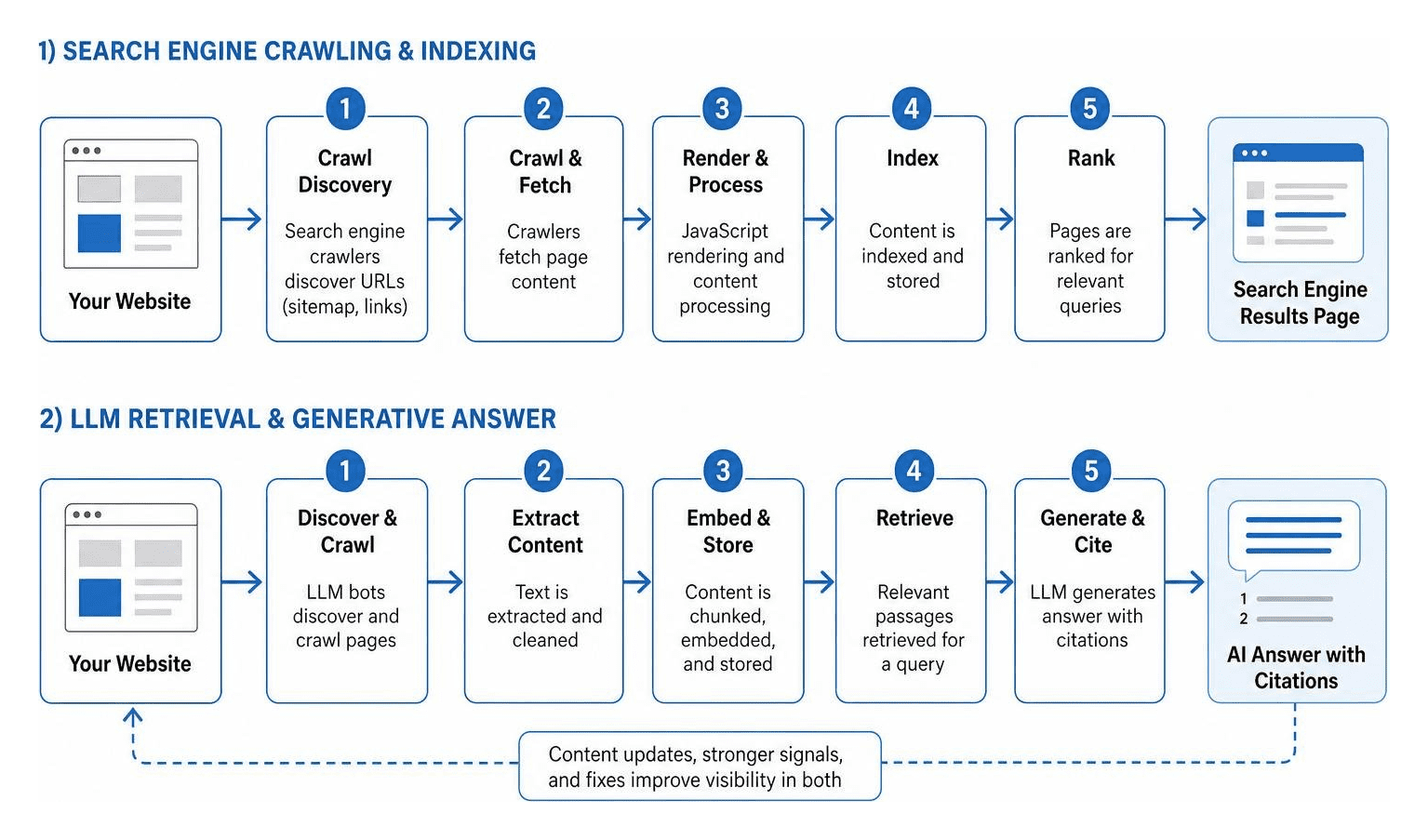
Historically, audits focused purely on helping Googlebot crawl and rank pages. Today, the landscape is more complex. We must optimize for traditional search engine crawlers and large language model (LLM) retrieval systems simultaneously. Traditional search engines look for keywords, site speed, and backlinks to rank a URL. AI engines, on the other hand, search the web to extract direct answers, synthesize concepts, and cite authoritative sources.
If your site contains technical roadblocks, search engines cannot index your pages, and AI models cannot retrieve your content to cite it. Conducting a Detailed SEO Analysis ensures your brand remains visible across both traditional search engine results pages and generative AI responses.
Free Audit Tools vs. Professional Technical Audits
Many business owners start their optimization journey by running their URL through free SEO checkers like Semrush or SEOptimer. While these automated checkers are excellent for identifying surface-level issues like missing meta tags or slow-loading images, they only tell part of the story.
A free tool cannot analyze your server logs to see how search engines actually distribute your crawl budget. It won't detect complex JavaScript rendering issues that prevent AI crawlers from seeing your primary content, nor can it provide a customized business strategy.
Professional technical SEO audit and implementation programs typically start at $2,500. This investment covers manual forensic analysis, rendering checks, and custom roadmaps that align with your business goals.
| Audit Feature | Free Automated Checkers | Professional Technical Audits |
|---|---|---|
| Crawl Simulation | Basic (limited pages) | Full-site depth |
| Server Log Analysis | No | Yes |
| JavaScript Rendering Check | Limited | Comprehensive |
| AI Search & LLM Readiness | Basic | Advanced GEO assessment |
| Prioritized Action Plan | Generic checklist | Customized developer tickets |
| E-E-A-T Signal Evaluation | No | Yes |
The Core Pillars of Modern SEO Auditing
To get the best return on investment, we must audit our websites in a logical order. We look at technical infrastructure first, content quality second, and authority layers third. Optimizing your site speed or writing new content is useless if a rogue meta tag is blocking search engines from indexing your pages in the first place.
Using a modern SEO and AI-answer visibility framework, we divide our audits into three core pillars: technical health, content/AI-readiness, and authority signals.
Technical SEO Visibility Audit Recommendations
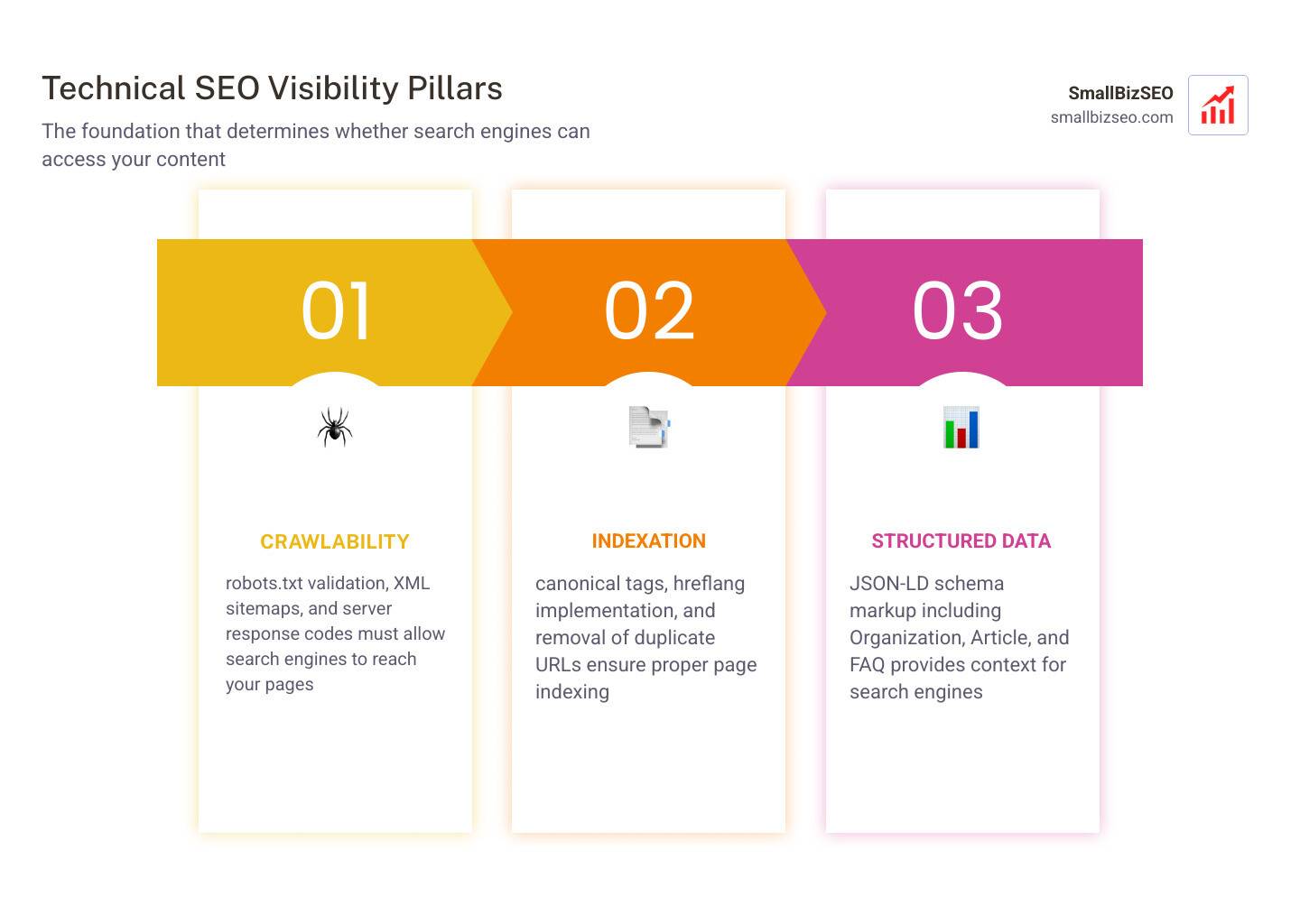
The technical foundation of your site dictates whether search engines can access your content. If you are wondering Why Your Rankings Are Still Stuck, the answer is almost always hidden in these core technical checks:
- robots.txt Validation: Ensure your robots.txt file is reachable and permissive. Double-check that staging rules (like
Disallow: /) were not accidentally deployed to your live production environment. - XML Sitemaps: Your sitemap should contain only indexable, canonical URLs that return a successful 200 status code. Remove redirects, broken pages, and non-canonical URLs.
- Canonical Tags: Every page must have a self-referencing canonical tag with an absolute URL to prevent duplicate content issues caused by URL parameters.
- Hreflang Implementation: For multilingual sites, ensure hreflang tags are reciprocal and use valid language and region codes.
- Structured Data: Implement valid JSON-LD schema markup (such as Organization, Article, and FAQ schema) to help search engines understand the context of your pages.
Content and AI Search SEO Visibility Audit Recommendations
Once search engines can crawl your site, your content must be clear, structured, and easy to extract. Generative Engine Optimization (GEO) requires a different approach than traditional keyword targeting. To earn citations in AI search tools, we recommend the following:
- The Extractable Answer Test: Structure your content using an inverted pyramid style. Place a direct, declarative answer to the user's primary query in the first two sentences of your page.
- FAQ Sections: Add dedicated FAQ sections to your primary service and product pages. Write answers in a concise, authoritative manner under 150 words.
- Header Optimization: Convert generic H2 and H3 headers into specific, question-based headings that match natural user queries.
- Content Gap Remediation: Perform a Keyword Gap Analysis: What It Is and How to Do It Right to identify topics your competitors cover that your site currently lacks.
Authority, E-E-A-T, and Trust Signals
Search engines and AI platforms prioritize trustworthy sources. To satisfy Google's Experience, Expertise, Authoritativeness, and Trustworthiness (E-E-A-T) guidelines, you must show who wrote your content and why they are qualified.
- Named Author Bylines: Replace generic admin editorial tags with real, named author bylines.
- Detailed Author Bio Pages: Link every byline to a dedicated author profile page detailing their credentials, industry experience, and professional achievements.
- External Citations: Back up your claims, statistics, and data points with outbound links to reputable, third-party sources. Learn How to Optimize Your Content for E-E-A-T and Build Real Search Trust to establish long-term authority.
How to Prioritize Your SEO Visibility Audit Recommendations
An audit report is only as valuable as the actions you take to implement it. To prevent your team from getting overwhelmed, we recommend grouping your audit findings into a prioritized roadmap.
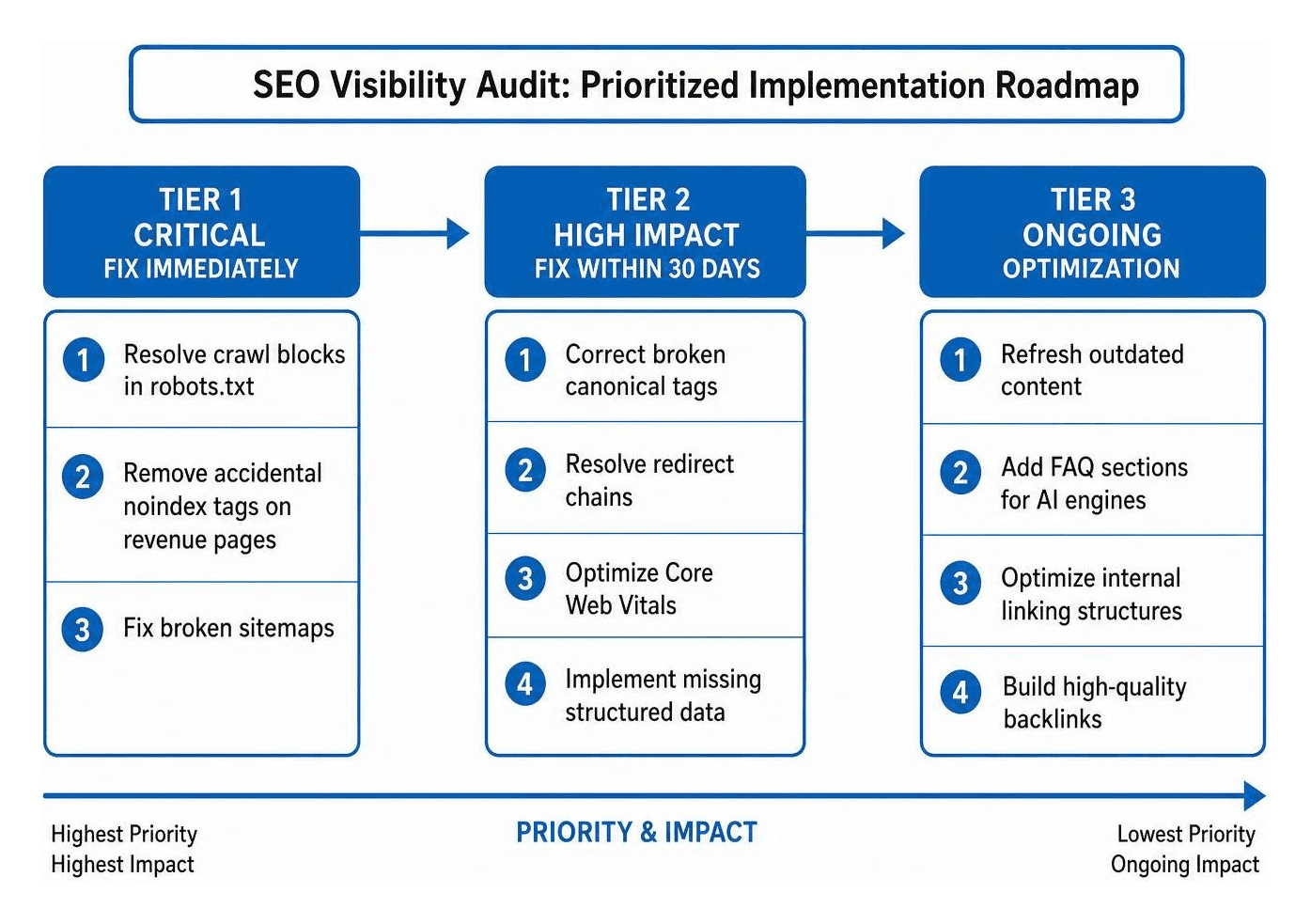
Sort your tasks into three clear tiers based on their impact and implementation difficulty:
- Priority Tier 1 (Critical - Fix Immediately): Resolve crawl blocks in robots.txt, remove accidental noindex tags on revenue-generating pages, and fix broken sitemaps.
- Priority Tier 2 (High Impact - Fix Next): Correct broken canonical tags, resolve redirect chains, optimize Core Web Vitals, and implement missing structured data.
- Priority Tier 3 (Ongoing Optimization): Refresh outdated content, add FAQ sections for AI engines, optimize internal linking structures, and build high-quality backlinks.
By organizing your findings this way, you can easily hand off technical tickets to your web developers and content briefs to your writing team. This structured approach is essential if you want to learn How to Pass Google's Own SEO Analysis Audits and maintain top rankings.
Measuring Success and Preventing Regression
After implementing your audit recommendations, you must monitor your performance to measure success and catch regressions. Use Google Search Console to track crawl rates, indexation status, and click-through rates. Monitor your Core Web Vitals using real-user field data rather than laboratory scores to ensure your site loads quickly for everyone.
To keep your rankings stable, establish a continuous monitoring routine. Web developments, plugin updates, and template changes can easily break your technical setup without your knowledge. Working with trusted SEO audit experts can help you set up automated regression detection alerts that notify you the moment an issue arises.
Frequently Asked Questions About SEO Visibility Audits
How often should a business run an SEO audit?
We recommend conducting a comprehensive, deep-dive SEO audit on a recurring schedule. You should also run smaller, targeted mini-audits whenever major website changes occur so you can monitor your top-performing pages and catch any technical regressions early.
Do Core Web Vitals directly affect search rankings?
Yes, Core Web Vitals are a confirmed ranking signal. While they primarily act as a tiebreaker among websites with similar content relevance and authority, having poor performance metrics can prevent your site from ranking at the very top of competitive search results.
What is the difference between traditional SEO and AI search optimization?
Traditional SEO focuses on optimizing for search engine algorithms to rank URLs on a results page and drive clicks. AI search optimization (or GEO) focuses on formatting and structuring your content so that LLMs can easily extract, synthesize, and cite your brand directly within their conversational answers.
Conclusion
Maximizing your online reach requires a technical foundation that supports both traditional search crawlers and modern AI retrieval systems. By systematically implementing these SEO visibility audit recommendations, you can resolve hidden infrastructure issues, improve your content structure, and establish real search trust.
At SmallBizSEO, we specialize in helping small businesses grow using our data-driven "Velocity" framework. We provide technical SEO, content strategy, and link-building services designed to deliver fast rankings and E-E-A-T-compliant growth with completely transparent, automated reporting.
Ready to uncover the roadblocks holding your website back? Get started today by requesting your professional SEO Visibility Audit and take control of your search presence.