Cheap SEO Services: A Practical Budget Buying Guide
Which Cheap SEO Services Are Worth Your Budget?
Cheap SEO is worth considering only when the scope is clear, the work has an owner, and you can see what was completed. A low budget can fund a focused project, an audit, or a limited monthly work plan. It usually cannot fund every part of an SEO program at once.
This guide helps small businesses compare practical ways to use a limited SEO budget: doing defined work in-house, hiring a specialist for one project, pairing an audit with implementation, or using an ongoing managed service. The goal is to choose a realistic next step, not to chase a universal “best” provider.
Start by writing down the business problem to solve, such as unclear service pages, technical errors, weak internal links, outdated content, or a lack of useful pages for customer questions. Then compare proposals against that need and the decision worksheet later in this guide.
For a current example of a broader managed-service scope, review SmallBizSEO’s SEO packages and book a consultation if a conversation would help clarify fit.
What Can a Limited SEO Budget Realistically Cover?
A limited budget works best when it funds a defined priority rather than an undefined promise of “full SEO.” Before comparing proposals, decide whether the immediate need is diagnosis, implementation, content, technical maintenance, or outside expertise.
These are illustrative scope options, not market-rate claims or outcome promises. They show how a buyer might narrow scope and what to ask about. Actual fees depend on the site, the work required, and who is responsible for implementation.
| Illustrative scope option | A sensible focus | Likely tradeoff or exclusion |
|---|---|---|
| Modest monthly budget | One recurring priority, such as content updates, internal linking, local-page cleanup, or technical maintenance | Less capacity for new content, outreach, development work, and strategy at the same time |
| Project budget | A defined audit, page refresh set, technical fix list, or specialist task | Ongoing implementation and monitoring may remain with the business |
| Larger recurring budget | Coordinated research, implementation, original content, refreshes, internal links, and relevant editorial outreach | The proposal still needs a written work plan, ownership, and exclusions |
A proposal should identify what happens each month, who performs it, what the business must supply, and which work is outside the fee. “Monthly reporting” is useful only when it connects completed work, evidence, and the next priority. For a separate framework for comparing cost and scope, see this cheat sheet to Google SEO services pricing.
Be careful with vague deliverables. A low-priced offer is not automatically poor, and a longer agreement is not automatically wrong. The important questions are whether the deliverables, cancellation terms, account ownership, and evidence of completed work are clear before signing.
Which SEO Buying Option Fits a Small Budget?
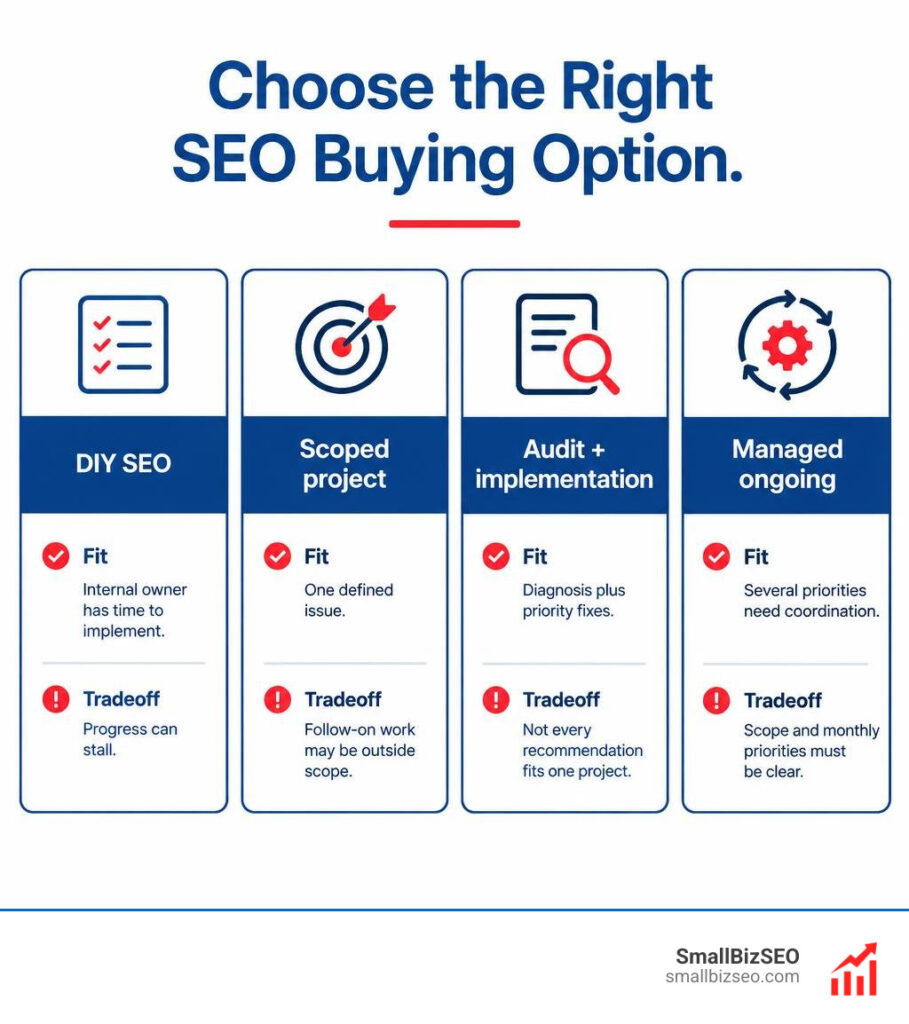
The best choice depends on whether the business needs learning time, a one-time fix, implementation support, or a coordinated ongoing program. Compare the operating model before comparing the headline price.
| Option | Best when | What should be included | Main tradeoff |
|---|---|---|---|
| DIY SEO | A team member can learn, prioritize, and complete the work consistently | A written checklist, access to the website, time for implementation, and a way to record changes | Progress can stall when the owner’s attention shifts to other work |
| Scoped specialist or project | One clear problem needs expertise, such as a technical issue, migration review, content brief, or page refresh | A written scope, deliverable dates, acceptance criteria, and handoff notes | The project may identify follow-on work that is not included |
| Audit plus implementation | The business needs a prioritized diagnosis and help completing the most important fixes | An audit, a ranked action plan, a defined implementation block, and evidence of completed fixes | Not every recommendation can be completed within one project |
| Ongoing managed service | Multiple priorities need regular coordination and execution | A recurring work plan covering research, implementation, content, technical upkeep, links where appropriate, and reporting | The agreement needs clear monthly priorities and boundaries |
Why Ongoing SEO Is More Than Scans and Reports
Ongoing SEO creates, improves, connects, and promotes useful pages over time. Technical scans can surface issues, but they do not resolve them. Reports can describe movement, but they do not create the work that supports a stronger site. For an additional side-by-side reference, see top SEO services compared.
A practical ongoing plan can include researched original content, updates to existing pages, internal links between related topics, technical implementation, and relevant editorial outreach. The mix should follow the site’s actual gaps. SEO content services can support research, writing, internal linking, and publishing workflows, while link-building services explain a relevance-focused outreach process. Neither activity makes a specific rankings, traffic, or revenue result certain.
Hypothetical monthly example: A small business might refresh one priority service page using customer questions, create one expert-reviewed guide, add relevant internal links, research a small set of relevant editorial prospects and log outreach, and verify technical fixes. The provider and business must agree on the exact scope and volume; this example includes no price or outcome guarantee.
What Should a Monthly Work Plan Show?
A useful monthly plan makes the work visible before it is billed. Ask for a short list of priorities, completed deliverables, evidence or links to the work, and the next actions. If a provider cannot explain how content, technical changes, and outreach connect to the business’s pages and customers, the scope needs clarification.
How Can You Evaluate an Affordable SEO Proposal?
Evaluate an SEO proposal by its documented work plan, ownership terms, and evidence, not by a label such as “cheap” or “premium.” A smaller proposal can be useful when it solves one specific problem well. A larger proposal should make its wider responsibilities equally clear.
A credible proposal should explain the priority, the deliverables, the person or team responsible, the information the business must provide, and the evidence that will show the work was done. Google’s guidance on hiring an SEO is also a useful reference for asking informed questions before engaging a provider.
Key evaluation points include the following. This guide on how to find the best affordable SEO companies without getting scammed offers additional questions to use during comparison:
- Specific deliverables: Look for defined work, such as a technical fix list, refreshed pages, content briefs, completed articles, implemented internal links, or documented outreach activity.
- Asset ownership: Confirm who owns the website content, source files, analytics access, accounts, and completed deliverables after the engagement ends.
- Evidence: Ask how completed work will be documented. Useful evidence can include change logs, page URLs, implementation notes, editorial placements, and a prioritized next-step list.
- Cancellation and renewal terms: Read the notice period, renewal language, and handoff terms. Choose terms the business can understand and manage.
- Claims about results: No provider can responsibly promise a specific ranking, traffic level, or revenue outcome; Google's SEO documentation provides useful hiring guidance. Ask instead how the proposed work addresses the site’s current priorities.
The point is not to reject every automated tool or recurring agreement. It is to make sure tools support accountable work and that the business knows exactly what it is purchasing.
How Do You Choose an SEO Partner With a Limited Budget?
Choose the option that assigns clear ownership to the highest-priority work and leaves no uncertainty about fees, exclusions, or cancellation. A quick worksheet can make competing proposals easier to compare.
SEO Decision Worksheet
Use this worksheet for each DIY plan, specialist proposal, audit, or managed-service option.
| Decision question | What to record before choosing |
|---|---|
| What is the priority? | The specific page, technical issue, content gap, or business goal the work will address |
| What is delivered each month or project phase? | Named pages, fixes, briefs, content, link outreach activity, meetings, reports, and handoff materials |
| Who owns each task? | The business, an internal developer or writer, a specialist, or the managed-service team |
| What is the total cost? | Setup fees, monthly fees, project fees, software costs, and any work billed separately |
| What is excluded? | Development, design, publishing, copy approvals, photography, paid media, content volume, or outreach volume not covered by the scope |
| Who owns the assets? | Website access, content files, research, completed work, reporting access, and credentials |
| How can the engagement end? | Notice period, renewal terms, handoff process, and any transition support |
| What evidence will be provided? | Change log, page URLs, completed task list, source notes, editorial placements, and next priorities. See an essential guide to finding a reliable SEO service provider for more comparison questions. |
What Questions Should You Ask Before Hiring?
Ask questions that turn a sales promise into an accountable work plan. Useful questions include:
- What will be completed in the first phase, and what will be completed each month after that?
- Which tasks are performed by the provider, and which tasks require an internal owner or developer?
- What fees, tools, or implementation tasks are outside the stated scope?
- How will completed work and recommendations be documented?
- Who retains ownership of content, accounts, files, and work products if the engagement ends?
- What notice, cancellation, and handoff terms apply?
When Does DIY Make More Sense?
DIY SEO can be a sound choice when someone can consistently complete the work and use specialist help only where it adds value. It is often practical for businesses that can publish approved content, update pages, and resolve straightforward tasks internally.
A hybrid approach can also work: use an audit or specialist project to set priorities, then assign implementation to an internal owner. If ongoing coordination is the real need, review the current scope on the SEO packages page before deciding whether managed support fits the budget.
Frequently Asked Questions About Affordable SEO
Can cheap SEO services hurt a website?
They can create problems when the scope encourages poor-quality work or when nobody is accountable for implementation. The risk is not the price alone. Review the methods, the deliverables, and the evidence of completed work before approving a plan.
Is a one-time SEO audit better than a monthly service?
An audit is useful when the business needs a prioritized diagnosis, while a monthly service is useful when priorities require ongoing execution. An audit has more value when someone has the time and skills to carry out the recommendations. A managed plan may fit better when research, technical work, content, refreshes, internal links, and outreach need coordination.
What should an affordable SEO proposal include?
It should state the priority, deliverables, responsible owner, total fees, exclusions, ownership, cancellation terms, and evidence of completed work. If any of those items are missing, ask for clarification before comparing the proposal with another option.
Build a Work Plan Before You Buy SEO
The most useful affordable SEO choice is the one that turns a limited budget into visible, prioritized work. Whether the business chooses DIY, a project specialist, an audit plus implementation, or managed support, start with a written scope and revisit it as priorities change.
For businesses that need coordinated research, content, technical implementation, and relevant outreach, SmallBizSEO’s SEO content services, link-building services, and SEO packages describe current service scope. For a broader overview, explore professional small business SEO services. Review the package details and book a consultation when a tailored work plan would be helpful.
A sound next step is simple: choose one priority, assign an owner, define the evidence of completion, and confirm what is not included before work begins.