What SEO Stands for in Business and How to Make It Work for You

What SEO Stands for in Business and How to Make It Work for You
What Does SEO Stand for in Business?
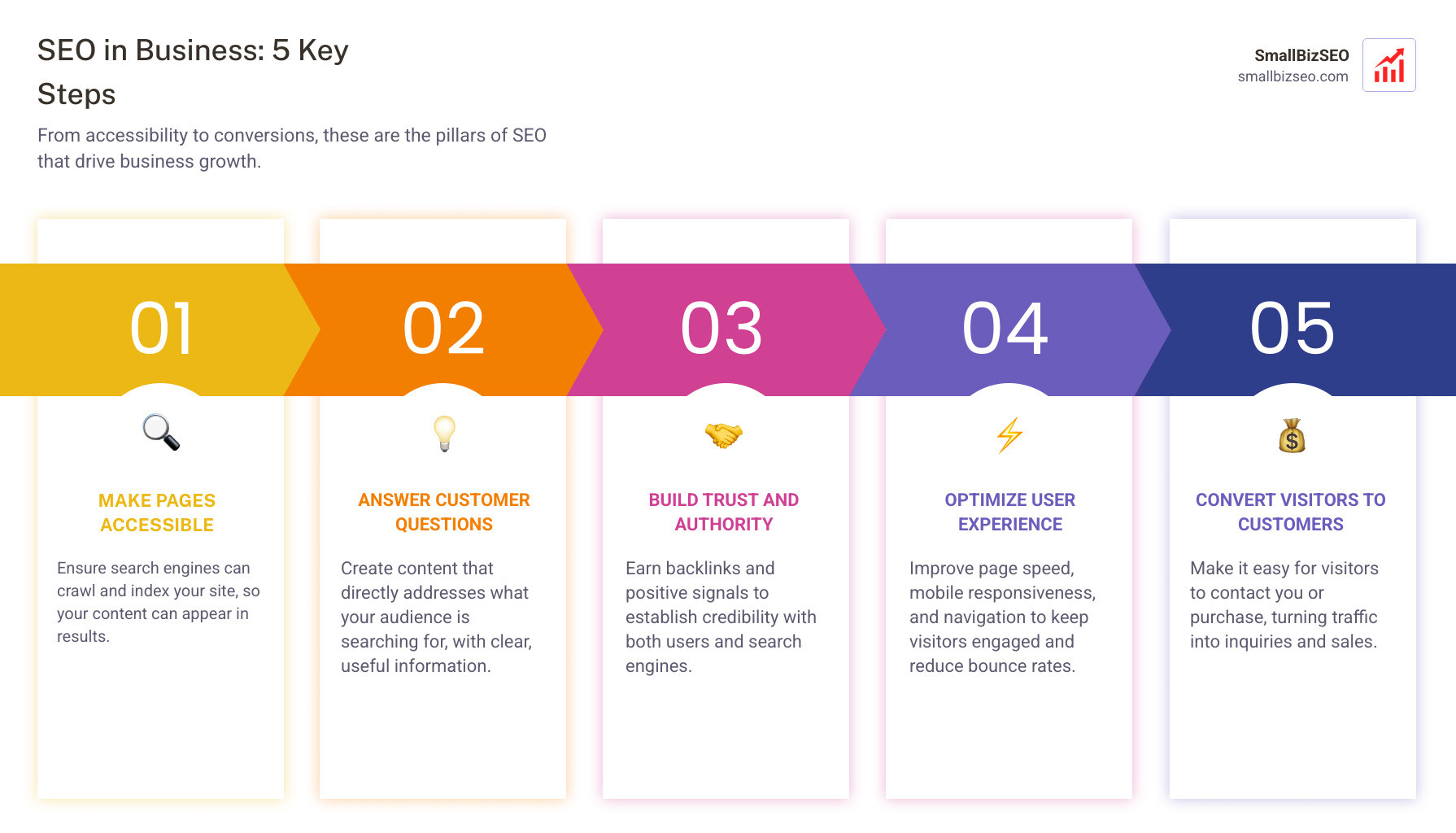
SEO stands for Search Engine Optimization. In business, it means improving your website so people can find your products or services in unpaid search results. Start by making sure search engines can access your pages, answering the questions customers search for, and making it easy for visitors to contact or buy from you.
These steps work together: a useful page cannot bring in customers if search engines cannot find it, and traffic matters most when it leads to inquiries or sales.
I'm Clayton Johnson, founder of SmallBizSEO. My work in custom SEO strategy and content helps business owners understand what SEO stands for in business and turn that knowledge into clearer pages, stronger visibility, and more qualified leads.
What Does SEO Stand for in Business, and Why Does It Drive Modern Revenue?
SEO drives modern business revenue by connecting your company directly with high-intent buyers who are actively searching for solutions. Unlike interruption-based ads, organic search captures demand at the exact moment a prospect seeks an answer, product, or service.
Every single day, search engines process over 8.5 billion search queries. While paid advertising can deliver immediate traffic, it stops generating leads the moment your budget runs out. SEO builds an enduring digital asset. Companies that understand what SEO stands for in business create compounding growth that lowers customer acquisition costs while establishing long-term commercial visibility and brand authority.
What Does SEO Mean for a Business Strategy?
In a strategic business plan, SEO serves as the primary engine for sustainable customer acquisition and pipeline generation. Rather than treating your website as a static digital brochure, SEO turns it into an active, 24/7 sales representative that captures potential buyers across every stage of the funnel.
When we look at the data, the business impact is clear:
| SEO Activity | Business Mechanism | Tangible Commercial Benefit |
|---|---|---|
| High-Intent Content Targeting | Answers commercial queries directly | Captures in-market buyers ready to make purchase decisions |
| Technical Site Architecture | Ensures flawless indexing and sub-2.5s speeds | Boosts conversion rates and captures top search rankings |
| E-E-A-T & Authority Building | Earns authoritative citations and industry links | Outranks competitors for core high-value keywords |
| User Journey Optimization | Streamlines navigation and calls-to-action | Reduces acquisition costs while increasing customer lifetime value |
The first organic search result on Google captures 27.6 percent of all clicks, and 69 percent of total clicks go to the top five results. By securing these premier spots, organizations reduce customer acquisition costs by up to 41 percent compared to relying solely on paid ad channels. To explore these mechanisms further, see our guide on why getting found matters.
What Are the Three Core Parts of SEO Execution?
A successful SEO strategy relies on three interconnected pillars: technical foundation, on-page optimization, and off-page authority.
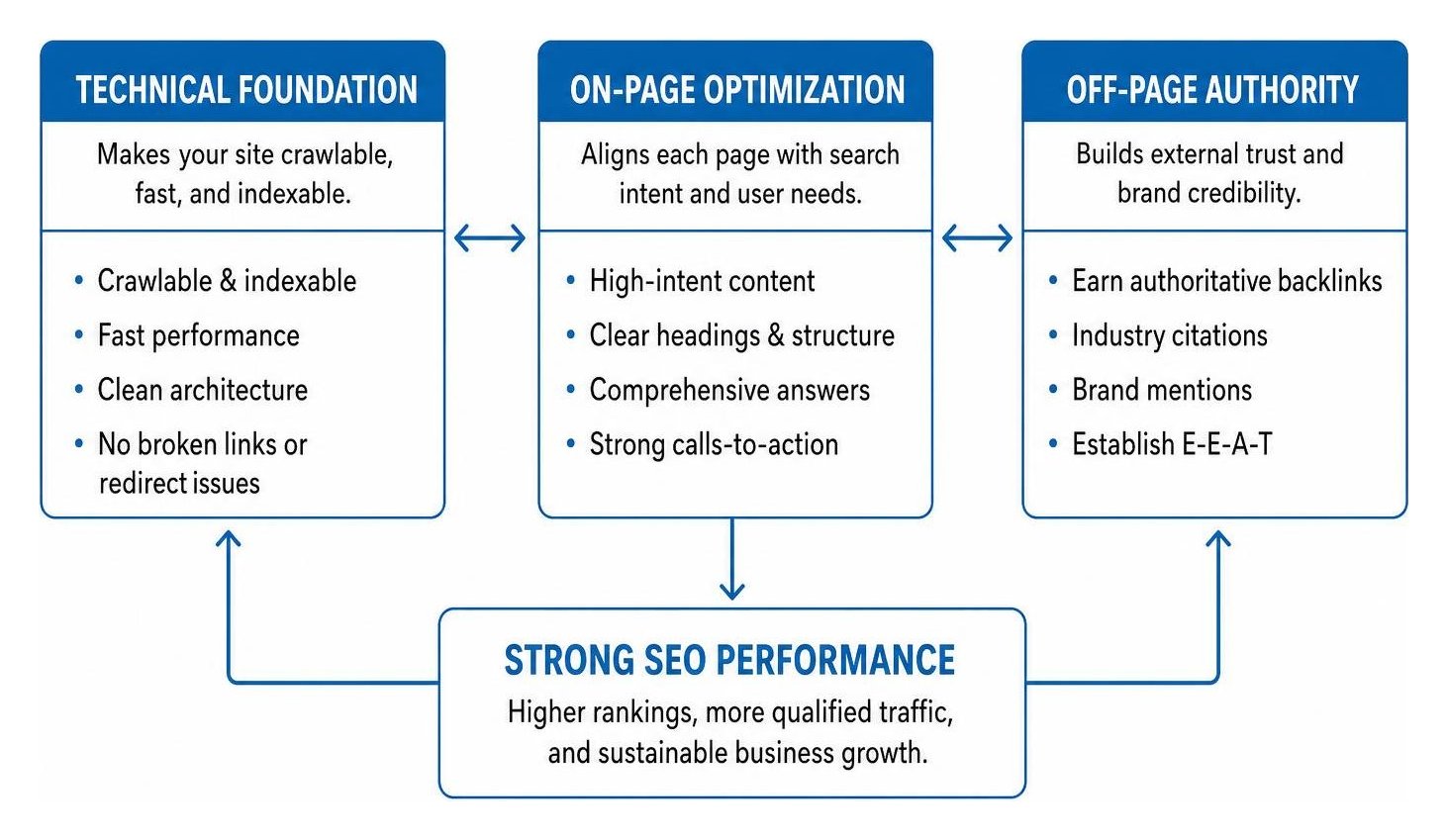
- Technical SEO: The foundation of your website. It ensures that search bots can crawl, render, and index your pages without encountering broken links, redirect loops, or sluggish server responses.
- On-Page SEO: The content and structure of individual web pages. It involves aligning your copy with search intent, structuring headings clearly, and providing thorough answers to user queries.
- Off-Page SEO: The external reputation of your business. It includes earning backlinks from reputable websites, securing industry citations, and establishing brand credibility.
These three parts function like a three-legged stool: if your technical foundation is broken, great content won't rank; if your content is thin, authoritative backlinks won't convert visitors. Learn more about how these layers align by reading our breakdown of 3 types of SEO explained for modern website owners.
How Do Search Engines Crawl, Index, and Rank Business Websites?
Search engines discover and organize the web through a continuous three-step process: crawling, indexing, and ranking.
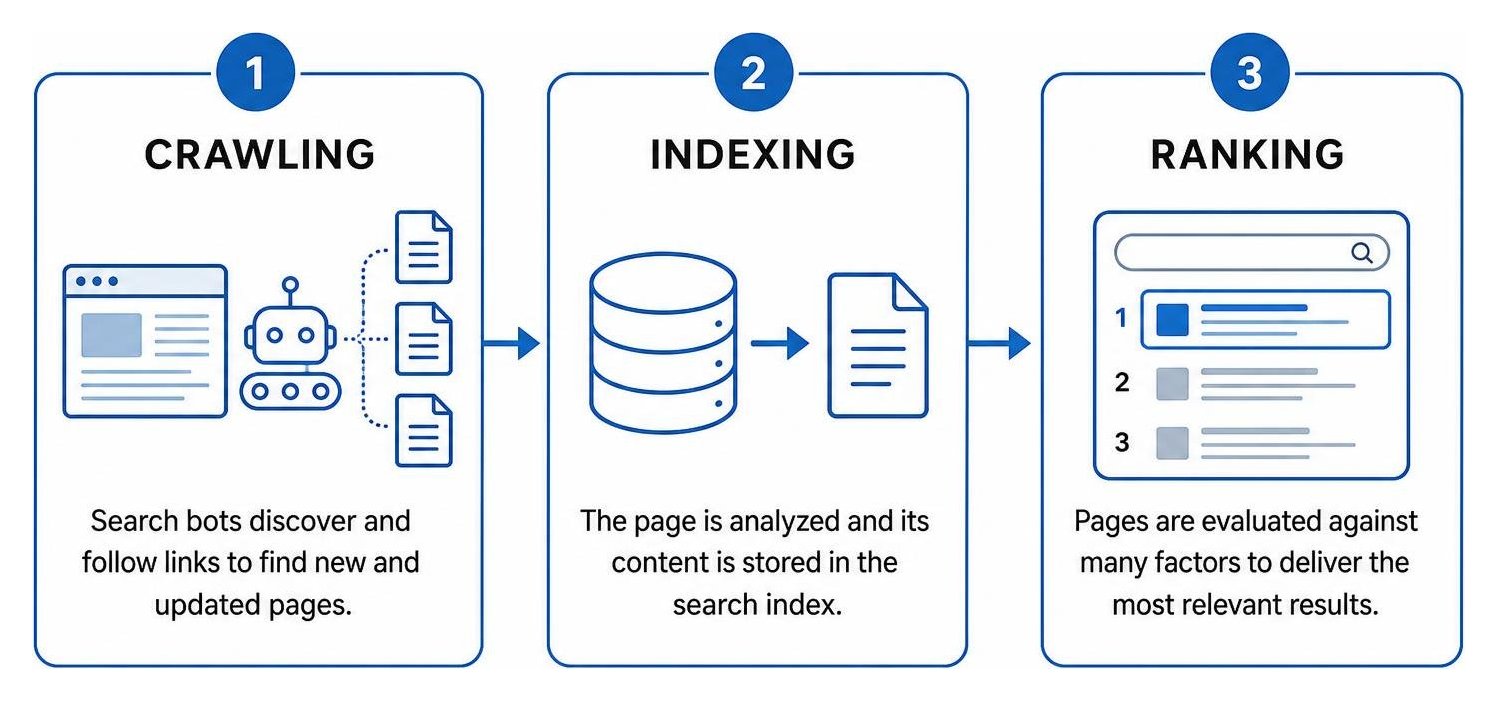
- Crawling: Automated search bots (such as Googlebot) follow links across the web to discover new and updated pages. A clean XML sitemap and a well-configured robots.txt file ensure crawlers find your most important business pages efficiently.
- Indexing: Once discovered, the search engine analyzes the page's text, images, and structure, storing this information in a vast global database known as the search index.
- Ranking: When a user enters a query, the search engine evaluates indexed pages against hundreds of ranking factors to return the most relevant, high-quality results.
Modern search engines rely heavily on semantic understanding, Core Web Vitals, and E-E-A-T (Experience, Expertise, Authoritativeness, and Trustworthiness) signals. Systems evaluate user intent and break complex queries into sub-topics to surface comprehensive answers. If you want a complete walkthrough of search engine algorithms, review our SEO 101 guide to how search engines work.
How Can You Execute an SEO Strategy That Maximizes Business Growth and ROI?
To maximize business growth and return on investment, focus your SEO execution on solving real customer problems, maintaining a fast, secure website, and systematically building market authority.
Executing an effective SEO strategy does not require gaming algorithms or chasing short-lived ranking tricks. Instead, it demands a repeatable, conversion-focused process that turns organic search visibility into measurable revenue.
Which On-Page and Technical SEO Factors Deliver the Highest Returns?
The highest-leverage on-page and technical optimizations are those that directly enhance user experience while making page topics crystal clear to search engines.

- Search Intent Mapping: Match your page format (whether a guide, service page, or product catalog) directly to what the user wants to accomplish. 52.65 percent of searches are informational, while commercial and transactional queries require clear service offerings and fast checkout paths.
- Descriptive URLs and Metadata: Write concise, keyword-rich URL slugs and craft compelling title tags (under 60 characters) and meta descriptions (under 160 characters) that encourage clicks.
- Core Web Vitals and Page Speed: Ensure pages load in under 2.5 seconds. Fast-loading pages keep visitors engaged and reduce bounce rates.
- Mobile Responsiveness: With over 58 percent of searches occurring on mobile devices, responsive mobile design is essential for both rankings and conversions.
- HTTPS and Website Security: Secure your domain with an SSL certificate to protect visitor data and satisfy baseline search engine trust standards.
For actionable steps on optimizing your content and metadata, read our guide on demystifying SEO fundamentals from keywords to content.
What Is the Difference Between White Hat, Black Hat, and Grey Hat SEO?
SEO practices fall into three categories based on their adherence to search engine guidelines:
- White Hat SEO: Ethical practices that focus on creating genuine value for users, maintaining sound technical performance, and earning organic backlinks. This approach provides sustainable, risk-free business growth.
- Black Hat SEO: Deceptive tactics designed to manipulate search algorithms for fast, short-term rankings. These methods violate guidelines and carry severe risks of domain penalties or complete de-indexing.
- Grey Hat SEO: Tactics that operate in an ambiguous middle ground—technically violating guidelines without using overtly malicious techniques.
High-risk black hat tactics that damage business domains include:
- Buying low-quality bulk backlink packages
- Keyword stuffing and hidden text
- Cloaking (showing different content to search bots than to human visitors)
- Scraping and republishing copyrighted content without adding original value
- Creating private blog networks (PBNs) to pass artificial authority
Protect your business reputation and long-term search assets by following the principles outlined in our SEO basics survival guide.
How Can Businesses Measure SEO ROI and Scale Long-Term Value?
Businesses measure SEO ROI by tracking how organic search visitors convert into qualified leads, pipeline opportunities, and closed revenue.
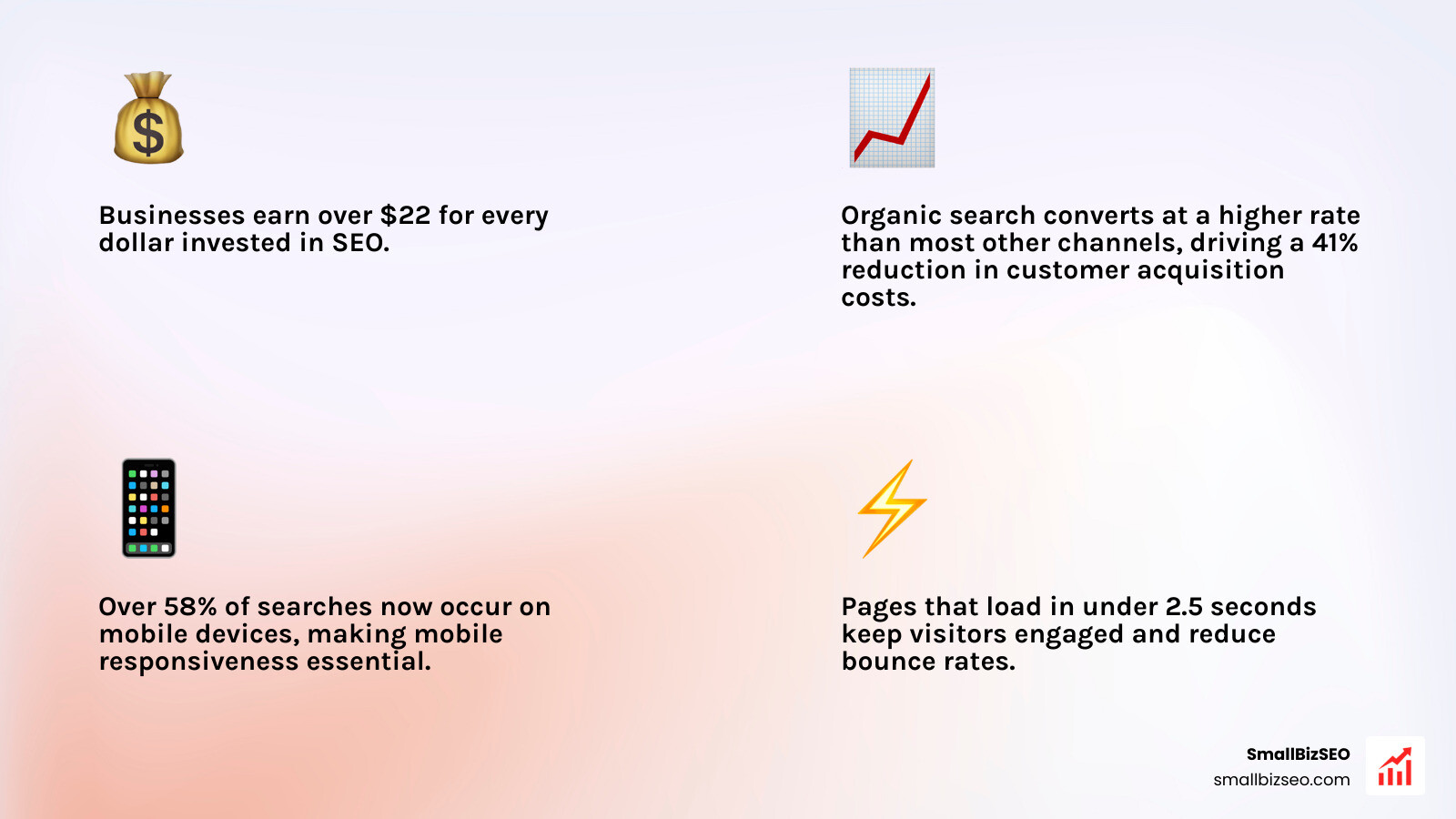
On average, businesses earn over $22 for every dollar invested in SEO, making it one of the most profitable marketing channels available. To measure this return accurately:
- Configure Conversion Tracking: Set up goal completions and ecommerce tracking in Google Analytics to measure form submissions, calls, and transactions originating from organic search.
- Track Key Search Metrics: Monitor total organic sessions, keyword ranking trends, click-through rates, and indexed pages via Google Search Console.
- Calculate Customer Lifetime Value (LTV): Tie organic lead acquisitions to your CRM pipeline to measure average revenue generated per organic customer over time.
At SmallBizSEO, we use our proprietary "Velocity" framework to help small businesses achieve rapid organic growth and E-E-A-T compliance through transparent, automated reporting. To see how these principles drive measurable commercial value, explore the complete guide to SEO business growth and find out how we build revenue-driven search campaigns.
Turn Search Visibility into Sustainable Business Value
Understanding what SEO stands for in business is the first step toward transforming your website from a passive expenses into an active revenue engine. By aligning technical excellence, high-value content, and trusted domain authority, you position your brand directly in front of buyers at the exact moment they need your services.
Ready to see how your website performs in organic search? Request a complimentary SEO visibility audit today, and let us help you build a high-velocity search strategy that scales your business pipeline.