6 Steps to Document and Enforce AI Web Crawler Permissions
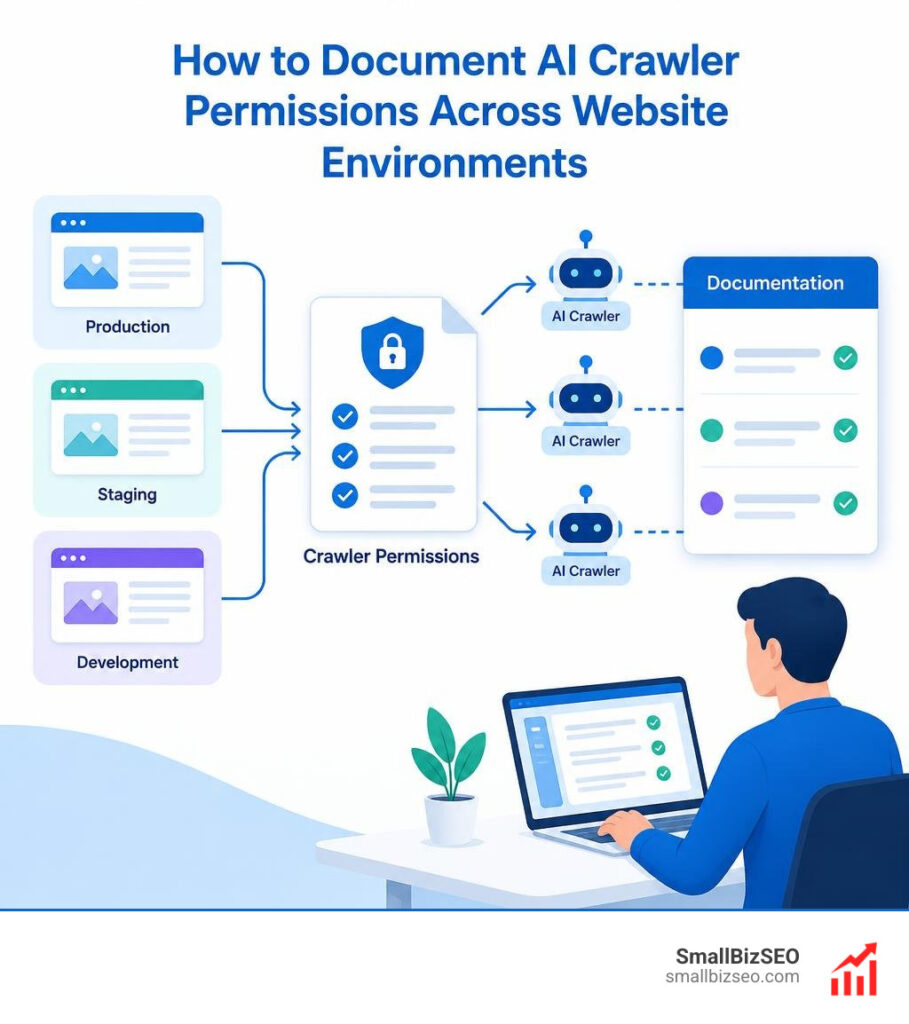
How Do You Document AI Crawler Permissions Across Website Environments?
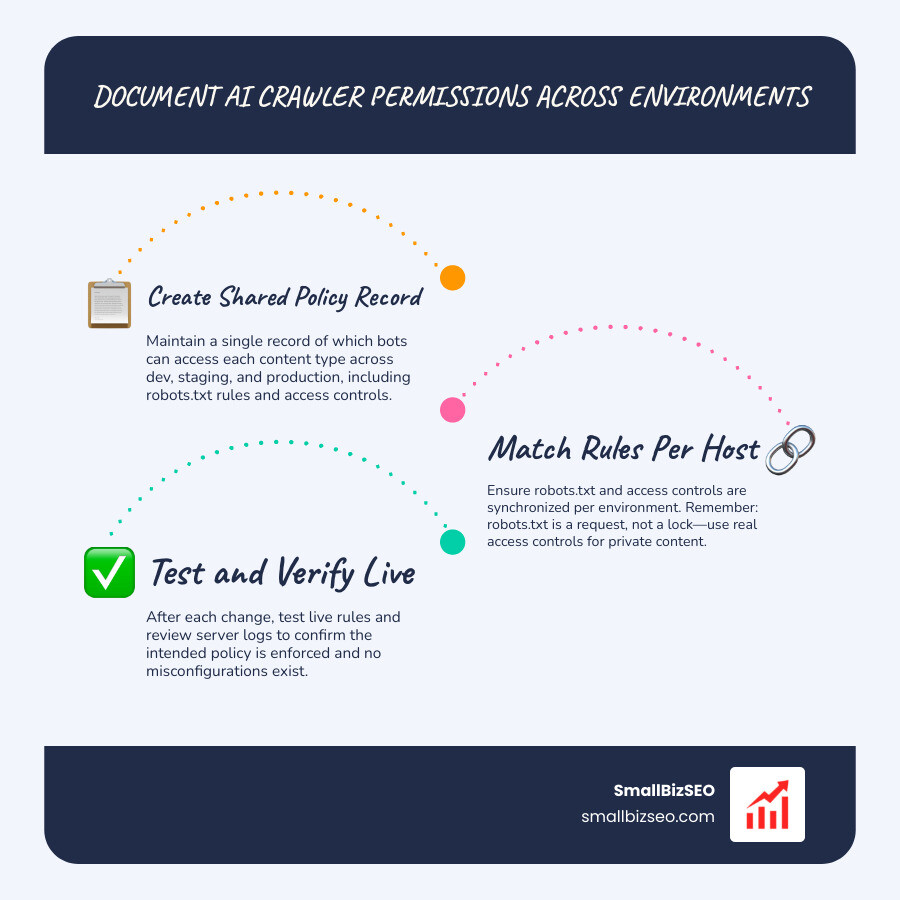
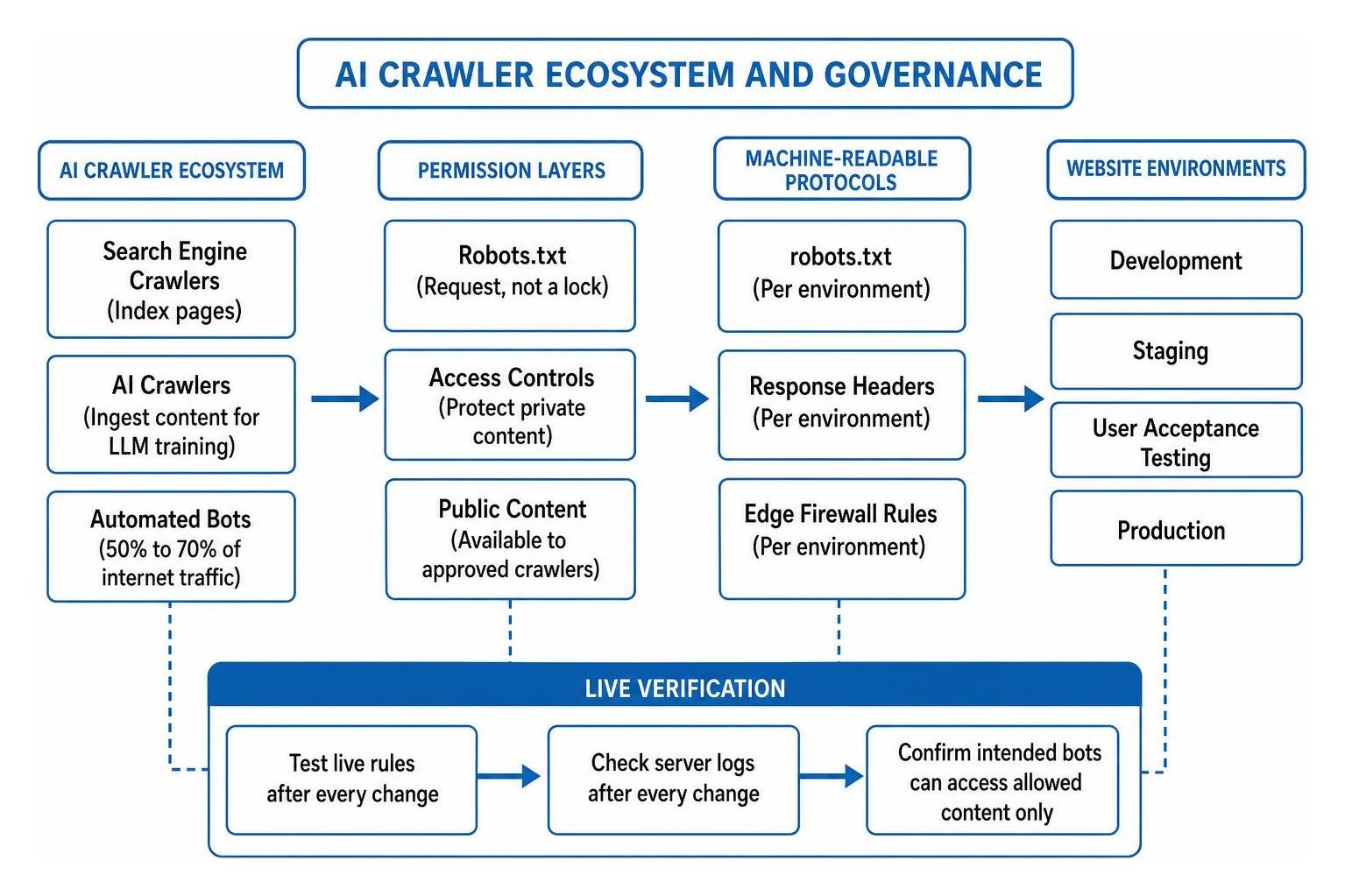
To document AI crawler permissions across website environments, keep one shared record of which bots may access each type of content in development, staging, and production. Record the matching robots.txt rules and access controls for each host. Then test the live rules and check server logs after every change.
Robots.txt is a request, not a lock. Protect private content with access controls, while keeping public pages available to the crawlers you want to reach them.
I’m Clayton Johnson, founder of SmallBizSEO, and my work in SEO and AI-driven discovery informs how to document AI crawler permissions across website environments. I’ll walk through the policy record first, then show how to check that the rules work.
What Is AI Crawler Governance, and Why Does It Matter?
AI crawler governance is the structured practice of defining, documenting, and enforcing which automated artificial intelligence systems are permitted to access, index, or scrape your web resources across various server environments. A documented governance policy balances protection against unlicensed data scraping with brand visibility in generative search platforms.
Automated bots account for roughly 50% to 70% of all internet traffic. These systems crawl websites for distinct reasons, ranging from search engine indexing to large-scale dataset aggregation for large language model (LLM) training. While traditional search crawlers index pages to direct human users to your URLs, many AI crawlers ingest entire content libraries into proprietary training corpora without guaranteeing referral traffic.
Without intentional governance, unmanaged crawling can consume server resources, distort web analytics, and expose staging or proprietary data. Documenting machine-readable directives across environments maintains your site's crawl budget while safeguarding valuable intellectual property.
How Can You Document AI Crawler Permissions Across Website Environments?
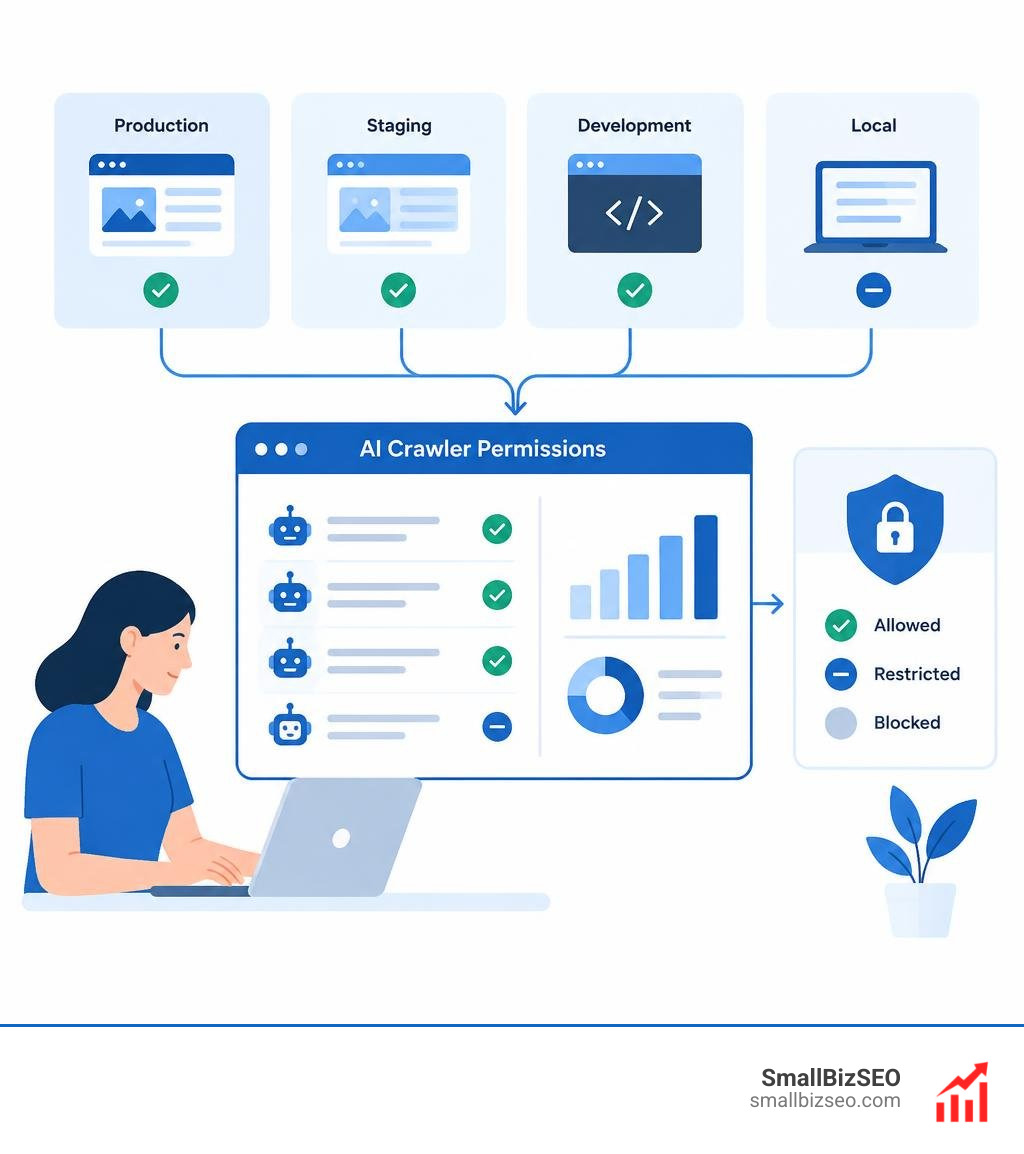
To document AI crawler permissions across website environments, maintain a centralized permission matrix that records which automated agents are allowed or blocked per hostname (development, staging, user acceptance testing, and production). You then translate these policies into environment-specific protocols, including robots.txt files, response headers, and edge firewall rules.

Managing permissions requires recognizing that different environments serve different audiences. Production hosts balance public visibility with content protection, whereas development and staging environments must disallow all public bots.
Documenting these directives across environments requires consistent caching policies and standard HTTP status code enforcement to ensure proxies, edge layers, and scrapers receive the correct signals. Emerging standards like the A2WF Specification also provide structured, machine-readable schemas to express these preferences cleanly across modern web stacks.
Which AI Bots Are Training Crawlers, Retrieval Systems, or Agents?
AI bots fall into three functional categories: training data scrapers that gather content for model development, Retrieval-Augmented Generation (RAG) and search fetchers that pull real-time data for user queries, and autonomous AI agents that browse or perform multi-step actions on behalf of users.
- Training Data Crawlers: Bots such as GPTBot (OpenAI), ClaudeBot (Anthropic), and Bytespider (ByteDance) scan public web pages in bulk to expand foundational training datasets.
- Retrieval-Augmented Generation (RAG) and Search Fetchers: Systems like OAI-SearchBot and search fetchers detailed in the Overview of Google crawlers and fetchers retrieve content in real time to cite sources directly inside generative answers.
- Autonomous AI Agents: Tools that power agentic search and use an agentic browser or user-directed assistant (like ChatGPT-User) navigate sites, click interface elements, and interact with web applications dynamically.
Identifying crawler purposes helps teams determine which systems to welcome for citation value and which to restrict to protect proprietary content.
Which Directives and Manifests Can Document AI Crawler Permissions Across Environments?
Documenting permissions across environments relies on a combination of established protocols like robots.txt and emerging machine-readable manifests that communicate purpose-specific access controls.
- Standard Robots Exclusion Protocol: Maintaining clear robots.txt rules remains the baseline standard recognized by well-behaved crawlers.
- Page-Level Meta Signals: Using NoAI meta tag directives allows granular per-page rules without restricting overall domain discovery.
- HTTP Header Signals: Delivering an opt-out header directly from the web server or edge layer applies policies cleanly to non-HTML assets like images, PDFs, and API endpoints.
- Structured Content Manifests: Preparing structured files such as llms.txt documentation guides AI assistants directly to approved, markdown-formatted summaries.
- Emerging JSON and Extended Specifications: Frameworks such as ai-policy.json, siteai.json, the robots2.txt specification, the robots-ai.txt syntax, and Permission Manifests for Web Agents allow publishers to declare fine-grained permissions for actions like training, quoting, and transactions.
| Standard / Manifest | Primary Location | Scope of Control | Primary Enforceability Mechanism |
|---|---|---|---|
| robots.txt | /robots.txt |
Path-level crawl access per User-Agent | Voluntary crawler compliance |
| ai-policy.json | /.well-known/ai-policy.json |
Purpose-level rights (training, search, input) | Voluntary compliance and policy discovery |
| siteai.json (A2WF) | /siteai.json or root |
Agent identity, read/action/data permissions | Voluntary compliance and edge rate-limiting |
| agent-permissions.json | /.well-known/agent-permissions.json |
DOM actions, UI elements, API interactions | Agent framework compliance |
How Can You Balance Content Protection with Search Visibility?
To balance content protection with brand reach, implement a tiered permission architecture that allows search-focused AI fetchers on public-facing marketing pages while restricting bulk dataset scrapers from proprietary data, internal documentation, and paywalled assets.
Many organizations want their insights cited in AI search platforms to capture qualified brand discovery, yet they also want to prevent third-party models from ingesting full content archives for commercial training.
By applying granular directives, teams can permit search-specific user agents (such as OAI-SearchBot) while blocking bulk scrapers (such as GPTBot). Platforms that manage AI crawlers with Cloudflare allow teams to enforce these distinctions dynamically at the DNS and reverse-proxy level, stopping aggressive scrapers before they reach origin servers.
How Do You Govern, Verify, and Audit AI Crawler Policies Across Environments?
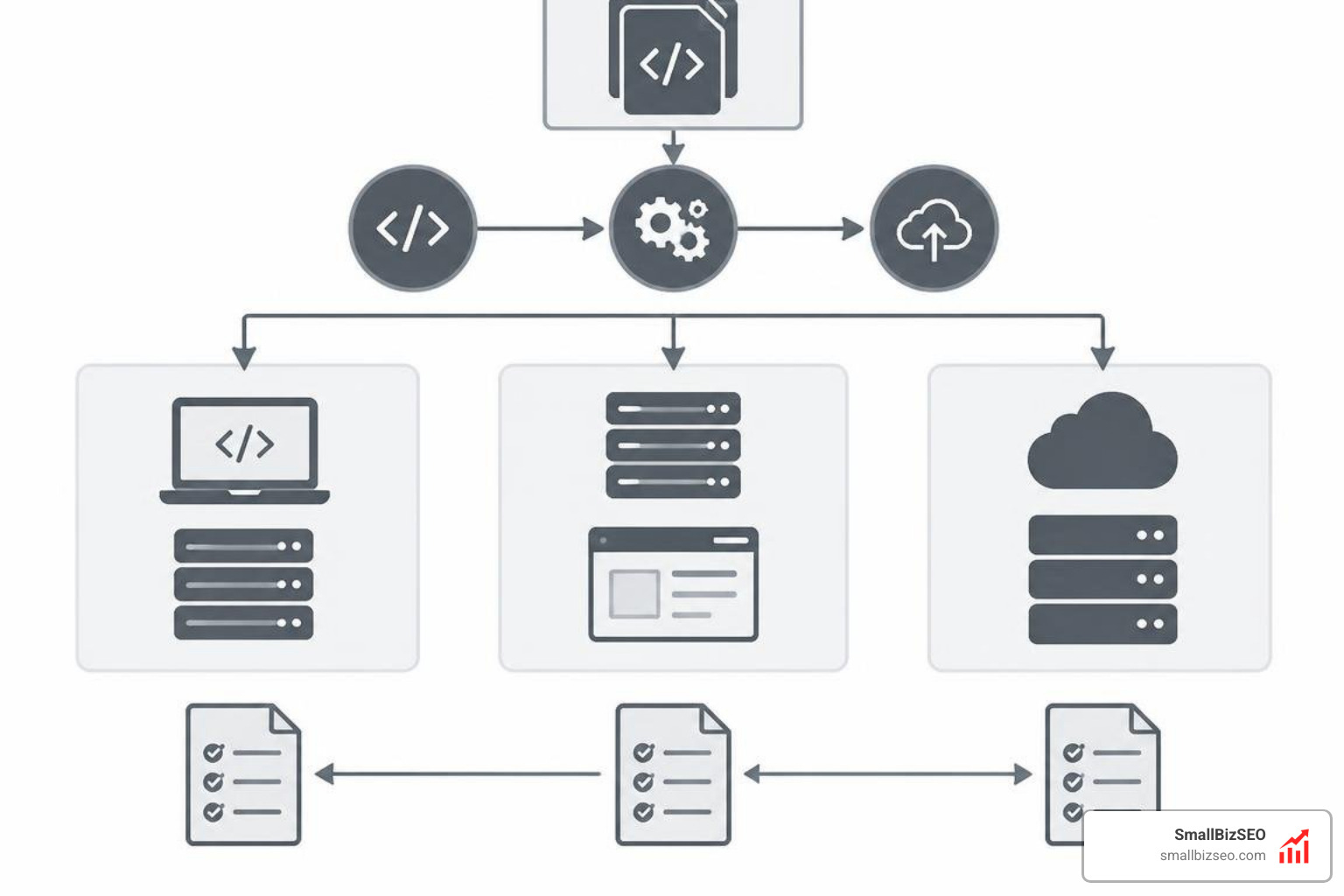
Governing AI crawler policies requires treating permission files as critical infrastructure code within a version-controlled deployment pipeline. Any rule applied to robots.txt, header configurations, or web application firewalls (WAF) should be documented, peer-reviewed, and synchronized across development, staging, and production.
Because voluntary text files do not deter non-compliant scrapers, security teams should pair public documentation with active edge governance. As outlined in the AI Crawler and Bot Guide by HUMAN Security, modern bot management pairs machine-readable policy declarations with real-time traffic analysis, rate limiting, and web application firewalls.
Maintaining strict CDN rule synchronization ensures that edge-cached header policies match origin configurations, preventing accidental leaks of pre-production assets.
How Do You Document AI Crawler Permissions from Development to Production?
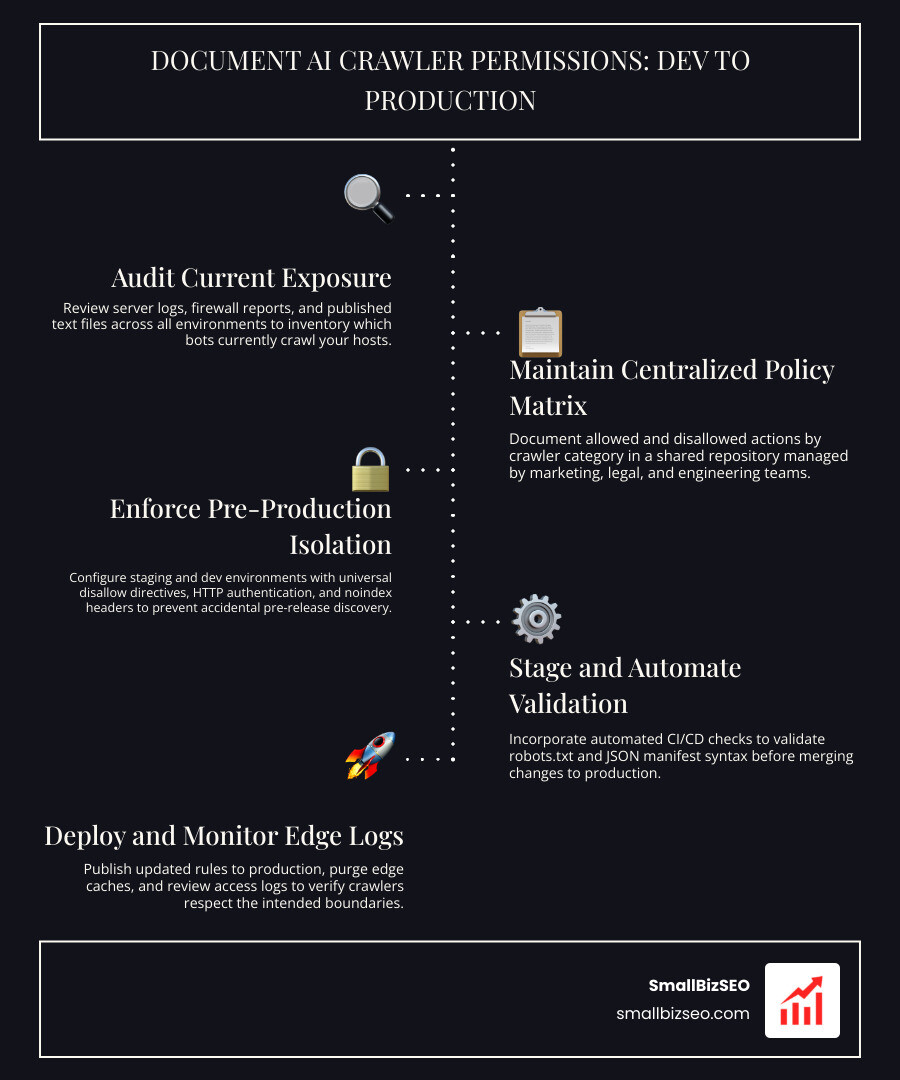
A standardized five-stage deployment process ensures crawler policies remain accurate, auditable, and fully synchronized across all website environments.
- 1. Audit Current Exposure: Review existing server logs, edge firewall reports, and published text files across all environments to inventory which bots currently crawl your hosts.
- 2. Maintain a Centralized Policy Matrix: Document allowed and disallowed actions by crawler category in a shared repository managed by marketing, legal, and engineering teams.
- 3. Enforce Pre-Production Isolation: Configure staging, testing, and development environments to return universal disallow directives paired with HTTP authentication and noindex response headers to prevent accidental pre-release discovery.
- 4. Stage and Automate Validation: Incorporate automated checks in your CI/CD pipelines to validate syntax for robots.txt and JSON manifests before merging changes to production, particularly during any major site migration.
- 5. Deploy and Monitor Edge Logs: Publish the updated rules to production, purge relevant edge caches, and review access logs to verify that crawlers respect the intended boundaries.
How Can Signatures, Logs, and Audit Trails Help Verify Crawler Policies?
To ensure that crawler activity matches documented permissions, engineering teams must maintain detailed audit trails of policy updates and validate incoming requests against published crawler identities and cryptographic signatures.
Because malicious scrapers frequently spoof legitimate user-agent strings, log verification requires checking request origins against published IP address ranges. Emerging frameworks also leverage HTTP Message Signatures to cryptographically authenticate legitimate automated agents before granting access to structured data or API endpoints.
Maintaining a version-controlled changelog connects every robots.txt or manifest modification to specific business requirements, such as data licensing agreements or privacy compliance updates. Organizations that conduct a formal AI access controls audit can systematically review server logs, validate reverse-proxy enforcement, and ensure their multi-environment crawler policies remain secure and up to date.
Mastering Your AI Discovery and Content Governance Strategy
Documenting AI crawler permissions requires aligning business goals with technical enforcement across every web environment. By maintaining a single source of truth for your bot policies, keeping pre-production environments private, and pairing public manifests with reverse-proxy enforcement, you protect valuable content while maintaining visibility in modern AI search platforms. Regularly audit your access logs and policy files to keep your governance framework resilient as the automated web continues to evolve.