Why Google Possum Filters Near-Duplicate Business Listings

How Does Possum-Era Local Filtering Differ From Duplicate Business Listings?
The key difference in possum-era local filtering versus duplicate business listings is what disappears. A filtered business profile still exists, but Google may leave it out of results for a particular search. A duplicate is an extra profile for the same business that can split reviews and confuse customers. If your profile is missing from the local pack, check whether it appears for your business name or from another search location before treating it as a duplicate.
Google's Possum update made local results more sensitive to searcher location and similarities between nearby businesses. That means two real businesses sharing a building can compete for visibility without either profile being a duplicate.
I'm Clayton Johnson, founder of SmallBizSEO. My work in SEO and business information helps me explain possum-era local filtering versus duplicate business listings as two different problems that call for different fixes.
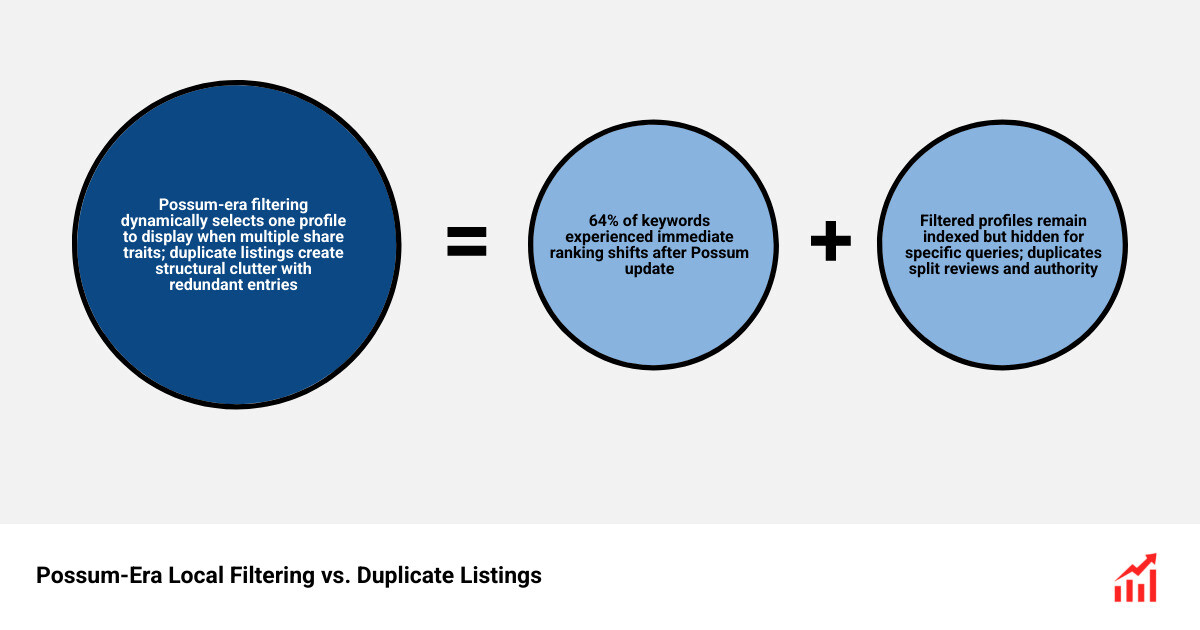
When Google launched this update, tracking data revealed that 64% of keywords experienced immediate ranking shifts within the Local Finder. The change aimed to diversify local results rather than penalize businesses. Just as an opossum plays dead when threatened, filtered profiles appear invisible under specific queries while remaining fully indexed and active in Google's database. Duplicate listings, by contrast, represent actual structural clutter—redundant entries that split user trust, review counts, and organic ranking signals.
How Do Possum-Era Local Filtering and Duplicate Listings Differ in Google Maps?
Algorithmic local filtering dynamically chooses which single profile to display when multiple entries share similar traits, whereas duplicate listings represent multiple live entries for a single enterprise.
Every Google Business Profile possesses a unique Customer Identification (CID) number. When an algorithmic filter engages, both profiles retain their independent CIDs, indexing status, and reviews, but Google displays only the stronger profile to prevent repetitive search packs. As detailed in the historical analysis of Explaining Possum, this shift forced local businesses to reconsider how physical addresses and digital assets interact.
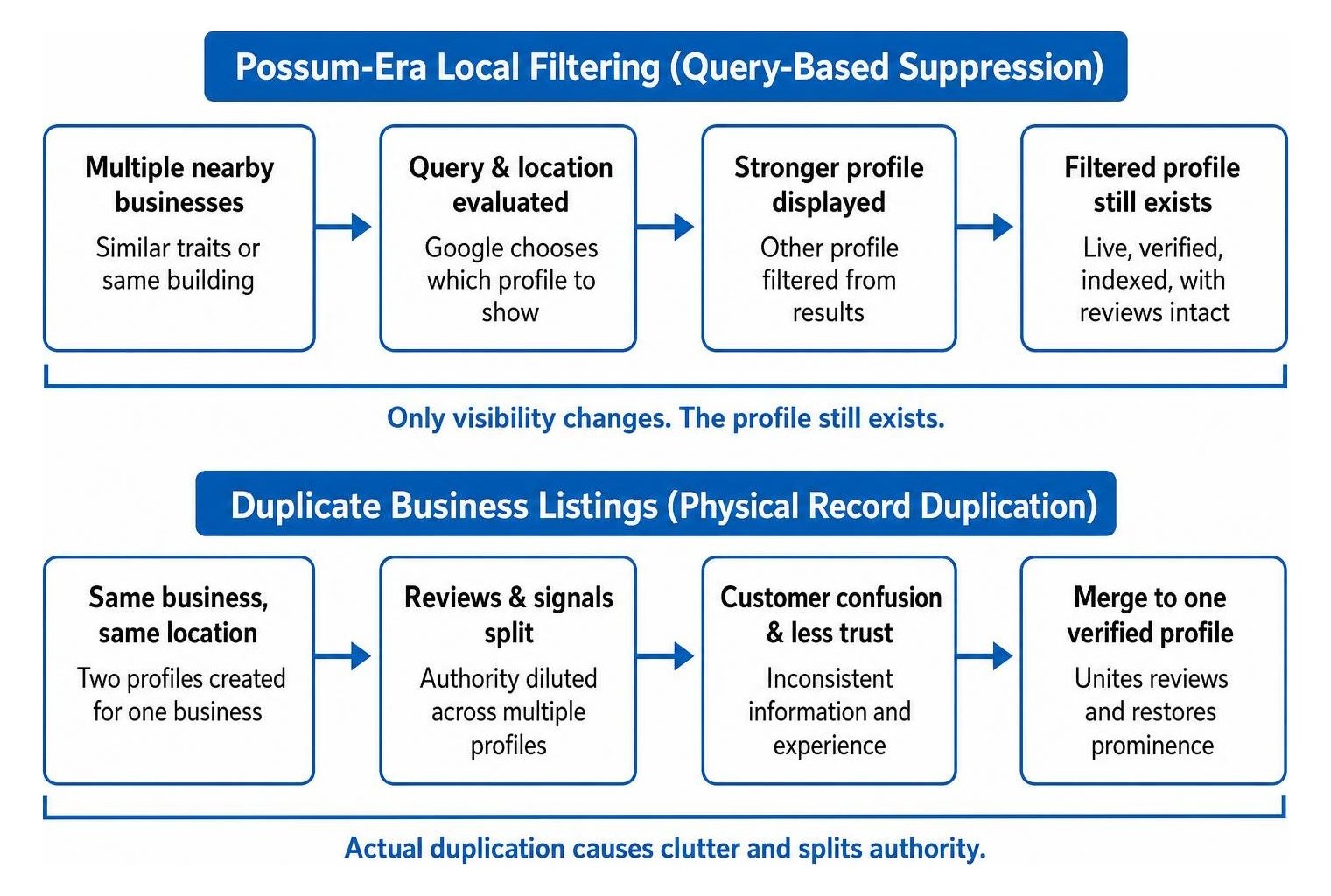
Duplicate listings introduce authority dilution. When an enterprise operates two distinct profiles for the exact same physical space, incoming customer reviews split across both assets. For example, a dental practice might discover an older profile holding 12 reviews while their primary profile holds 40. Merging those duplicate assets unites all 52 reviews onto one verified profile, immediately elevating prominence.
| Characteristic | Possum-Era Local Filtering | Duplicate Business Listings |
|---|---|---|
| Profile State | Live, verified, and completely indexed | Unintentionally duplicated or abandoned |
| Primary Cause | Proximity overlap or shared address | Multiple manual creations or auto-generation |
| Review Impact | Reviews stay intact on a single profile | Reviews split across multiple listings |
| Map Visibility | Toggles based on query and searcher location | Both listings compete or confuse map crawlers |
| Resolution Strategy | Differentiate categories, content, and prominence | Claim, consolidate, and merge extra listings |
Why Did Google Launch Possum and the Hawk Update to Refine Proximity?
Google introduced these updates to break the artificial barriers created by strict city borders and eliminate repetitive directory spam from the Local Pack.
Before these adjustments, a service business located just outside municipal limits struggled to rank for central city queries, even when situated closer to the user than downtown competitors. The update relaxed hard municipal boundaries, allowing 9% of tracked keywords to introduce new businesses into the Local Finder. This update simultaneously prioritized real-time searcher proximity signals over keyword-stuffed titles while actively combating map spam across clustered commercial zones.
However, the initial filter proved overly aggressive, hiding separate businesses simply because they shared an office building or street block. To resolve this, Google introduced a follow-up refinement known as the Hawk update. Hawk tightened the filtering radius, allowing distinct companies located near one another to appear together in local search results as long as their operational categories remained distinct.
Why Does Google Filter Shared Addresses, Practitioners, and Proximity Clusters?
Google filters shared addresses and clustered businesses to present a varied list of distinct choices instead of flooding the map with multiple listings from the same office.

When multiple businesses list the same building without unique branding or differentiated services, search algorithms interpret them as a single entity attempting to dominate the map pack. As explored in The Mechanics of Proximity: How Google’s Local Algorithm Works, search engines rely on a complex entity-matching pipeline that clusters listings based on physical location, business names, website domains, and shared phone numbers.
What Triggers Address-Based Filtering for Co-Located Businesses and Practitioners?
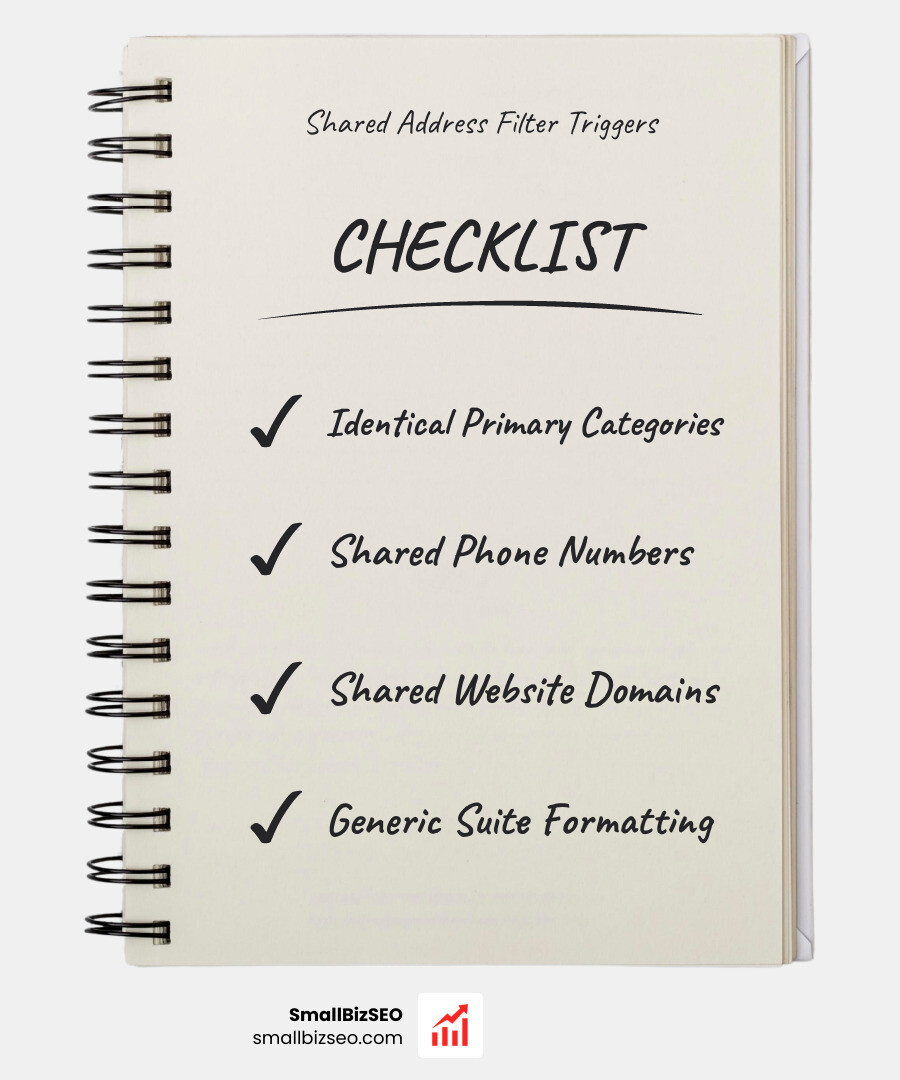
Address-based filtering occurs when separate listings feature overlapping categories, shared contact information, or identical suite coordinates.
Professional spaces such as legal practices, wellness clinics, and co-working facilities face high filtering risks. If three independent attorneys operate out of suite 200 under the primary category "Personal Injury Attorney," Google will generally display only the listing with the highest prominence and review count. Implementing tested Google Business Profile ranking tips helps prevent these suppression traps.
- Identical Primary Categories: Two co-located businesses using identical primary categories trigger immediate deduplication.
- Shared Telephone Numbers: Utilizing the same front-desk phone number across distinct profiles links them as a single entity.
- Shared Website Domains: Pointing practitioner profiles and master practice profiles to the identical root URL causes algorithmic filtering.
- Generic Suite Number Formatting: Using shared suite numbers or ambiguous virtual office addresses confuses mapping algorithms.
- Practitioner Overlap: Individual practitioner profiles competing directly against their parent practice profile for core category searches.
How Have Vicinity and Neural Matching Changed Possum-Era Local Filtering?
Modern algorithm updates have integrated deep semantic language models and strict proximity bounds, significantly shrinking the geographic area over which any single business listing can rank.

The Vicinity update reshaped local visibility by reducing average local ranking radiuses by roughly 30%. While earlier updates allowed prominent listings to rank across wide regions, modern proximity algorithms heavily weight the exact location of the searcher.
Simultaneously, neural matching allows algorithms to grasp implicit user intent. Even if a search query lacks explicit local keywords, Google matches the request with hyper-relevant business profiles based on user context and real-time open status. Furthermore, local advertising space has expanded substantially; sponsored local listings grew from under 3% to roughly 22% of tracked mobile keywords, making organic map spots more competitive. Understanding Google's Vicinity update is vital for navigating this compressed geographic landscape.
How Can You Diagnose, Fix, and Future-Proof Local Pack Visibility?
Diagnosing local visibility requires tracking rankings across a geographic grid, verifying listing status, isolating duplicate records, and establishing distinct profile signals.

Relying on a single search from your office computer can produce misleading results because proximity skews the display. Instead, multi-point geo-grid tracking evaluates performance from various coordinates across your target neighborhood. By applying disciplined local SEO strategies, you can uncover hidden ranking drop-offs, differentiate business details, and build continuous prominence signals.
How Can You Tell If Your Profile Is Filtered or Facing a Business Profile Suspension?
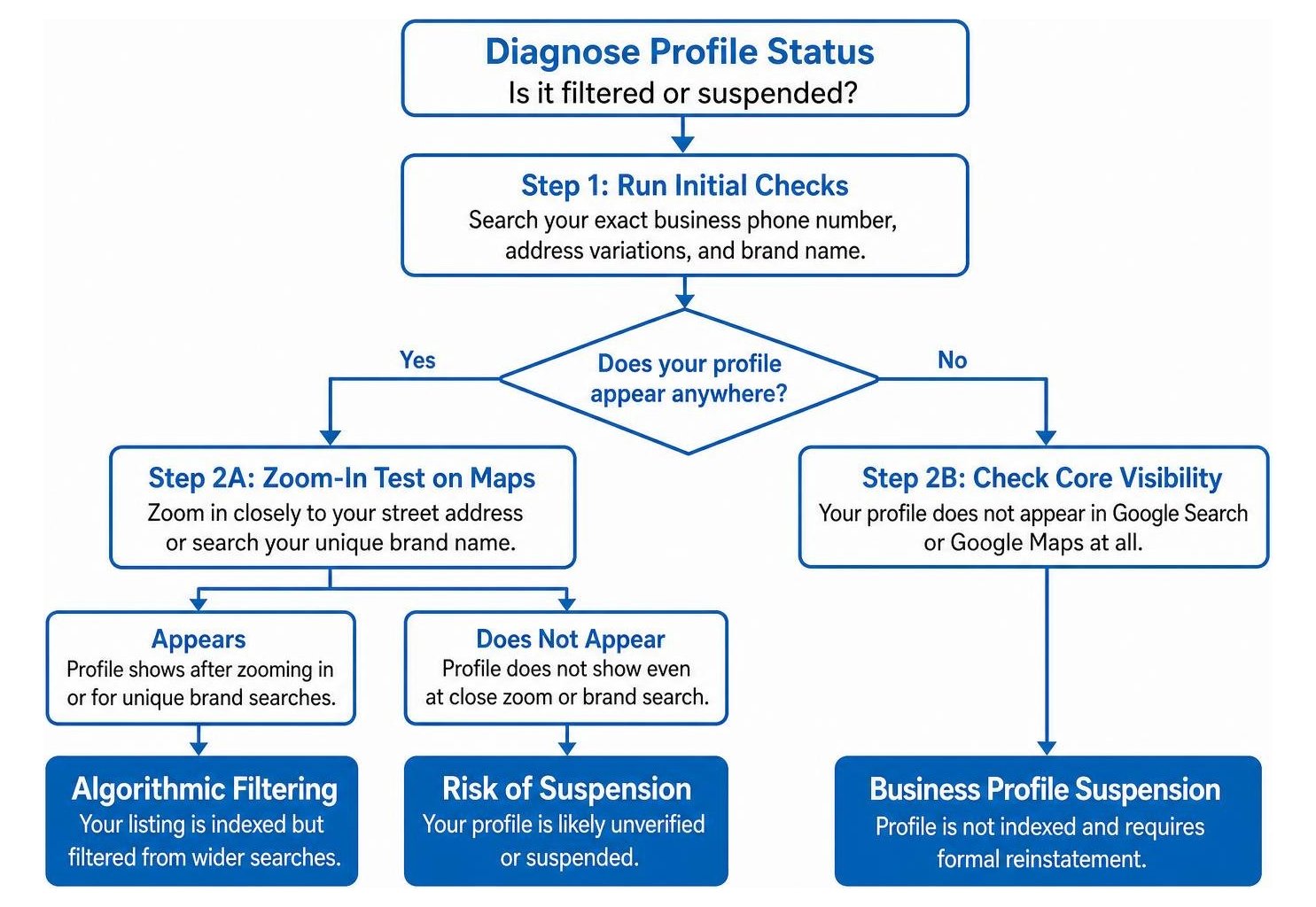
A filtered profile remains completely indexed and visible when searching its exact brand name, whereas a suspended profile disappears entirely from Google Search and Google Maps.
To diagnose your status, perform a zoom-in test on Google Maps. If your profile appears after zooming in closely to your street address—or appears for unique brand searches—your listing is encountering algorithmic filtering rather than a manual penalty. Conversely, an unverified or suspended profile will fail to appear entirely, indicating the risk of a business profile suspension that requires formal reinstatement.
How Can You Consolidate Duplicates, Resolve Entity Clashes, and Optimize for AI Local Search?
Fixing local visibility issues involves merging true duplicate profiles, providing clear physical suite distinctions, implementing structured data, and expanding brand citations across high-authority networks.
Start by searching your exact business phone number, address variations, and brand name across Google Maps. When duplicate profiles surface, use Google Business Profile support to merge the extra entries so that accumulated reviews consolidate onto your primary profile. For shared offices, ensure distinct suite identifiers, unique phone lines, and individual landing page URLs for every practitioner.
Integrate comprehensive LocalBusiness structured data markup onto your website landing pages to reinforce your organization's unique identity. This clarity directly benefits modern search, where platforms rely on structured entities to answer complex local prompts. Independent industry research shows Yelp earned 3.4 times more citations across 28 million conversational local responses than any rival platform, highlighting the need for clean, widespread citations.
Despite the emergence of automated discovery assistants, 93% of consumers continue to place their highest trust in traditional search results for finding local services. Businesses that align their technical foundational data avoid suppression and capture ongoing local market demand.
Elevate Your Local Pack Presence
Mastering the difference between dynamic algorithmic filtering and physical duplicate records is essential for sustaining local search visibility. If your business shares an address, operates multi-practitioner offices, or experiences unexpected drops in local pack impressions, our specialized diagnostics can help. Schedule a comprehensive SmallBizSEO Possum local SEO audit to identify hidden filters, resolve profile conflicts, and secure top-tier local rankings.