A Practical Guide to Local SEO for Scaffolding Rental & Leasing

How Can Scaffolding Rental Companies Get More Local Search Leads?
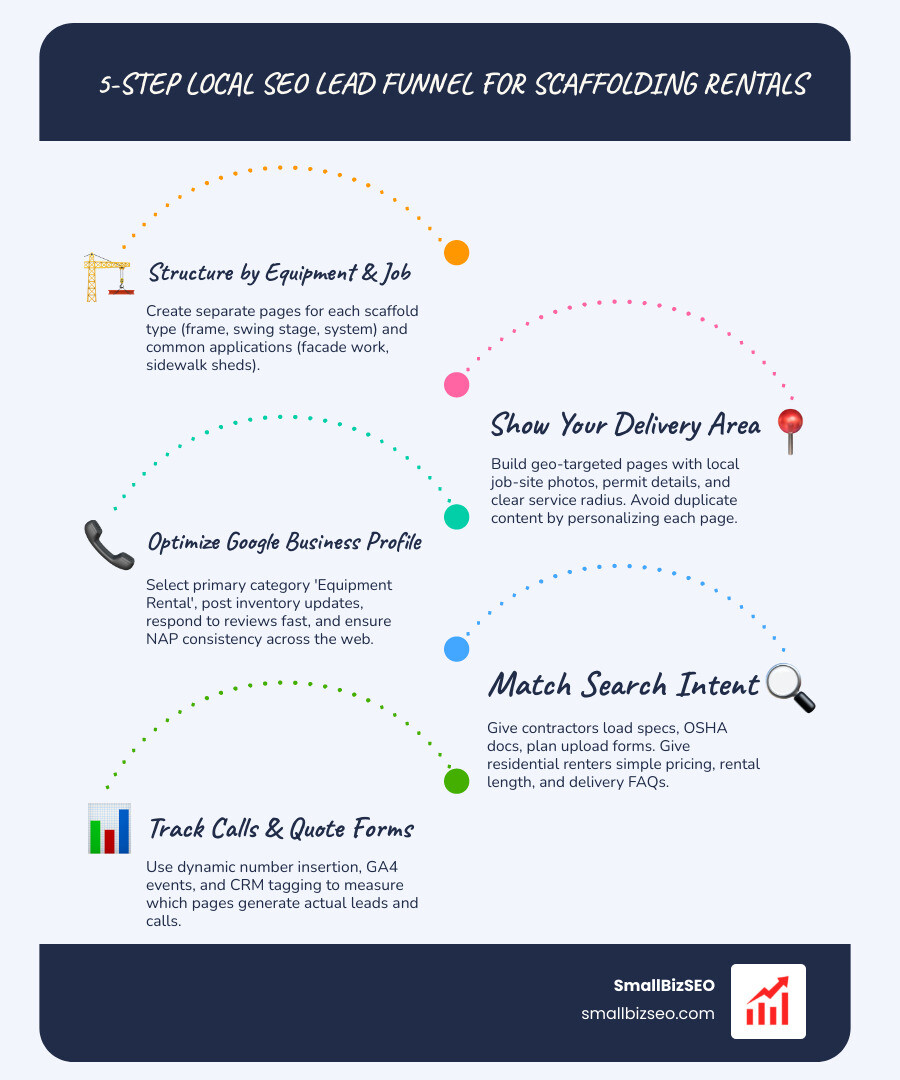
SEO for scaffolding rental & leasing starts with the searches your customers make. Create separate pages for the equipment you rent and the jobs it supports. Show where you deliver, what is available, and how to request a quote. Keep your Google Business Profile accurate, then track calls and quote forms so you can see which pages bring in leads.
Commercial contractors may need load details, safety information, and a way to upload plans. Residential renters often need a simpler answer about access, rental length, and delivery. Each should be able to find the right next step quickly.
I'm Clayton Johnson, founder of SmallBizSEO. My work in technical SEO, content strategy, and building website authority informs this guide to SEO for scaffolding rental & leasing.
Terms related to SEO for scaffolding rental & leasing:
- SEO for contractor
- SEO for demolition & excavation contractors
- SEO for mobile offices & commercial units
Introduction to Scaffolding Search Visibility
Commercial scaffolding is a capital-intensive industry where fleet utilization dictates profitability. Roughly 40% of construction equipment across regional markets is rented rather than purchased. A typical project keeps staging equipment on-site for four to five months, making rental fleets the primary choice for project managers looking to protect working capital.
General contractors (GCs), project estimators, and site supervisors do not search for scaffolding equipment casually. They operate within an active two- to four-week digital research window prior to issuing bids or mobilizing job sites. During this period, procurement teams evaluate local providers based on inventory availability, safety compliance, engineering capabilities, and delivery turnaround speed.
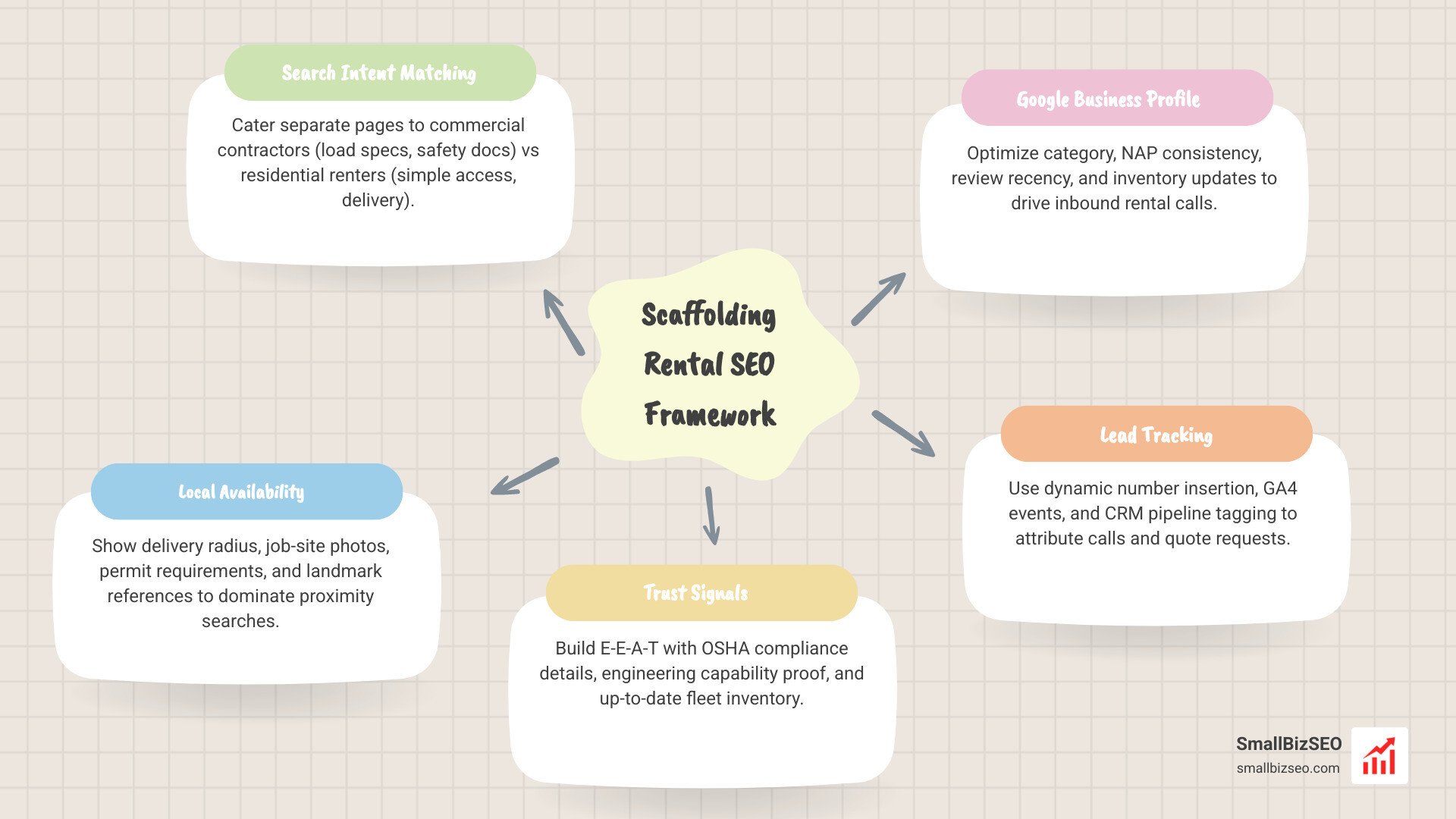
If your rental yard is invisible in search engines during that critical vetting phase, you lose recurring commercial accounts before an RFP is even sent. Winning high-margin leasing contracts requires a digital presence that captures immediate proximity searches while proving your engineering capabilities.
Core Frameworks in SEO for Scaffolding Rental & Leasing
Executing SEO for scaffolding equipment suppliers requires structuring your website as a technical topic cluster rather than a single monolithic services catalog. A single catch-all equipment page dilutes topical authority and confuses search engine crawlers trying to understand your distinct inventory types.
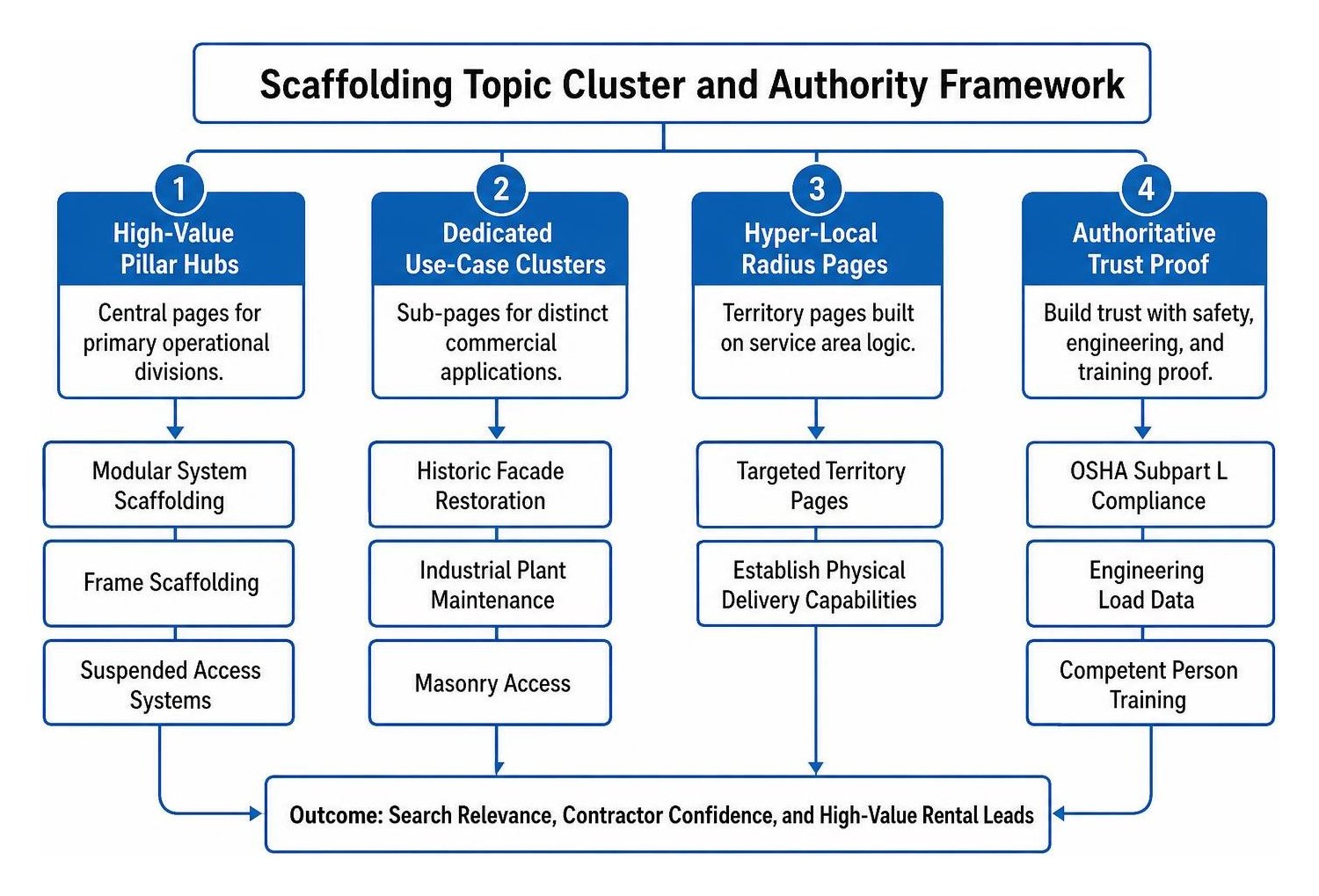
To build sustainable organic visibility, we implement four core architectural layers:
- High-Value Pillar Hubs: Central pages representing your primary operational divisions, such as modular system scaffolding, frame scaffolding, and suspended access systems like Suspended scaffolding rental services.
- Dedicated Use-Case Clusters: Supporting sub-pages that address distinct commercial applications, including historic facade restoration, industrial plant maintenance, and masonry access.
- Hyper-Local Radius Pages: Targeted territory pages built on service area logic that establish physical delivery capabilities.
- Authoritative Trust Proof: Integrating OSHA Subpart L safety compliance references, engineering load data, and certified "Competent Person" training documentation directly into your content architecture.
As an experienced contractor SEO company, we recognize that industrial equipment buyers demand absolute technical clarity. Search engines use these structured clusters to evaluate relevance, while human project managers use them to confirm you can fulfill complex site requirements.
How Do Search Intents Differ Between Commercial Contractors and Residential Renters?
Commercial project managers and residential do-it-yourselfers search with fundamentally different project requirements, budgets, and risk profiles. Treating these two audiences identically on your landing pages hurts conversion rates across both segments.
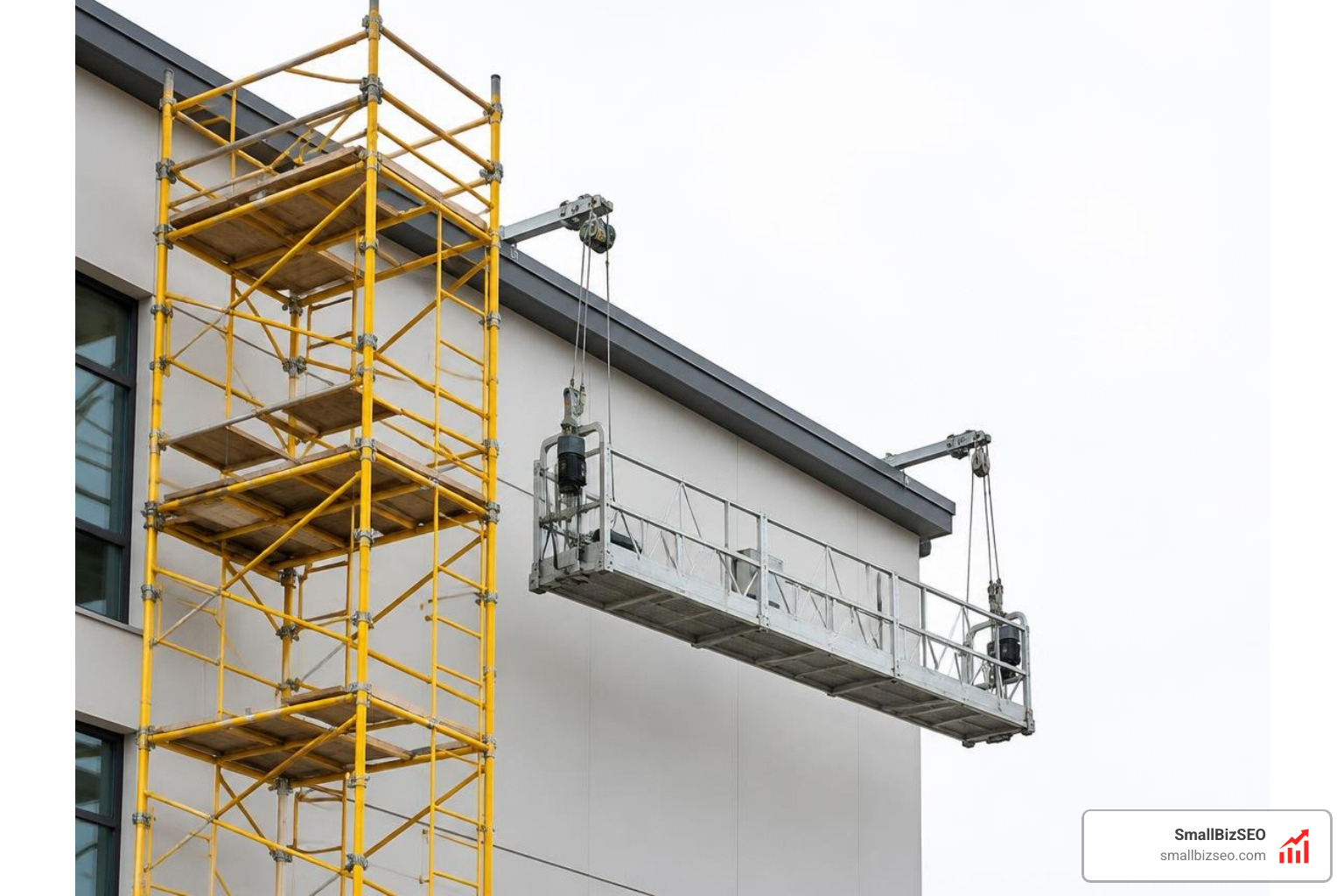
Commercial contractors require high-capacity access systems, strict regulatory compliance, and fast mobilization. Their search queries involve specialized terminology such as mast climbing work platforms, engineered swing stages, load capacities, and shoring systems. Their buying process involves submitting structural drawings and verifying liability insurance.
Residential users typically search for standard mobile rolling towers or basic frame scaffolding for home painting, siding repair, or roof maintenance. Their primary questions center on daily or weekly rental rates, delivery logistics, and ease of assembly.
| Buying Criteria | Commercial Contractor Intent | Residential / DIY Intent |
|---|---|---|
| Primary Systems | Suspended stages, system scaffold, shoring, sidewalk bridges | 5x5 frame scaffold sets, rolling aluminum towers, utility staging |
| Key Technical Concerns | OSHA Subpart L compliance, PE-stamped drawings, tieback points, live load ratings | Simple assembly steps, platform height, castor wheel locks, transport options |
| Conversion Mechanism | Multi-file architectural drawing upload, RFP form, direct line to engineering dispatch | Straightforward contact form, daily/weekly rate chart, equipment pickup inquiry |
| Rental Timeframe | 3 to 12+ months continuous lease | 1 to 7 days short-term hire |
| Key Decision Driver | Risk mitigation, mobilization speed, fleet capacity | Transparent pricing, proximity, straightforward rental terms |
To capture both audiences without creating user friction, our team at our local SEO company implements dual-funnel landing page architectures that route high-stakes B2B requests directly to project engineers while guiding residential users through streamlined rental inquiries.
How Should You Structure Service Pages in SEO for Scaffolding Rental & Leasing?
To rank for high-intent search terms, your website must maintain dedicated, individual URLs for every equipment category and trade application you support. Search engines evaluate topical authority on a page-by-page basis; a broad overview page cannot compete against targeted, item-specific URLs.
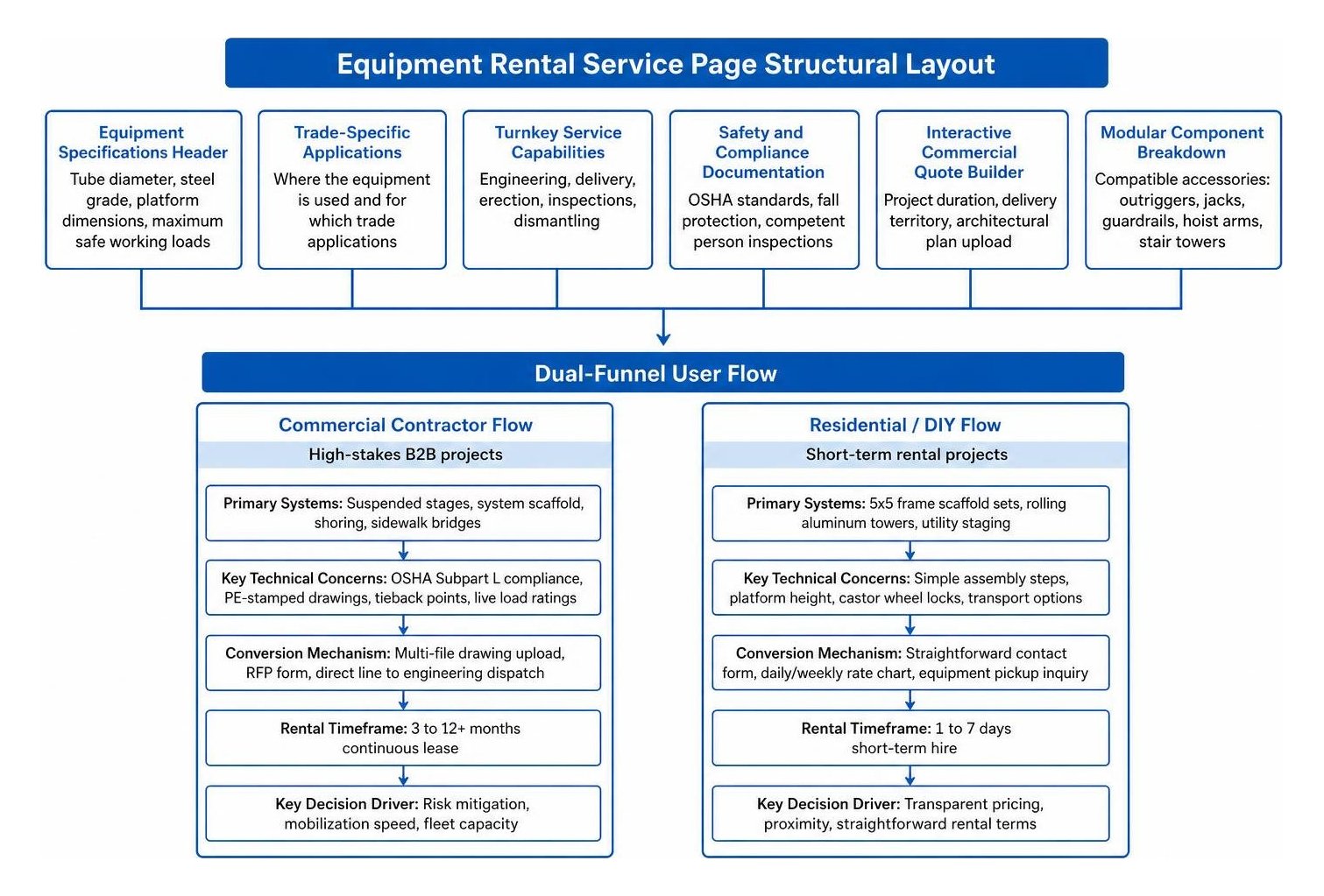
As a specialized B2B SEO company, we recommend organizing your core service pages with the following high-converting structural modules:
- Equipment Specifications Header: Clear technical breakdowns including tube diameter, steel grade, platform dimensions, and maximum safe working loads.
- Trade-Specific Applications: Explicit sections detailing where the equipment is used (e.g., masonry wall construction, exterior insulation finishing systems, glazing installation).
- Turnkey Service Capabilities: Clear descriptions of engineering design, delivery logistics, certified field erection, scheduled safety inspections, and dismantling.
- Safety and Compliance Documentation: Direct references to OSHA standards, fall protection protocols, and competent person inspection guidelines.
- Interactive Commercial Quote Builder: A clean form featuring project duration selectors, delivery territory inputs, and architectural plan upload capabilities.
- Modular Component Breakdown: Clear lists of compatible accessories including outriggers, leveling jacks, guardrail systems, hoist arms, and modular stair towers.
How Can You Build Geo-Targeted Location Pages Without Duplicate Content?
Scaffolding yards typically serve commercial jobs within a wide regional radius, but creating cookie-cutter city pages with swapped city names triggers search engine quality filters and frustrates users. Geo-targeted pages must demonstrate genuine localized operational capability.
To build location pages that drive leads without duplicating text, apply these local SEO tips for businesses:
- Document Local Permitting Protocols: Address specific municipal building codes, sidewalk shed encroachment permits, and Department of Transportation street-occupancy requirements.
- Feature Real Job-Site Case Studies: Embed unedited photographs of your staging systems deployed on recognizable local commercial properties or industrial facilities.
- Detail Real Delivery Logistics: Outline typical dispatch response times, staging yard proximity, and freight mobilization procedures for nearby industrial corridors and commercial districts.
- Include Regional Client References: Feature genuine feedback and reviews from regional general contractors and subcontractors operating in that territory.
- Embed Interactive Service Maps: Clearly delineate your primary mobilization zone, secondary delivery radius, and local equipment pickup yards.
What Google Business Profile Signals Drive the Most Inbound Rental Calls?
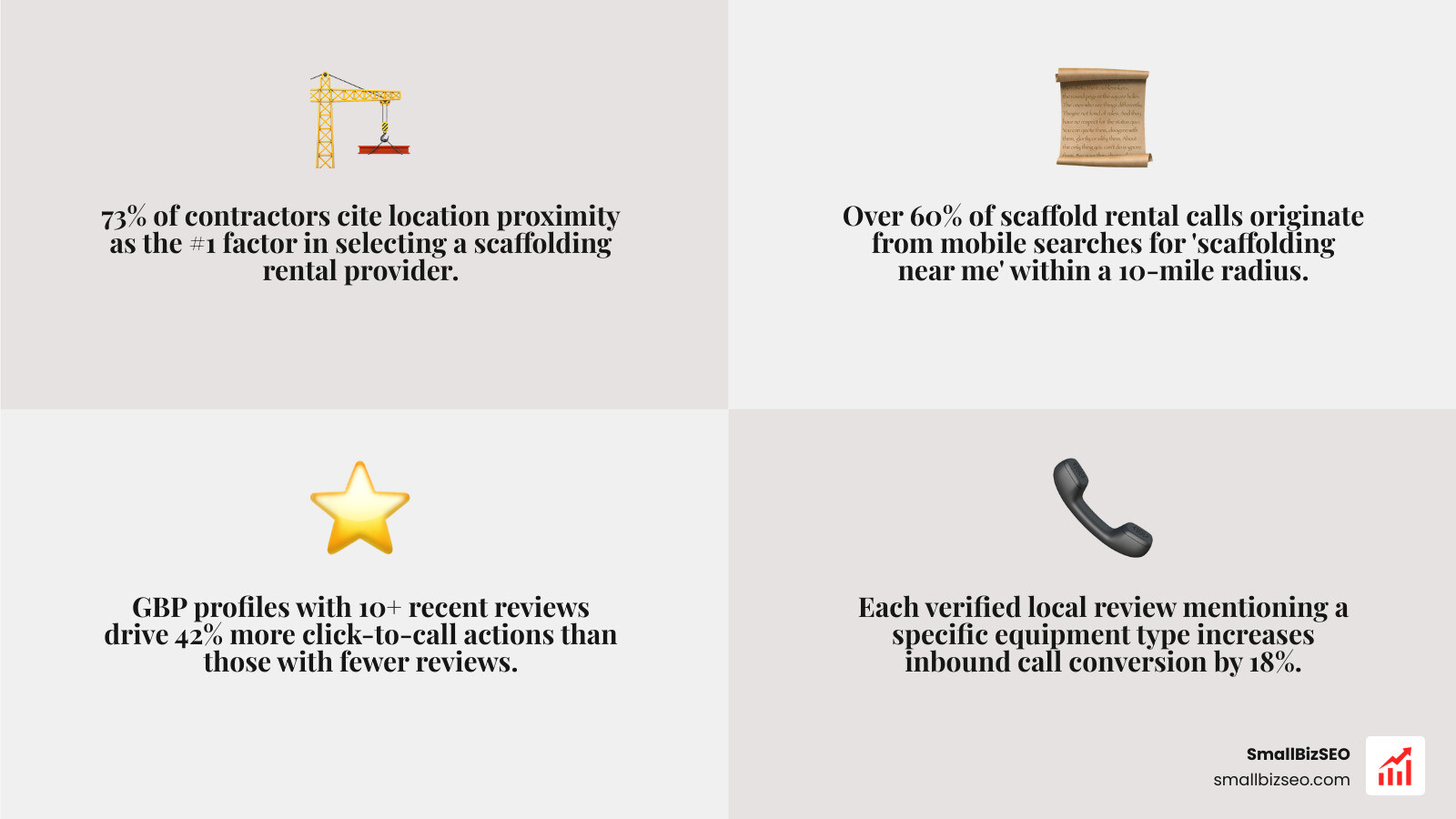
Your Google Business Profile (GBP) is the primary driver of urgent local phone calls from job-site supers and procurement managers who need equipment mobilized immediately.
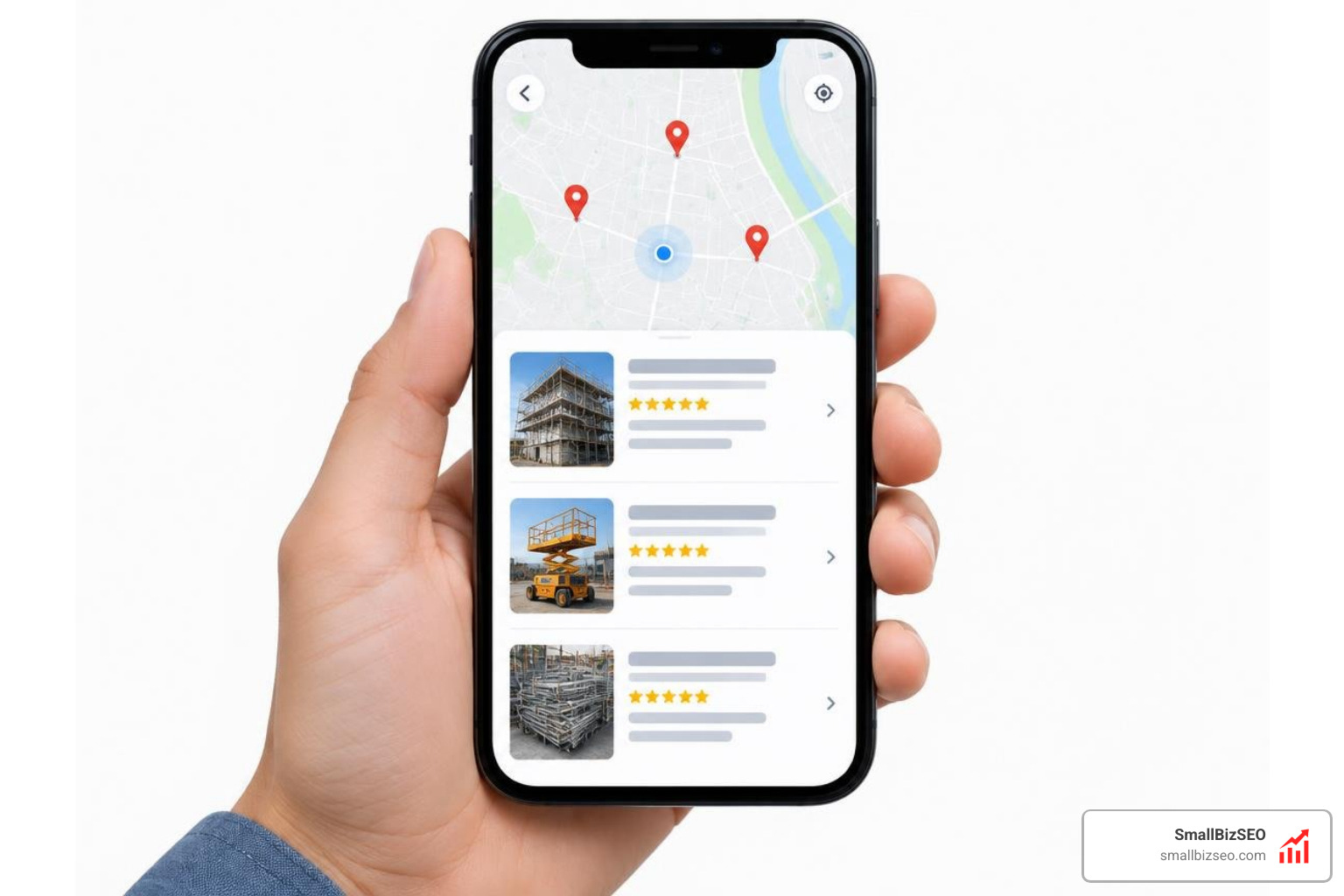
Google ranks local equipment profiles based on three primary algorithmic pillars: Relevance, Distance, and Prominence. For businesses working with an industrial equipment suppliers SEO company, optimizing these specific GBP signals yields the highest call volume:
- Category Prioritization: Select primary and secondary categories accurately, ensuring "Scaffolding Rental Service," "Equipment Rental Agency," and "Construction Equipment Supplier" are active.
- Review Recency and Depth: Implement an automated review collection workflow upon completion of every scaffold strike. Encourage commercial project managers to mention specific equipment types (such as swing stages or stair towers) in their feedback.
- Unedited Inventory Visuals: Upload high-resolution photographs of your physical yard inventory, delivery flatbeds, and active job-site installations directly to your profile.
- Regular Product Catalog Updates: Maintain an updated in-profile product catalog showcasing your core modular systems, frame units, and specialty access hardware.
- Exact NAP Verification: Ensure your legal business Name, physical Address, and primary local Phone number match your website and trade directory listings without discrepancies.
Lead Attribution and Measuring Long-Term Organic ROI
Securing top rankings is only valuable if it produces verified commercial lease agreements and increases equipment utilization. Scaffolding operations require lead attribution systems that track calls, RFPs, and high-value project inquiries back to specific search terms and content hubs.
At SmallBizSEO, our proprietary Velocity framework pairs technical site optimization with multi-channel conversion tracking. We help industrial suppliers eliminate marketing waste and capture predictable pipeline revenue through automated, transparent performance tracking. You can evaluate your current digital foundation by requesting our comprehensive SEO visibility audit.
How Do You Track and Attribute Organic Phone Calls and Quote Requests?
Because commercial contractors frequently call dispatch straight from active job sites, relying solely on basic web analytics misses a significant portion of inbound revenue.
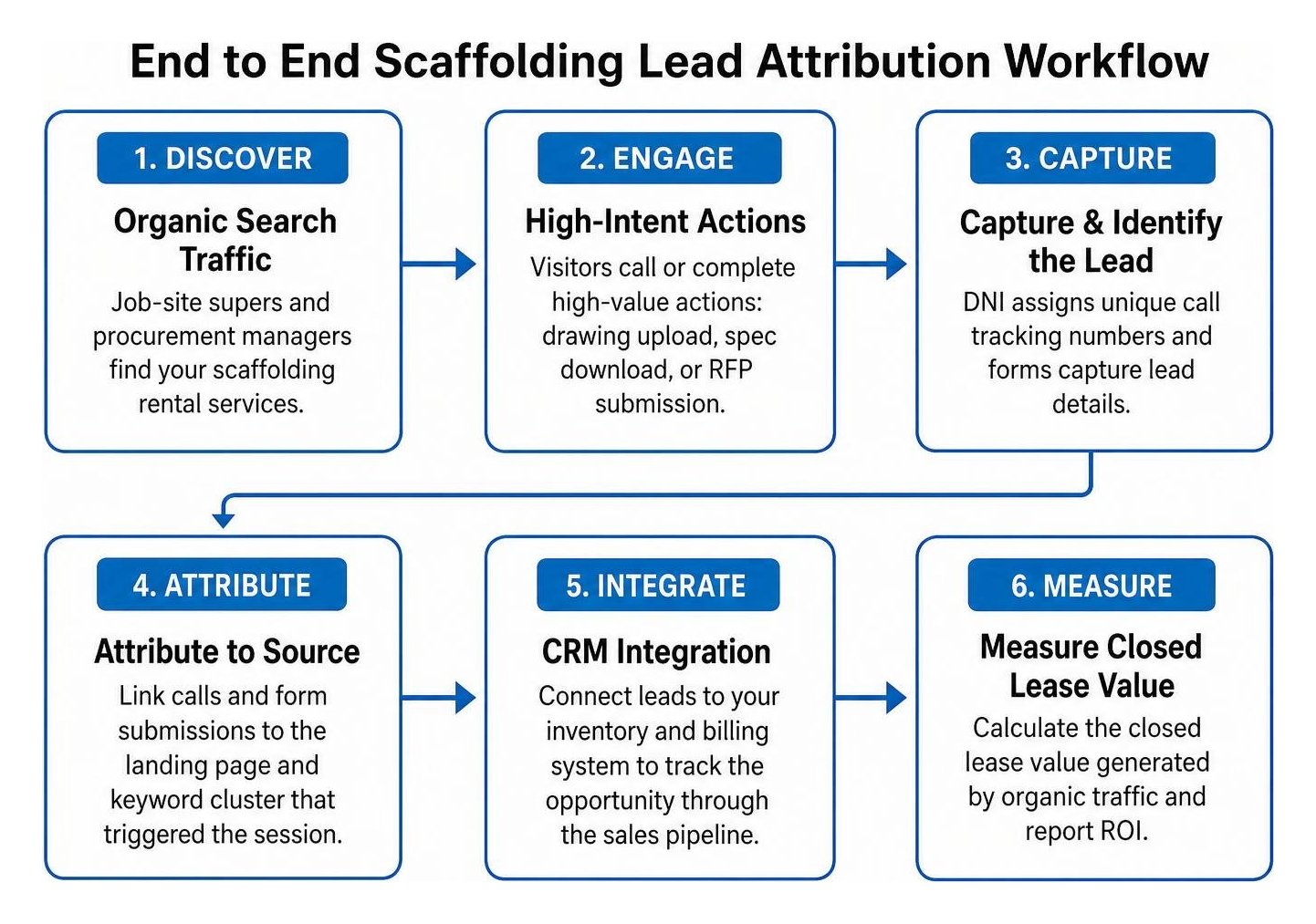
A modern attribution framework for a construction SEO company combines three essential layers:
- Dynamic Number Insertion (DNI): Assigns unique call tracking phone numbers to organic search visitors, linking inbound calls directly to the landing page and keyword cluster that triggered the session.
- GA4 Custom Event Configuration: Tracks high-intent digital conversion events separately, including drawing upload completions, specification sheet downloads, and commercial RFP submissions.
- CRM Pipeline Integration: Connects inbound digital form submissions with your back-office equipment inventory and billing software to calculate the exact closed lease value generated by organic traffic.
When Does SEO for Scaffolding Rental & Leasing Break Even Against Paid Ads?
While pay-per-click (PPC) advertising can deliver immediate traffic, commercial keyword costs in the equipment rental space often exceed sustainable acquisition margins. Over-reliance on paid ads means your lead flow disappears the moment your daily ad budget runs out.
Investing in organic search content builds an enduring operational asset. As documented in broader industry analyses of Scaffolding Equipment Rental & Setup Services, organic optimization compounds over time, lowering your cost per lead as topical authority grows.
The financial break-even point for scaffolding rental SEO typically occurs between month six and month nine of a focused campaign. At this stage, cumulative organic lead volume overtakes paid channel volume, while the cost per acquisition drops substantially. Once your core category hubs achieve top search positions, your organic presence continues generating high-margin commercial inquiries without ongoing cost-per-click charges.
Scaling Your Scaffolding Fleet's Inbound Commercial Pipeline
Securing consistent, high-margin scaffolding rental contracts requires moving beyond generic digital marketing. By building structured equipment clusters, addressing the distinct technical needs of commercial contractors, maintaining an optimized Google Business Profile, and tracking offline conversions, you position your fleet directly in front of procurement teams during their critical pre-bid research window. Organic search visibility turns local online searches into long-term commercial leasing revenue.