A Practical Guide to Search Volume for Keywords in Modern SEO

What Does Search Volume Tell You About a Keyword?
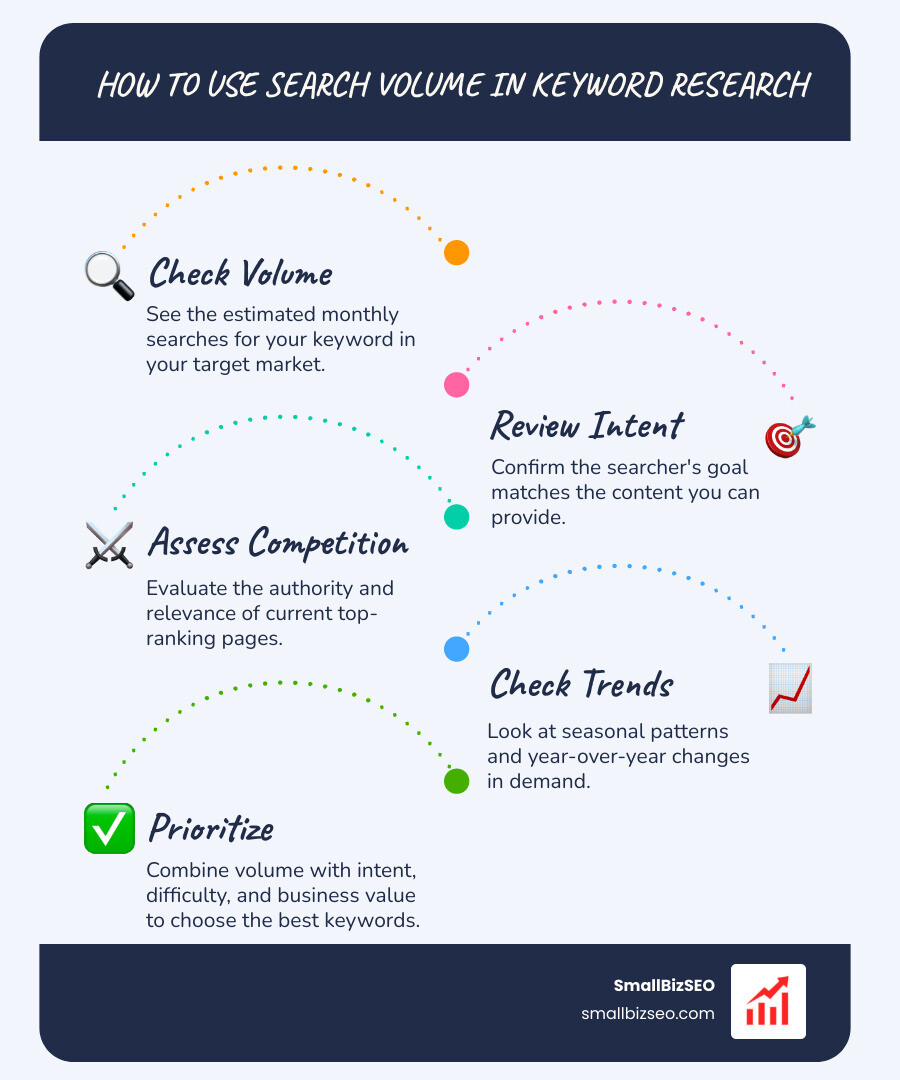
Search volume in keyword research is an estimate of how often people search for a term, usually shown as an average per month. It helps you compare demand for content ideas, but it does not predict how many people will visit your site. To choose a useful keyword, check its volume in the market you serve, then look at search intent, competition, and recent trends.
I’m Clayton Johnson, founder of SmallBizSEO. I use keyword research search volume data to help small businesses plan content around customer questions and qualified leads.
What Is Keyword Research Search Volume and How Does It Work?
Search volume is an estimate of how often people search for a keyword over a set period, usually shown as a monthly average. It can help you compare demand, but it does not tell you how many visits a page will get.
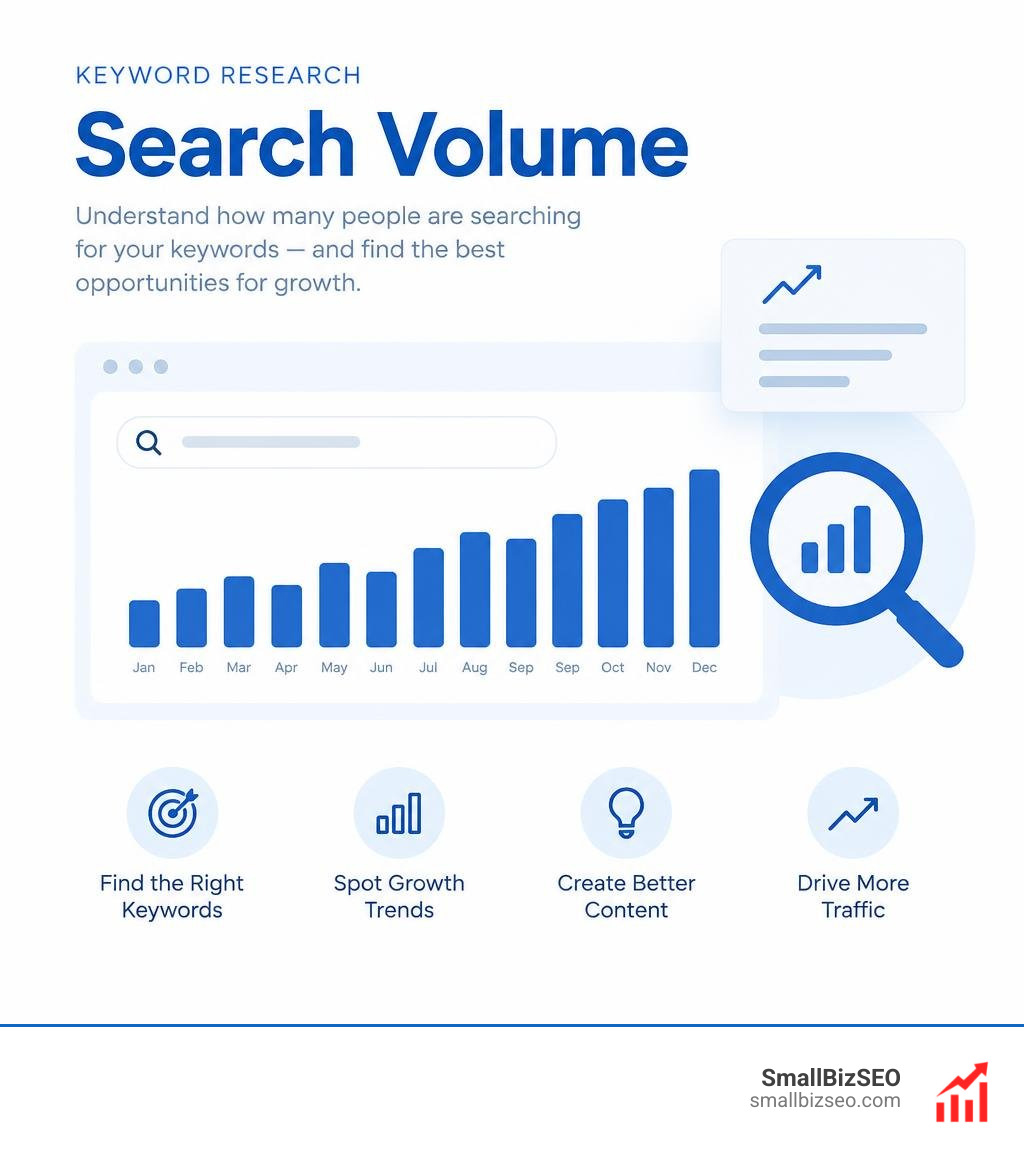
When we analyze queries, search volume provides a snapshot of aggregate user interest. Rather than representing an exact counter of real-time queries, search volume reflects historical demand normalized over time. Major platforms utilize massive databases to supply this data; for instance, modern tools index tens of billions of keywords across hundreds of regional databases to build their estimates.
Understanding search volume fundamentals helps prevent common planning mistakes. Raw query counts come from multiple sources, including ad platform keyword tools, third-party data aggregators, and anonymized clickstream models. Machine learning algorithms process these inputs to filter out automated bot traffic, deduplicate syntax, and estimate what typical monthly searches look like across different markets.
How Is Search Volume in Keyword Research Calculated and Measured?
Search volume is commonly estimated from past search activity, often averaged across 12 months. Tools may group similar searches or round low numbers, so treat the result as an estimate.
Most providers calculate monthly volume by taking the total searches over the previous trailing 12 months and dividing by 12. This rolling average smooths out temporary spikes, giving content teams a steady baseline. However, the underlying collection methods introduce distinct variations:
- Ad Platform Buckets: Google Keyword Planner frequently presents search volumes in broad ranges (such as 1K to 10K) unless an active advertising budget is maintained.
- Query Grouping: Some ad platforms combine close variants, plurals, and misspellings into a single bucket, while specialized SEO databases use variant separation to show distinct counts for singular and plural terms.
- Clickstream Sampling: Third-party datasets analyze panels of user browsing sessions to calibrate search demand estimates independent of advertising tools.
When finding high-intent seed keywords, tracking these calculations prevents relying on distorted data. Seasonal terms, such as tax preparation or holiday gifts, might show a moderate 12-month average while generating massive spikes for two months and near-zero searches for the rest of the year.
Why Does Search Volume Differ from Actual Organic Traffic and Potential?
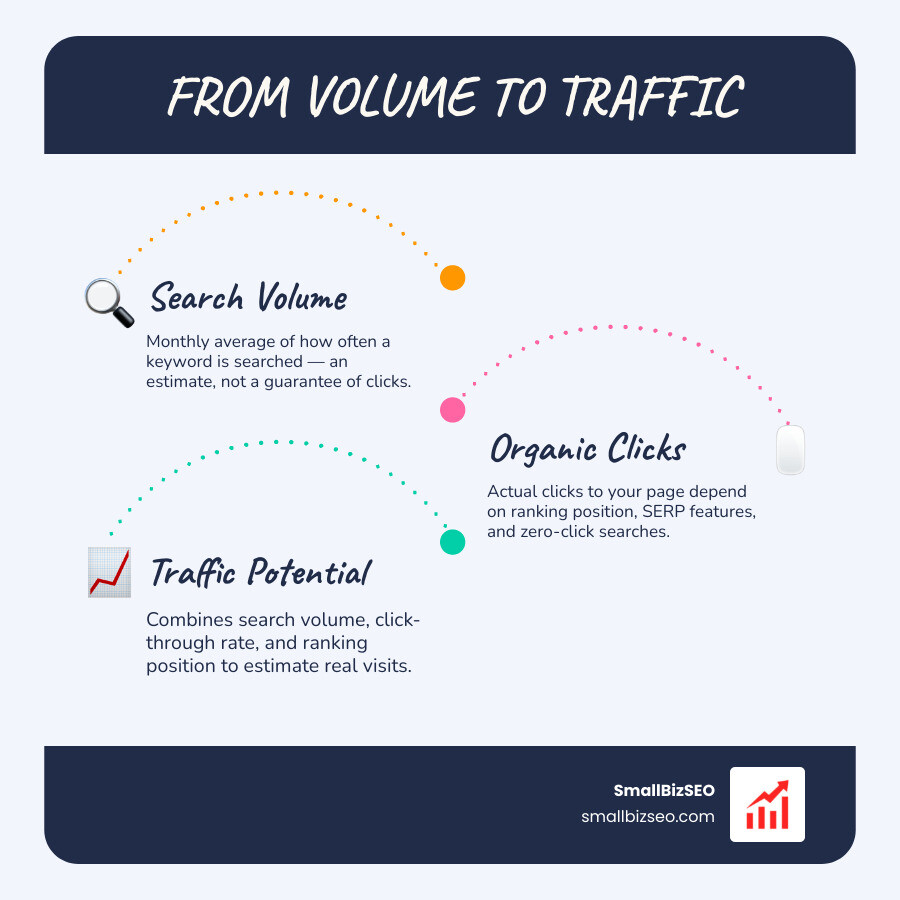
Search volume is not the same as organic traffic: some searches get no clicks, and a page’s traffic also depends on its ranking and the results shown. Compare estimated volume with likely clicks and traffic potential.
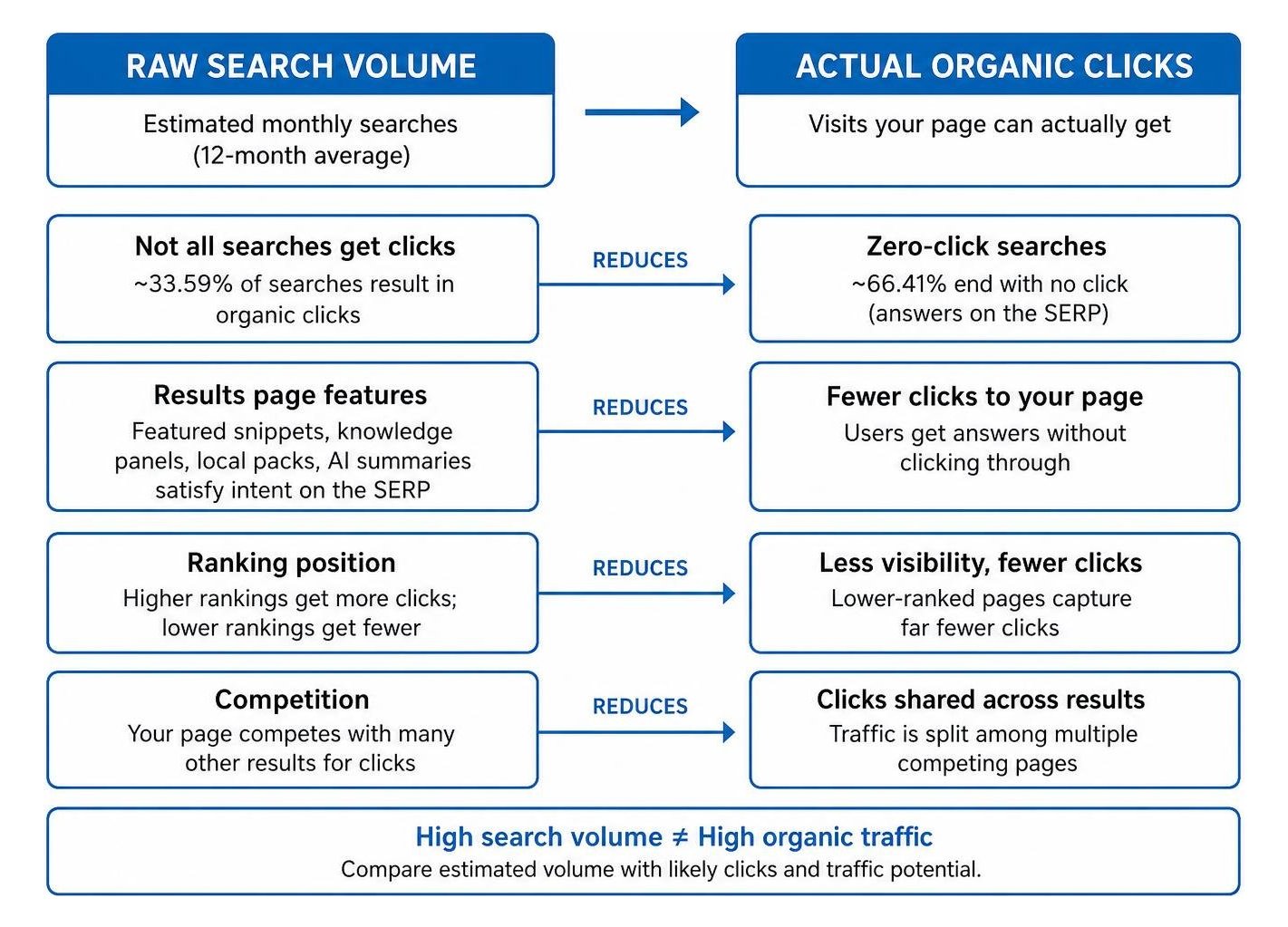
A high volume metric does not guarantee high visitor counts. Industry research shows that out of 5.1 trillion searches in a benchmark study, only an estimated 33.59% resulted in clicks on organic search results. Roughly two-thirds of searches ended as zero-click queries, where users found their answer directly on the search engine results page (SERP) via featured snippets, knowledge panels, or local map packs.
Furthermore, AI-generated answer features on modern search engines directly summarize web content, satisfying user intent before an organic link is selected. To accurately assess real-world viability, we must examine more than the top-level number when analyzing search volume.
| Metric Type | What It Measures | Impact on Strategy | Example Scenario |
|---|---|---|---|
| Search Volume | Total monthly searches across all users | Gauges total market interest | A broad term shows 10,000 searches per month. |
| Organic Click Share | Percentage of searches that click organic results | Identifies zero-click SERP features | Rich snippets answer the query, reducing clicks to 2,000. |
| Traffic Potential | Total visits to the top-ranking page from all keywords | Reveals full topic value across secondary terms | The #1 page ranks for 300 related terms, driving 4,500 total visits. |
A page ranking in position one rarely captures 100% of organic clicks. Typical first-position click-through rates range between 25% and 35%, declining sharply for lower positions. However, a single authoritative page can rank for hundreds of secondary long-tail variations, allowing its total traffic potential to far exceed the volume of its primary target keyword.
How to Evaluate and Prioritize Keywords Using Demand Metrics
Prioritize keywords by combining demand with intent, competition, and business value—not by choosing the highest-volume terms alone. Group related terms into content clusters and validate that the results match what you can offer.
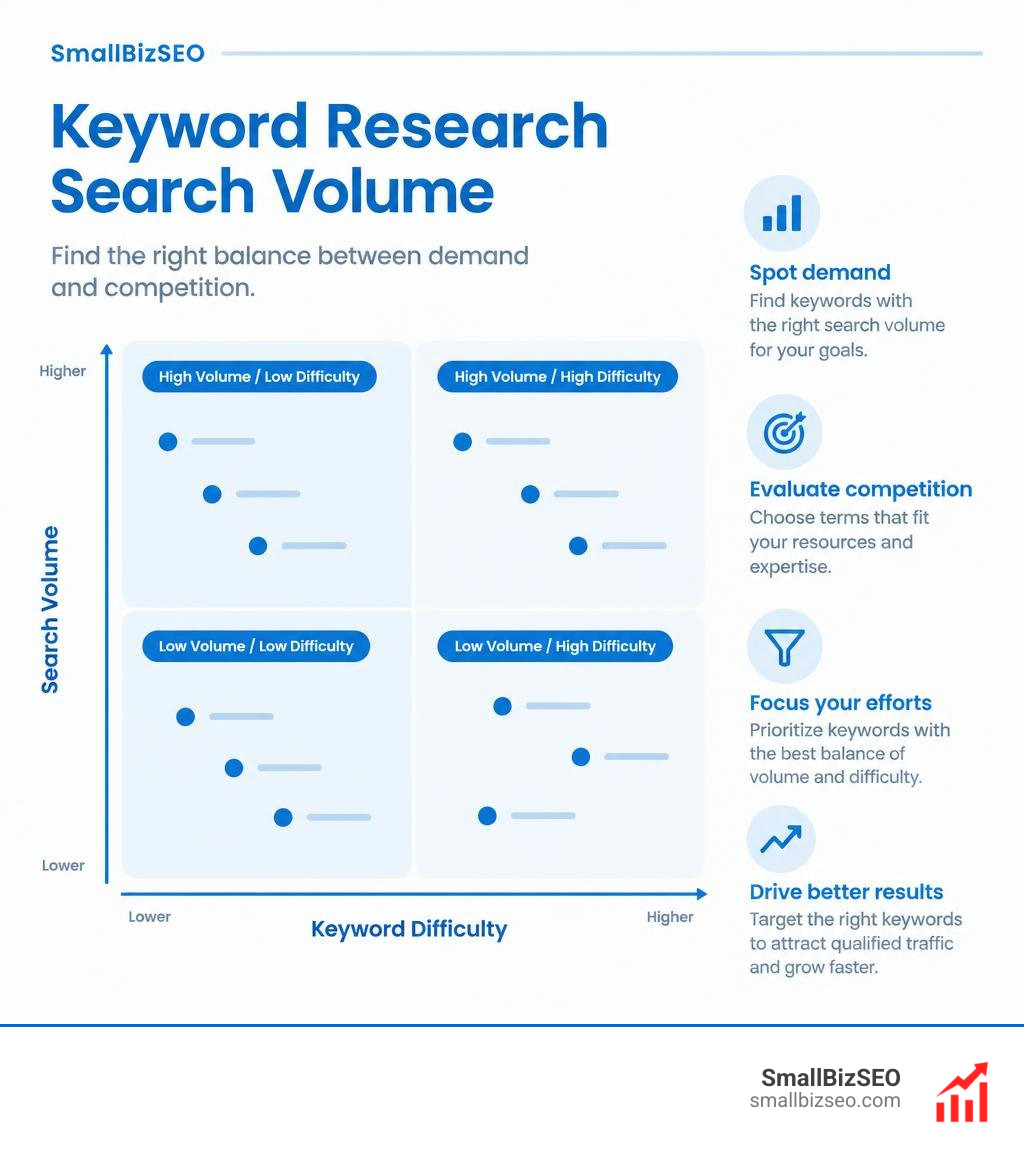
Effective keyword prioritization requires balancing search volume against ranking feasibility and commercial relevance. You can use platforms like the Google Ads Keyword Planner to discover query ideas, but ranking success depends on building strategic topical authority rather than chasing isolated numbers.
What Is a Good Search Volume in Keyword Research for Different Niches?
A good search volume depends on the market and the value of a search; there is no single useful minimum for every niche. A specific local or B2B query with modest demand may be more valuable than a broad head term.
Broad consumer markets often see head terms with monthly volumes exceeding 50,000 searches. Conversely, specialized business-to-business sectors or localized services might find that their most profitable terms register fewer than 200 monthly searches.
When evaluating what makes a volume level viable, consider the conversion value:
- Broad Head Terms (10,000+ searches): High competition, lower conversion intent, and broad informational focus.
- Mid-Tail Categories (1,000 to 10,000 searches): Moderate competition with clearer topical boundaries.
- Targeted Long-Tail Terms (Under 1,000 searches): Highly specific intent with lower ranking hurdles.
For niche providers, targeting low-volume search queries often delivers faster organic visibility and higher conversion rates than fighting for generic keywords. By uncovering long-tail opportunities, you connect with prospects who are further along in their buying cycle and ready to take action.
How to Evaluate Search Intent, Difficulty, and CPC Alongside Volume
Check what searchers want, how competitive the results are, and whether the keyword could support a business goal. CPC can hint at commercial value, but it does not prove that a search will convert.
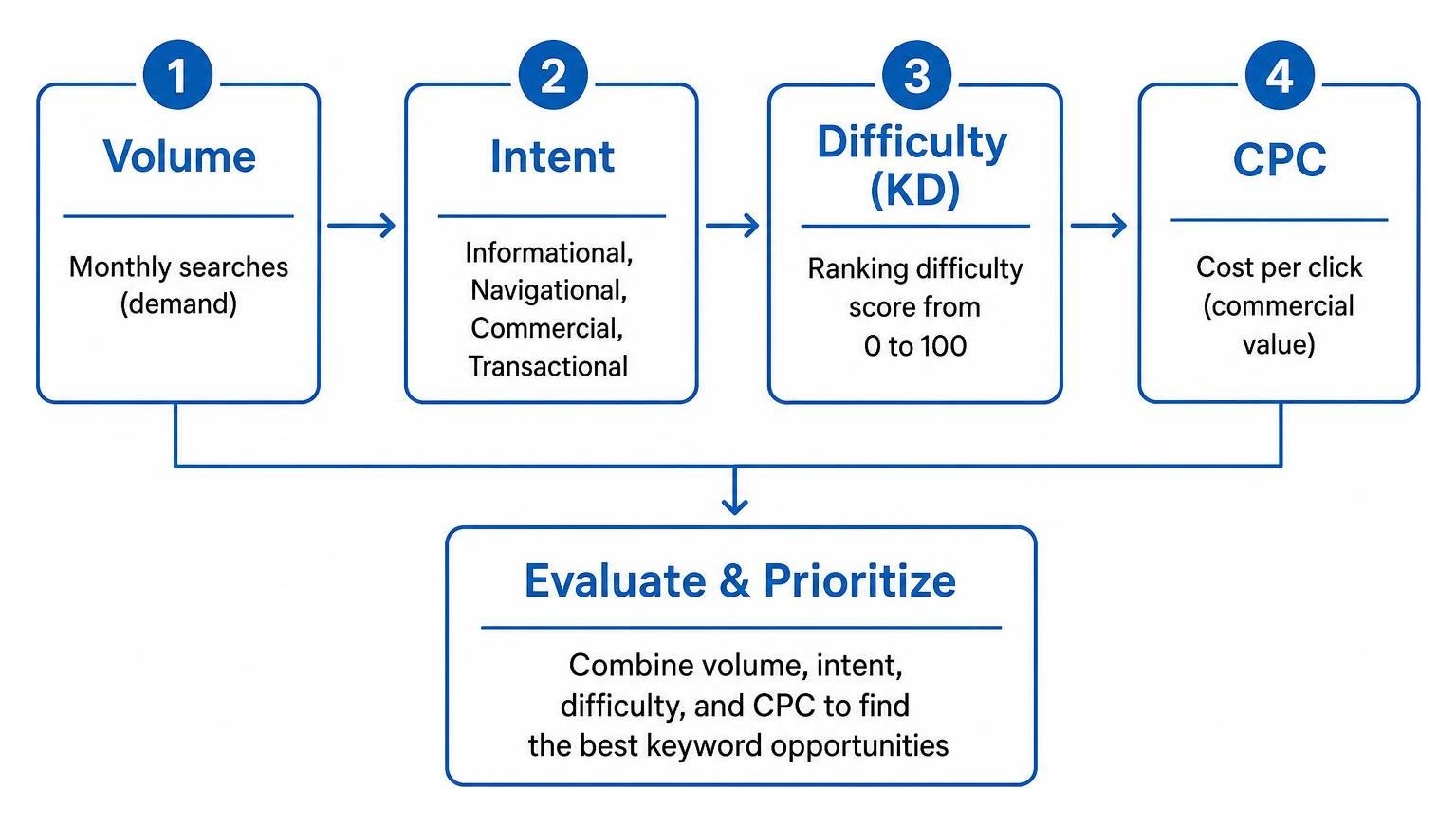
A query with 5,000 monthly searches is useless if the search intent does not match your business model. We evaluate three complementary metrics alongside search volume:
- Search Intent Match: Search engines categorize queries as informational, navigational, commercial investigation, or transactional. By evaluating search intent, we ensure an educational guide is not created for a query where users expect a product checkout page.
- Keyword Difficulty (KD): Most SEO tools score ranking difficulty from 0 to 100 based on the backlink profiles and domain authority of the current top ten results. Targeting terms with low-to-moderate difficulty allows newer websites to secure rankings quickly.
- Cost Per Click (CPC): High advertiser bids signal strong commercial intent. If businesses are willing to pay $10 or more per click in paid search campaigns, ranking organically for that phrase carries high financial value.
Organizing these insights through structured keyword mapping ensures each page on your website targets a unique set of terms, preventing internal cannibalization while covering the entire buyer journey.
How to Account for Location Differences and 12-Month Averaging Limitations
Check search volume for the location you serve and compare the monthly trend with the 12-month average. This helps reveal seasonal peaks and prevents rounded or smoothed estimates from hiding changes in demand.
Search volumes vary significantly across geographic regions. A search phrase with 15,000 monthly queries nationally might only receive 80 searches per month within your specific target service territory. Always filter keyword tools by your target country, state, or metropolitan area to avoid overestimating your reachable audience.
Additionally, evaluate trend momentum. Because standard search volume relies on a 12-month rolling average, it lags behind emerging industry trends and obscures seasonal volatility. A sudden drop or surge in consumer interest will take months to visibly alter the annual average, making historical trend charts essential for accurate planning.
How to Integrate Volume Data into SEO Forecasting and AI Search Strategy
Use search volume as a starting estimate, then forecast likely clicks based on rankings and click-through rates. Track changes over time and pair keyword data with visibility in AI-generated answers.

To build reliable SEO forecasts, we translate raw search volume into realistic traffic and revenue projections. Our team applies our data-driven "Velocity" framework to model traffic growth across planned content campaigns:
- Projected Impressions: Total estimated search volume across primary and secondary keywords in a cluster.
- Estimated Organic Clicks: Applying position-based click-through rate models (e.g., 30% for position 1, 15% for position 2, 8% for position 3) adjusted for SERP feature interference.
- Conversion Modeling: Multiplying anticipated organic visits by historical website conversion rates to estimate new leads and sales.
Automating these workflows via data pipelines gives businesses clear visibility into campaign momentum and content performance over time.
How Does Search Demand Connect to AI Prompts and Future Visibility?
Search volume tools may not capture every conversational prompt people use with AI tools. Track relevant prompts, brand mentions, and source citations alongside traditional keyword demand to understand visibility across both types of search.
Modern consumers increasingly use conversational queries and generative AI interfaces to research solutions. Because large language models do not publish individual prompt search volumes, traditional keyword databases often display zero search volume for long, multi-sentence AI prompts.
Adapting your search strategy requires bridging traditional keyword data with generative AI search optimization. By establishing broad topical authority through comprehensive content clusters, your site becomes a trusted reference source. AI engines pull citations and brand recommendations directly from websites that thoroughly answer both high-volume core questions and highly specific conversational inquiries.
Turning Search Demand Insights into Sustainable Organic Growth
Search volume serves as a compass for identifying market demand, but it represents only one component of a successful organic strategy. True visibility requires interpreting the numbers behind the metrics—understanding search intent, assessing competition, adjusting for seasonal and local variances, and optimizing for both classic search engines and AI interfaces.
By evaluating keywords through a balanced framework of search intent, competitive difficulty, and commercial value, you can build content that attracts qualified prospects rather than empty clicks. Explore our SmallBizSEO keyword strategy services to see how our data-driven frameworks turn search demand into sustainable business revenue.