A Realistic Guide to Picking the Right Search Engine Optimization Reseller Program

A Realistic Guide to Picking the Right Search Engine Optimization Reseller Program
How to Choose a Search Engine Optimization Reseller Partner
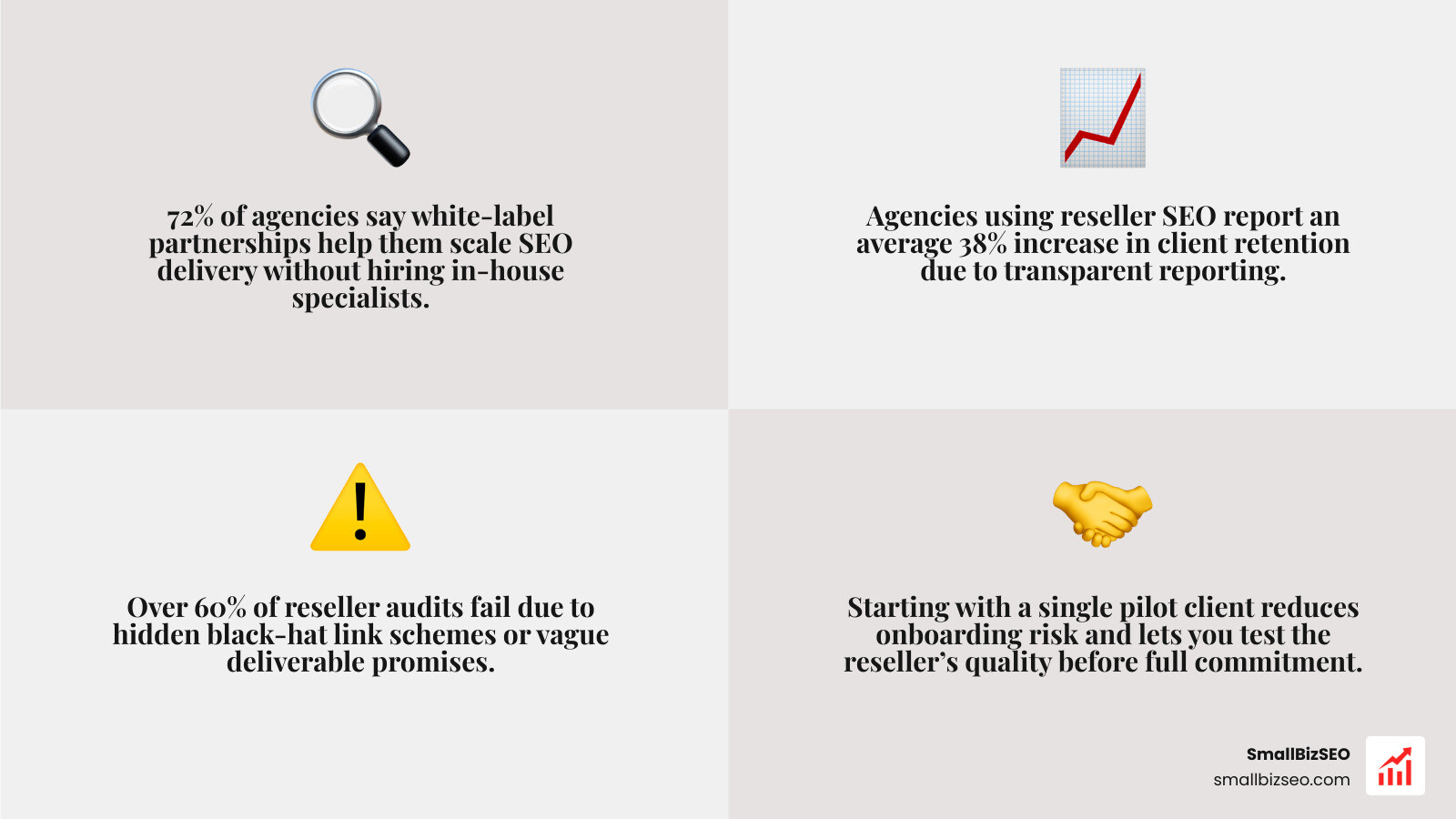
Choose a reseller by checking the work behind the price. Ask for a sample audit, a clear list of monthly tasks, and a report that shows what was done. Check how the provider earns links, who makes changes to client sites, and what happens when work is late. Start with one client before moving more accounts over.
A reseller program lets your agency sell SEO while a partner handles some or all of the work. You set the client price and own the relationship. White-label SEO describes the branding side of that arrangement: clients see your agency’s name on the work and reports. It can help you add capacity without hiring a full team, but your agency remains responsible for the quality clients receive.
I’m Clayton Johnson, founder of SmallBizSEO, where I work on SEO, content, and search visibility for businesses. I’ll use that experience to help you assess a search engine optimization reseller program based on its work, reporting, and fit for your clients.
Basic search engine optimization reseller terms:
Introduction to White-Label SEO Partnerships
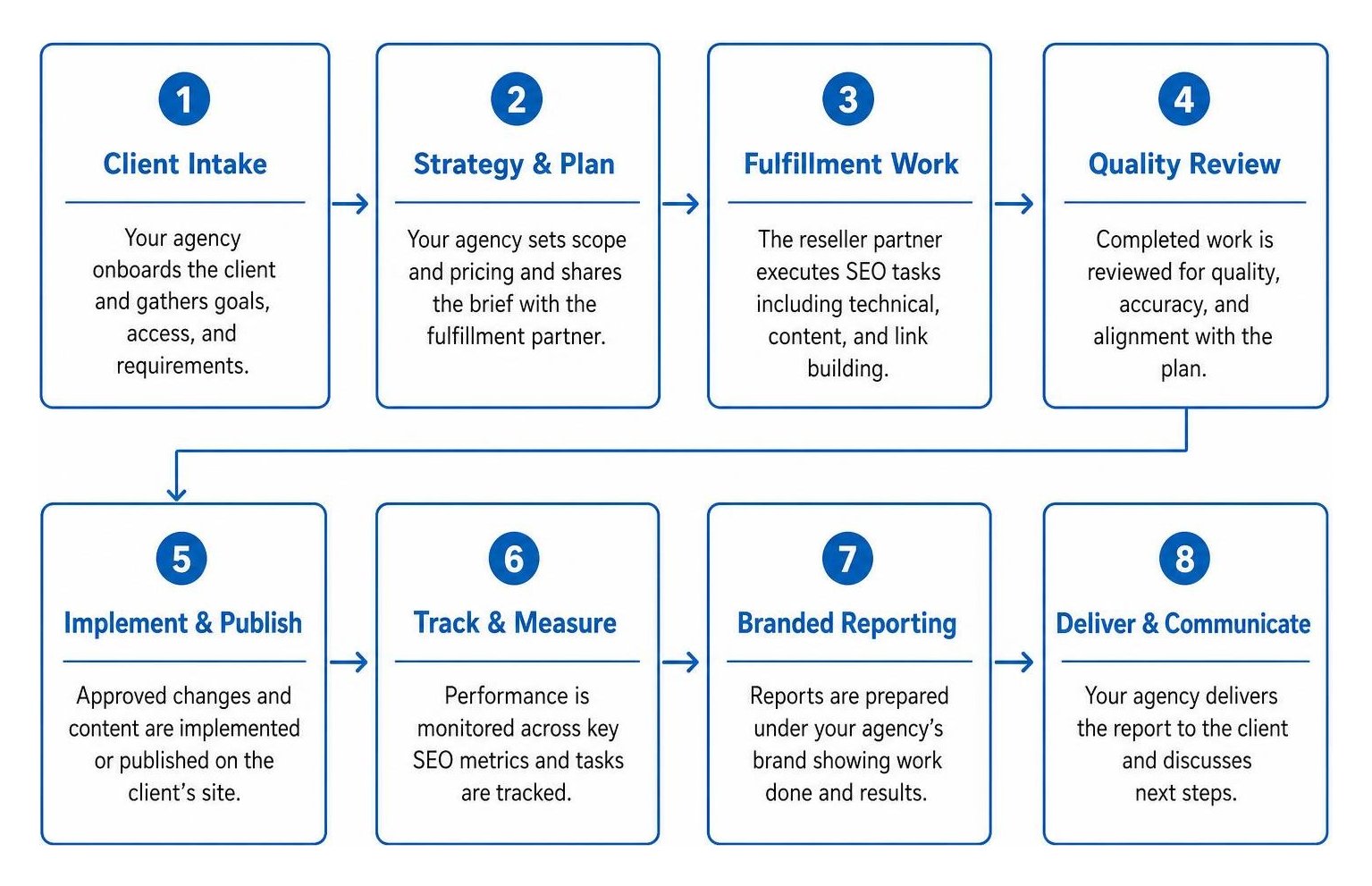
An SEO reseller partnership allows your agency to sell professional search optimization services under your brand while an external team handles execution behind the scenes. You maintain client communication, own the billing relationship, and set retail prices, while your fulfillment partner delivers the technical tasks, content, and reporting.
Offering organic search is standard for growing agencies. Industry research reveals that 81% of marketing agencies offer SEO, making it the single most requested digital marketing service. However, scaling an agency by adding complex fulfillment often creates operational bottlenecks.
A trusted wholesale fulfillment model solves this dilemma by converting fixed labor costs into flexible variable expenses. Instead of turning away clients or burning out internal staff, you scale delivery capacity on demand.
What Is a Search Engine Optimization Reseller Program vs. In-House Fulfillment?
An SEO reseller program provides backend execution without the financial risk or management overhead of hiring full-time internal staff. While an in-house team gives you direct physical oversight, it introduces substantial fixed payroll costs regardless of client retention.
Building an internal department requires significant capital. The median US SEO specialist earns $68,185 in base compensation. When factoring in benefits, recruiting fees, management overhead, and enterprise software licenses, the true year-one cost of an in-house hire easily reaches approximately $108,500.
If client demand fluctuates, that fixed overhead remains. In contrast, partnering with a strategic outsource SEO company shifts your agency to a variable-cost model where fulfillment expenses only occur when you have paying clients.
| Operational Factor | In-House SEO Department | White-Label SEO Reseller |
|---|---|---|
| Year-One Cost | ~$108,500+ (salary, tools, benefits) | Pay-as-you-go wholesale fulfillment |
| Capacity Scalability | Limited by individual employee bandwidth | Instantly scalable across multiple accounts |
| Tooling & Software | $1,000+ monthly for audits, tracking, links | Included in reseller service packages |
| Management Overhead | High (training, quality assurance, retention) | Low (dedicated partner account managers) |
| Service Breadth | Limited to the specific hire's skill set | Access to technical, content, and link specialists |
What Core SEO Services Should Be Included?
A comprehensive reseller package must cover technical website health, on-page optimization, content creation, and authoritative link building. Modern fulfillment programs should also optimize for conversational search engines and AI answer engines.
A complete fulfillment scope includes:
- Technical Website Audits: Crawl error resolution, schema markup deployment, mobile performance fixes, and core web vitals optimization.
- On-Page Optimization: Keyword mapping, metadata optimization, URL restructuring, and internal linking adjustments.
- Content Creation: Search-informed, well-researched copy designed to satisfy user intent and establish topic authority.
- White-Hat Backlink Acquisition: Contextual outreach and digital PR placements that earn genuine editorial links.
- AI Search Optimization: Answer Engine Optimization (AEO) and Generative Engine Optimization (GEO) structured to capture citations in conversational AI platforms.
When evaluating service tiers, select tailored SEO packages that match your clients' target market sizes. You can review industry standards across leading providers in this evaluation benchmark of top agencies.
How to Evaluate and Choose a Search Engine Optimization Reseller

Evaluate potential SEO partners by reviewing their fulfillment track record, reporting transparency, white-hat practices, and software portal capabilities. Never choose a partner based purely on the lowest wholesale price.
A reliable partner operates as an invisible extension of your team. Ensure they provide service-level agreements (SLAs), clear turnaround windows, and white-label dashboards where you can monitor progress.
How Do Pricing Models and Profit Margins Work for Agencies?
Agencies buy reseller packages at wholesale rates and apply markups between 200% and 300%, yielding gross profit margins of 30% to 50%. You control the retail pricing charged to your end clients.
While some vendors advertise 70% or higher margins, independent data shows that only 5.5% of agencies sustain gross margins above 70%. A realistic target for healthy agency growth is 40% to 60% gross margin on monthly retainers.
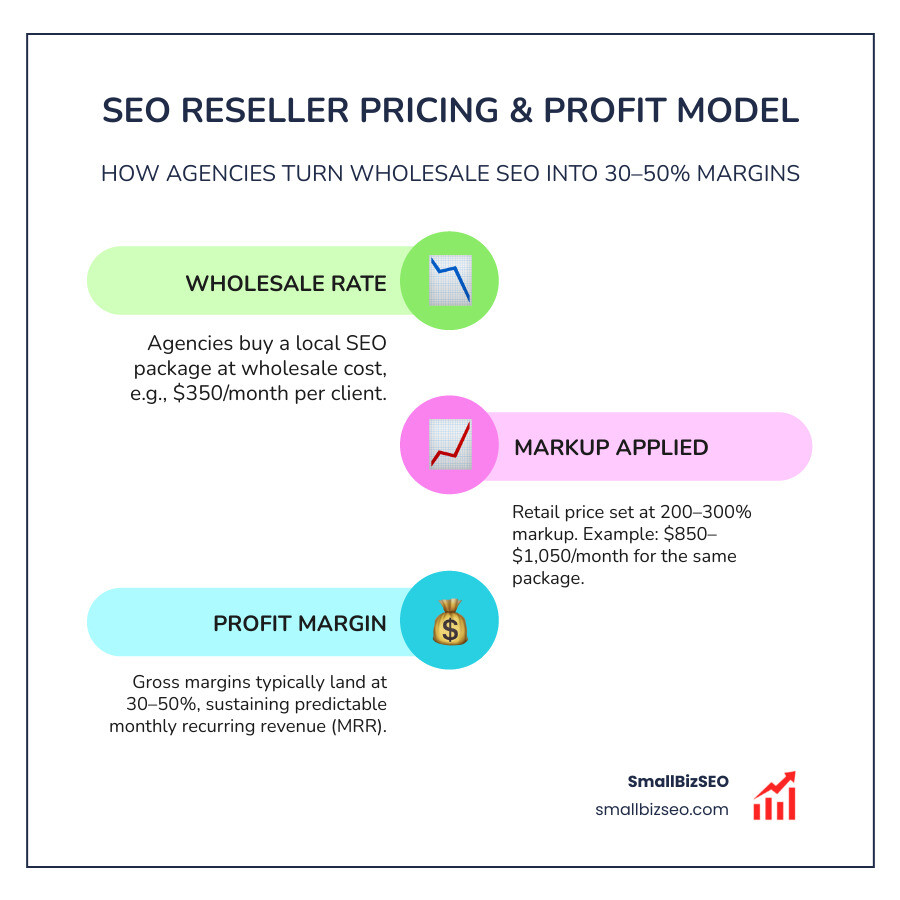
For instance, if a wholesale local SEO package costs $350 monthly, you can retail it to local businesses for $850 to $1,050 monthly. This creates predictable monthly recurring revenue (MRR) while leaving ample margin to cover client management. Review this practical guide to choosing an affordable SEO package to structure your pricing tiers effectively.
How Do You Vet a Search Engine Optimization Reseller and Spot Red Flags?
Vet potential partners by confirming their link-building methods and demanding sample proof-of-performance reports. Avoid any provider that guarantees specific numerical search rankings or conceals their operational workflow.
Watch for these critical red flags during partner vetting:
- Guaranteed Number-One Rankings: Search algorithms update constantly; no ethical provider can guarantee top rankings.
- Suspiciously Cheap Wholesale Pricing: Packages sold for under $100 per month almost always rely on automated spam, dangerous Private Blog Networks (PBNs), or low-quality spun text.
- Opaque Reporting: Providers that refuse to supply exact URLs for acquired links or fail to show task-level implementation logs.
- No Client Onboarding Process: A lack of initial strategy questionnaires, baseline audits, or roadmap sign-offs indicates unorganized fulfillment.
To protect your agency's reputation, consult this step-by-step guide to picking an SEO business partner.
Step-by-Step Implementation and Scaling Your Agency Revenue
To scale recurring revenue smoothly, establish a standardized onboarding workflow and present automated, branded performance reports to your clients every month. Systematizing fulfillment safeguards your client retention.
Building a scalable agency requires combining dependable delivery with systematic account management.
What Is the Onboarding and Campaign Launch Workflow?
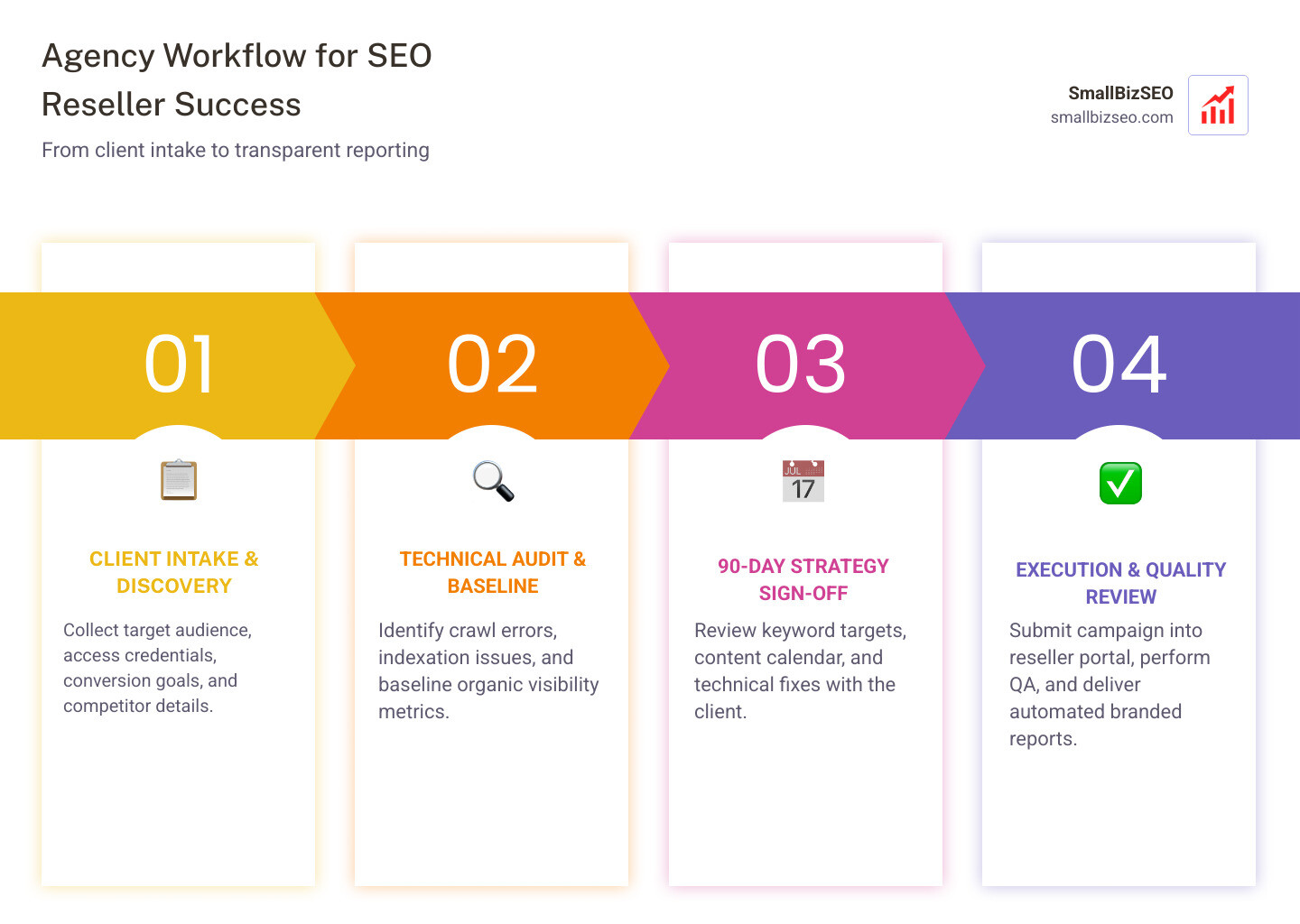
A professional campaign launch follows a structured sequence: client intake, technical baselining, 90-day strategy approval, and task execution. Standardizing this workflow keeps your team organized and your clients informed.
Follow this standard fulfillment sequence:
- Intake & Discovery: Collect target audience parameters, access credentials, primary conversion goals, and competitor details.
- Technical Audit & Baseline: Identify crawl errors, indexation issues, and baseline organic visibility metrics.
- 90-Day Strategy Sign-Off: Review the planned keyword targets, content calendar, and technical fixes with your client.
- Execution & Order Placement: Submit the approved campaign parameters into your reseller's order management portal.
- Quality Review: Conduct internal quality assurance on deliverables before client presentation, backed by strict non-disclosure agreements (NDAs).
This structured process works equally well across local businesses and sophisticated targeted B2B SEO company campaigns.
How Do Transparent Reports and Bundling Drive Client Retention?
Regular proof-of-performance reporting increases agency client retention by 38%, while offering complementary service packages dramatically reduces churn. Proactive communication demonstrates value before clients question their monthly retainer.
Data shows that agency client retention improves as service offerings expand:
- Agencies offering a single service maintain an average two-year retention rate of only 30%.
- Agencies bundling four or more services increase two-year client retention to 80%.
- 62% of clients whose agencies failed to introduce an upsell within three months churned within two years.
Combine SEO with local directory management or paid search to secure client accounts. Research shows that maintaining consistent NAP (Name, Address, Phone) data across major citation sources makes businesses 40% more likely to rank in local map packs. Learn how to format clear client deliverables with these client-retaining monthly SEO report best practices.
Growing Your Agency with SmallBizSEO
At SmallBizSEO, we help agencies expand their capabilities with reliable, data-driven fulfillment. Our proprietary Velocity framework delivers rapid search rankings and E-E-A-T-compliant organic growth, supported by automated, fully transparent white-label reporting.
Whether you need backend support for local service businesses or enterprise platforms, we manage technical audits, content creation, and authoritative link acquisition under your brand. Schedule your SmallBizSEO automated reporting and campaign consultation today to scale your agency without expanding your payroll.