Beginner’s Guide to Comparing Urgent Care SEO Companies
Beginner's Guide to Comparing Urgent Care SEO Companies
What to Look for in an Urgent Care SEO Company
When choosing an urgent care SEO company, prioritize partners that deliver HIPAA-compliant call tracking and form security, Google Map Pack dominance, verified medical E-E-A-T content, and a symptom-focused site architecture tailored for immediate walk-in conversion. Because urgent care marketing targets patients facing acute symptoms, pain, or time-sensitive distress, search engines evaluate clinic websites under Google's strict Your Money or Your Life (YMYL) standards.
A qualified medical seo company must demonstrate a deep understanding of healthcare search intent, regulatory boundaries, and the technical mechanics that drive same-day walk-in traffic. When evaluating potential partners, comparing general digital marketing agencies against specialized healthcare providers highlights significant operational differences.
| Evaluation Criteria | General Digital Marketing Agency | Specialized Urgent Care SEO Company |
|---|---|---|
| Search Intent Focus | Broad-match informational keywords and top-of-funnel blog posts | Hyper-local "near me", condition-specific, and immediate-availability terms |
| Healthcare Compliance | Standard Google Analytics, unencrypted web forms, generic tracking | Signed BAAs, HIPAA-compliant call tracking, and Protected Health Information (PHI) safeguards |
| Content Quality & E-E-A-T | Non-credentialed copywriters writing surface-level articles | Clinically reviewed copy with verified provider credentials and structured medical schema |
| Conversion Optimization | Standard contact forms and generic download offers | Real-time wait times, accepted insurance filters, and one-tap mobile check-in flows |
| Local Map Pack Execution | Basic citation building and periodic directory updates | Aggressive Google Business Profile optimization, review velocity management, and geo-grid tracking |
Core Services Provided by an Urgent Care SEO Company
A specialized urgent care partner provides a comprehensive suite of technical, strategic, and creative services engineered to capture nearby patient demand.
- Comprehensive Technical Audits: Identifying structural site errors, crawl bloat, broken redirects, and mobile rendering bottlenecks that prevent search engine bots from evaluating your clinic. To understand how site architecture impacts performance, reviewing The Ultimate Guide To Seo Audit Errors What Literally Happens When Your Site Breaks provides actionable technical insight.
- High-Intent Keyword Research: Mapping queries based on acute symptoms (such as "strep throat test," "sprained wrist X-ray," or "asthma nebulizer treatment") rather than generic medical head terms.
- On-Page Optimization: Structuring individual service pages with clean heading hierarchies, descriptive metadata, transparent pricing, and insurance details that convert searchers.
- Local Directory Cleanups: Ensuring complete Name, Address, and Phone Number (NAP) consistency across major healthcare aggregators like Solv, Zocdoc, and Healthgrades.
- Full-Funnel Content Architecture: Deploying specialized Seo Services that target high-margin B2B employer programs, such as DOT physicals and occupational health screenings, alongside standard walk-in traffic.
How an Urgent Care SEO Company Handles HIPAA Compliance
Data privacy is non-negotiable in healthcare marketing. Generalist marketing firms often overlook the regulatory risks of standard digital tracking tools. Installing default tracking pixels or standard web analytics can inadvertently transmit Protected Health Information (PHI)—such as patient IP addresses combined with viewed medical condition URLs—to third parties, triggering severe regulatory penalties.
A dedicated healthcare agency executes strict privacy protocols before launching any campaign:
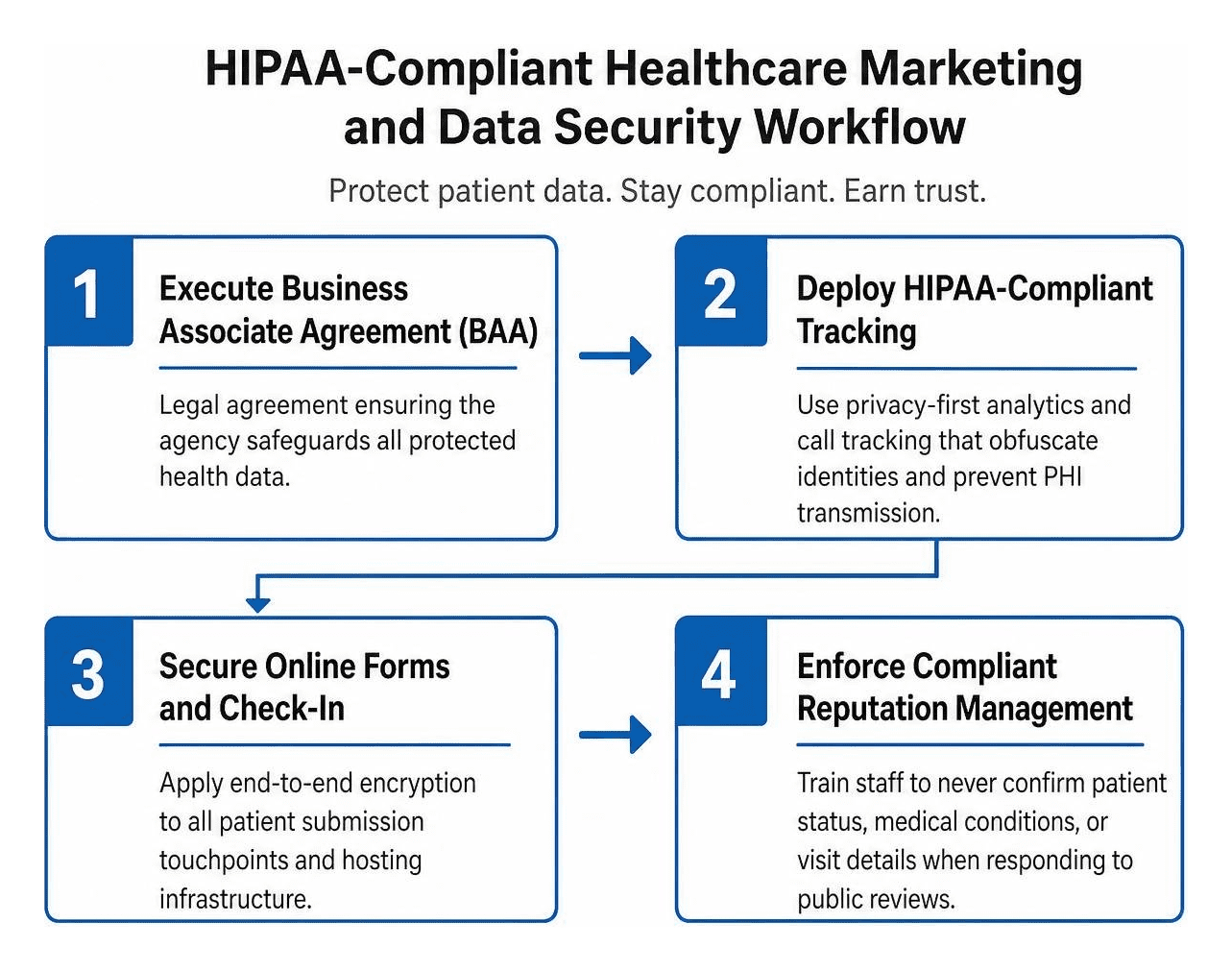
- Executing a Business Associate Agreement (BAA): A legally binding contract ensuring the agency implements appropriate safeguards for all protected health data.
- Deploying HIPAA-Compliant Tracking: Using specialized, privacy-first analytics and call tracking software that obfuscates patient identities and prevents PHI transmission.
- Securing Online Contact and Check-In Forms: Utilizing end-to-end encryption on all patient submission touchpoints and hosting infrastructure.
- Enforcing Compliant Reputation Management: Training staff to never confirm patient status, medical conditions, or visit details when responding to public online reviews.
High-Impact Urgent Care SEO Strategies: Local Pack, GEO, and Content
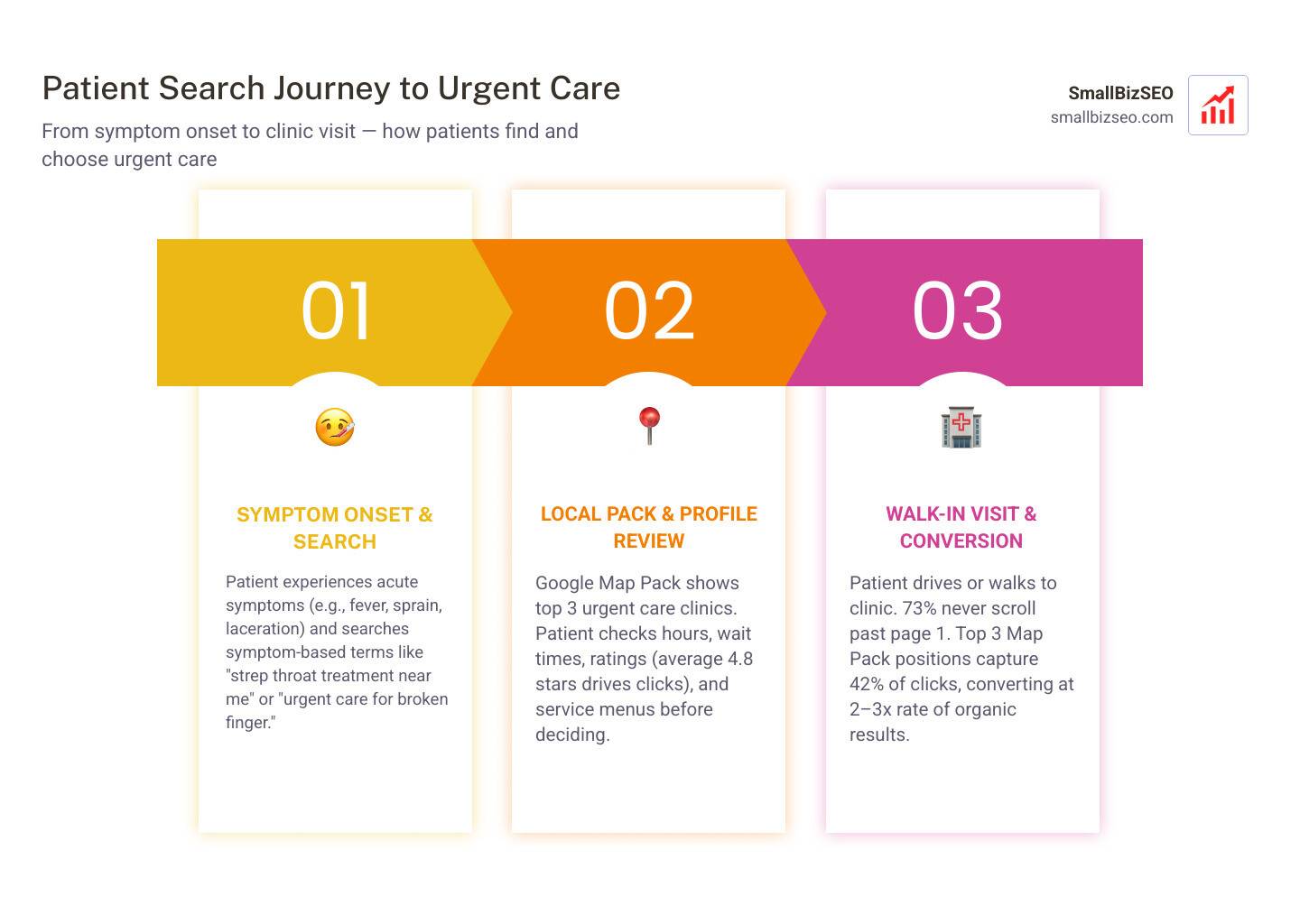
Urgent care patient acquisition relies heavily on immediate search proximity. Over 73% of patients turn to search engines when looking for healthcare treatment centers, and more than 60% of searchers never scroll past the first page of results. Capturing this demand requires an integrated approach that combines local map dominance with structured content.
Understanding the fundamentals in The Ultimate Guide To Local Search Optimization Basics allows healthcare operators to connect technical optimization with practical patient capture, demonstrating how competitive metropolitan clinics build search dominance.
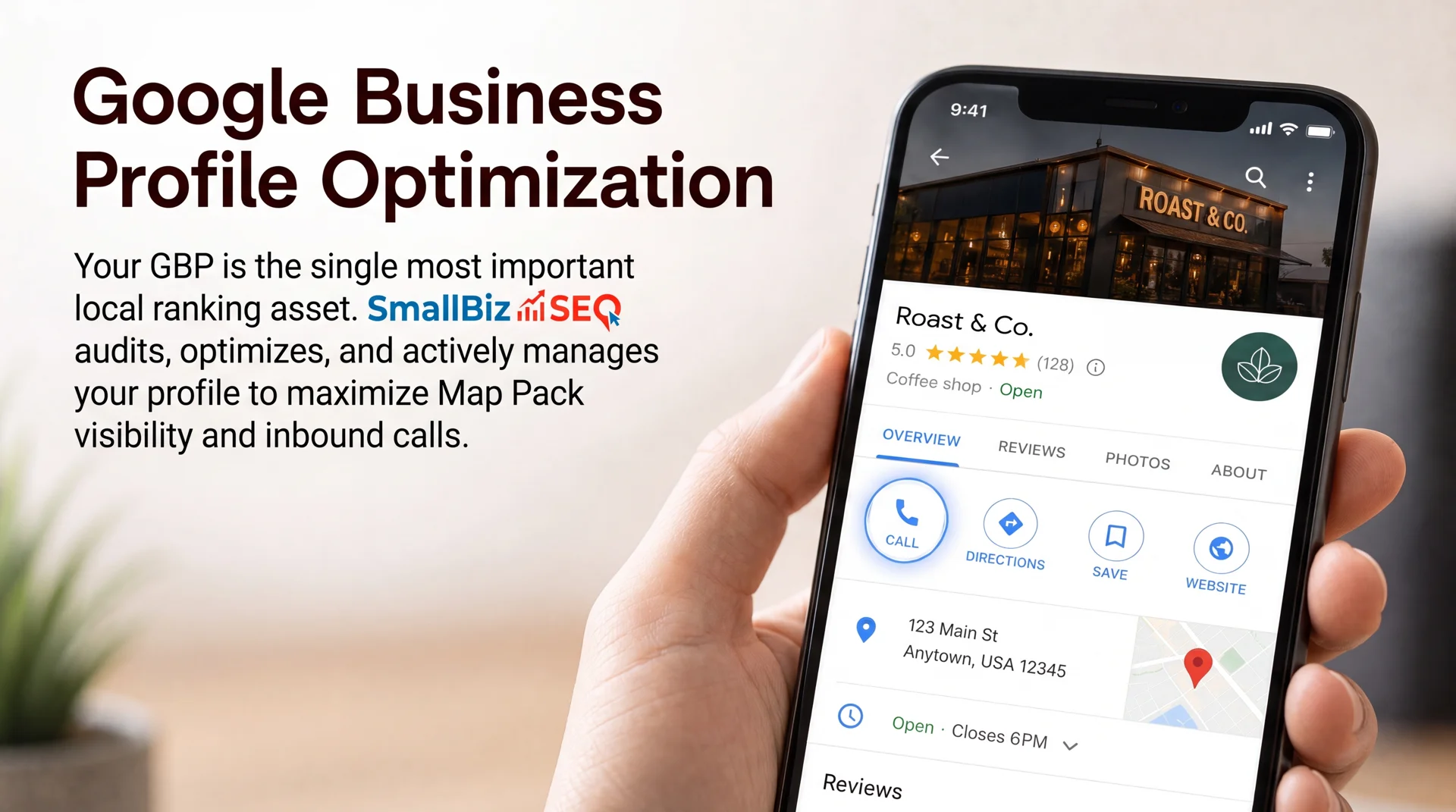
Dominating Local Search and Google Business Profile
Because roughly 92% of urgent care searches trigger a Google Map Pack, your Google Business Profile (GBP) functions as your digital front door. The top three positions in the local pack capture approximately 42% of all search clicks, converting at two to three times the rate of standard organic search listings.
To establish and maintain local pack prominence, your partner must implement rigorous profile optimization:
- Strategic Primary Category Selection: Choosing "Urgent Care Clinic" as the primary category, while adding appropriate secondary categories like "Medical Clinic," "Walk-In Clinic," or "Diagnostic Center."
- Service Menu Granularity: Listing specific acute treatments, rapid lab tests, pediatric services, and imaging procedures directly inside the profile.
- Review Velocity and Quality: Establishing automated post-visit workflows that generate a steady stream of patient feedback. Maintaining an average rating of 4.8 stars generates significantly more clicks than profiles hovering near 4.0 stars.
- Real-Time Data Integration: Providing updated operational hours, holiday schedules, and current clinic wait times to capture immediate decision-makers.
For detailed steps on outranking nearby competitors, explore our guide to Map Your Way To The Top With These Google My Business Ranking Tips, or collaborate with a dedicated local seo company to manage multiple map profiles at scale.
Symptom-Based Content and Medical E-E-A-T
When patients face sudden illnesses or minor injuries, they search for immediate relief based on their symptoms. Creating comprehensive, condition-specific landing pages allows your practice to capture high-intent search queries that bypass broad hospital terms.
Every medical content asset published on your site must satisfy Google's Experience, Expertise, Authoritativeness, and Trustworthiness (E-E-A-T) standards:
- Verified Clinical Authorship: Every article, symptom guide, and treatment overview should feature the byline, medical credentials, and professional biography of an active physician or clinical director.
- Medical Schema Markup: Implementing structured JSON-LD code (
MedicalClinic,MedicalProcedure,MedicalCondition, andPhysicianschema) to help search engines instantly parse your clinical capabilities. - Clear Triage Guidance: Providing distinct indicators on when to visit an urgent care clinic versus when a condition warrants an emergency room visit. For an in-depth breakdown of acute-care search strategies, read our guide on emergency care seo, or examine real-world clinic positioning such as Financial District Urgent Care Walk-In in NY .
Optimizing for AI Overviews and Generative Engines
Search behavior is shifting toward conversational artificial intelligence platforms. Approximately 1 in 4 regular ChatGPT users submits a health-related prompt weekly, and 70% of those conversations take place outside normal clinic operating hours. When prospective patients consult tools like Perplexity, Claude, or Google AI Overviews to evaluate midnight fevers or sudden lacerations, your clinic must be cited as a recommended local authority.
Generative Engine Optimization (GEO) requires structuring content with direct, natural language answers, clear entity definitions, and consistent clinical facts. When search algorithms evaluate medical authority across large language models, clinics that maintain authoritative citations, structured schema markup, and robust patient review sentiment are systematically prioritized in conversational answers.
Scalability, Timelines, and SEO Pricing Models
Investing in healthcare search marketing requires a clear understanding of financial commitments, development timelines, and patient acquisition economics. Unlike pay-per-click advertising, which ceases generating leads the moment ad budgets are cut, organic search builds an appreciating digital asset that compounds over time.
Selecting suitable Seo Packages depends on your physical footprint, local market competition, and operational expansion goals.
Multi-Location vs. Single-Location Urgent Care SEO
Single-location clinics and multi-location networks face distinctly different optimization challenges:
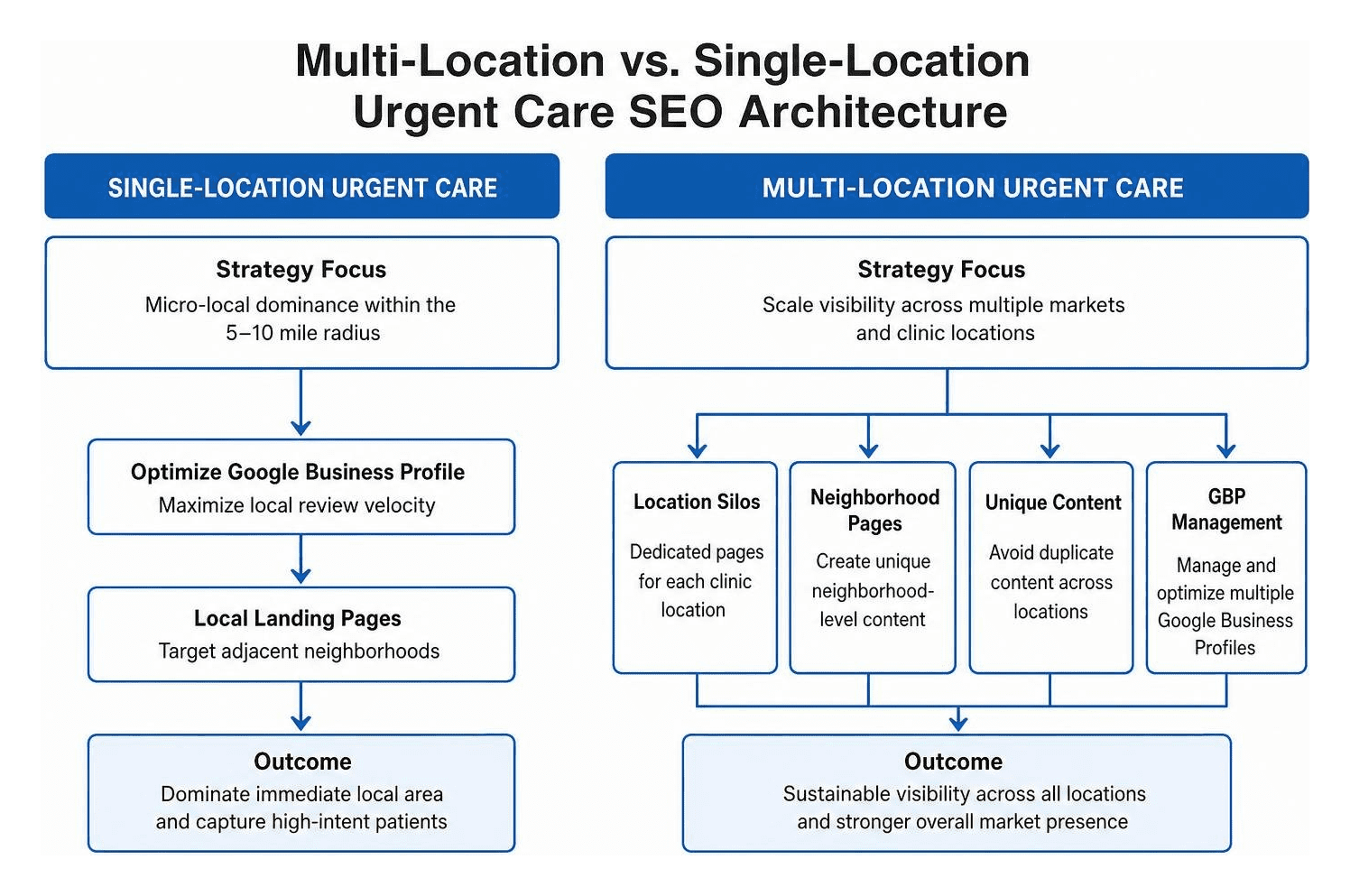
- Single-Location Centers: The strategy centers on micro-local proximity, dominating the immediate 5-to-10-mile radius, maximizing local GBP review velocity, and creating targeted landing pages for adjacent neighborhoods.
- Multi-Location Groups: Scaling requires dedicated location silos, distinct neighborhood-level pages, unique localized content to avoid duplicate copy penalties, and centralized multi-profile GBP management across dozens or hundreds of clinics.
Expected Timeline and Measurable ROI
Urgent care SEO is a compounding process that moves through distinct operational phases:
- Months 1 to 3: Technical remediation, site speed optimization, schema deployment, and Google Business Profile overhauls typically yield initial Map Pack visibility and phone call increases within 30 to 60 days.
- Months 4 to 6: Condition-specific landing pages and neighborhood silos begin ranking, driving noticeable increases in organic website visits and online check-ins.
- Months 6 to 12: Sustainable market authority is established. Compounding organic search visibility routinely reduces blended patient acquisition costs from over $85–$180 per patient down to under $50–$94.
For enterprise healthcare providers, data shows healthcare SEO programs can generate an average of $1.9M per year in new, net patient revenue, reinforcing the value of partnering with an experienced healthcare seo company.
Critical SEO Mistakes Urgent Care Clinics Must Avoid
Even well-funded urgent care networks can experience traffic declines by falling into common digital marketing traps. Reviewing 5 Local Seo Mistakes Killing Your Visibility helps avoid basic structural blunders, while understanding How To Recover From A Google Algorithm Penalty protects your domain against algorithmic updates.
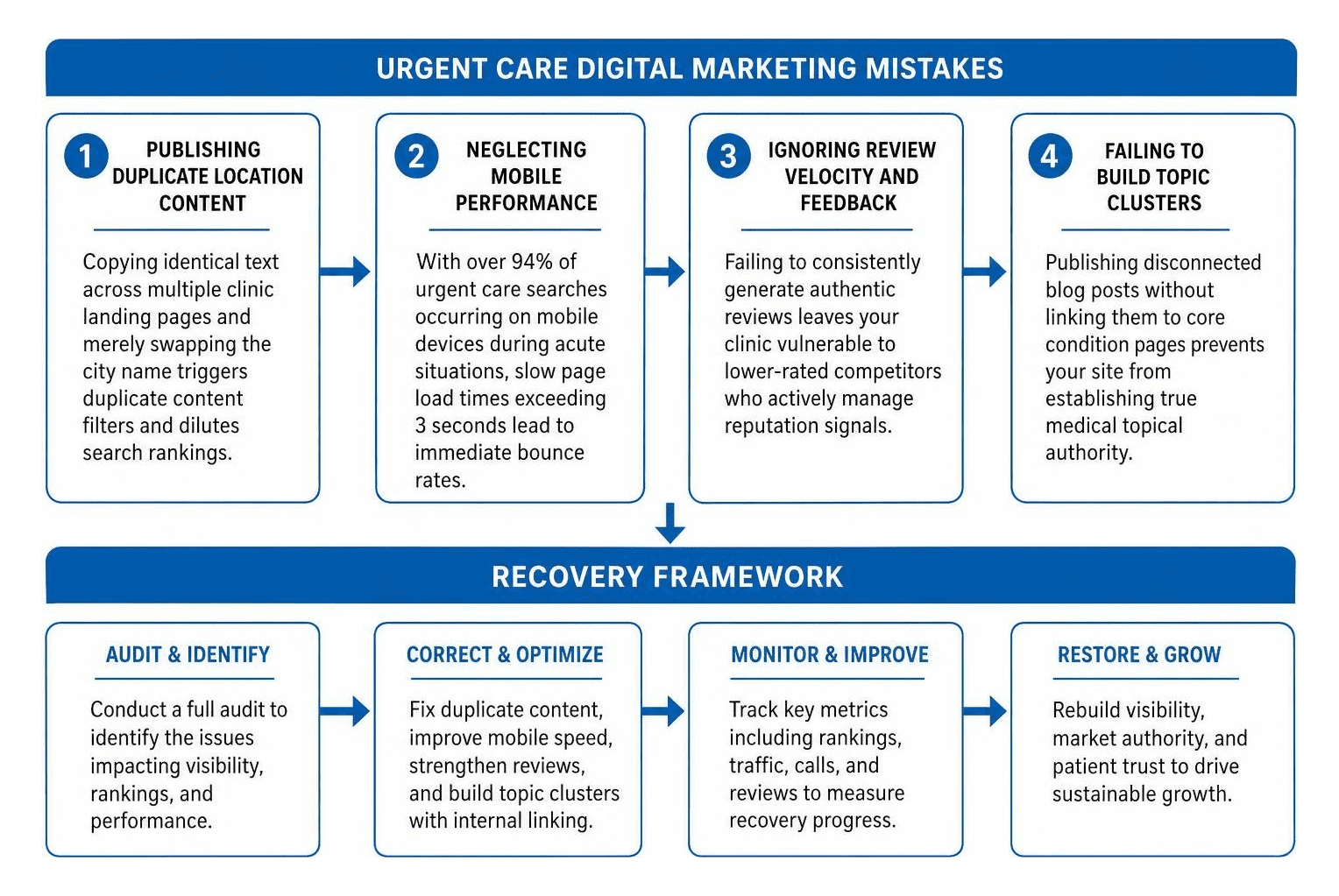
- Publishing Duplicate Location Content: Copying identical text across multiple clinic landing pages and merely swapping the city name triggers duplicate content filters and dilutes search rankings.
- Neglecting Mobile Performance: With over 94% of urgent care searches occurring on mobile devices during acute situations, slow page load times exceeding 3 seconds lead to immediate bounce rates.
- Ignoring Review Velocity and Feedback: Failing to consistently generate authentic reviews leaves your clinic vulnerable to lower-rated competitors who actively manage reputation signals.
- Failing to Build Topic Clusters: Publishing disconnected blog posts without linking them to core condition pages prevents your site from establishing true medical topical authority. For foundational strategies on avoiding these traps, consult our Local Seo Guide.
Frequently Asked Questions About Urgent Care SEO
How long does it take to see results from urgent care SEO?
Initial ranking movements and increased phone calls from Google Business Profile optimizations typically appear within 30 to 60 days. Comprehensive organic rankings for competitive symptom and treatment keywords mature over 6 to 12 months, creating a compounding channel for patient acquisition.
What percentage of urgent care patients come from organic search?
Between 63% and 77% of new urgent care patients originate from organic search and local map pack listings. Because acute medical needs require immediate treatment, searchers consistently choose top-ranking local providers over paid advertisements.
How much does professional urgent care SEO cost per month?
Professional, HIPAA-compliant SEO services for a single urgent care location typically range from $899 to $1,699+ per month. Multi-location clinic networks with 10 to 15 facilities generally invest between $5,500 and $7,000+ per month for enterprise-level management and localized content deployment.
Accelerate Your Clinic's Patient Acquisition
Choosing the right digital marketing partner determines whether your urgent care clinic remains visible during critical patient decision windows or loses ground to competing hospital networks. At SmallBizSEO, our proprietary Velocity framework combines technical precision, HIPAA-compliant tracking, and medical E-E-A-T optimization to deliver rapid, sustainable search growth.
If you are ready to fill your waiting rooms, dominate the local Map Pack, and scale your practice, explore our specialized urgent care SEO solutions today.