How to Choose a Good SEO Company in 7 Smart Steps
How to Choose a Good SEO Company in 7 Smart Steps
Step-by-Step Blueprint: How to Choose a Good SEO Company
To choose a good SEO company, follow four core steps: define commercial business goals and revenue-focused KPIs, audit pricing models against detailed deliverables for total transparency, verify client case studies that match your business conversion model, and rigorously vet technical and strategic capabilities through direct specialist interviews. Selecting the right search partner is a systematic procurement process.
While about 50% of marketers report that SEO provides a better return on investment than other marketing channels, reaching that upside depends on finding the best seo company for real organic growth. Moving forward blindly risks accumulating "selection debt" - wasting months on low-impact tasks and recovering from poor execution.
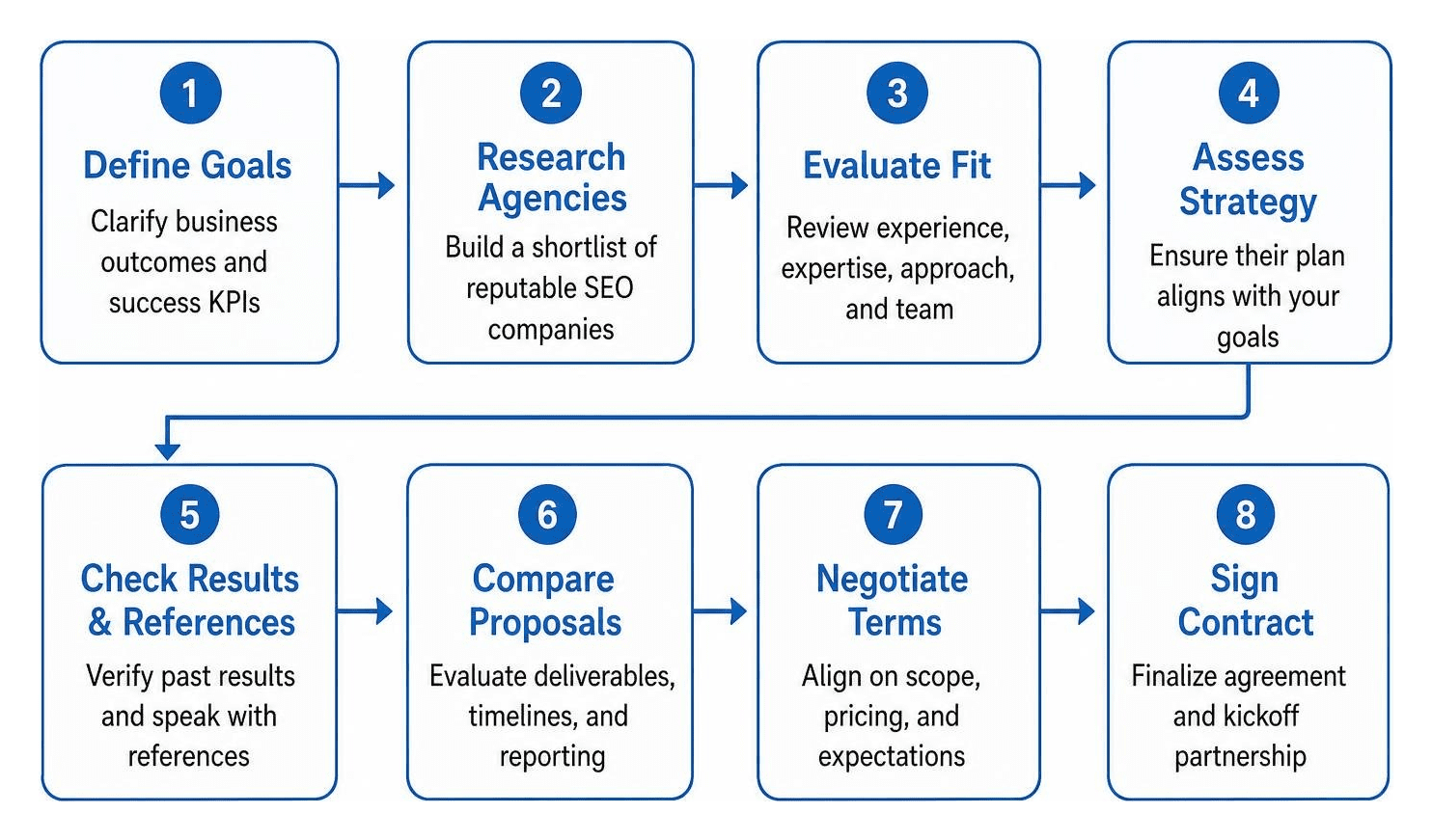
A strong selection process should also define who owns each decision internally. Assign one person to compare proposals, one to validate analytics access, and one to confirm whether the proposed work supports sales-qualified leads, ecommerce transactions, or another measurable business outcome. This prevents agencies from winning the contract with attractive dashboards while leaving the real revenue model unaddressed.
Phase 1: Defining Clear Business Goals
Before reaching out to agencies, define the commercial outcomes you need to achieve. An agency cannot align its strategy if your internal success metrics are undefined.
Reviewing the definitive guide to choosing an seo business partner helps clarify how to tie organic targets to revenue pipelines rather than vanity search impressions.
Set specific, measurable KPIs:
- Increase inbound qualified sales leads by a defined percentage over a clear planning cycle.
- Capture top rankings for high buying-intent queries.
- Expand organic revenue and transaction volume for core product lines.
- Build sustainable organic visibility across both classic search results and AI search surfaces.
Focusing on commercial search intent ensures long-term return: research indicates that content targeting high buying-intent search queries converts 2400% better than high-volume informational posts with low intent. Your goal document should separate awareness traffic from sales-focused traffic, because those categories require different content formats, internal links, calls to action, and attribution models.
Phase 2: Evaluating Pricing Models and Structuring Budgets
SEO pricing reflects the depth of expertise, custom development, content production, and strategic oversight required. Standard hourly consulting rates generally run between $100 and $149 per hour, while comprehensive project scopes typically range from $10,000 to $40,000. Evaluating an affordable seo company requires weighing the total retainer against the actual deliverables included.
| Pricing Model | Typical Price Range | Best Suited For | What Is Included |
|---|---|---|---|
| Monthly Retainer | $1,500 - $10,000+ / mo | Ongoing growth and active competition | Technical fixes, monthly content, outreach, reporting |
| Project-Based | $10,000 - $40,000 | Site migrations, one-time technical overhauls | Architecture rebuild, structured data, audit remediation |
| Hourly Consulting | $100 - $149 / hr | Strategy validation, internal team training | Strategic advisory, custom technical guidance |
Do not compare price alone. Compare price per strategic output. A lower retainer that includes only automated reports and light keyword tracking can be more expensive than a higher retainer that includes technical implementation, expert-written content, conversion analysis, and quality link acquisition. Ask each finalist to map every fee to a deliverable you can inspect.
Phase 3: Shortlisting and Reviewing Verified Client Track Records
Examine third-party platforms and verified case studies to evaluate past client performance. Look for case studies that match your business conversion model, whether that is B2B lead generation or ecommerce transactions. We also recommend reading this independent guide on vetting SEO providers to better assess an agency's technical depth.
Checking objective seo company reviews helps confirm how teams handle roadblocks. One optimized campaign drove a 105% increase in organic revenue and a 119% rise in organic transactions through technical, on-page, and content work. Another client achieved a 66% month-over-month lift in organic leads alongside a 42% decrease in cost per conversion.
Critical Vetting Questions and Strategy Evaluation

The interview stage separates capable strategists from polished sales representatives. Request to speak directly with the tactical specialists who will manage your website day-to-day. Asking probing questions about diagnostic frameworks, workflow execution, and reporting cadence helps expose whether an agency relies on pre-packaged templates or delivers bespoke technical solutions designed for your specific industry landscape.
Technical and Strategic Depth: How to Choose a Good SEO Company Without Falling for Vanity Metrics
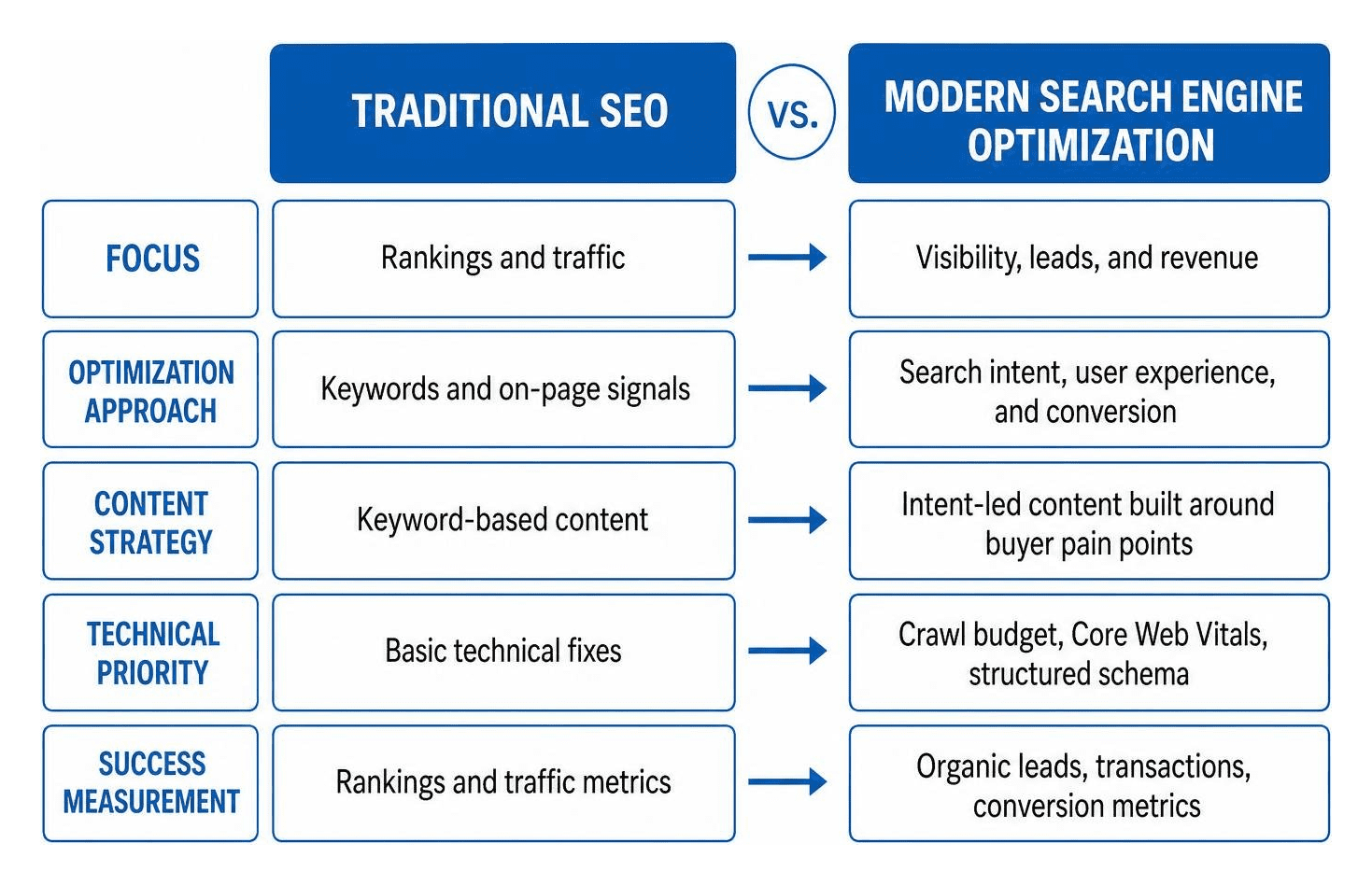
A competent provider must audit crawl budget, rendering issues, structured schema, and Core Web Vitals. Evaluating b2b seo agencies that actually deliver leads instead of just traffic means ensuring their technical scope directly supports lead generation.
Search engines continue to evolve, with AI Overviews frequently surfacing across query categories. Over 76% of pages cited in AI Overviews already rank in the top 10 organic search positions. A forward-thinking agency optimizes for Answer Engine Optimization (AEO) and Generative Engine Optimization (GEO) alongside classic rank signals.
Evaluating Content Creation, Search Intent, and Conversion Optimization
Do not settle for generic content briefs that leave writing to your internal staff. Vet whether the agency conducts subject matter expert interviews to extract authentic product differentiators. Intent-led content built around specific buyer pain points outperforms the flawed practice of sprinkling keywords across broad, thin articles. Ensure their editorial process includes comprehensive on-page optimization, entity mapping, and integrated conversion funnels that guide visitors from discovery to closed revenue.
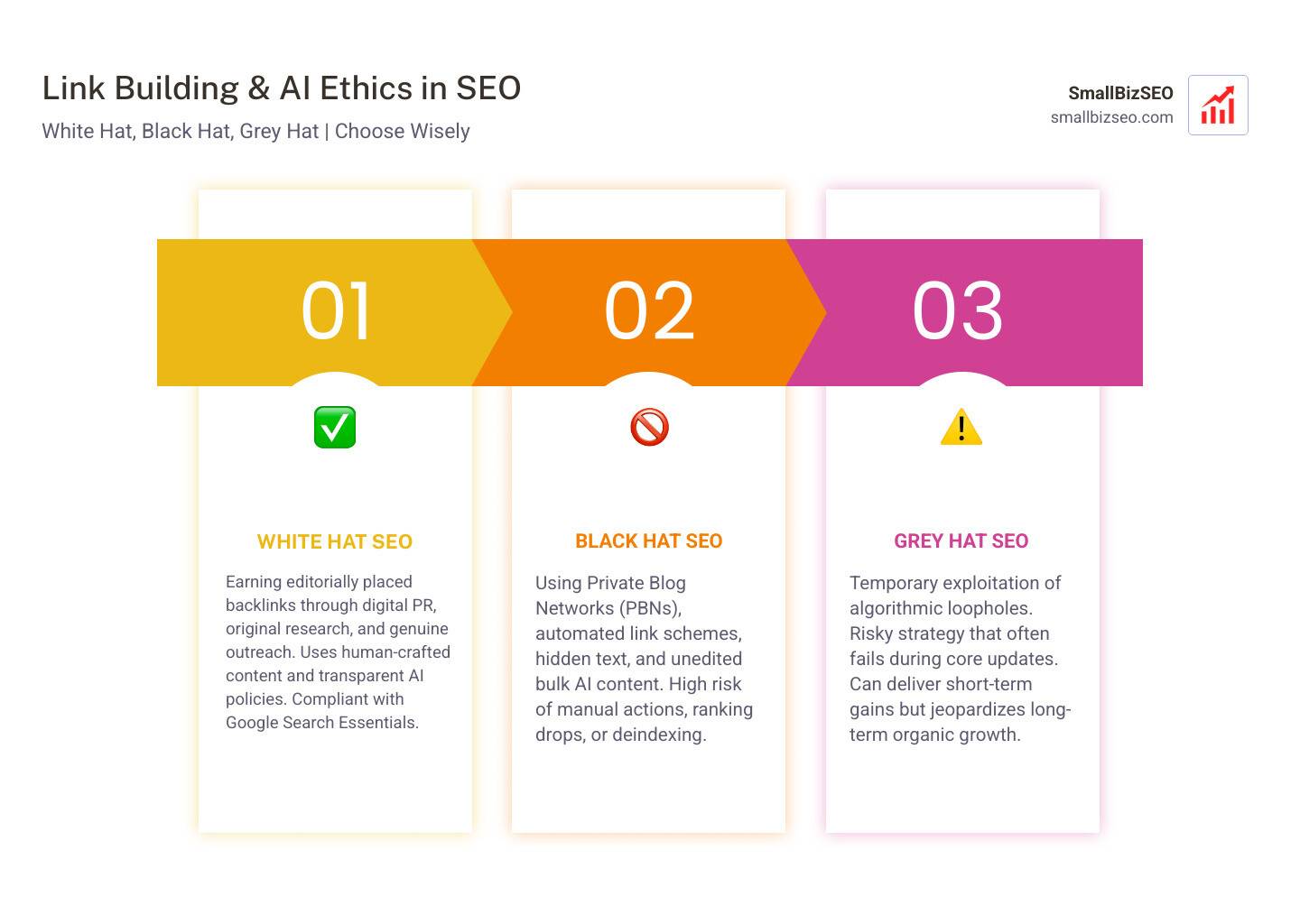
White Hat vs. Black Hat Practices: Link Building and AI Ethics
Strict adherence to Google Search Essentials is mandatory. Inquire about link acquisition methods and ask to see recent live placements:
- White Hat SEO: Earning editorial backlinks via digital PR, original research, and outreach. Fully transparent with human-edited content strategies.
- Black Hat SEO: Using private blog networks (PBNs), automated link schemes, hidden text, and unedited bulk AI content that risk severe search penalties.
- Grey Hat SEO: Exploiting temporary algorithmic loopholes that carry high risk of sudden traffic loss during core updates.
Decoding Contracts, Deliverables, and the First-90-Day Roadmap
What to Expect in an SEO Agreement: Scope, SLAs, and Asset Ownership
Ensure your contract guarantees 100% administrative ownership of your Google Analytics, Google Search Console, tag management configurations, and CMS assets. Reputable firms operate on clear deliverables and transparent terms rather than locking clients into rigid contracts without recourse. Review the service-level agreements (SLAs) carefully to confirm explicit response times, account management availability, and detailed monthly deliverable schedules.
The agreement should also define what happens when priorities change. Strong SEO programs evolve as crawl data, rankings, competitors, and conversion behavior reveal new opportunities. A practical contract allows the team to reallocate effort from low-impact tasks to higher-value fixes without hiding the change from you. Ask for a shared roadmap, a backlog of recommended work, and a simple explanation of how urgent technical issues are escalated.
The First 90 Days: Technical Audits and Milestone Checkpoints
On average, it takes 6 months or more to see comprehensive SEO results, but early technical progress should begin immediately. Following the no nonsense guide to achieving the best seo results ensures your first quarter establishes a strong baseline:
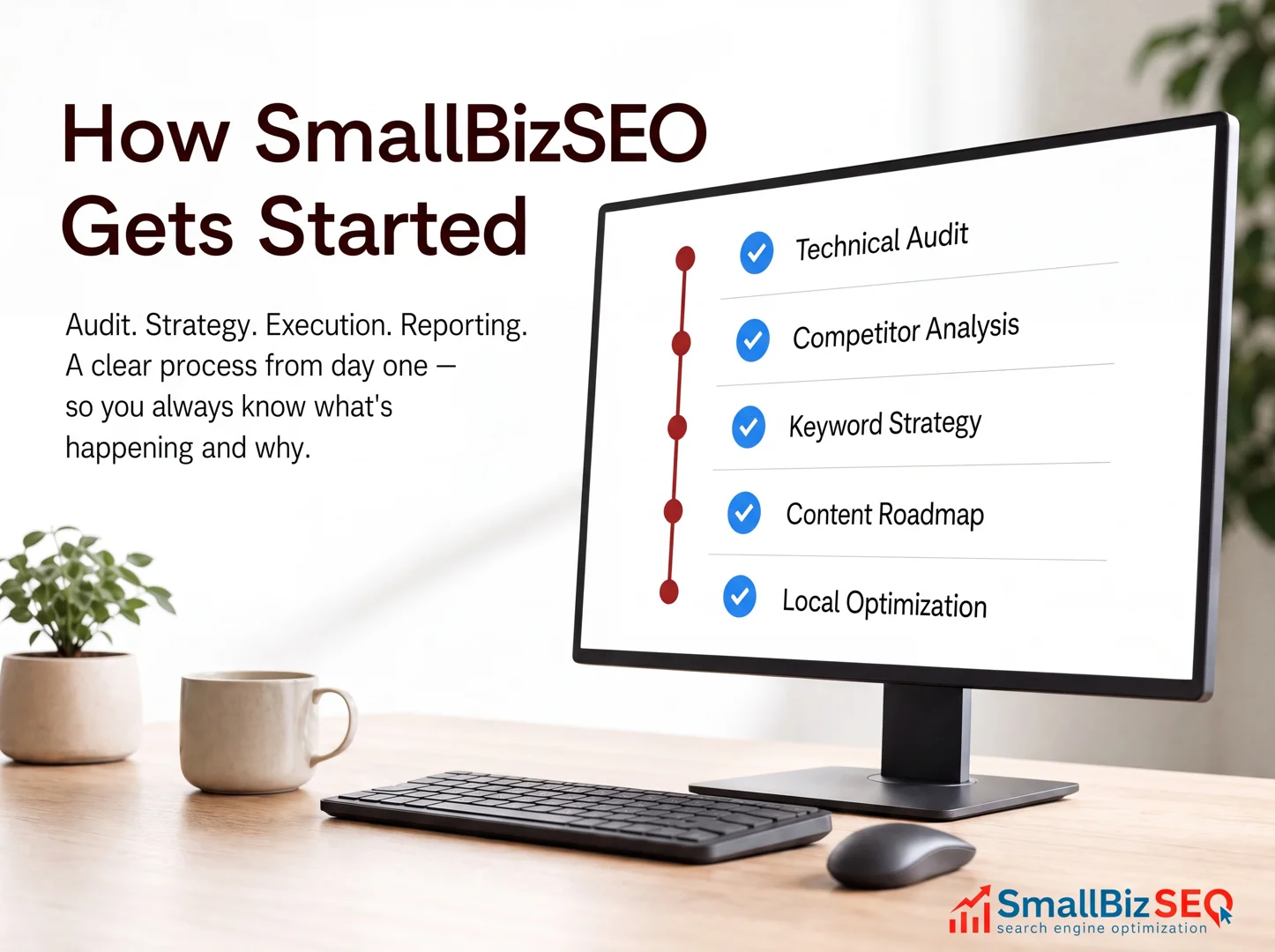
- Initial sprint: Comprehensive technical crawl, tracking audit, baseline ranking diagnostics, and priority keyword mapping.
- Implementation sprint: Core Web Vitals remediation, schema implementation, and bottom-of-funnel content production.
- Growth sprint: Content publishing sprints, digital PR outreach, and initial conversion path adjustments.
By the end of the onboarding period, you should not merely receive a list of completed tasks. You should understand which fixes removed indexing barriers, which pages are tied to revenue opportunities, which content assets are moving into production, and which KPIs will determine whether the engagement is creating business value.
Red Flags and Warning Signs to Watch Out For
Guaranteed Rankings and Canned Proposal Traps
Google explicitly states that no agency can guarantee a #1 ranking. Algorithmic changes, competitive moves, and site health are dynamic. Any agency promising guaranteed top rankings within 30 days is cutting corners or targeting meaningless zero-volume search terms.
Secret Tactics and Lack of Analytics Access
Beware of agencies claiming "proprietary secret formulas" or sending static PDF reports containing only vanity traffic metrics. If an agency withholds access to your data or refuses to explain its link-building methods, end the conversation.
Frequently Asked Questions About Choosing an SEO Agency
How long does it typically take to see measurable SEO results?
Meaningful organic growth generally materializes after several months, with compounding commercial returns developing as technical fixes, content quality, authority signals, and user engagement reinforce one another. Highly competitive verticals with large domain authority gaps may require a longer period of consistent optimization before rankings and qualified leads stabilize.
Some early indicators should appear sooner than revenue growth. Examples include cleaner index coverage, improved crawl efficiency, faster page performance, stronger rankings for long-tail commercial queries, and better engagement on optimized landing pages. Treat those signals as progress markers, not as substitutes for pipeline, transactions, and customer acquisition.
Is it better to hire an agency, an in-house specialist, or a freelancer?
Freelancers excel at targeted, individual tasks. In-house hires offer deep brand integration but represent significant overhead and a narrower skill set. An agency provides an entire multi-disciplinary team - technical engineers, digital PR specialists, conversion designers, and senior strategists - for the cost of a single senior hire. Many scaling brands succeed using a hybrid model: pairing an internal marketing manager with an external agency for strategic execution.
What should I expect to pay for legitimate SEO services?
Professional monthly retainers typically start between $1,500 and $5,000+ per month for small-to-mid-sized businesses. Custom enterprise initiatives range upward from $10,000 per month. Avoid packages priced below $1,000 per month, as they rarely cover the senior hours and technical resources needed to compete.
The right budget should reflect the gap between your current organic visibility and the market share you want to win. A site with technical debt, thin content, weak authority, and aggressive competitors needs a deeper scope than a healthy site seeking incremental gains. Ask every agency to explain which budget level is required, what tradeoffs exist, and which activities would be delayed if you choose a smaller package.
Partner With a Strategic Search Team for Real Business Growth
Choosing the right partner means finding a team that prioritizes business outcomes over vanity metrics. At SmallBizSEO, our data-driven "Velocity" framework delivers reliable rankings, solid E-E-A-T signals, and sustainable traffic growth supported by transparent reporting. When you are ready to build lasting search visibility with a trusted good seo company, our team is here to help you scale.
Use the selection process in this guide as a scorecard before signing any agreement: clear KPIs, transparent pricing, verified proof, technical depth, ethical link acquisition, owned analytics access, and a realistic onboarding roadmap. The best SEO relationship should make your marketing decisions clearer, not more confusing.