Are AI Agents Really Replacing Human Workflows?
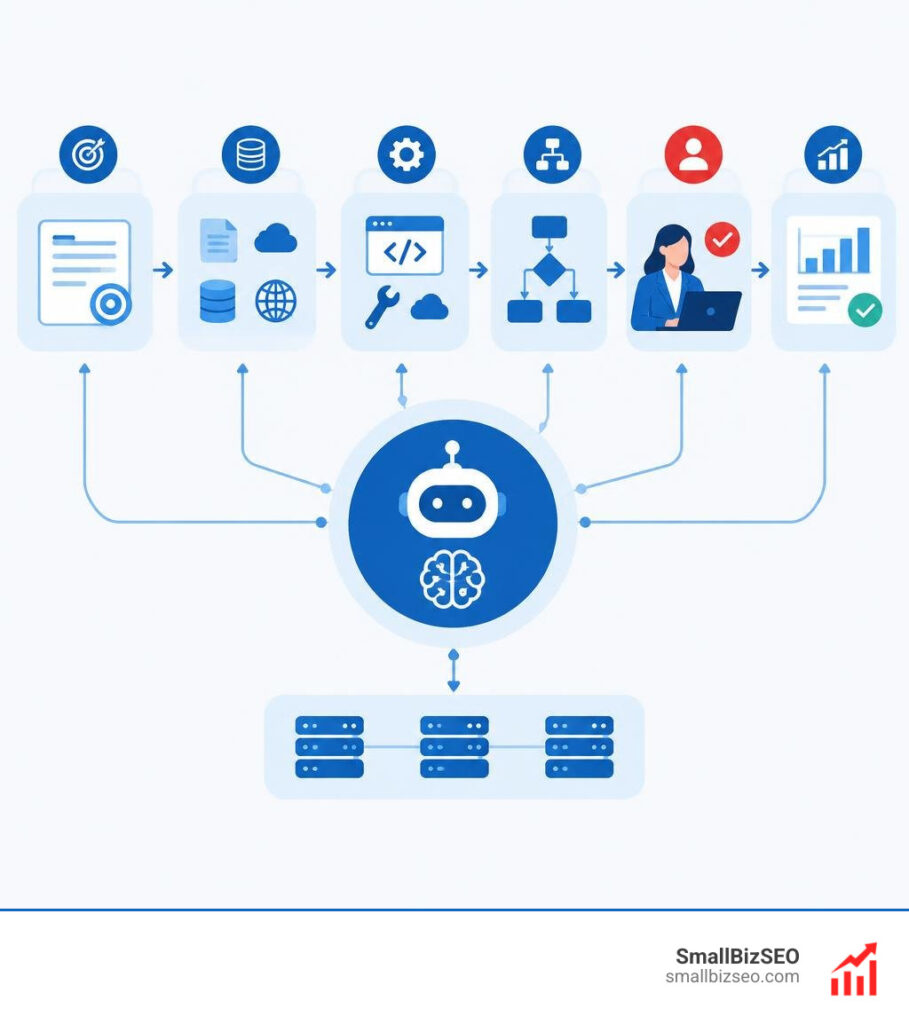
Are AI Agents Really Replacing Human Workflows?
50 AI Agent Statistics: Adoption, Automation, and Business Impact
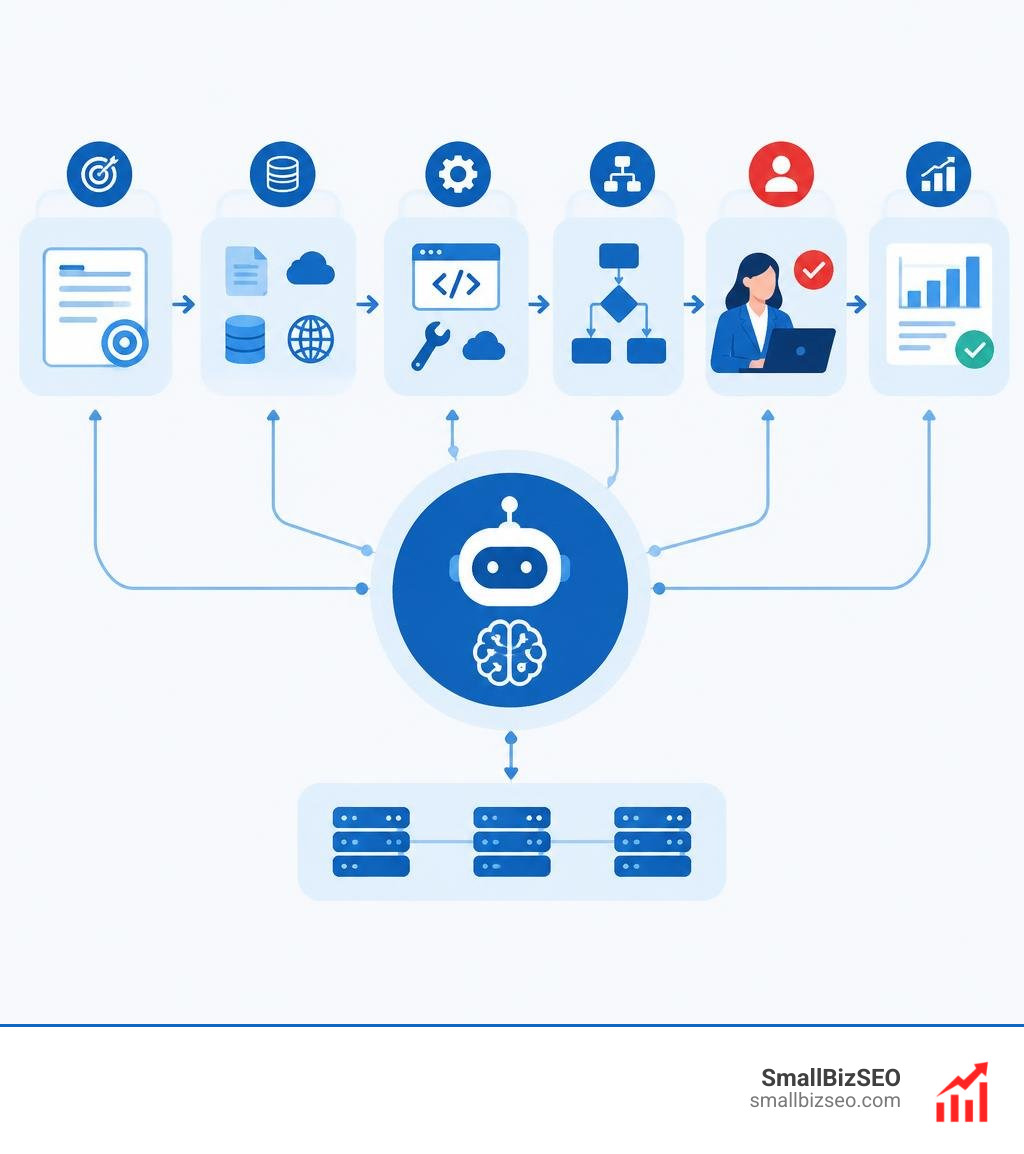
AI agents represent a fundamental evolution in software: instead of waiting for conversational prompts, these autonomous systems evaluate goals, plan multi-step actions, call external APIs, and execute workflows independently. The following 50 AI agent statistics on adoption, automation, and business impact show how quickly this shift is happening.
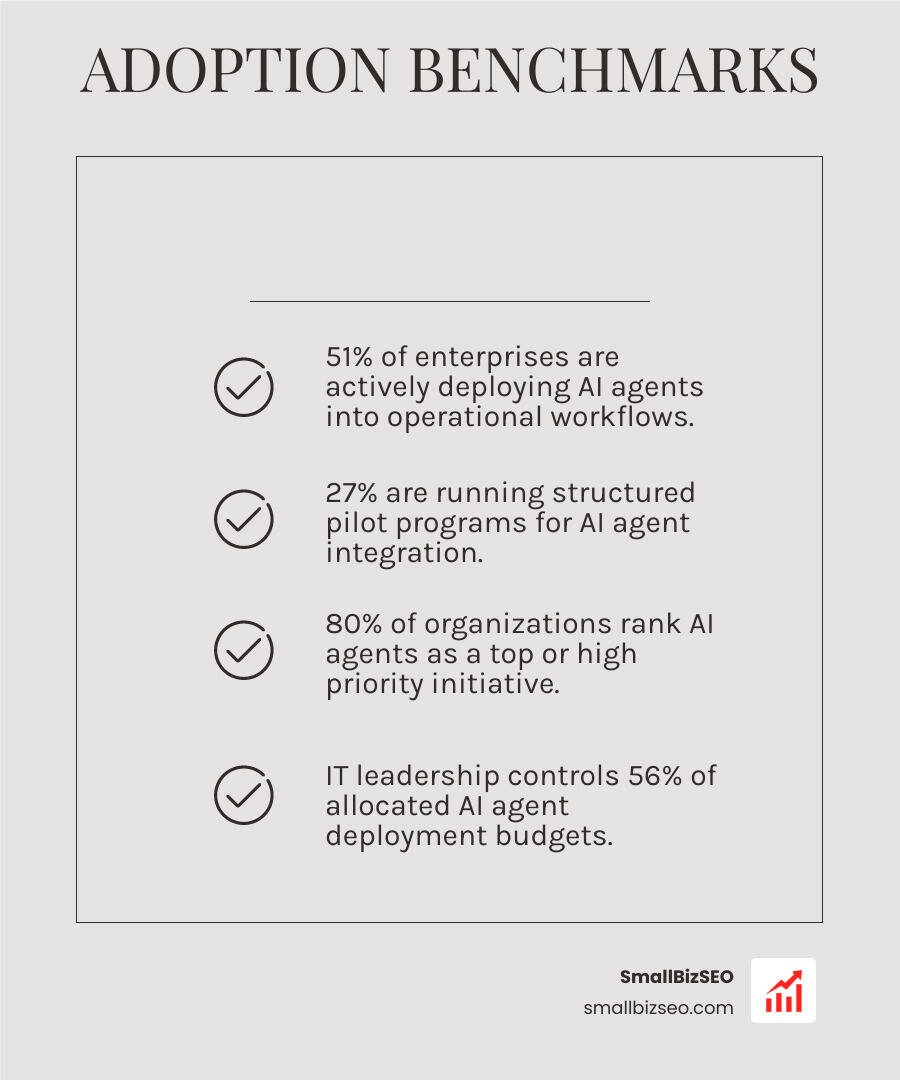
According to global research benchmarks, 80% of organizations now rank AI agents as a top or high priority among their emerging technology initiatives. To understand the broader economic context, our analysis of 10 artificial intelligence statistics on adoption and business impact shows that enterprise investments are consolidating around goal-driven automation rather than simple text generation. IT leadership has taken the reins, driving 48% of internal use case identification and controlling 56% of allocated deployment budgets.
What Is the Current Adoption Rate of AI Agents Across Industries?
Across active enterprise environments, 51% of companies are deploying AI agents into operational workflows, while 27% are running structured pilot programs.
Adoption distribution reveals clear patterns across company scale and operational vertical:
- Global Enterprise Uptake: 85% of organizations utilizing modern AI technologies have integrated at least one agentic workflow into daily business operations.
- Company Size Concentration: Rapid agent deployment is concentrated heavily within mid-to-large enterprises; 65% of active deployments occur within organizations employing between 1,000 and 4,999 workers.
- IT Leadership Adoption: 50% of IT decision-makers report active daily use of autonomous agents, while another 32% have formal implementation roadmaps scheduled.
- Vertical Focus: Horizontal tasks dominate initial rollouts, though sector-specific adoption is accelerating across financial services, insurance claims processing, healthcare administration, and industrial logistics.
How Are Enterprises Applying AI Agent Workflows Across Operations?
Enterprises apply AI agents primarily to orchestrate business process automation across disconnected software silos, CRM platforms, and customer databases.
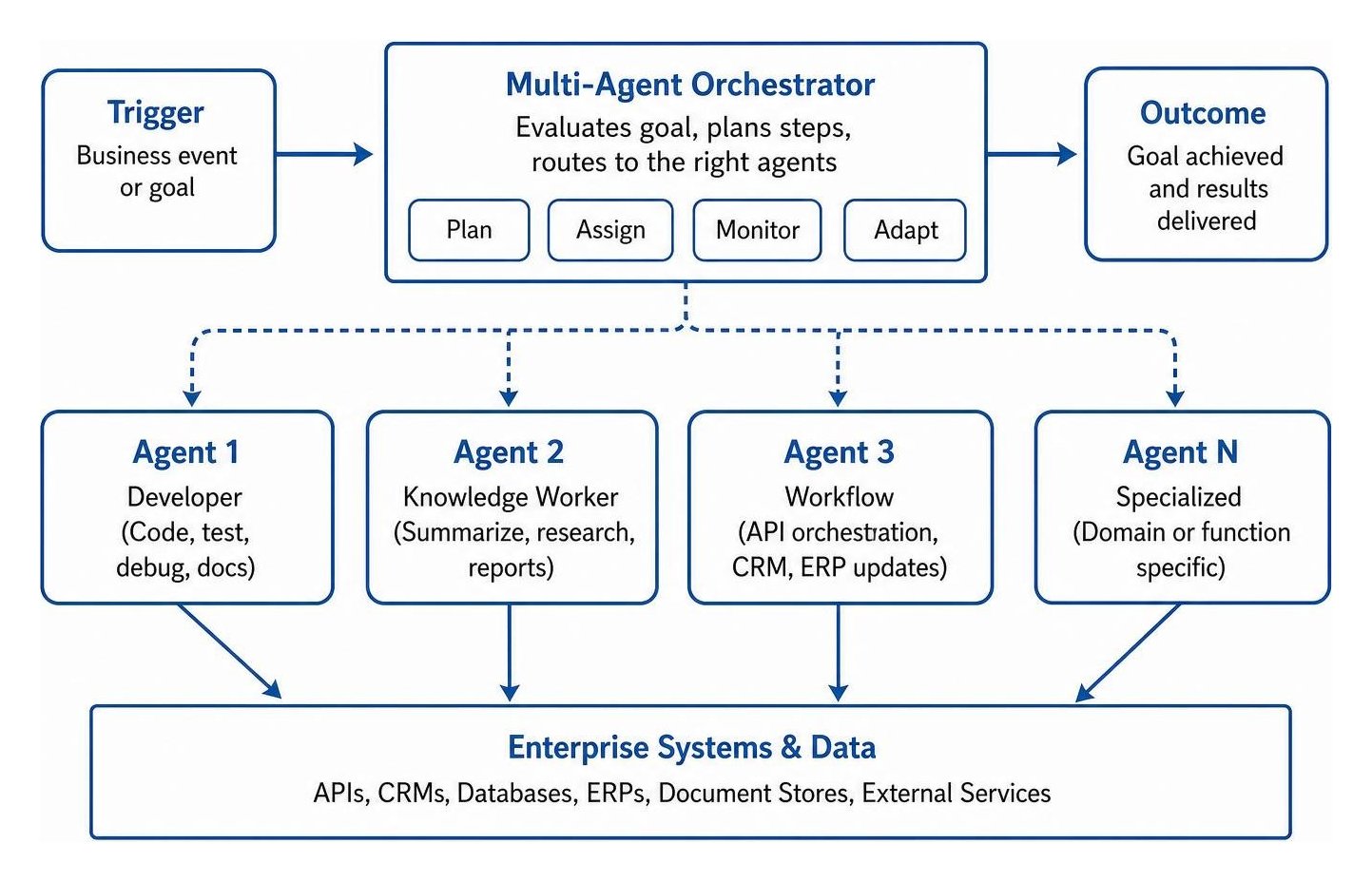
Industry studies, including 50+ key AI agent statistics and adoption benchmarks, highlight that 64% of agent deployments focus directly on automating multi-step business processes. These implementations generally operate across four modular layers:
- Developer Layer: Coding assistants generating automated test suites, debugging, and maintaining documentation.
- Knowledge Worker Layer: Autonomous agents summarizing cross-channel data, synthesizing research briefs, and preparing outbound reports.
- Workflow Layer: Goal-directed systems orchestrating complex API pipelines, synchronizing CRM records, and updating enterprise resource planning (ERP) databases.
- Control Layer: Policy guardrails and supervisory systems that monitor agent outputs for data compliance, security bounds, and model drift.
Business Process Automation, Cost Reductions, and Budget Trends
Autonomous agent deployments are driving significant shifts in IT budget allocations. Rather than cannibalizing existing software initiatives, 45% of enterprise AI agent budgets are entirely new, standalone capital allocations, while 27% are reallocated from non-AI legacy technology funds.
Tracking how much money businesses spend on AI infrastructure demonstrates that 42% of enterprise organizations plan to allocate more than $1 million directly toward autonomous agent frameworks annually. This budget ramp-up outpaces early generative AI adoption curves by more than triple at comparable commercial stages.
What Tasks Are AI Agents Automating to Cut Operational Costs?
AI agents primarily automate high-volume, rules-based tasks such as tier-one customer service triage, claims processing data extraction, sales enrichment, and code refactoring.
According to the AI agent workflow transformation report, organizations are replacing manual ticket handling and fragmented data entry with autonomous multi-agent systems.
| Business Workflow | Traditional Manual Execution | Autonomous AI Agent Execution | Measured Impact |
|---|---|---|---|
| Customer Support Ticket Triage | Human agents manually categorize, route, and resolve basic inquiries | Dual-agent networks resolve and verify standard tier-one issues autonomously | 60% first-contact resolution achieved without human escalation |
| B2B Sales Prospecting | Sales reps spend hours enriching lead sheets and drafting personalized emails | Autonomous agents pull CRM data, research prospect websites, and draft messages | 25% reduction in manual sales workload |
| Insurance Claim Processing | Manual data entry across unstructured PDFs, forms, and legacy portals | Vision and text agents parse documents and update core claims systems | Processing timelines reduced from hours to minutes |
| Software Maintenance | Engineers write routine boilerplate code and unit test coverage | Autonomous code agents generate test suites and refactor legacy functions | Up to 126% increase in coding speed benchmarks |
What Do the Data Reveal About Enterprise ROI and Time Savings?
On average, IT departments save 19 hours per week per active AI agent, with overall business productivity increasing by up to 25%.
Examining how much money AI actually saves businesses highlights that autonomous agents produce clear operational returns:
- Average Enterprise Density: Modern adopting companies maintain an average of 32 active AI agents across functional departments, with plans to double deployment density.
- Direct Labor Savings: High-profile customer support implementations have automated the equivalent workload of hundreds of full-time representatives, generating tens of millions of dollars in annual operating savings.
- Confidence in Outcomes: The enterprise survey on AI agent outcomes indicates that 92% of IT decision-makers believe AI agents will deliver substantial business outcomes, with 84% expressing equal or greater trust in an agent’s execution accuracy compared to human workers for repetitive tasks.
- Realization Timelines: Despite high confidence, 62% of executives acknowledge that full, organization-wide financial impact requires more than one year of operational tuning to achieve maximum ROI.
Adoption Barriers, Security Risks, and System Integration
Deploying autonomous systems introduces security and governance hurdles that standard conversational tools never faced. When evaluating the true cost of AI software and infrastructure, organizations must account for data cleaning, API middleware, and continuous security auditing alongside raw software licensing.
What Are the Top Security, Compliance, and Data Integration Challenges?
Security and compliance concerns represent the single largest barrier to AI agent adoption, cited by over 60% of enterprise technology leaders.
Key organizational bottlenecks include:
- Permissions and Boundary Control: Autonomous agents require broad read-and-write permissions across databases, raising risks of unauthorized data exposure if system boundaries fail.
- Legacy Software Silos: 24% of IT decision-makers cite legacy database integration as a primary roadblock to autonomous execution.
- Data Integration Expertise: 29% of organizations state that third-party data engineering and API orchestration are the most critical external capabilities needed to ensure successful deployment.
- Build vs. Buy Trade-offs: While 89% of leaders agree that custom in-house agent development provides superior operational control, 85% acknowledge that prebuilt commercial agent platforms are essential for meeting rapid deployment timelines.
How Do Governance Frameworks and Human-in-the-Loop Oversight Mitigate Risks?
Organizations mitigate agentic risks by pairing multi-agent verification checks with structured human-in-the-loop review protocols for all sensitive actions.
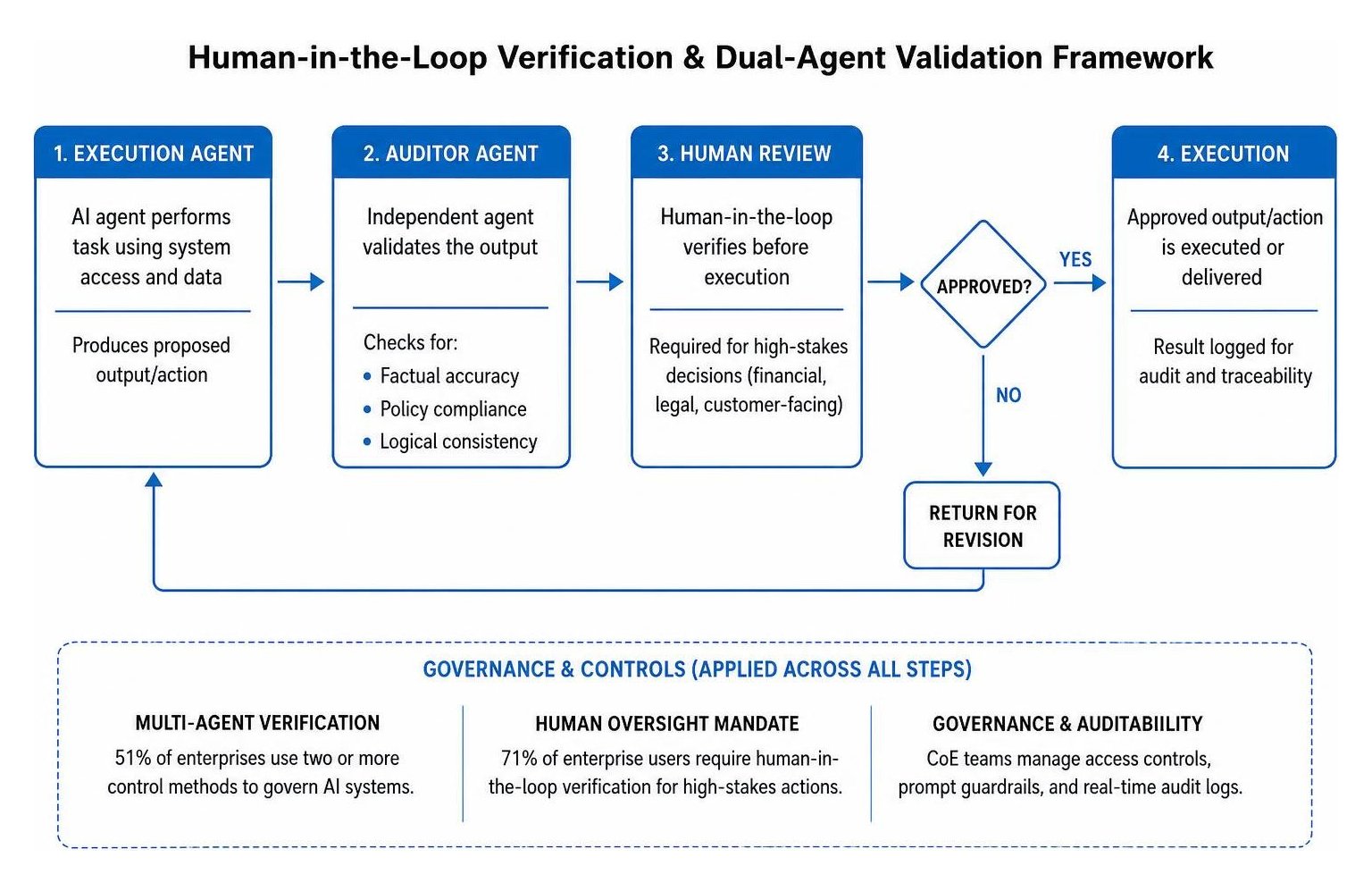
To protect organizational compliance, 51% of enterprises deploy two or more distinct control methods to govern their AI systems. Following structured responsible AI use policies, technology teams establish strict operational guardrails:
- Human Oversight Mandates: 71% of enterprise users insist on human-in-the-loop verification before allowing an agent to execute high-stakes financial, legal, or customer-facing decisions.
- Dual-Agent Verification: Advanced systems pair execution agents with independent auditor agents that check outputs for factual hallucinations, policy compliance, and logical errors prior to external delivery.
- Centers of Excellence (CoE): Dedicated internal governance teams oversee role-based access controls, comprehensive prompt guardrails, and real-time audit logging across departments.
Workforce Evolution and Future Market Growth Projections
Rather than wholesale worker replacement, AI agents are reshaping daily job functions by absorbing administrative friction and accelerating specialized output across industries.

How Do Autonomous Agents Impact Developer Productivity and Customer Experience?
AI developer agents boost routine coding speed by up to 126%, while automated customer service systems increase first-contact resolution rates to 60%.
The workforce impacts span technical, service, and administrative roles:
- Software Engineering: Automated agents handle unit testing, documentation, and continuous integration workflows. However, on complex unassisted benchmarks like SWE-bench, standalone agents currently resolve only about 14% of complex software engineering tickets unassisted, reinforcing the ongoing necessity of human developer guidance.
- Customer Experience Transformation: Agents resolve standard support tickets in seconds, reducing wait times and allowing human representatives to focus exclusively on complex, emotionally sensitive customer inquiries.
- Healthcare Administrative Support: Automated systems streamline appointment routing, documentation triage, and patient follow-up communication, alleviating administrative burdens for frontline staff.
- Emerging Enterprise Roles: Deploying autonomous workflows has spurred demand for specialized skill sets, including Agent Systems Architects, LLMOps Engineers, and AI Governance Auditors.
What Is the Projected Market Size and Growth of AI Agents?
The global AI agent market is expanding at an extraordinary Compound Annual Growth Rate (CAGR) of 45.3%, projected to surge from $7.38 billion to over $103.6 billion over the coming years.
Market expansion is driven by key technological catalysts:
- Efficiency of Open-Weight Models: Lightweight, open-weight models have reduced per-token operating costs, making continuous multi-agent execution financially viable for businesses of all sizes.
- Composability of Agent Frameworks: Standardization of developer tools, API routing protocols, and vector memory layers has drastically simplified the assembly of custom autonomous workflows.
- Autonomous Decision Loops: Software is shifting from passive reference libraries into active operational partners capable of real-time scheduling, transaction processing, and autonomous business decision-making.
Frequently Asked Questions About AI Agent Statistics
What is the difference between an AI chatbot and an autonomous AI agent?
An AI chatbot is a reactive conversational tool that generates text responses to user prompts. An autonomous AI agent is a goal-oriented software system equipped with memory, planning logic, and tool access. It can independently break a high-level objective into sequential steps, query external databases, call third-party APIs, and execute end-to-end tasks without requiring step-by-step human intervention.
How much do enterprises typically spend on AI agent implementations?
Enterprise investments vary based on company scale and customization requirements. The average enterprise expenditure for organizations deploying autonomous agents is approximately $2.5 million annually. Among surveyed organizations, 42% allocate $1 million or more per year to dedicated agentic initiatives, covering software licensing, API access, cloud compute infrastructure, and third-party data integration services.
What percentage of organizations require human oversight for AI agents?
Approximately 71% of business users require human-in-the-loop validation for high-stakes operational workflows, including automated financial transactions, customer-facing communications, and sensitive legal or compliance operations. Most enterprises employ multi-tiered governance structures combining automated guardrails with mandatory human approval checkpoints.
Navigating the Future of Agentic Automation
Autonomous AI agents are fundamentally reshaping how modern businesses manage workflows, optimize resource allocation, and scale operations. While technical and security hurdles remain, the trajectory of business automation is undeniably shifting from reactive chat prompts to proactive, self-directed systems.
To make agentic systems work for your business, start with focused, low-risk automation pilots, establish transparent governance controls, and continually evaluate your return on investment. For more context on foundational trends shaping modern business technology, review our guide to 50 generative AI statistics every business owner should know to build an effective, forward-looking automation strategy.