Beginner’s Guide to AI-Assisted Editing Benefits

What is AI-assisted editing, and when does it help?
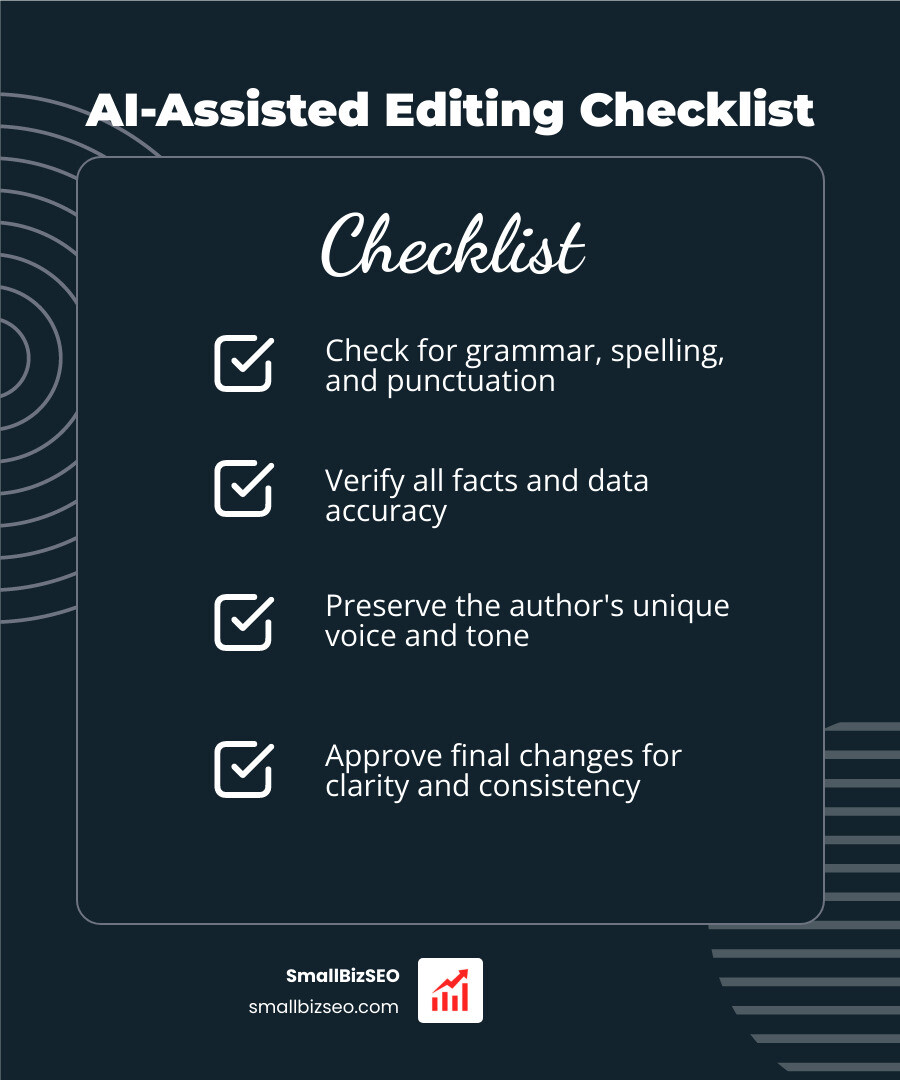
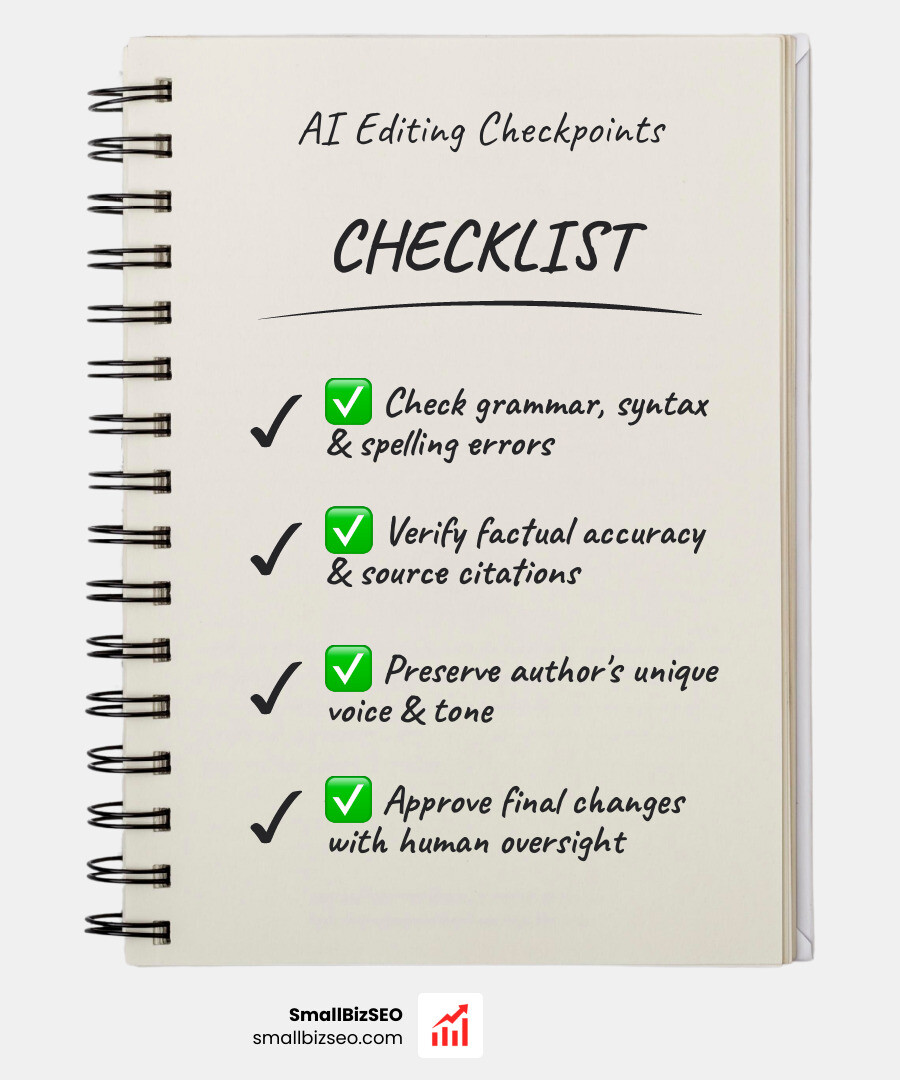
AI-assisted editing uses software to suggest changes to a draft, while a person decides what stays. It can speed up routine checks for grammar, clarity, and consistency. But every suggestion still needs review for accuracy, meaning, and the writer’s voice.
The amount of human work depends on the draft. Polishing a writer’s own words is different from rebuilding AI-generated text that has no clear point of view. That difference affects both the editor’s role and the time the job takes.
I’m Clayton Johnson, founder of SmallBizSEO. My work on AI-supported content workflows has taught me to keep human judgment at the center of ai-assisted editing, especially when a business needs its own expertise to come through.
Understanding AI-Assisted Editing and How It Transforms Modern Workflows

AI-assisted editing accelerates content production by handling mechanical language tasks, allowing human editors to focus on strategic storytelling, voice calibration, and factual integrity. By pairing generative language models with human oversight, editorial teams achieve higher output velocity without losing authorial intent.
When integrated thoughtfully, artificial intelligence does not replace the developmental editor or proofreader. Instead, it automates repetitive formatting, style-sheet matching, and syntax corrections, acting as an intelligent co-pilot across every phase of the editorial pipeline.
What is AI-assisted editing and how does it differ from traditional proofreading?
AI-assisted editing differs from traditional proofreading by analyzing full-context syntax, document structure, and tone rather than simply flagging isolated spelling or grammatical errors. Traditional proofreading applies rigid, rule-based mechanics to catch surface-level mistakes. In contrast, modern language tools offer dynamic structural reorganizations, vocabulary enhancements, and tone adaptations.
Recent academic editing research demonstrates that multi-stage AI systems can handle complex outlining, structural rephrasing, and cross-referencing within word processors. Rather than working in disconnected chat windows, professional editors now deploy in-app editorial add-ins that output revisions directly as native tracked changes and explanatory comments.
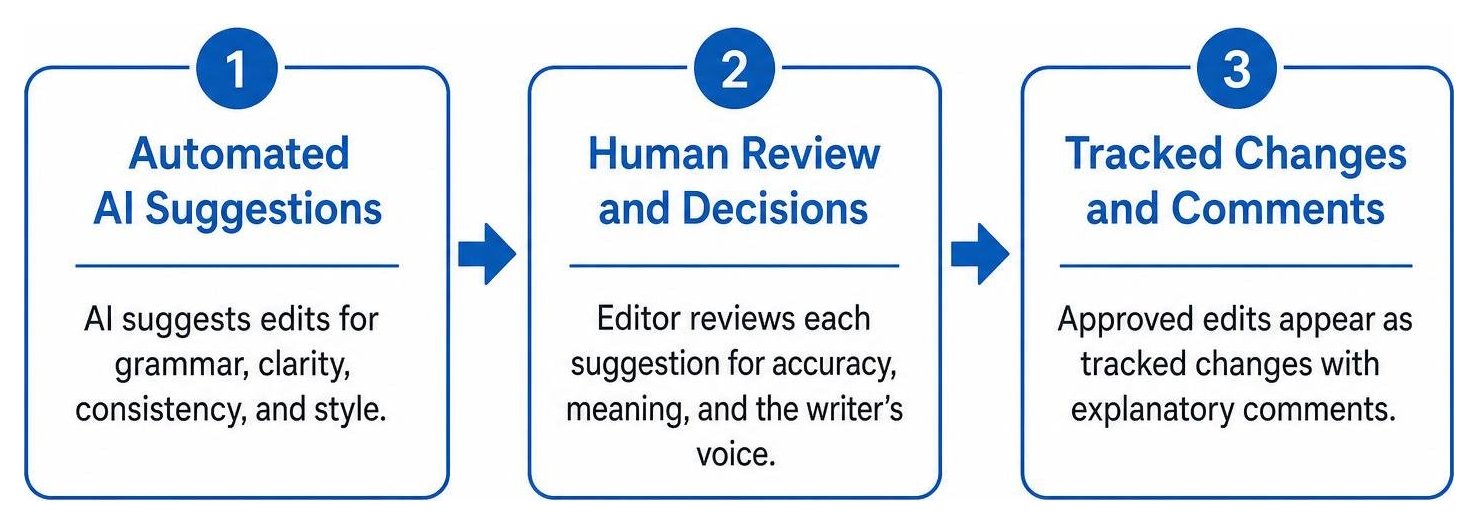
This in-line integration keeps the human editor in absolute control. The software flags stylistic inconsistencies, trims passive voice, and uncovers syntax bottlenecks, but the human professional evaluates whether each suggested revision preserves the author's nuanced perspective.
How does AI-assisted editing change editorial pricing and contract terms?
Editing AI-generated text requires fundamentally different pricing and contract terms because synthetic drafts lack intrinsic authorial intent, forcing editors into deep developmental rewriting rather than light copyediting. While machine-generated text arrives grammatically spotless, it often reads as flat, impersonal prose that conceals what the writer actually believes.
As a result, professional editors frequently charge a 50% pricing surcharge for manuscripts generated by AI. The work sits squarely in a demanding middle ground between standard editing and complete ghostwriting: the raw structure exists, but the substance requires extensive humanization and author-level decision-making.
| Editorial Dimension | Human-Written Manuscripts | AI-Generated Drafts |
|---|---|---|
| Mechanical Quality | Variable grammar, punctuation, and syntax errors | Flawlessly clean, grammatically polished surface |
| Authorial Voice | Clear personal perspective and authentic intent | Soulless, generic, and uniform sentence cadence |
| Primary Editorial Task | Evaluating execution and refining clarity | Making authorial choices and restoring human perspective |
| Pricing Baseline | Standard per-word or hourly editorial rates | 50% premium surcharge due to structural rewriting |
| Contract Safeguards | Standard scope of work and revision rounds | Mandatory AI disclosure, scope creep caps, and termination rights |
To protect against scope creep, professional agreements now feature clear contract addendums defining synthetic content thresholds. These clauses allow editors to renegotiate fees or terminate contracts if undisclosed machine generation turns a routine copyedit into an exhaustive structural overhaul.
Real-World Benefits: A Publishing Case Study on Workflow and Quality

In our comprehensive publishing case study, implementing AI-assisted editorial workflows cut overall project turnaround times by 42% while improving cross-chapter stylistic consistency across multi-author releases.
By utilizing dedicated professional manuscript workflows, our editorial team separated mechanical cleanup from developmental refinement. The machine handled terminology alignment, tense consistency, and structural summaries, leaving human specialists free to focus on strategic positioning and narrative punch.
What did our case study reveal about editorial time savings and voice retention?
Our case study revealed that while AI dramatically reduces time spent on mechanical tasks, preserving authentic voice requires structured prompt libraries and disciplined human review. Unchecked AI outputs often flatten writing into bland cliches. In an era marked by rapid content saturation, homogenizing your prose destroys audience engagement.
To combat the mental fatigue that comes with polishing repetitive, machine-generated drafts, our team created standardized prompt guidelines. Instead of asking AI for open-ended rewrites, editors applied targeted micro-prompts for specific rule-based tasks—such as matching active verb constructions or enforcing brand style sheets. This structured approach prevented editorial burnout and kept the original writer's voice front and center.
Why do AI detection tools fail to evaluate narrative quality?
AI detection tools fail to evaluate narrative quality because they only calculate statistical word predictability (perplexity and burstiness), completely ignoring creativity, factual depth, and emotional resonance. A detection score can suggest whether an automated model assembled a sentence, but it cannot judge whether that sentence communicates meaningful ideas or persuades a reader.
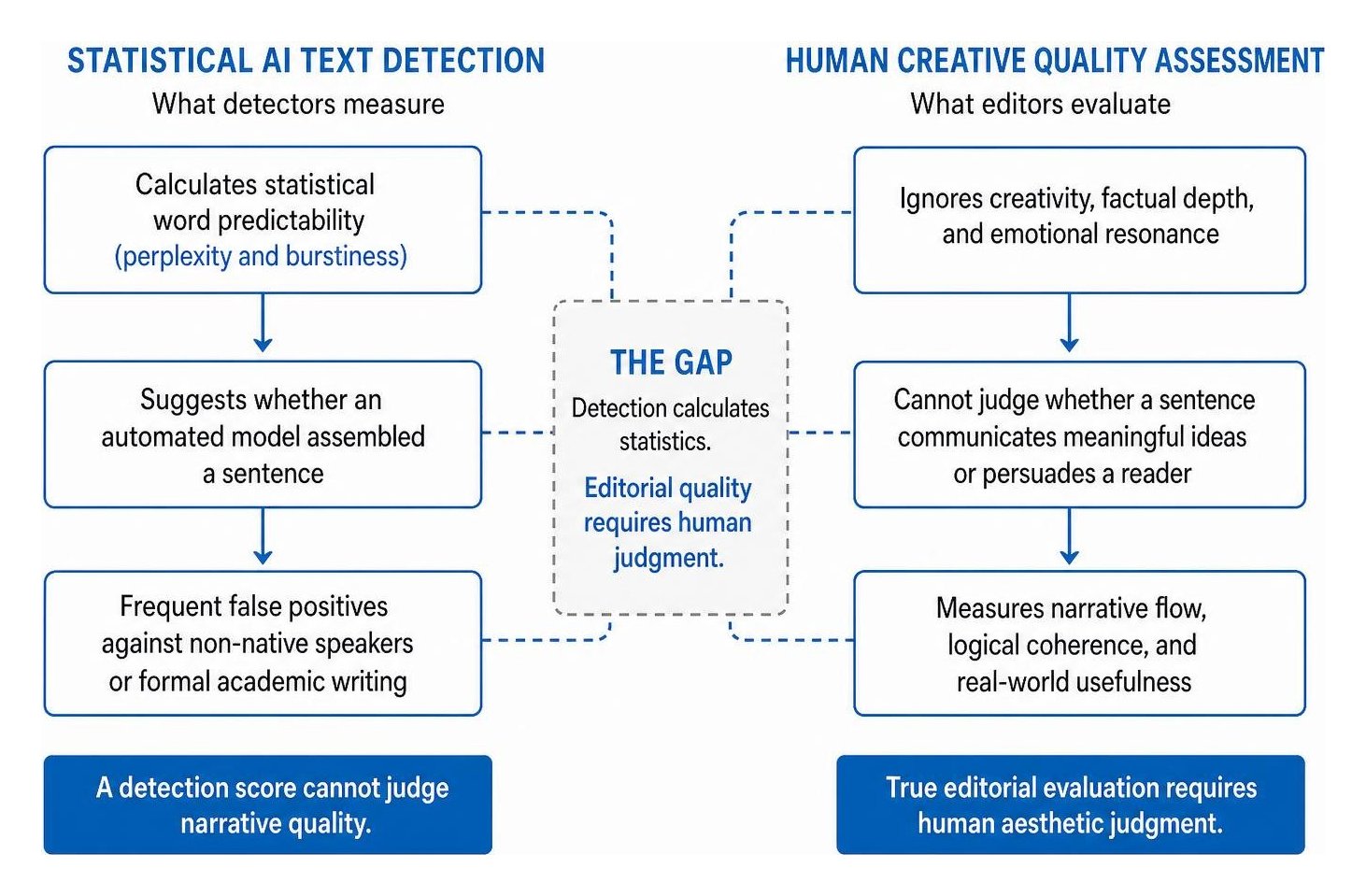
Relying on automated detectors creates substantial risks, including frequent false positives against non-native speakers or formal academic writing. True editorial evaluation requires human aesthetic judgment. Editors must measure narrative flow, logical coherence, and real-world usefulness—qualities that no mathematical detection algorithm can quantify.
Best Practices for Editors and Writers Collaborating with AI

Successful collaboration between writers and editors requires clear communication, transparent boundaries around tool usage, and an unwavering commitment to factual accuracy.
Treating AI as an assistive drafting tool rather than an autonomous creator keeps human judgment at the center of the creative process.
How can editors establish transparent AI disclosure policies?
Editors can establish transparent AI policies by introducing non-punitive disclosure clauses in initial client agreements that specify exactly where, why, and how language models will be used. Transparency protects intellectual property rights, establishes mutual trust, and ensures clear alignment on project expectations from day one.
A healthy disclosure policy treats AI as an editorial tool, much like a digital thesaurus or grammar checker. When clients openly disclose their use of AI for outlining or rough drafting, editors can structure realistic scopes of work, apply fair pricing tiers, and plan the exact developmental steps needed to restore authentic voice.
How does human oversight protect brand authenticity and compliance?
Human oversight protects brand authenticity by catching hallucinations, verifying legal compliance, and aligning every piece of content with Google's E-E-A-T (Experience, Expertise, Authoritativeness, and Trustworthiness) standards. Automated models regularly invent plausible-sounding citations and output misleading data.
Understanding the principles of establishing editorial safeguards is vital for any team publishing at scale. Unmonitored generation introduces compliance liabilities and reputational damage. As detailed in our breakdown of why unchecked AI errors threaten compliance, factual inaccuracies can quickly undermine consumer trust and search performance.
Through our proprietary Velocity framework, SmallBizSEO merges algorithmic precision with experienced human review. This balance enables small businesses to expand their organic search footprint quickly without sacrificing quality. To build an efficient, secure content workflow for your brand, explore SmallBizSEO's AI-assisted editing services and transform your publishing operations.
Mastering the Human-Led Editorial Future
The rise of generative language tools has not made human editors obsolete; it has made expert editorial oversight more critical than ever. As automated text floods search results and publications, audiences crave clear, authoritative perspectives rooted in genuine human experience.
By automating repetitive copyediting tasks while keeping human judgment in charge of storytelling and factual verification, modern editorial teams achieve unmatched efficiency. When you combine machine speed with thoughtful human craftsmanship, your content maintains the quality, compliance, and distinct voice needed to lead your industry.