Crucial ChatGPT Usage Statistics and Demographics You Should Know

Crucial ChatGPT Usage Statistics and Demographics You Should Know
What do ChatGPT usage statistics tell us?
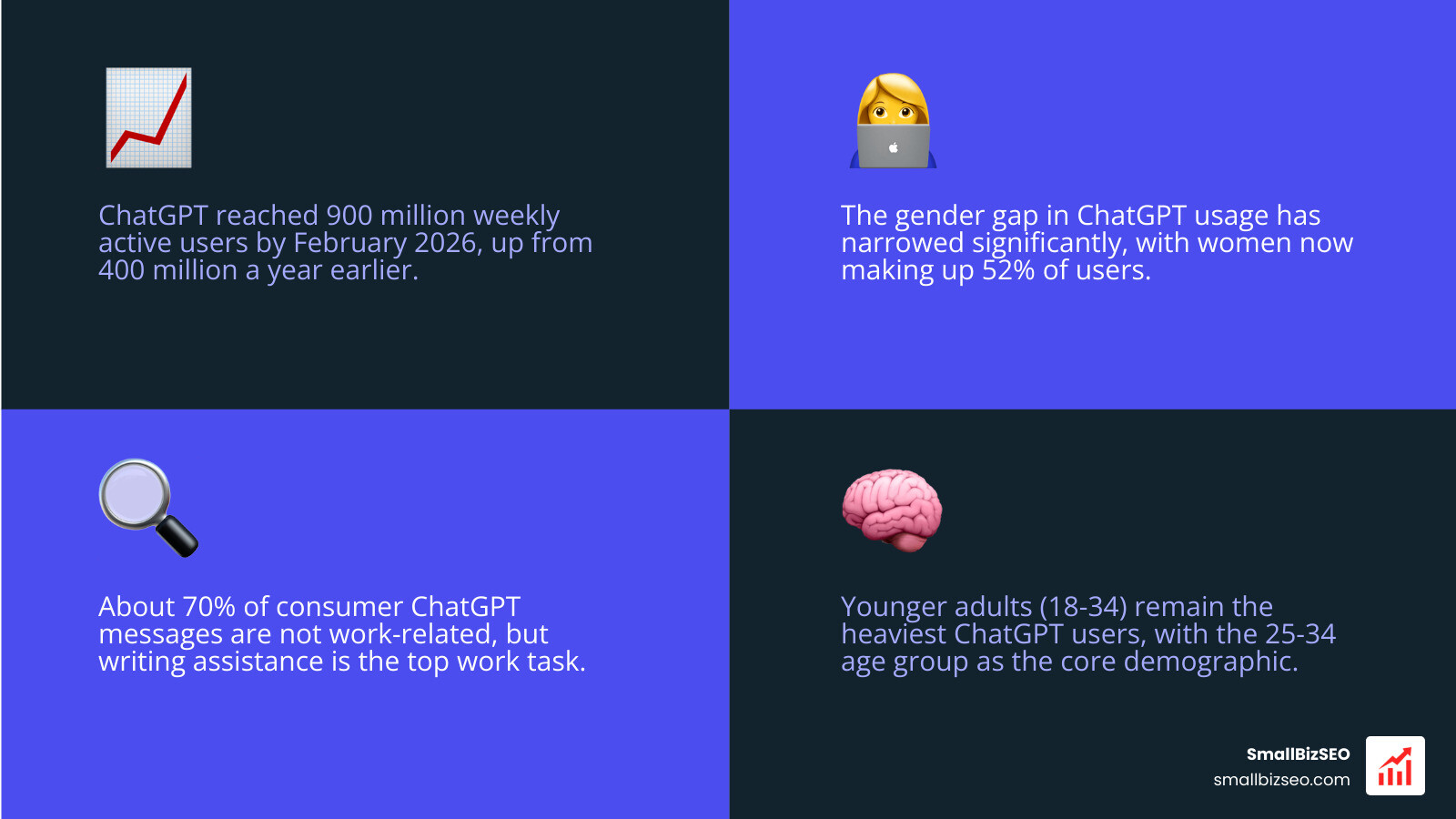
ChatGPT has 900 million weekly active users, up from 400 million a year earlier. People use it most for practical advice, finding information, and writing. About 70% of consumer messages are not work-related, though writing is the top task among work messages, according to research on how people use ChatGPT.
Its audience is broadening, too. The early gender gap has narrowed, while younger adults remain heavy users. For small businesses, the key question is not just how many people use ChatGPT, but what they ask it when making decisions.
I'm Clayton Johnson, founder of SmallBizSEO, where I help businesses make their expertise easier to find through SEO and AI-generated answers. My research into ChatGPT Usage Statistics: Demographics, Popular Tasks, and Business Applications builds on that work; let's look first at who's using the tool.
ChatGPT Usage Statistics: Demographics, Popular Tasks, and Business Applications glossary:
- AI Marketing Statistics: How Businesses Are Using Artificial Intelligence to Attract Customers
- AI Training Statistics: How Businesses Are Preparing Employees for Artificial Intelligence
- Human vs. AI-Generated Content: Traffic, Engagement, and Conversion Statistics
ChatGPT Usage Statistics: Demographics, Popular Tasks, and Business Applications
Understanding generative AI begins with analyzing real user activity. Globally, the platform processes over 2.5 billion daily prompts across 5.51 billion monthly visits. It has transformed from a niche tech demonstration into the fifth most-visited web property in the world.
Below, we examine the empirical data driving adoption across consumer profiles, daily tasks, enterprise workflows, and competitive landscapes.
Who Uses the Tool Most: ChatGPT Usage Statistics: Demographics, Popular Tasks, and Business Applications by User Profile?
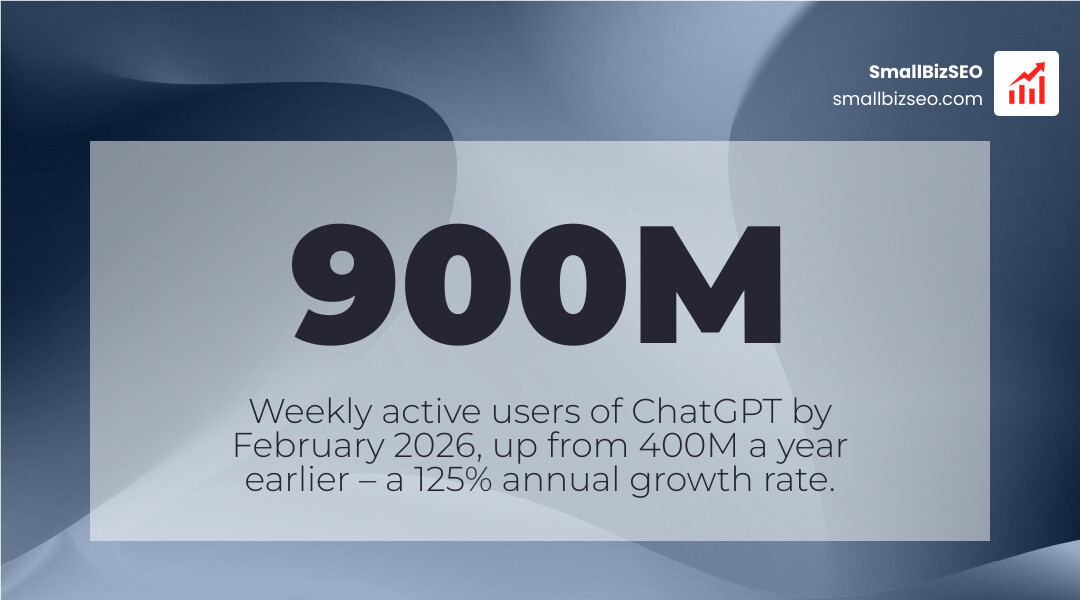
Direct Answer: The typical ChatGPT user base has reached near-even gender parity, skews toward adults under 35, and correlates strongly with higher education levels. Furthermore, adoption rates in developing economies now outpace those in mature markets by more than four times.
1. Gender Distribution and Parity
Early adoption favored masculine user profiles by nearly four to one. Today, that gap has closed entirely:
- 52% of active consumer accounts feature traditionally feminine names, compared to just 37% during early tracking cycles.
- Web traffic panels reflect a balanced split of 54% male and 46% female visitors.
2. Age Demographics
Younger generations drive high prompt frequency, but working professionals represent the largest overall headcount:
- 25–34 Age Bracket: Represents 29.9% of all unique web visitors.
- 18–24 Age Bracket: Accounts for 22.6% of visitors, yet generates nearly half of all total message volume.
- 35–54 Age Bracket: Makes up 33.5% of regular users, primarily leveraging the platform for career and administrative tasks.
3. Education and Knowledge Roles
Usage rates increase alongside formal educational attainment:
- 45% of adults with postgraduate degrees utilize large language models daily.
- Only 17% of individuals with a high school diploma or less report daily usage.
- Knowledge-driven fields lead adoption, led by computer-related occupations (57%), business management (50%), and engineering/science roles (48%). To bridge this divide across enterprise teams, review these AI training statistics highlighting the corporate skills gap.
4. Geographic Expansion
The United States represents approximately 15.1% of direct web traffic, with India and Brazil following closely behind. However, adoption velocity in lower-income countries is growing over 4x faster than in high-income regions, proving that generative assistance offers immense utility where traditional institutional resources are limited. For deeper academic context, explore scientific research on estimating LLM usage in the general public.
What Are People Asking: ChatGPT Usage Statistics: Demographics, Popular Tasks, and Business Applications for Daily Tasks?
Direct Answer: Contrary to common assumptions about automated coding or creative writing, roughly 80% of all prompts fall into three practical buckets: seeking advice, finding information, and drafting everyday text.
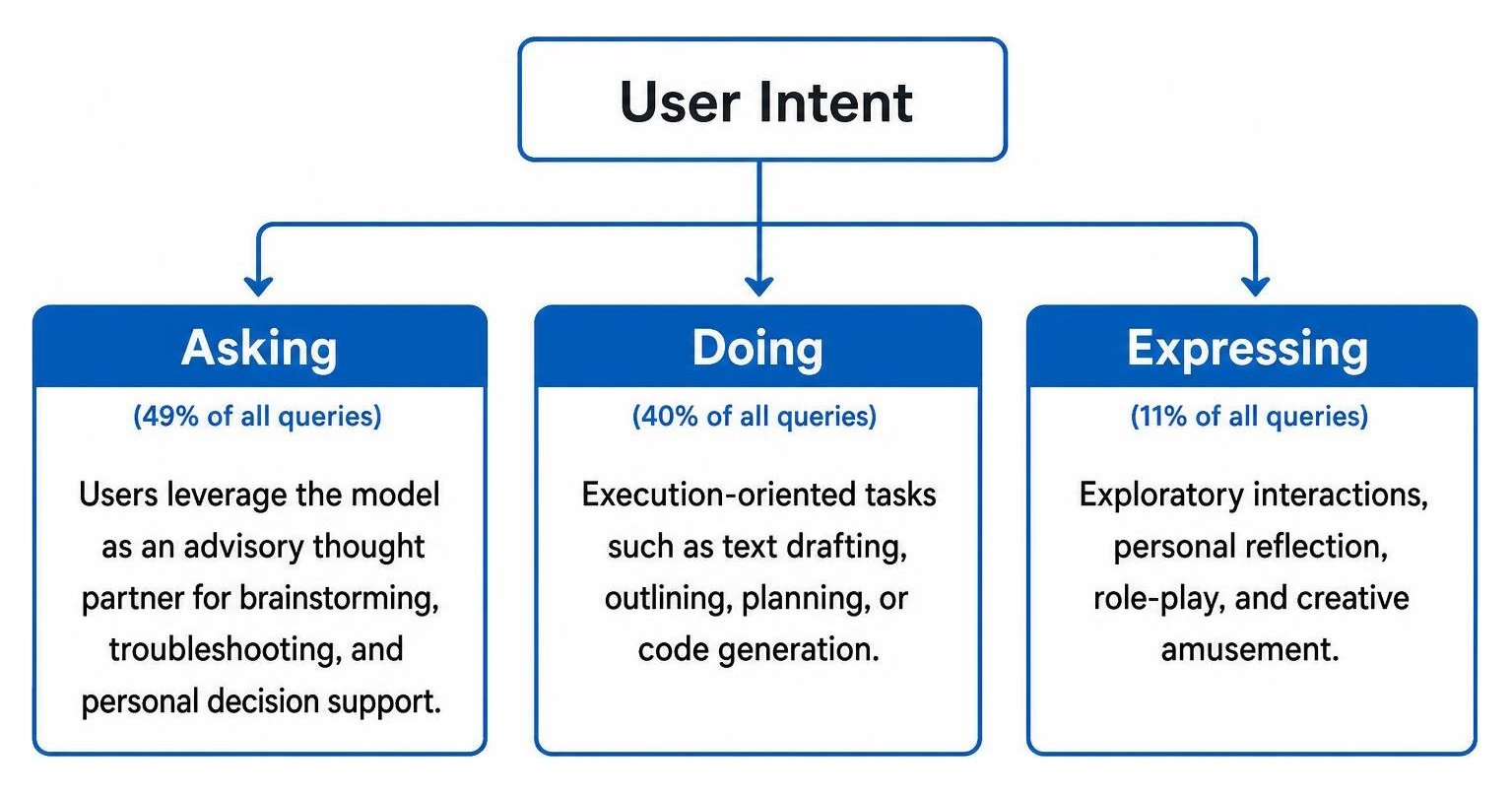
Researchers segment user behavior into a simple functional framework:
- Asking (49% of all queries): Users leverage the model as an advisory thought partner for brainstorming, troubleshooting, and personal decision support.
- Doing (40% of all queries): Execution-oriented tasks such as text drafting, outlining, planning, or code generation.
- Expressing (11% of all queries): Exploratory interactions, personal reflection, role-play, and creative amusement.
Non-work conversations represent 73% of total platform activity. In work contexts, writing and editing dominate at 40% of all job-related messages. When planning your brand's publication strategy around these patterns, compare performance using these AI vs human content traffic engagement conversion stats.
How Are Enterprises Capitalizing on Generative AI Productivity and Cost Savings?
Direct Answer: Over 92% of Fortune 500 corporations deploy ChatGPT within their organizational workflows, saving workers an average of 40 to 60 minutes per day and producing verified double-digit productivity gains.

Corporate integration spans several primary operational channels:
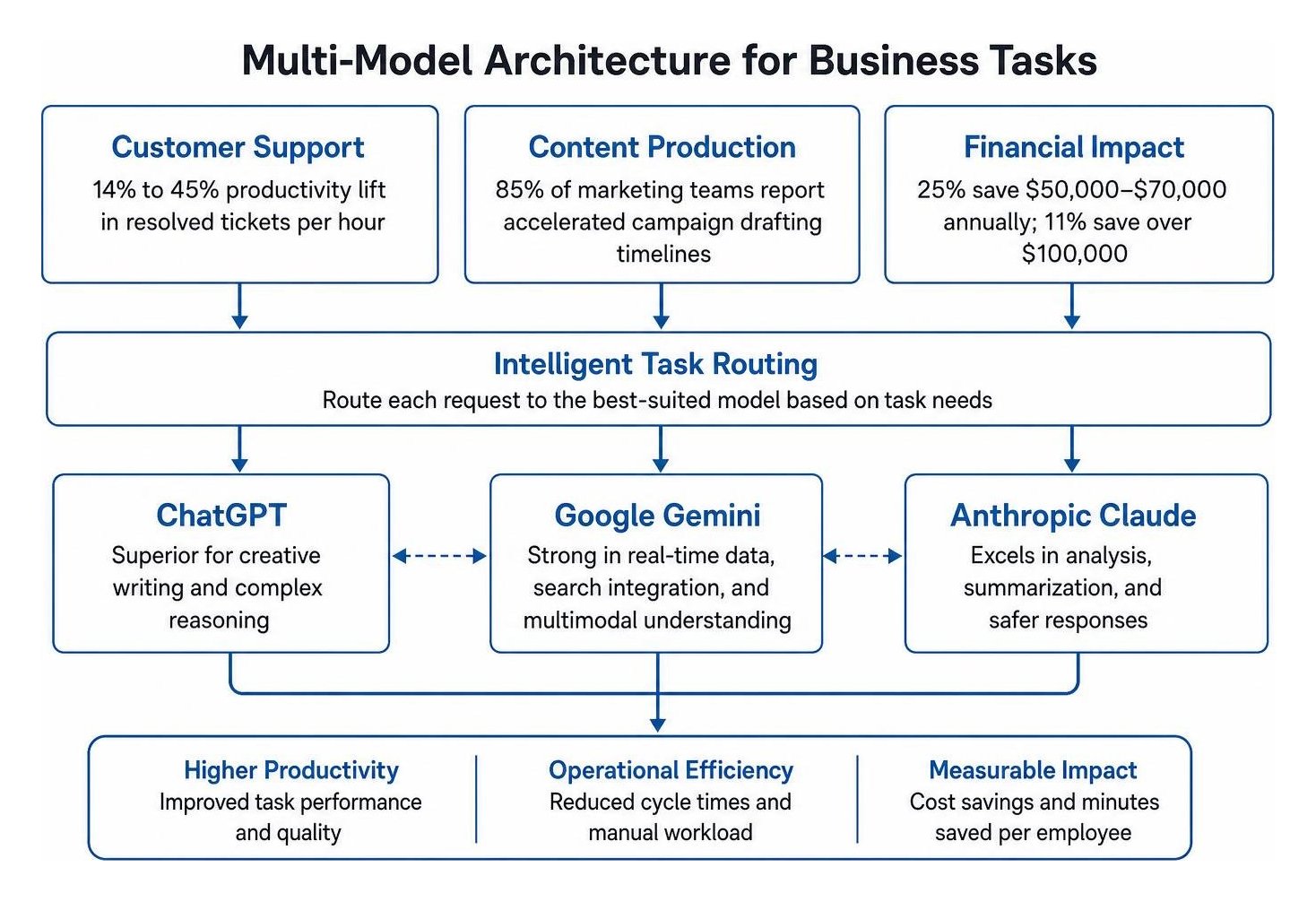
- Customer Support: Organizations report a 14% to 45% productivity lift in resolved support tickets per hour.
- Content Production: 85% of marketing teams report accelerated campaign drafting timelines.
- Direct Financial Impact: A quarter of mid-sized organizations report saving between $50,000 and $70,000 annually, with 11% saving over $100,000. Discover detailed ROI benchmarks in our guide on how much money AI actually saves businesses.
Despite rapid adoption, governance remains a major challenge: 68% of enterprise employees admit to using AI tools without official disclosure. As automation evolves, business leaders are evaluating whether AI agents are really replacing human workflows or primarily augmenting knowledge tasks.
What Does the Competitive Landscape Look Like Across Major LLMs?
Direct Answer: While ChatGPT maintains a commanding market share of over 60%, competitors like Google Gemini and Anthropic Claude continue to expand their footprints, encouraging modern organizations to adopt multi-model architectures.
Because nearly 37% of modern consumers now initiate discovery queries directly through conversational assistants, ranking inside model responses requires new search optimization techniques. Learn how to monitor these shifts in our breakdown of the future of search and LLM visibility tools.
Turning AI Search Trends Into Measurable Business Growth
The rapid expansion of generative AI highlights an essential truth for modern organizations: consumers and professionals no longer rely solely on conventional search engines to find answers, evaluate products, or make buying decisions. Over 900 million weekly users treat conversational models as their personal advisors for everything from local services to complex enterprise software purchases.
To maintain your brand's digital visibility, your web presence must be structured for citation by modern conversational engines. Review these 50 Generative AI Statistics Every Business Owner Should Know to understand how data-backed content optimization can secure your brand's position at the forefront of AI-driven search.