Enterprise AI Adoption Benchmarks Across Every Major Business Sector

Enterprise AI Adoption Benchmarks Across Every Major Business Sector
AI Adoption by Industry: Which Business Sectors Are Investing the Most?
Direct answer: Software and information services, banking, and professional scientific services lead all commercial sectors in total capital allocation and active AI integration. The heaviest spenders are organizations whose daily operations rely heavily on processing structured data, complex risk modeling, and digital product delivery.
Analyzing AI adoption by industry and which business sectors are investing the most shows that real-world capital commitments concentrate where cognitive automation delivers immediate labor efficiency. According to the Intelligence Report: Which Industries Are Investing the Most in AI? | Richmond Fed, non-residential software investment has surged most rapidly in information processing, securities, and professional technical fields.
Organizations tracking these patterns closely monitor tracking enterprise AI investment statistics and projections to evaluate how capital budgets shift from exploratory pilots to permanent operational lines.
| Industry Sector | AI Adoption Rate (Firm-Level) | Work-Related GenAI Usage | Top Spending Focus Areas | Primary Use Cases |
|---|---|---|---|---|
| Information & Technology | ~33% – 73% (Size Dependent) | ~65% | In-house tooling, coding agents, cloud compute | Automated software engineering, platform operations |
| Banking & Financial Services | ~30% | 63% | Risk systems, compliance, cybersecurity | Fraud detection, automated credit underwriting, algorithmic trading |
| Professional & Technical Services | ~33% | 62% | Knowledge retrieval, workflow copilots | Contract review, client research, automated document synthesis |
| Healthcare & Life Sciences | ~12% – 18% | ~40% | Diagnostics, clinical tools, discovery | Clinical notes transcription, predictive triage, drug discovery |
| Manufacturing & Logistics | ~12% | ~35% | Industrial robotics, predictive maintenance | Quality control, demand forecasting, non-production workflows |
| Retail & Hospitality | ~4% – 8% | ~28% | Customer experience, personalization | Recommendation engines, dynamic pricing, inventory tracking |
AI Adoption by Industry: Which Business Sectors Are Investing the Most in Enterprise Software?
Direct answer: The information and data processing sector, alongside global banking institutions, invests the largest dollar volume into enterprise AI software infrastructure.
Financial institutions and data-heavy tech organizations commit immense budgets because their core margins depend on processing speed, predictive accuracy, and security. Enterprise spending data from IDC - IDC’s Worldwide AI and Generative AI Spending – Industry Outlook shows that software services and financial institutions collectively command tens of billions in annual enterprise AI allocations.
In financial services, investments concentrate heavily on automated fraud detection, algorithmic risk modeling, and regulatory compliance. Banks allocate significant portions of their AI budgets strictly to risk mitigation. Meanwhile, information service providers deploy AI directly into the development lifecycle, automating testing pipelines and user interfaces. For companies evaluating enterprise adoption and business impact statistics, the return on software investment stems directly from lowering error rates and accelerating product release cycles.
AI Adoption by Industry: Which Business Sectors Are Investing the Most in Agentic Automation?
Direct answer: Technology, media, telecommunications (TMT), and asset management firms lead enterprise investment in autonomous, agentic automation systems.
Organizations are increasingly moving past standard interactive chatbots to build multi-agent autonomous systems that execute tasks without constant manual oversight. Findings from the KPMG Survey: AI Agents Move from Pilots to Production Across Industries as Leaders Make Recession-Proof Investments and Reimagine Talent Strategies reveal that top-performing enterprises treat AI agent systems as recession-proof productivity drivers rather than experimental tools.
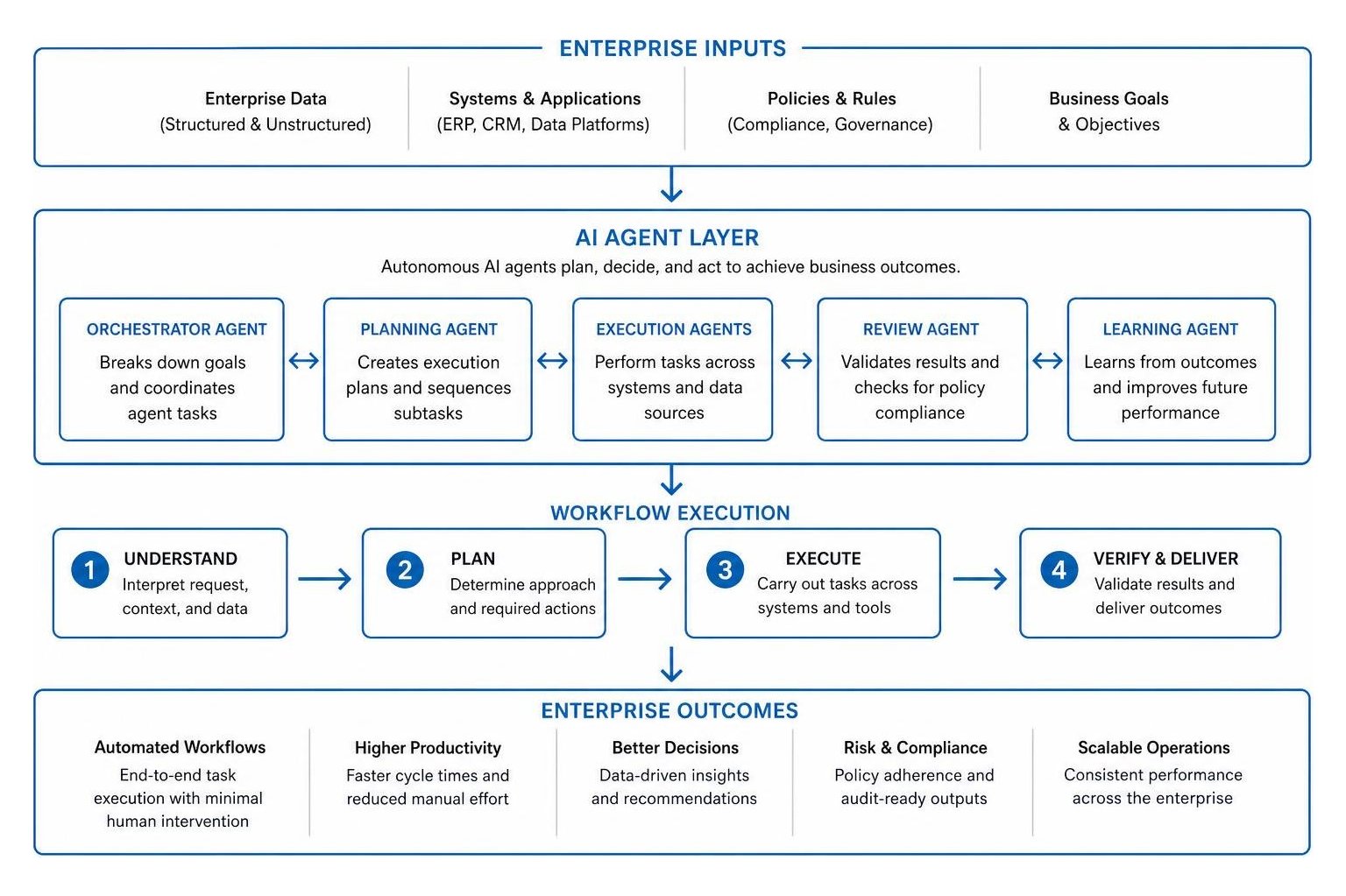
TMT organizations frequently deploy autonomous agents directly within software engineering pipelines. Rather than purchasing rigid, expensive third-party software licenses, these firms use agentic coding tools to construct custom internal solutions. Asset managers and private equity firms use autonomous workflows to monitor real-time portfolio risks, scan market disclosures, and conduct initial deal screening. When examining how autonomous AI agents replace human workflows, the focus is moving from simple text production to automated orchestration of multi-step corporate tasks.
How Does AI Adoption Vary Across Manufacturing, Healthcare, and Lagging Sectors?

Direct answer: Manufacturing and healthcare show moderate, specialized AI adoption, while construction, retail, and hospitality show lower overall firm-level penetration.
Physical and regulated industries adopt technology differently than purely digital sectors:
- Healthcare and Life Sciences: Adoption is high in specialized domains like diagnostic imaging and administrative workflow transcription, supported by initiatives outlined in Supporting the Apply AI strategy: AI Start up and investment activity across 10 key industrial sectors | Shaping Europe’s digital future. However, broad clinical adoption remains careful due to stringent regulatory frameworks and patient safety requirements.
- Manufacturing: Industrial adoption focuses on predictive equipment maintenance, visual quality inspection, and supply chain balancing. Many manufacturing organizations also deploy AI in back-office functions like procurement and business-to-business marketing.
- Retail and Construction: Small-scale retail, food service, and trade contractors exhibit lower firm-wide adoption rates. In these sectors, hands-on physical labor dominates day-to-day operations, making digital automation less immediately applicable to frontline work.
Reviewing comprehensive generative AI statistics for business owners shows that adoption correlates directly with the volume of knowledge work within an industry's operating model.
What Economic Factors and Barriers Drive Uneven AI Investment?
Direct answer: Disparities in AI investment are driven primarily by workforce skill profiles, average wage levels, capital availability, and the digital maturity of existing workflows.
Industries with higher average hourly wages adopt AI faster because automating cognitive tasks yields higher cost savings per hour worked. When a high-compensation analyst, software engineer, or legal professional automates five hours of administrative work each week, the financial return quickly justifies the underlying infrastructure expense.
Key drivers accelerating enterprise deployment include:
- High Baseline Wages: Greater financial upside when automating routine knowledge work.
- Accessible Cloud Infrastructure: Pre-existing modern data pipelines that allow rapid tool integration.
- Data Availability: Large volumes of structured proprietary data ready for model training or retrieval.
- Competitive Market Dynamics: Aggressive competition where early efficiency gains secure larger market shares.
Understanding software pricing benchmarks and AI infrastructure costs helps explain why capital-rich firms can absorb modern model inference expenses while smaller operations must choose their software tools carefully.
Why Does Firm Size and Workforce Wage Level Determine AI Integration Depth?
Direct answer: Large firms possess the capital, centralized data assets, and administrative scale to absorb implementation costs, while smaller businesses adopt lightweight tools through subscription software.
Firm size is a significant predictor of enterprise AI integration. Large enterprises (organizations with hundreds or thousands of workers) frequently achieve adoption rates exceeding 70% in information sectors, compared to significantly lower rates among smaller operations. Large firms have dedicated data engineering teams, internal compliance officers, and the financial bandwidth to build custom software.
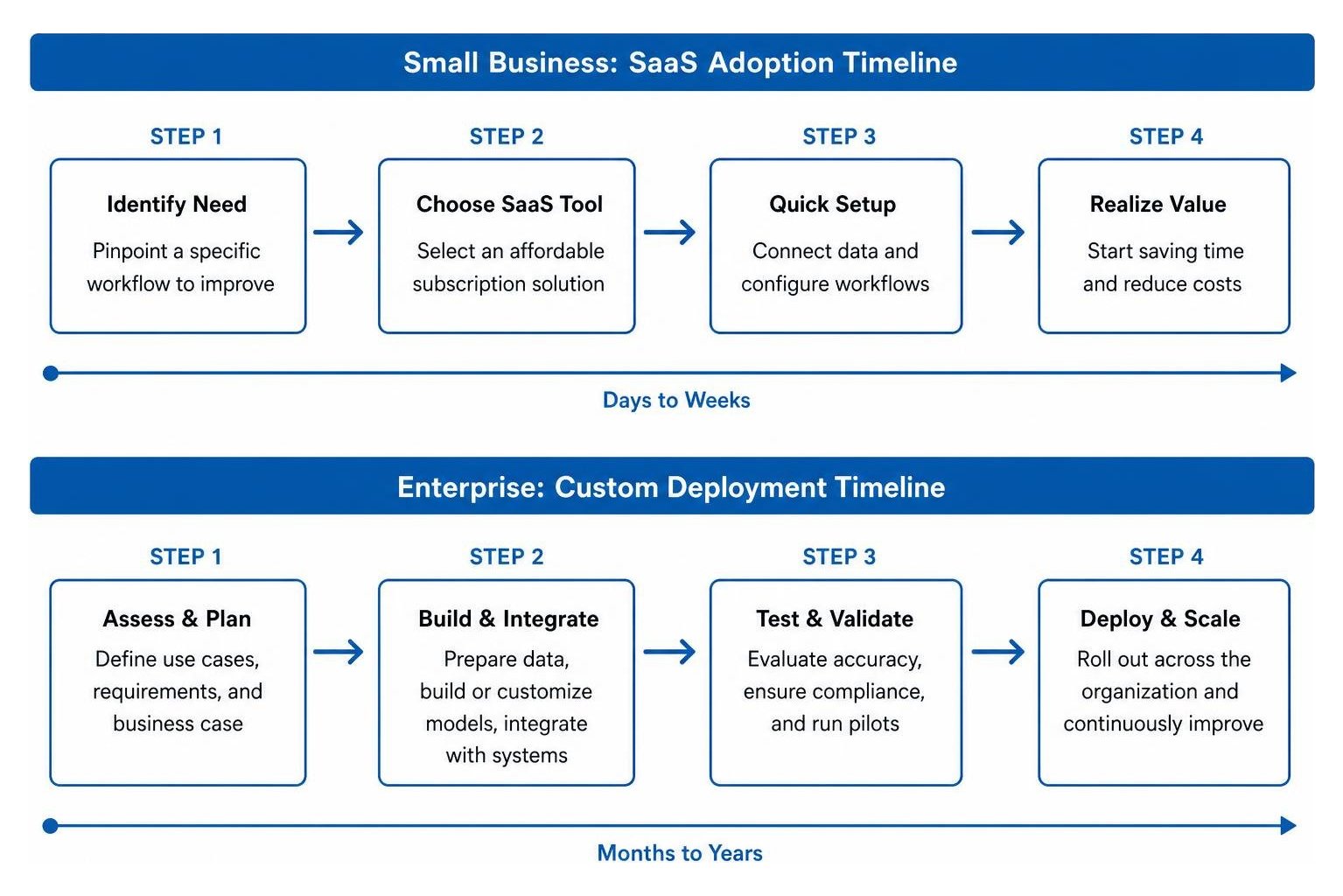
However, smaller businesses are adopting technology through modern cloud software. Small teams increasingly leverage accessible, low-cost subscription tools that embed intelligence directly into search marketing, accounting, and customer communication. Because early-stage firms can build lean workflows from day one, newer business cohorts are reaching functional adoption much faster than legacy organizations did in previous technology cycles.
What Are the Key Implementation Barriers and Spending Constraints Across Industries?

Direct answer: The primary barriers to enterprise AI adoption are recurring computing costs, workforce skill shortages, legacy system friction, and regulatory compliance risks.
While interest in automated systems is high, companies encounter real-world obstacles during production rollout:
- Ongoing Operating and Compute Expenses: High query volumes and continuous model inference generate steady operational costs that require clear financial returns.
- Workforce Skills Scarcity: Many teams lack internal specialists capable of connecting external models to internal databases securely. Insights from analyzing corporate AI training statistics and workforce skill gaps indicate that internal training programs remain necessary to bridge this divide.
- Legacy Technical Debt: Outdated, fragmented database architectures prevent models from retrieving accurate operational data.
- Data Privacy and Governance: Highly regulated industries require strict safeguards against data leakage and automated decision bias.
Navigating the Next Phase of Sector-Specific AI Growth
Understanding cross-industry investment patterns allows leadership teams to allocate resources where they create genuine operational leverage. Rather than treating artificial intelligence as a generic solution, top performers match automated tools to their industry's core workflows—whether optimizing legal documentation, automating code pipelines, or personalizing customer communication.
At SmallBizSEO, we track these enterprise adoption dynamics to help businesses build sustainable search visibility and organic traffic. As search engines and discovery platforms increasingly rely on advanced machine models to evaluate and surface content, having an authoritative, technically sound digital foundation is essential. Whether your goal is to modernize technical infrastructure or scale search visibility with data-driven AI SEO services, building on accurate performance data ensures your business stays competitive as discovery technologies evolve.