Key Video Marketing Metrics Proving Generative AI Lowers Cost Per View
Key Video Marketing Metrics Proving Generative AI Lowers Cost Per View
Do AI Video Marketing Statistics Show a Lower Cost per View?
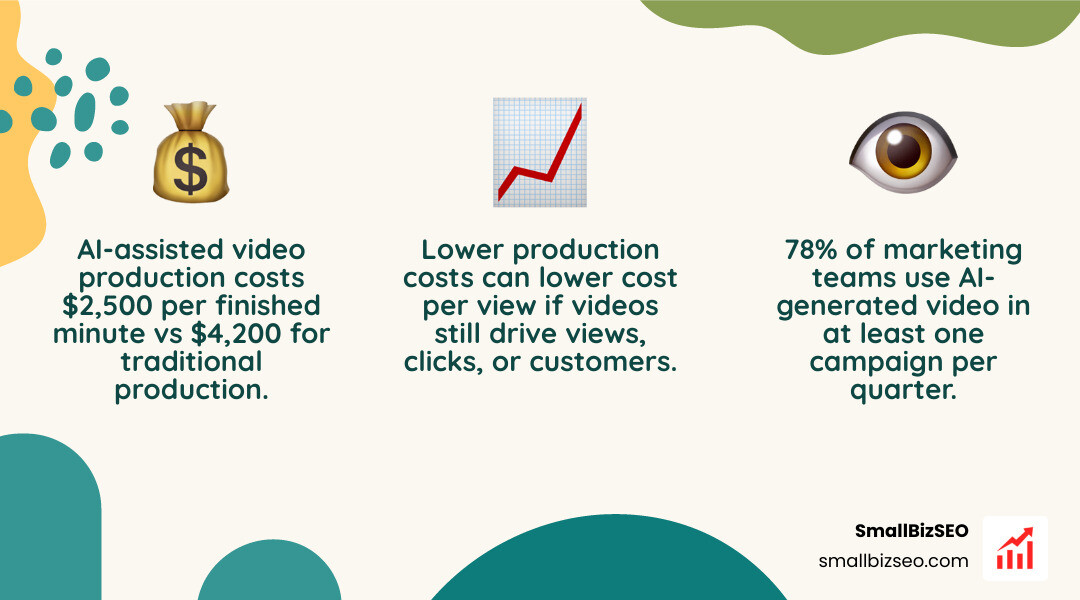
AI video marketing statistics on adoption, production costs, and advertising performance point to a clear benefit: AI can make video cheaper and faster to produce. One industry estimate puts AI-assisted production at $2,500 per finished minute, versus $4,200 for traditional production. The same report says 78% of marketing teams use AI-generated video in at least one campaign per quarter. These figures are estimates, not a promise of results.
Lower production costs can help lower cost per view, but only if the videos still reach people. Track total production and ad spend against views, then check whether those views lead to clicks or customers.
I’m Clayton Johnson, founder of SmallBizSEO, where I help small businesses connect SEO and content strategy to search visibility. My work on AI Video Marketing Statistics: Adoption, Production Costs, and Advertising Performance focuses on helping owners use the numbers without mistaking cheaper video for better marketing.
AI Video Marketing Statistics: Adoption, Production Costs, and Advertising Performance glossary:
- AI Advertising Statistics: Spending, Performance, and Consumer Engagement
- AI Marketing Statistics: How Businesses Are Using Artificial Intelligence to Attract Customers
- Consumer Trust in Artificial Intelligence: Survey Statistics and Buying Behavior
Core AI Video Marketing Statistics: Adoption, Production Costs, and Advertising Performance

Generative tools have shifted from a creative novelty into an operational engine for digital advertising. When we look at overall market metrics, AI-powered ad spend is growing three times faster than total digital ad spend worldwide.
How Do AI Video Marketing Statistics on Adoption, Production Costs, and Advertising Performance Compare to Traditional Workflows?
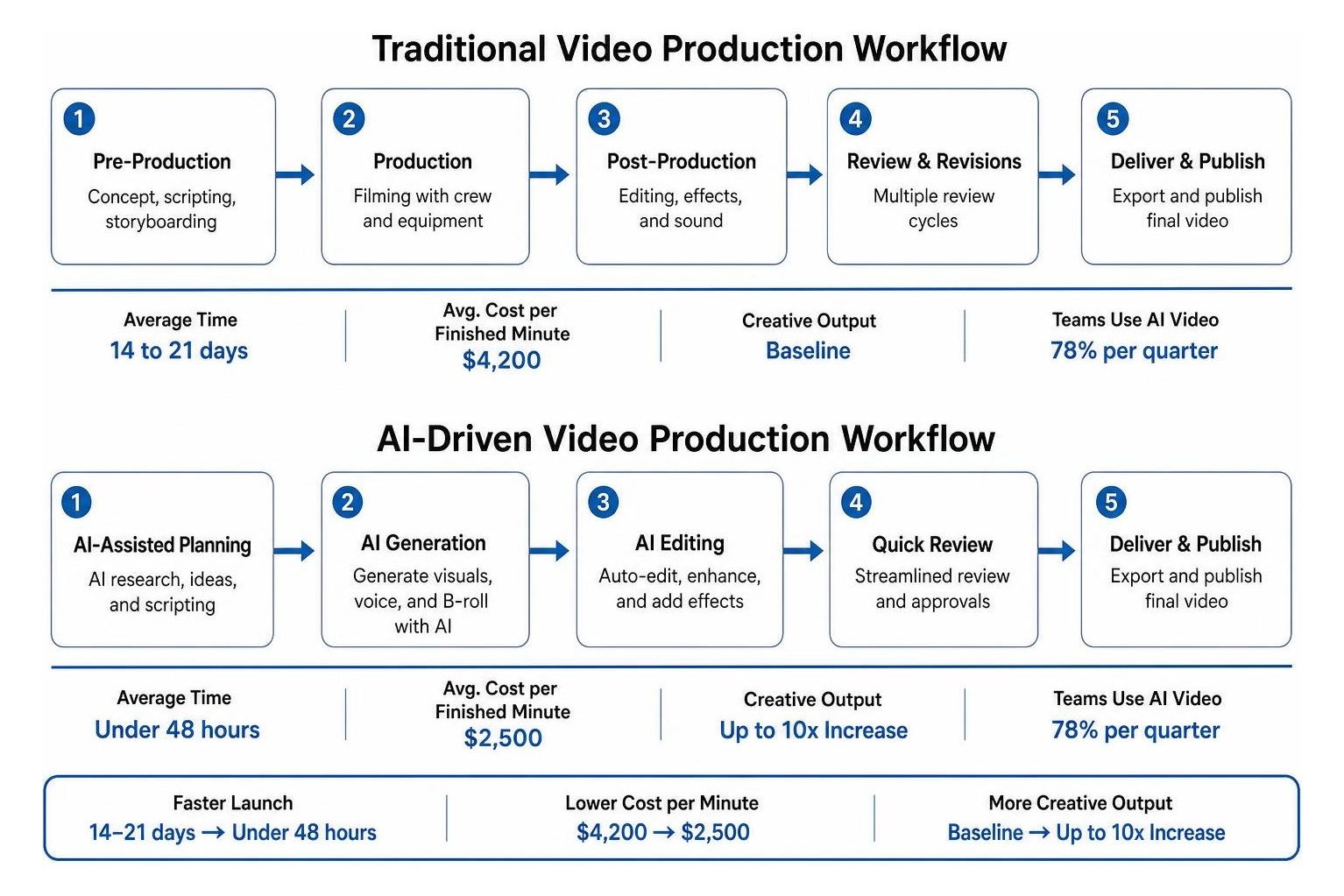
Direct answer: Modern marketing teams use AI video generation to achieve up to a 10x increase in creative output without expanding headcount, shrinking campaign launch times from three weeks down to under two days.
Adoption has expanded across both boutique agencies and global enterprises. Currently, 78% of marketing teams integrate AI video into at least one campaign each quarter. Enterprise adoption mirrors this trend, with 73% of Fortune 500 organizations deploying automated video tools to support product explainers, localization, and customer onboarding. When exploring generative AI statistics for business, the central pattern is simple: companies are automating asset versioning so human teams can focus entirely on high-level strategy.
Key adoption metrics across the industry highlight this transition:
- Executive Priority: 89% of CEOs and founders rate AI as critically or very important to their ongoing operations.
- Agency Scaling: Over 60% of digital agency decision-makers deploy generative video solutions to produce multichannel assets.
- Production Acceleration: Time-to-launch for omnichannel ad campaigns has fallen from an average of 14 to 21 days down to under 48 hours.
How Much Does Generative AI Slash Per-Minute Production Costs and Turnaround Times?
Direct answer: Generative AI cuts video production costs by 85% to 95%, reducing the expense of short-form video assets from hundreds of dollars down to just a few dollars per render while completing drafts in minutes instead of weeks.
The traditional production cycle requires location scouting, physical equipment, talent fees, and labor-intensive post-production editing. AI-driven creative automation replaces these friction points with scripted text prompts, automated scene composition, and synthetic avatars. As documented in broader business productivity and cost-savings statistics, slashing baseline rendering overhead allows businesses to reallocate capital directly into media buying and creative testing.
| Production Factor | Traditional Studio Production | AI-Assisted Video Creation |
|---|---|---|
| Median Cost per Finished Minute | $4,200 | $2,500 |
| Social UGC Ad Unit Cost | $150 – $500 per creator video | $0.50 – $5.00 per render |
| Turnaround Time | 13 to 28 business days | 10 to 30 minutes |
| Weekly Asset Variation Capacity | 1 to 3 finished cuts | 50+ unique variations |
| Localization Overhead | Studio re-recording & manual dubbing | Instant voice cloning across 20+ languages |
Why Do AI Video Marketing Statistics on Adoption, Production Costs, and Advertising Performance Show Massive ROAS Gains?
Direct answer: AI-generated video ads generate an average return on ad spend (ROAS) improvement of 32% within 90 days because high-volume creative iteration defeats ad fatigue and drives higher click-through rates.

Data shows that every $1 invested in AI advertising technology yields an average of $8.44 in incremental revenue. When brands run continuous multi-variant testing, AI-generated variations outperform human-designed static controls in A/B split tests 68% of the time. Advertisers who deploy tools for maximizing advertising return on investment consistently benefit from lower customer acquisition costs.
Performance benchmarks confirm these gains across major platforms:
- Conversion Multipliers: User-generated content (UGC) style AI avatar ads achieve three times higher conversion rates than polished studio videos on mobile-first feeds.
- Engagement Lift: Personalized AI video ads generate click-through rates 9.4% higher than static image ads and 6.5% higher than generic promotional video clips.
- TikTok Completion Rates: AI-optimized vertical video ads secure 2.4x higher video completion rates on TikTok compared to standard manually produced assets.
- Customer Acquisition Costs: Brands using AI targeting and creative automation achieve 40% lower acquisition costs than non-AI competitors.
What Are the Key Governance Risks, Ad Fatigue Trends, and Consumer Trust Factors?
Direct answer: While AI reduces production bottlenecks, 70% of marketers report encountering at least one AI incident—such as off-brand hallucinations or bias—making human oversight essential to protect consumer trust.
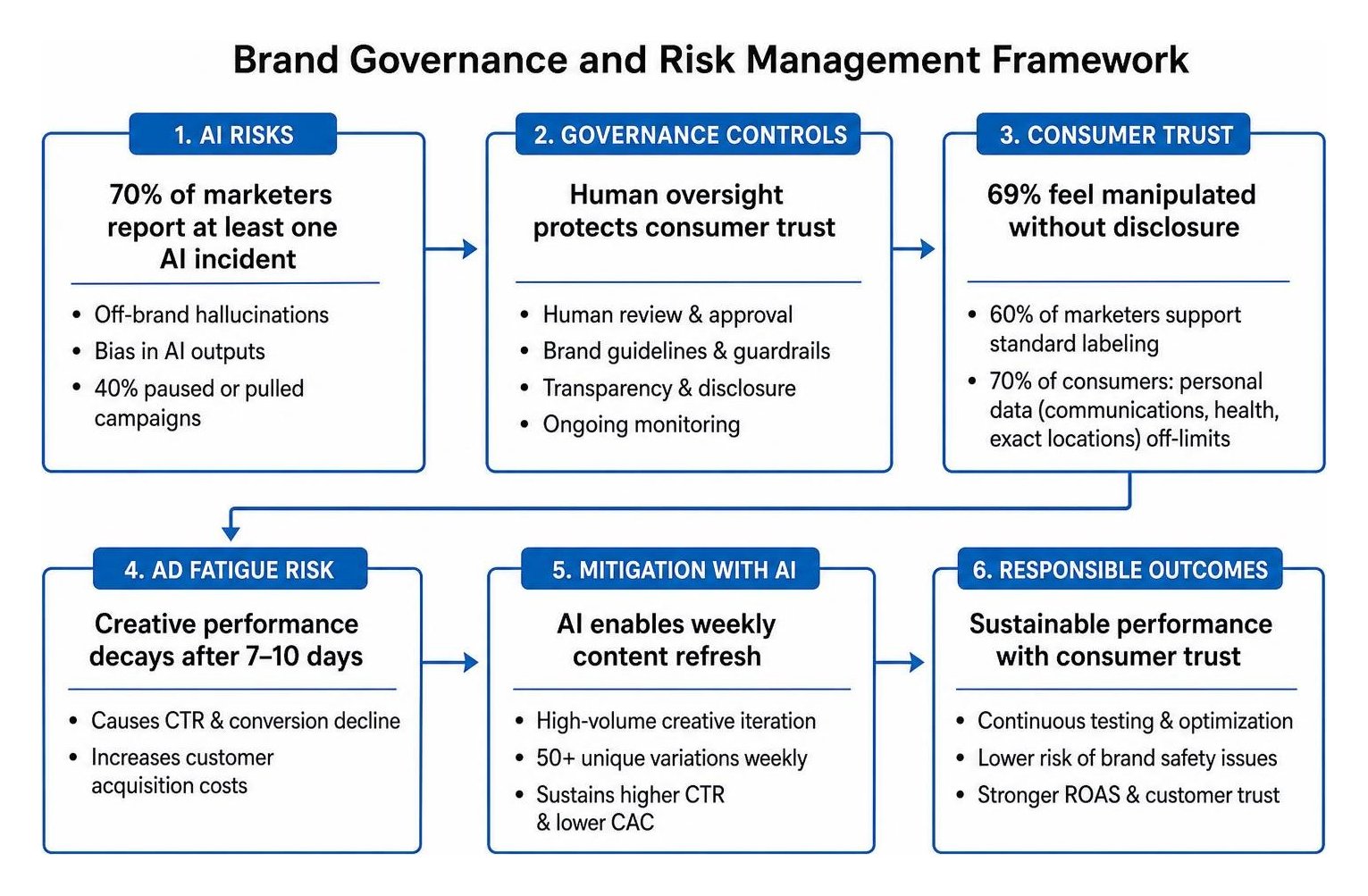
Unchecked automation carries real brand safety risks. Roughly 40% of advertisers have had to pause or pull campaigns due to unvetted AI outputs. Trust metrics also demand transparency: 69% of consumers report feeling manipulated when businesses publish AI-generated promotional content without disclosure. Understanding consumer trust benchmarks in artificial intelligence helps brands set responsible publishing standards.
- Mandatory Disclosure: Over 60% of marketers advocate for standard labeling on synthetic media, aligned with transparency frameworks like the EU AI Act.
- Data Privacy Concerns: Nearly 70% of consumers view personal communications, health metrics, and exact locations as off-limits for AI ad targeting models.
- Ad Fatigue Mitigation: Creative performance on platforms like TikTok and Meta typically decays after 7 to 10 days; AI workflows allow teams to refresh video hooks weekly without inflating budgets.
Strategic Takeaways and Future Projections for Video Marketers

The broader market for AI in advertising is expanding rapidly. Valued at $16.3 billion in recent market valuations, the sector is projected to reach $107.5 billion within the next decade, expanding at a compound annual growth rate of 26.7%.
AI-powered media buying is set to grow from 8% of total ad spend ($35 billion) up to 26% ($142 billion) as platforms automate audience modeling and real-time bidding, as highlighted in comprehensive analyses on how AI-powered advertising reaches market scale.
How Should Brands Allocate Budgets and Deploy Scalable Video Workflows in the Future?
Direct answer: Brands must transition from one-off video production budgets to continuous "content engines," pairing automated volume testing with human creative judgment and search visibility.
To maximize digital growth, we recommend three foundational practices:
- Automate the Repetitive Baseline: Use generative video tools for high-volume creative testing, cutdowns, aspect ratio adjustments, and multilingual localization.
- Preserve Human Editorial Control: Ensure every synthetic video passes human brand-safety checks before running in paid campaigns to safeguard brand equity.
- Connect Video Creative to Search Intent: Pair video assets with structured product feeds and conversational search optimization through SmallBizSEO's AI SEO services to capture high-intent buyers across emerging discovery platforms.
Turning Video Automation Into Sustainable Business Growth
Generative AI has fundamentally rewritten the economics of digital video. By compressing production cycles from weeks into minutes and reducing creation costs by up to 95%, businesses of all sizes can now compete with massive brand budgets.
However, lower production costs only translate to lower cost per view when paired with compelling storytelling and sound brand governance. By combining high-velocity creative testing with strict editorial oversight, your business can lower customer acquisition costs, capture higher market share, and scale digital revenue efficiently.