Law Firm SEO: Turn High-Intent Google Searches into Retained Clients

How Can SEO for an Attorney Bring in More Clients?
Start with the searches that show someone needs help. Build a page for each practice area you serve, answer common client questions, and make it easy to call or request a consultation. Then keep your Google Business Profile accurate, improve your site's mobile speed, and earn links from relevant, trusted sources.
Legal SEO needs more than keywords. People may be making urgent decisions, so each page should be accurate, clear about who wrote or reviewed it, and focused on the client's next step. Track calls and qualified inquiries alongside rankings so you know whether your work is bringing in potential cases.
I'm Clayton Johnson, founder of SmallBizSEO, where I connect technical SEO, content, and digital PR to help small businesses attract qualified leads. My approach to SEO for attorney websites starts with clear answers, credible evidence, and a path from search to inquiry.
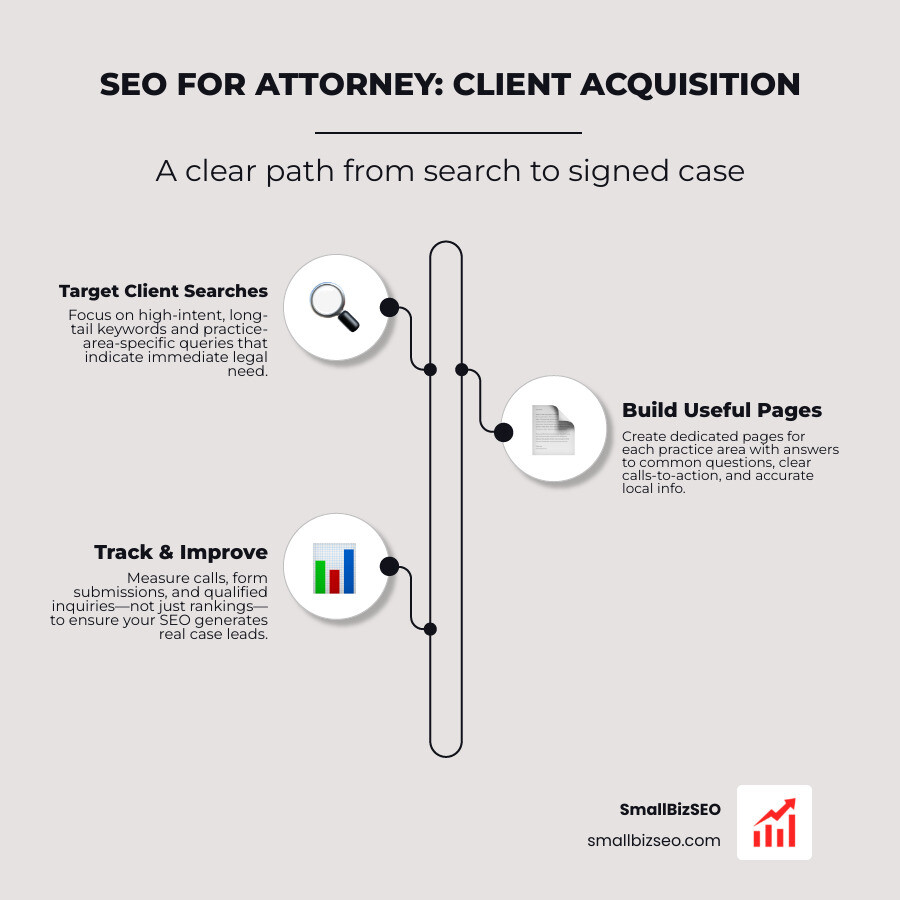
SEO for attorney vocab explained:
How Legal Search Engines Drive High-Value Client Acquisition

Organic search connects law practices directly with prospective clients at the exact moment they face critical legal challenges. When individuals encounter complex disputes, sudden injuries, or urgent family matters, search engines serve as their primary resource for legal representation and guidance.
Consumer behavior data reveals that 97% of individuals turn to search engines when researching legal information online, and 96% seek legal advice through organic search queries. Prospective clients rarely search for specific law firm names initially; in fact, 62% of users use non-branded terms when searching for legal services. These searchers focus on their specific legal dilemmas, searching for terms like "contested divorce process" or "emergency commercial litigation counsel."
Speed and search visibility dictate client acquisition because 59% of potential clients only contact one attorney before making a hiring decision. If your practice does not occupy top organic rankings or the local map pack, prospective clients will retain competing firms before ever discovering your website.
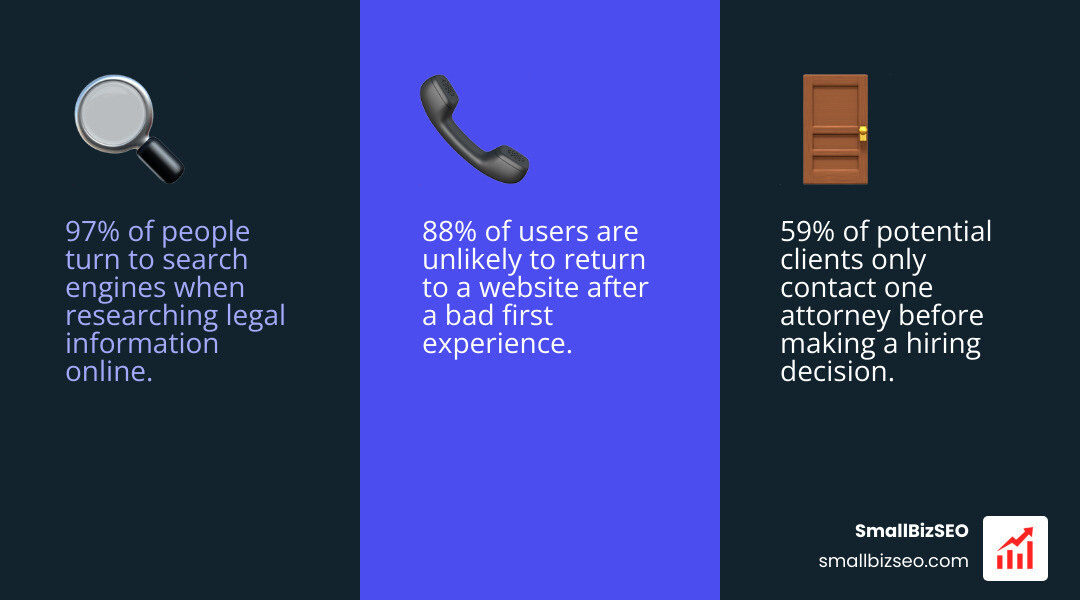
A seamless digital experience remains vital for retaining this traffic. Research shows that 88% of people are likely to leave a website and not return if they have a bad first experience. Slow loading times, confusing navigation, or hidden contact options drive qualified prospects directly to your competitors. Capturing these high-intent leads requires a comprehensive technical and content foundation.
The Core Blueprint: SEO for Attorney Websites That Want Sustainable Case Growth

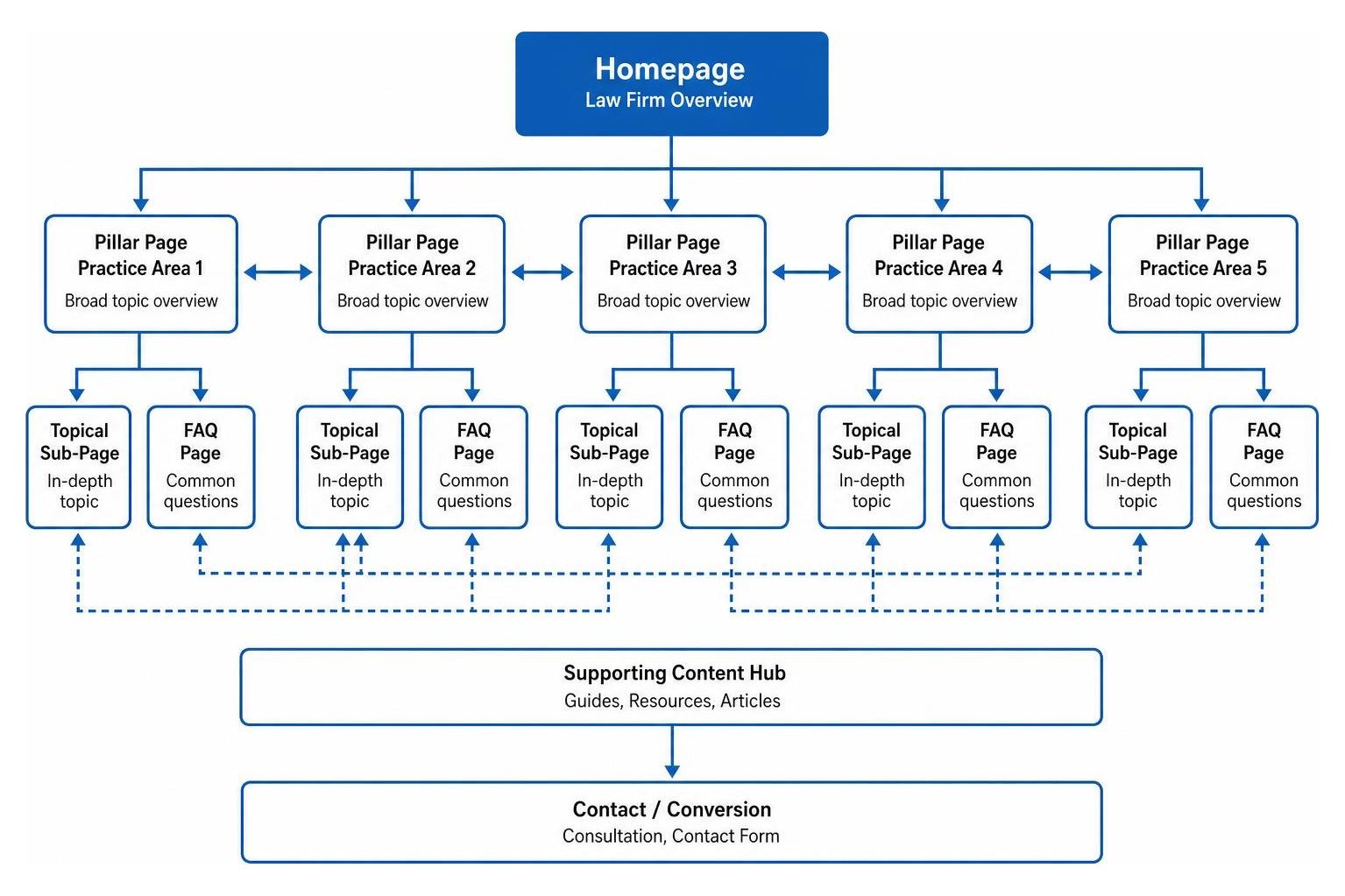
A high-performing legal website requires a structured architecture that establishes topical authority while delivering flawless technical performance. Rather than treating a website as a static digital business card, successful practices build an interconnected hub of educational resources and dedicated service pages.
Implementing proven attorney website SEO strategies begins with a clean content hierarchy. Each distinct practice area requires a dedicated pillar page supported by topical sub-pages, detailed guides, and frequently asked questions. Structuring your content this way distributes internal link equity and signals comprehensive expertise to search crawlers. To dive deeper into execution, reviewing a structured step-by-step law firm optimization framework helps clarify the essential milestones for sustainable organic growth.
Technical performance underpins this architecture. Search engines utilize mobile-first indexing, evaluating your website's speed, layout, and responsiveness on mobile devices before desktop versions. Meeting Core Web Vitals thresholds—keeping Largest Contentful Paint under 2.5 seconds and maintaining visual stability—ensures search engines rank your pages favorably while preventing user abandonment.
Why Does SEO for an Attorney Demand Strict E-E-A-T and YMYL Standards?
Search engines classify legal content as Your Money or Your Life (YMYL), applying rigorous Experience, Expertise, Authoritativeness, and Trustworthiness (E-E-A-T) standards. Because legal advice directly influences a person's freedom, financial stability, and family well-being, search algorithms prioritize verified legal authorities over generic informational sites.
Demonstrating genuine E-E-A-T requires distinct trust signals across your domain:
- Verified Author Profiles: Every article and practice guide must feature a detailed attorney biography displaying state bar admissions, law degrees, court certifications, and relevant years in practice.
- Editorial Oversight: Content should explicitly state who wrote and legally reviewed the material to ensure accuracy and ethical compliance.
- Verifiable Case Studies: Include anonymized case results and settlement summaries within ethical advertising boundaries to provide tangible proof of courtroom and negotiation experience.
- Ethical Compliance: Ensure all content adheres to state bar advertising guidelines and ABA Model Rules 7.1 through 7.3 regarding disclaimers, fee transparency, and past results.
Firms that master modern search engine optimization for law firms consistently embed these credentials directly into their page structures and schema markup, establishing institutional trust with both search raters and prospective clients.
How Do You Conduct High-Intent Keyword Research and Practice Area Mapping?
High-intent keyword research focuses on identifying specific search queries that signal an immediate need to hire legal counsel. Broad educational queries like "what is negligence" attract casual readers, while transactional and commercial phrases like "hire commercial lease lawyer" or "car accident attorney fee structure" indicate active hiring intent.
To build an efficient keyword map:
- Identify Primary Practice Terms: Pair core practice areas with geographical modifiers and transactional terms (e.g., "probate lawyer near me," "business litigation attorney").
- Uncover Long-Tail Problem Queries: Target specific client scenarios, such as "how to respond to an employment severance agreement" or "steps for filing a shareholder derivative lawsuit."
- Map Queries to Dedicated URLs: Assign one primary keyword and supporting semantic variations to a single, dedicated page to prevent internal keyword cannibalization.
- Group Supporting Content into Topic Clusters: Publish detailed FAQ pages and explanatory guides that link directly back to the primary practice page using descriptive internal anchor text.
Firms seeking immediate ranking improvements can review our quick start guide to legal SEO strategies to streamline their keyword mapping process and prioritize their most profitable practice areas.
What Are the Key Local Search Tactics for Dominating the Google Map Pack?
Local search optimization secures high-visibility placements in the Google 3-Pack, capturing high-intent searchers looking for immediate legal help in their immediate area. Approximately 85% of consumers use online maps to locate local legal service providers, making localized prominence indispensable.
Establishing local dominance requires mastering core local search principles for legal practices:
- Google Business Profile Optimization: Claim and verify your profile, select precise primary and secondary practice categories, upload professional office imagery, and ensure business hours and contact details remain completely accurate.
- Strict NAP Consistency: Maintain identical Name, Address, and Phone Number data across all major legal directories (such as Avvo, Justia, and FindLaw) as well as general local citation sources.
- Ethical Review Generation: Solicit reviews from satisfied clients systematically, responding promptly and professionally to all feedback while respecting client confidentiality.
- Localized Practice Area Pages: Embed localized schema markup, local landmark references, and Google Maps embeds on city-specific service pages.
Partnering with a dedicated lawyer SEO company ensures that local citations, directory profiles, and review management workflows remain actively maintained and protected against duplicate listings or map suspensions.
How Can Law Firms Optimize for Technical UX and AI Overviews?

Optimizing for modern search engines requires structured data implementation alongside concise, answer-ready content that AI search models can easily parse and cite. As conversational search engines and automated AI overviews synthesize legal answers directly on search engine results pages, websites must format content to serve as primary source material.
Implement comprehensive structured data using JSON-LD formatting:
LegalServiceschema to define your firm's practice specialties, address, telephone number, and operating hours.Personschema for individual attorney profiles, linking to bar association listings, alumni profiles, and published works.FAQPageschema on practice guides to provide clear, direct answers to common legal inquiries.
To capture citations in AI summaries, begin major informational sections with clear, two-sentence direct answers followed by structured bullet points, data, and statutory references. Complement this technical markup with active digital PR—securing expert quotes on platforms like Qwoted and earning authoritative editorial backlinks that reinforce your firm's standing as a verified industry authority.
Measuring Search ROI: In-House Execution vs Professional Agency Management
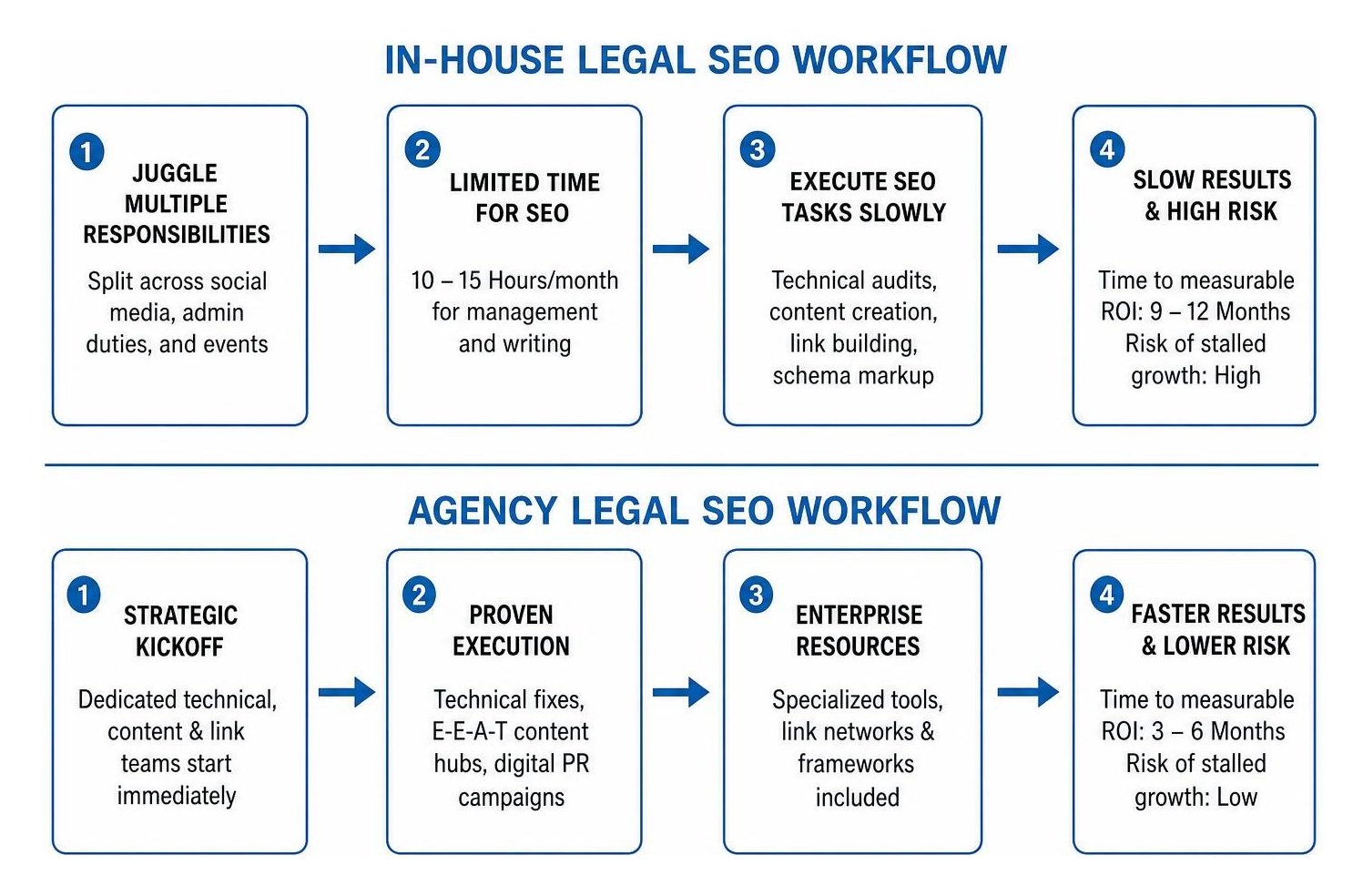
Evaluating the return on investment of an organic search strategy requires balancing direct labor costs, specialized tool expenses, and time-to-rank velocity. While some firms attempt to manage optimization internally, the technical complexity and ongoing content requirements often make professional management more cost-effective.
| Comparison Factor | In-House Legal SEO | Specialized SEO Agency |
|---|---|---|
| Average Monthly Cost | $5,000 – $8,000 (Salary & Benefits) | $2,000 – $5,000 (Fixed Retainer) |
| Software & Tool Overhead | $500 – $1,500/month (Ahrefs, Semrush, Crawlers) | Included in Retainer |
| Attorney Time Required | 10 – 15 Hours/month (Management & Writing) | 1 – 2 Hours/month (Review & Approval) |
| Technical Expertise | Limited to General Marketing Skills | Dedicated Technical, Content & Link Teams |
| Time to Measurable ROI | 9 – 12 Months | 3 – 6 Months |
| Risk of Stalled Growth | High (Staff Turnover & Learning Curve) | Low (SLA Backed & Proven Frameworks) |
Which In-House Metrics vs Agency SEO for Attorney Campaigns Deliver the Best Return?
Agency-managed search campaigns typically deliver superior return on investment by deploying established link networks, specialized technical stacks, and dedicated content resources from day one. In-house marketing coordinators often split focus across general administrative duties and day-to-day office coordination, leaving little bandwidth for technical audits, backlink acquisition, and deep schema implementation.
By choosing dedicated legal professional services SEO packages, law firms access enterprise-grade tracking and strategic execution without hiring full-time internal personnel. At SmallBizSEO, our proprietary Velocity framework accelerates rankings by combining technical fixes, E-E-A-T-compliant content hubs, and digital PR campaigns into a streamlined workflow backed by automated, transparent reporting.
What Critical KPIs Define Sustainable Organic Growth for Modern Law Practices?
Tracking organic search success requires monitoring bottom-line business metrics like qualified client inquiries and signed cases rather than vanity keyword rankings alone.
To measure true commercial impact, firms must track:
- Organic Intake Completions: Total phone calls, click-to-call conversions, and secure consultation form submissions originating from organic search sessions.
- Cost Per Qualified Lead (CPQL): Total monthly SEO investment divided by the number of validated prospective client inquiries.
- High-Intent Practice Rankings: Search positions for commercial terms within your specific geographical target area.
- Cost Per Signed Retainer: Total marketing expense allocated toward signing a paying client, demonstrating direct revenue attribution.
Conducting a comprehensive SEO visibility audit establishes baseline metrics across these key performance indicators, identifying technical roadblocks and untapped keyword opportunities across your entire website.
Transforming Search Visibility into Retained Legal Clients
Building an authoritative organic search presence is the most reliable, cost-effective method for generating high-value legal cases. By establishing an airtight technical foundation, demonstrating authentic E-E-A-T credentials, dominating local map rankings, and tracking qualified case conversions, your firm can achieve prominent search visibility and build a sustainable stream of prospective cases.
Take control of your firm's digital growth today. Connect with our team to audit your current search performance, eliminate technical friction, and implement a data-driven strategy that consistently turns organic searchers into retained clients.