Step-by-Step Guide to Auditing Location Pages for Doorway Patterns
How Do You Spot Doorway Patterns in Location Pages?
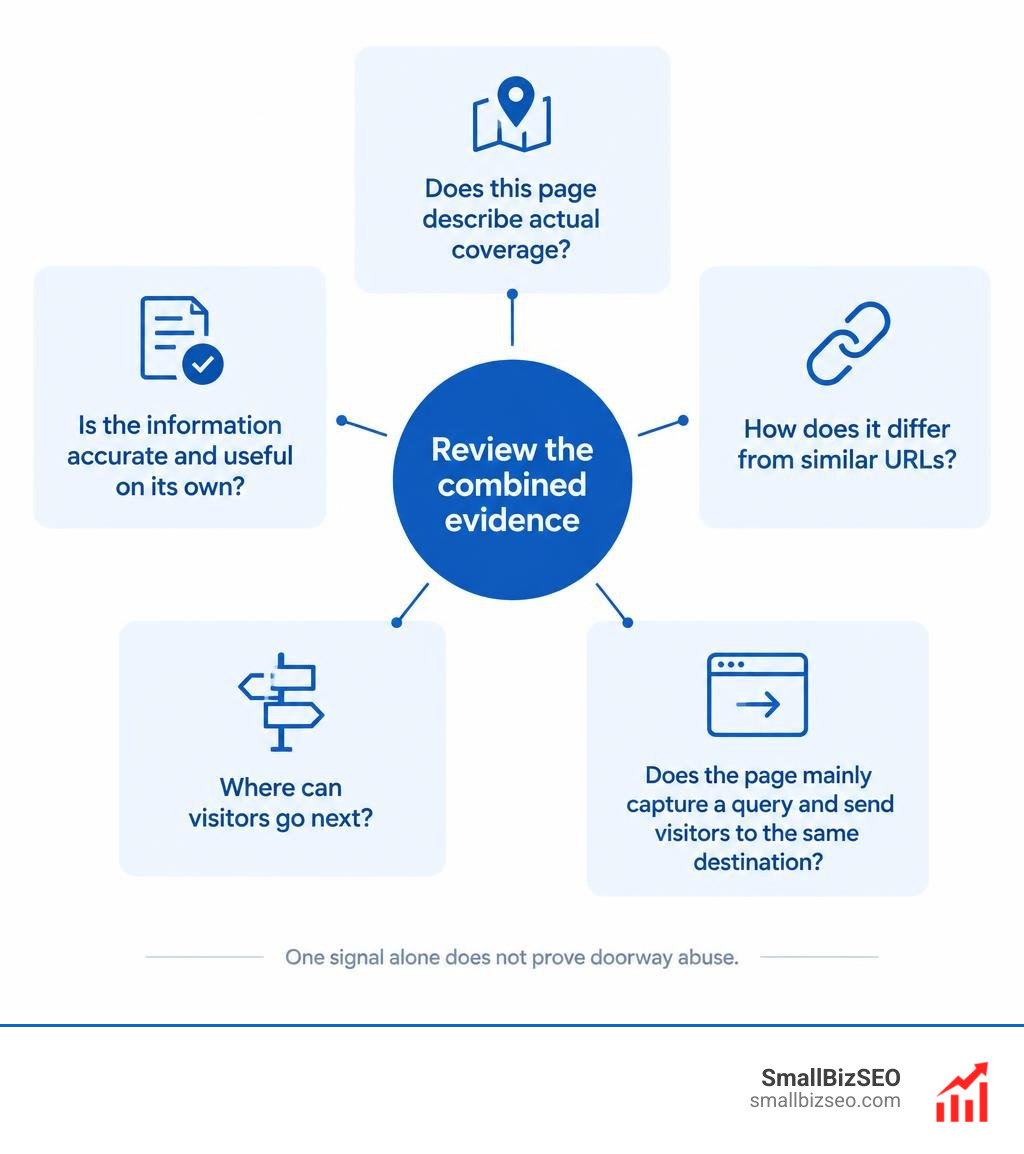
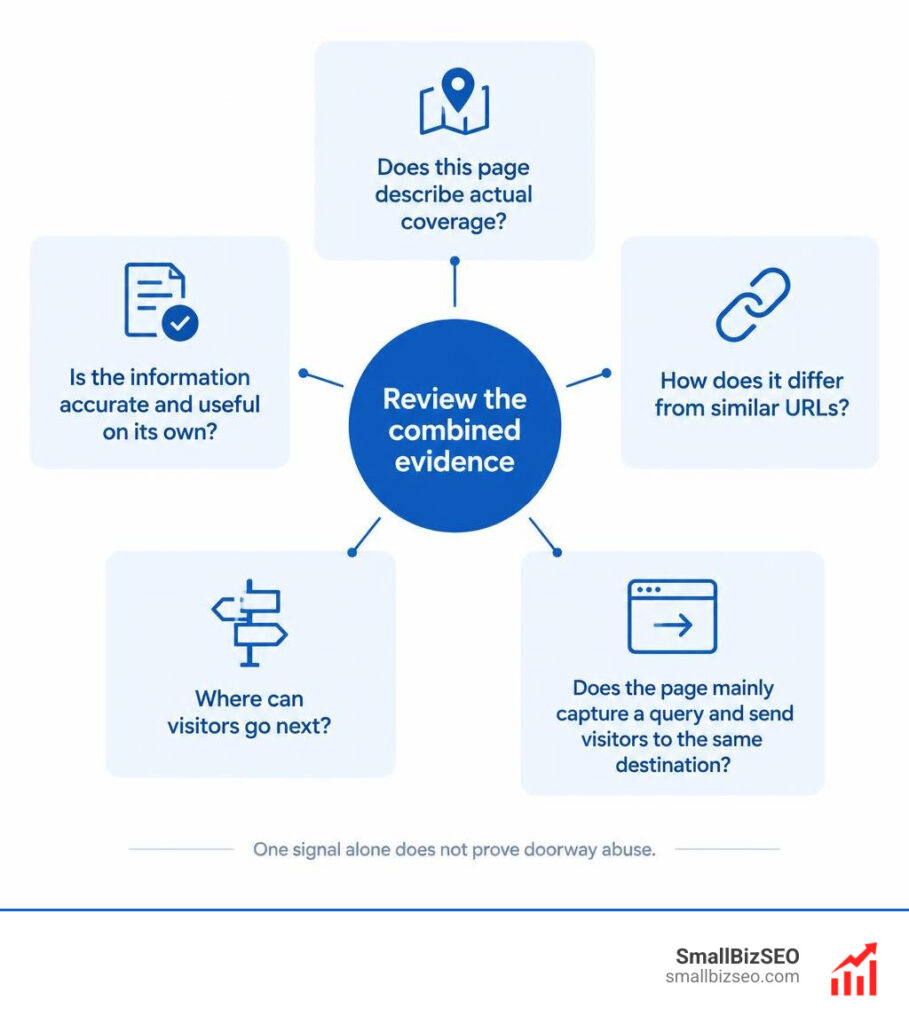
Start with a page-by-page question: does each URL give a visitor a useful, independently meaningful experience, or does it mainly exist to capture a query and send people to substantially the same destination? Google’s doorway abuse policy focuses on pages or sites created to rank for closely related searches and funnel users to the same place without clear added value.
A repeated template, shared call to action, common phone number, shared staff, absence from a primary menu, or a service area without an office can be normal for a legitimate business. None of those signals alone proves doorway abuse. The audit should instead evaluate the combined evidence: actual coverage, accuracy, unique decision-helping information, the page’s relationship to similar URLs, and where visitors can go next.
Treat the result as an editorial and technical risk review, not a penalty diagnosis. A cluster of similar pages may deserve improvement, consolidation, or retirement, but the right action depends on the business reality and the usefulness of each page.
What Should a Comprehensive Framework for Auditing Location Pages for Doorway Patterns Include?
A reliable audit combines complete inventory work, comparison of on-page purpose, evidence of actual service coverage, multi-location search architecture and internal-link context, and a review of search performance. It does not label pages as spam from one template or metric.
What Evidence Should You Review Before Making a Decision in Multi-Location Search Architecture?
Use the following questions to guide the review. A “yes” or “no” on one row is not a verdict; assess the full pattern and preserve the evidence behind the decision.
| Evidence question | What to inspect | Why it matters |
|---|---|---|
| Does the page help a visitor make a decision for this service area? | Clear scope, relevant constraints, availability details, and next steps | Independent usefulness is more meaningful than cosmetic variation |
| Does the business actually serve the area described? | Documented coverage, fulfillment process, and accurate claims | Service-area content should reflect real operations, not fictional premises |
| Is the page materially distinct where intent differs? | Service context, audience needs, route to help, and supporting evidence | Similar wording can be efficient; pages should not exist solely for keyword permutations |
| How do related pages route visitors? | Internal links, destination URLs, and conversion paths | Sending visitors to a shared destination is not conclusive, but it can matter alongside other evidence |
| Is the page discoverable and maintained for people? | Navigation context, hubs, recent updates, and crawl findings | An orphaned or lightly linked page merits review, but navigation placement alone is not proof of abuse |
How Do You Build a Complete Doorway-Abuse Audit Inventory?
Create an inventory from the CMS, a crawl, XML sitemaps, and Google Search Console. Include both indexable and non-indexable URLs, then record canonical status, noindex directives, redirects, and whether the URL appears in the sitemap or search data. For supporting context on the policy, see this doorway abuse overview. A sitemap is a source for discovery, not proof that every listed URL is indexed.
For each source, note the collection date, filters, and sampling limits. Large sites may require representative samples before a full crawl is complete. Preserve the URL, page title, canonical target, backlinks, query evidence, impressions, clicks, and observed internal links so later recommendations can be reviewed instead of reconstructed from memory.
How Should You Compare Similar Pages?
Use text-similarity tools to triage groups that deserve a closer human review. Similarity scores can surface duplicated templates, but they are not a doorway-abuse verdict and do not create a universal pass or fail threshold. Read the visible main content, compare the visitor journey, and check whether each page has an accurate, useful reason to exist.
Ask whether the page describes real coverage and gives information that helps visitors choose or obtain the service. Do not require an invented office, local staff profile, address, testimonial, or project photo to make a page legitimate. Conversely, merely changing a place name, adding a shared call to action, or hiding a page from a menu does not settle the question either.
How Do You Audit Location Pages Step by Step?
- Build the inventory: Combine CMS exports, crawl data, sitemaps, and Google Search Console, keeping indexable and non-indexable URLs separate.
- Group comparable pages: Cluster pages by service, audience, and intent, then remove global navigation and boilerplate only for comparison purposes.
- Review usefulness and accuracy: Check real service coverage, decision-helping details, claims, and the visitor path on each representative page.
- Inspect search and link evidence: Retain query, impression, click, backlink, canonical, and internal-link data before proposing a change.
- Check enforcement signals correctly: A traffic drop alone does not diagnose a penalty. Review the Manual actions report in Search Console to confirm whether a manual action exists, and investigate technical, demand, and quality causes separately.
Canonical tags, noindex directives, and robots rules can support a deliberate technical plan, but they do not make low-value content useful. Robots rules are also not a reliable way to remove a URL from search results. This is educational guidance only; do not make destructive changes until the evidence and implementation plan have been reviewed. For a separate technical troubleshooting framework, see algorithmic penalties vs. technical indexing failures.
How Can You Remediate Flagged Geo Pages and Build Sustainable Multi-Location Authority?
Choose the remediation that best matches the page’s real usefulness, the service model, and the available evidence. Do not apply a sitewide rule based on the number of pages, and do not consolidate every town page by default.
What Is the Right Action for Each Page in an SEO Visibility Audit?
| Decision | Use when | Implementation guardrails |
|---|---|---|
| KEEP | The page is accurate, independently useful, and supports real coverage | Refresh details when operations change; retain the URL, query, backlink, and internal-link evidence |
| IMPROVE | The service is real but the page is thin, unclear, or poorly connected | Add accurate context, improve navigation, and clarify the visitor’s next step without inventing local proof |
| MERGE | Multiple pages satisfy equivalent, overlapping intent and one relevant destination can serve visitors better | Map each retiring URL to the closest relevant replacement with a 301 or 308 redirect, then review the redirect map before launch |
| RETIRE | The business no longer offers the service or area and no relevant replacement exists | Use a 404 or 410 where appropriate; a 404 is not inherently harmful, and do not redirect unrelated pages to the homepage |
How Should You Protect Search Evidence During Changes?
Before changing URLs, preserve the actual data behind the decision: current URL status, canonical target, query and performance evidence, backlinks, inbound internal links, and the intended destination for every redirect. Review the redirect map with stakeholders, then test status codes, canonical behavior, internal links, and user journeys after deployment. A comprehensive SEO visibility audit can help organize this evidence before implementation. This process also helps avoid common local SEO mistakes during implementation.
A redirect can preserve continuity when the old and new pages are genuinely relevant, but no redirect guarantees traffic or preserves every ranking signal. Avoid broad rules that send unrelated retired URLs to a homepage or one generic hub. If no suitable replacement exists, a clear 404 or 410 can be the more honest outcome.
What Makes Service-Area Content Legitimate?
A legitimate service-area page accurately explains how the business serves that area and gives visitors useful context for choosing the service. That can include coverage boundaries, service availability, process differences, travel considerations, or the relevant team and contact path when those details are true. Keep this assessment distinct from near-duplicate business listing filters, which address a different local-search context.
Do not confuse Google Business Profile eligibility with the usefulness of website service-area content. A business may have valid website pages for areas it serves without qualifying for a public Business Profile at every area, and a Business Profile is not proof that each website page is independently valuable. Keep both sets of claims accurate and consistent with real operations.
When Should You Use Canonicals, Noindex, or Robots?
Use canonical, noindex, and robots controls for the specific technical purpose they support, not as a shortcut for weak content. A canonical expresses a preferred duplicate or near-duplicate URL; noindex requests that a crawlable page not appear in search results; robots.txt controls crawling but is not a reliable deindexing tool. Each option requires a page-level implementation review. For broader background, review programmatic SEO risk models and this multi-location search playbook.
For complex cleanups, start with a controlled sample, document expected outcomes, and verify crawl, indexing, redirect, and visitor-path results before expanding the work.
Action Plan for Long-Term Geographic Search Health
Maintain location content as an operating system, not a one-time cleanup. Reassess the page set after service changes, new templates, major content refreshes, or changes to internal navigation.
What Should Be on the Evidence Checklist?
- Service reality: Confirm that each page’s coverage and claims match how the business actually serves customers.
- Visitor usefulness: Record the decision-helping information, page purpose, and next step available on each URL.
- Search evidence: Keep query, impression, click, canonical, indexability, backlink, and internal-link evidence with the audit record.
- Comparison notes: Use similarity analysis to prioritize human review, then document why pages were kept, improved, merged, or retired.
- Change validation: Review redirect maps before launch and test status codes, canonical signals, internal links, and user journeys afterward.
Strengthen the pages that remain with accurate content refreshes, useful contextual internal links, and legitimate outreach that reflects the services the business actually provides. For implementation support, explore technical SEO services, SEO content services, and link-building services. When a deeper review is needed, book an SEO consultation.