What Makes Marketing with Content Work for Modern Brands?

What Makes Marketing with Content Work?
Marketing with content means helping people before asking them to buy. A small business might publish a guide that answers a common customer question, then share it through search, email, or social media. Unlike an ad that leads with a sales pitch, useful content gives people a reason to find the business, understand its expertise, and return when they need help.
That can improve visibility, lead quality, and customer trust, but results depend on the audience, the quality of the content, and how well the business shares and measures it.
I’m Clayton Johnson, founder of SmallBizSEO. My work connects SEO, digital PR, and marketing with content to help small businesses turn what they know into useful resources for their audiences.
How Does Marketing with Content Differ from Traditional Advertising?
Marketing with content attracts prospective buyers by solving problems upfront, whereas traditional advertising uses paid placements, including search ads, display ads, and sponsored social posts. By focusing on helpful education, brands may improve discoverability and trust over time, depending on audience needs, distribution, and execution.
Paid advertising and content both require budget, time, and testing. Paid campaigns can provide more immediate placement when they are well targeted, while useful articles, teardowns, and tutorials may remain discoverable after publication. Neither approach guarantees rankings, qualified inquiries, or lasting results; outcomes depend on audience needs, distribution, competition, and execution.
| Performance Factor | Traditional Outbound Advertising | Inbound Content Marketing |
|---|---|---|
| Primary Mechanism | Paid placements and promotions | Educational resources and organic discovery |
| Audience Mindset | May reach people during other activities | May reach people researching a question or need |
| Resource Needs | Requires budget, creative work, targeting, and testing | Requires research, creation, distribution, maintenance, and testing |
| Measurement | Can be measured against campaign goals, with attribution limits | Can be measured against content goals, with attribution limits |
| Longevity | Visibility may decline when a campaign ends | Content may remain discoverable, but rankings and useful life are not guaranteed |
Ad blockers can limit some advertising, but browsing in a private window does not itself prevent ads from appearing. As Search Engine Land's guide to sustainable inbound strategies explains, helpful content can give people useful information before a purchase decision, without replacing the need for clear offers and testing. Google’s people-first content guidance recommends creating content primarily for people rather than search engines, with clear value for the intended audience.
How Is Content Marketing Different from a Content Management System?
Content marketing is the high-level business strategy that defines what you create and why, while a content management system (CMS) is the underlying software that stores, formats, and publishes those digital assets.
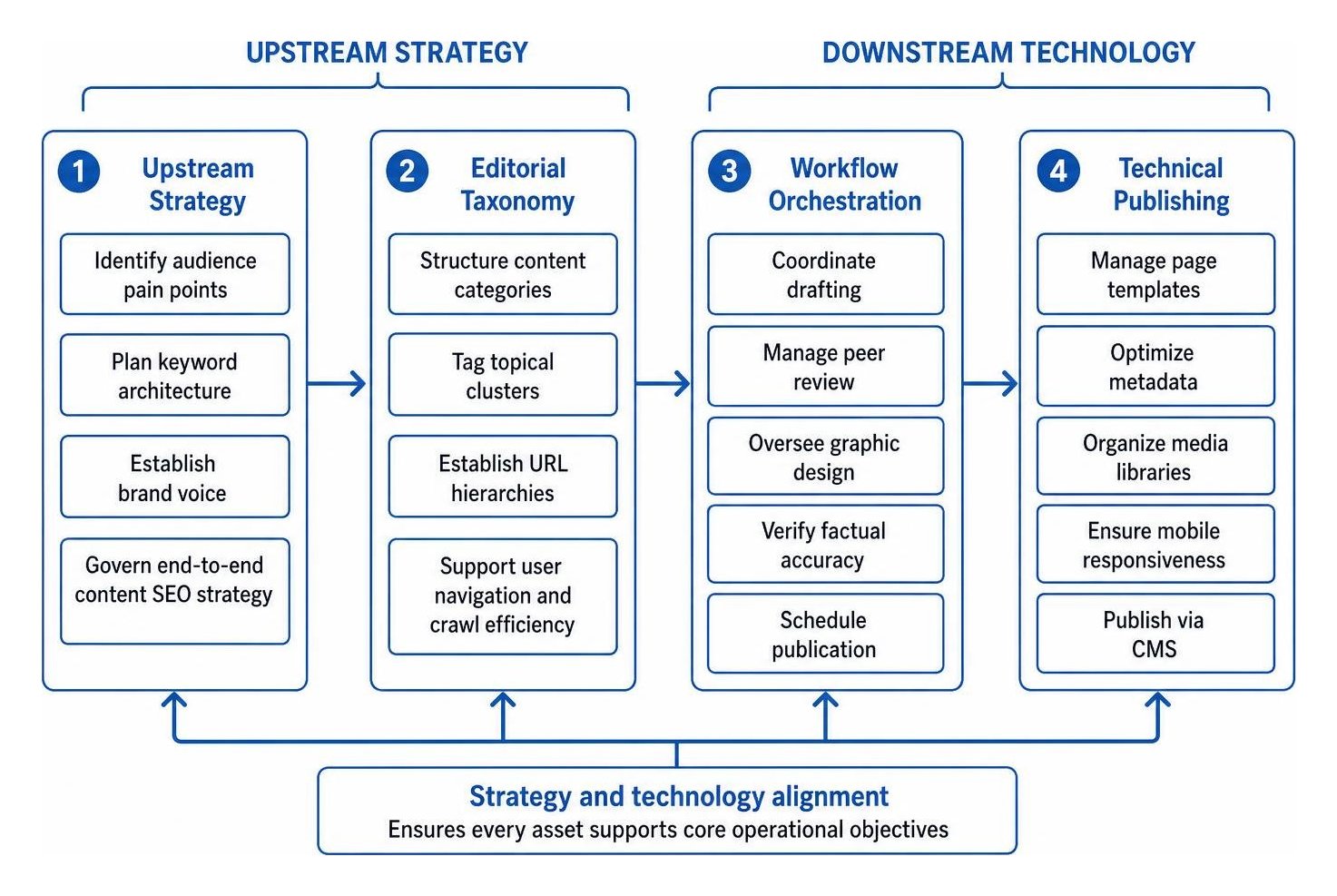
To run an efficient growth program, marketing teams must orchestrate both upstream strategy and downstream technology:
- Upstream Strategy: Identifying audience pain points, planning keyword architecture, establishing brand voice, and governing an end-to-end content SEO strategy.
- Editorial Taxonomy: Structuring content categories, tagging topical clusters, and establishing URL hierarchies to support user navigation and crawl efficiency.
- Workflow Orchestration: Coordinating drafting, peer review, graphic design, and factual accuracy verification before scheduling.
- Technical Publishing: Utilizing a CMS to manage page templates, metadata, media libraries, and mobile responsiveness.
When strategy and technology align, businesses can connect each asset to a clear purpose, while recognizing that publishing alone does not ensure rankings or business results.
How Do High-Value Content Assets Connect to the Modern Sales Funnel?
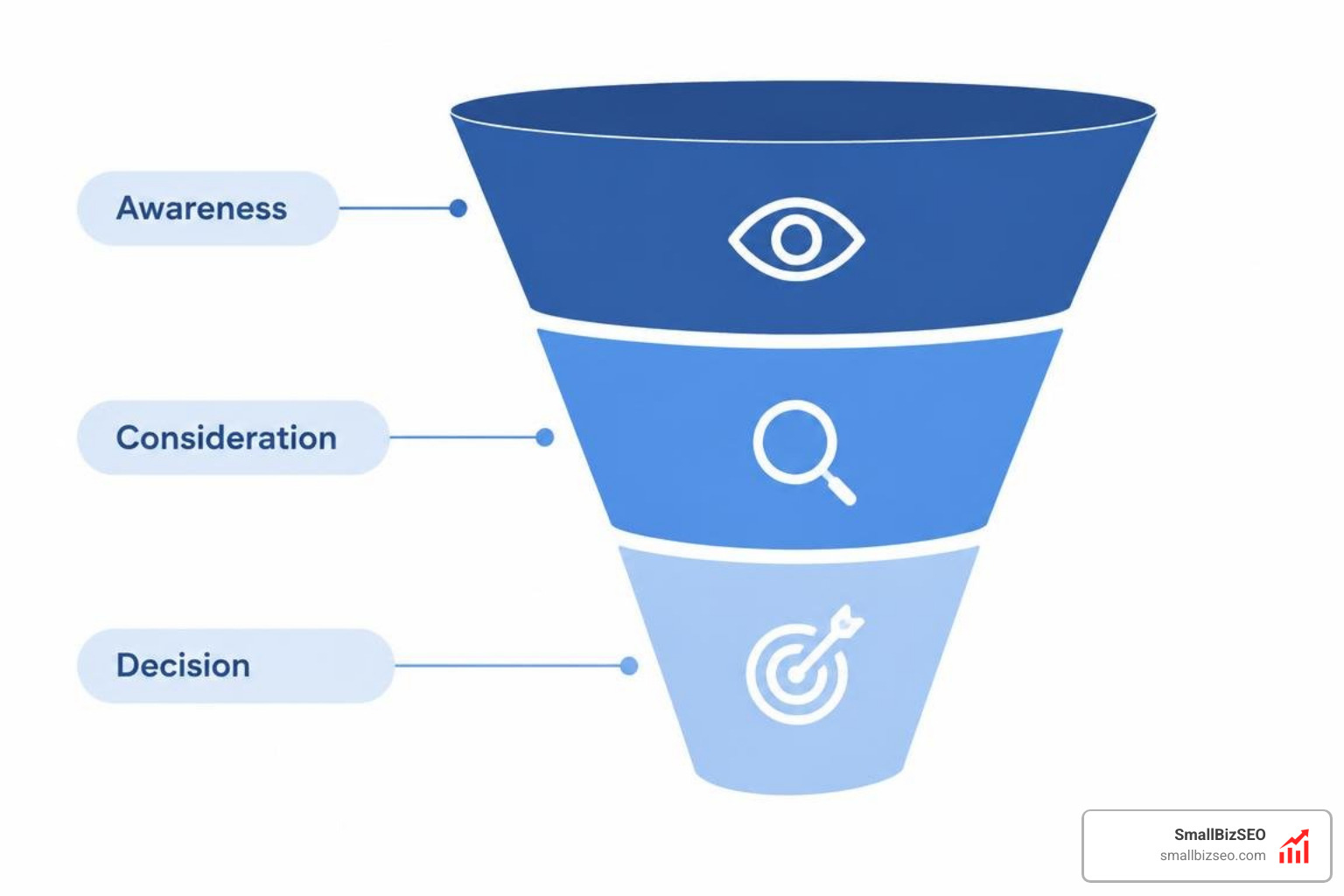
High-value content guides prospective buyers through the sales funnel by delivering the specific information they need at each stage of their decision-making process. Rather than forcing an immediate sale, tailored content resolves customer hesitation during discovery, evaluation, and final selection.
Many buyers research independently before contacting a business, but the path to a decision varies by industry, purchase complexity, and stakeholder needs. Clear, transparent resources can support that research and help people decide whether to make an inquiry; they do not guarantee a shorter sales cycle or conversion.
As highlighted in the American Marketing Association's overview of educational assets, content bridges the gap between passive interest and active purchasing decisions by demonstrating relevant expertise and helping people evaluate their options.
How Can You Map the Customer Journey from Awareness to Conversion?
A funnel can be a useful planning model for aligning content formats and search intent across awareness, consideration, and decision stages. Real customer journeys are often nonlinear: people may move between stages, revisit sources, or contact a business at any point.
- Awareness Stage (Informational Intent): Prospective customers recognize a problem and search for broad solutions. Provide comprehensive educational guides, glossary entries, and beginner tutorials that address core symptoms without heavy sales pitches. Use E-E-A-T optimization principles as a practical reference for clear sourcing, first-hand expertise where relevant, and accurate explanations at this stage. E-E-A-T is a set of quality concepts that can guide this work, not a certification or a guarantee of trust or rankings.
- Consideration Stage (Commercial Intent): Buyers compare different methodologies and solution categories. Deliver detailed comparison matrices, teardown articles, product selectors, and actionable webinars that outline the pros and cons of various approaches.
- Decision Stage (Transactional Intent): Prospects are ready to select a specific vendor. Consider transparent pricing information, documented case studies where available, implementation roadmaps, and practical decision tools that help people evaluate fit.
For example, a hypothetical cybersecurity provider could publish an educational post on data-protection regulations for awareness, offer a compliance checklist for consideration, and provide a product demonstration with supporting documentation for decision-stage research. This is an illustrative sequence, not a required or linear path.
Which Content Formats Work in Competitive Niches?
Competitive niches require a balanced mix of content formats tailored to how target audiences consume information across multiple touchpoints.
- Search-Optimized Articles: Choose the article length and format that best fit the audience's question, search intent, and the depth of explanation needed. Useful articles can support discovery, but they do not guarantee acquisition.
- Short-Form and Explainer Video: Video can help explain technical processes when it matches the audience’s preferences and the team can produce it accurately.
- Podcasts and Audio Interviews: Passive listening formats allow brands to explore nuanced industry topics and build deep, conversational connections with busy executives.
- Visual Infographics and Data Charts: Clear visuals can make proprietary data easier to understand when the underlying information is accurate and appropriately sourced.
- Gated Whitepapers and Technical Reports: Proprietary research can support lead capture when the value exchange and consent language are clear.
- Owned Email Newsletters: Curated insights can help maintain contact with subscribers, although deliverability, consent, and inbox filtering still affect reach.
To prioritize these formats effectively, perform regular competitive research to identify an unaddressed audience content gap. Select formats that balance your team’s production bandwidth with audience consumption habits, ensuring all assets are fully responsive across mobile devices.
How Can You Build, Measure, and Scale a Content Engine?
Building a scalable content engine requires setting quantifiable commercial goals, establishing a structured editorial workflow, diversifying distribution channels, and tracking clear performance metrics. A reliable content framework can make planning and measurement more consistent, but it does not make revenue predictable.
Content often plays a role in broader marketing operations, but sustainable execution requires a documented, repeatable system. Search visibility can contribute to commercial outcomes, yet the connection is influenced by audience fit, conversion paths, sales follow-up, and other channels.
How Can You Establish Editorial Workflows and Distribution Channels?
To establish a scalable publishing workflow, implement an organized production cadence backed by a structured content calendar. A realistic schedule can help coordinate production; review workload and adjust capacity to avoid overcommitting.
A practical four-step production workflow includes:
- Topic Validation and Intent Mapping: Research user search volume, competitor coverage, and buyer intent before drafting.
- Standardized Briefing and Drafting: Create structured outlines detailing target headings, core statistics, and unique brand angles. Teams can use artificial intelligence to assist with preliminary research, but experienced human subject matter experts must refine drafts for accuracy and voice.
- Editorial Review and Optimization: Verify factual claims, check mobile formatting, and ensure internal links connect logically to relevant service pages.
- Multi-Channel Distribution and Repurposing: Maximize asset value by transforming a single long-form anchor piece into derivative assets.
For example, a hypothetical industry survey could serve as an anchor asset and be adapted into blog posts, a visual summary for social platforms, an email breakdown for subscribers, and short video summaries. The right mix depends on the source material, audience, consent, and available resources.
How Can You Measure ROI and Avoid Tool Fatigue?
Measuring return on investment (ROI) requires connecting top-of-funnel search performance to bottom-of-funnel commercial metrics. At the same time, marketing teams must simplify their software setups to prevent operational drag.
A fragmented software stack can make reporting and workflows harder to manage. Choose a small set of tools that the team can maintain, document how each is used, and review whether the data supports useful decisions.
When tracking content performance, focus on metrics that reflect true commercial impact:
- Leading Visibility Indicators: Track keyword rankings, indexed pages, organic search impressions, and relevant inbound links as directional signals, not proof of business impact.
- Engagement and Intent Metrics: Monitor engagement time, scroll depth, newsletter sign-ups, and resource downloads while respecting consent choices and applicable privacy requirements.
- Qualified Inquiry Signals: Track relevant calls, form submissions, demo requests, and sales-qualified inquiries where consent and systems allow. Attribution is often incomplete, so compare multiple sources and avoid assigning every result to a single page or channel.
SmallBizSEO’s SEO content services page describes its approach to content planning and optimization. Businesses should evaluate any provider’s methods, reporting, and fit for their goals; E-E-A-T is a set of quality concepts, not a certification or performance guarantee.
Transforming Audience Attention into Lasting Growth
Modern content marketing succeeds because it respects the customer's independence. By answering urgent questions, simplifying complex purchasing decisions, and delivering continuous value before requesting a sale, brands can help prospective customers make better-informed decisions, without guaranteeing commercial growth.
When you combine strategic intent mapping, efficient production workflows, and disciplined measurement, marketing with content can support ongoing organic discovery and better-informed inquiries when the work remains useful, accurate, and aligned with audience needs.