How to Win Local Search with Home Services SEO
How Does Home Services SEO Bring in More Local Jobs?
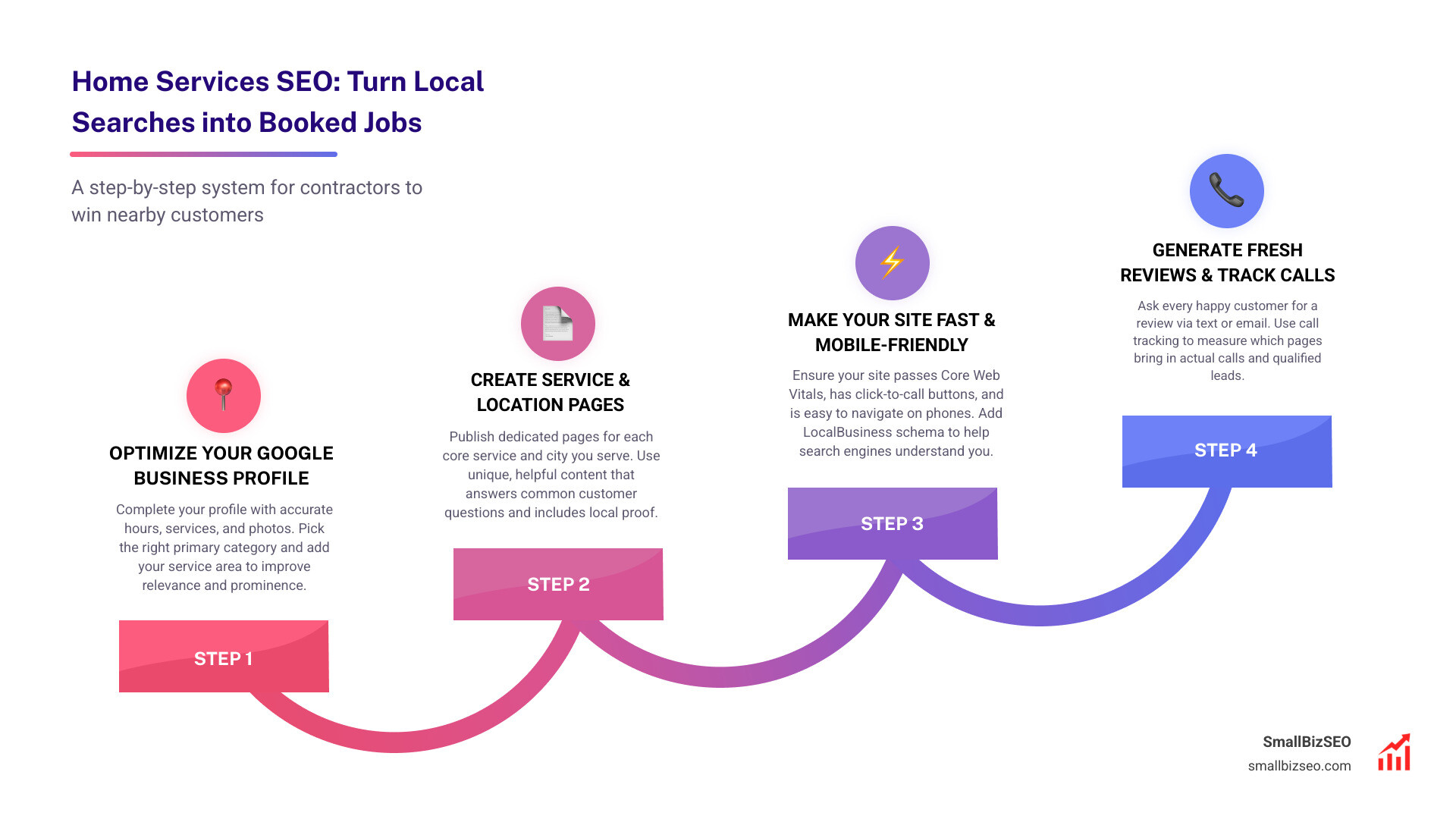
Home services SEO helps contractors appear when nearby customers search for urgent repairs or planned work. Start by completing your Google Business Profile, creating a page for each core service, making your phone number easy to tap, and asking customers for reviews. For local results, Google looks at relevance, distance, and prominence. You can improve how clearly you show what you do and where you work, but you cannot optimize away distance.
I'm Clayton Johnson, a digital marketing and SEO strategist who applies search, content, and digital PR principles to home services SEO. This guide starts with the local search basics, then shows how to turn visibility into calls and booked jobs.
Relevant articles related to home services SEO:
- enterprise local SEO
- local SEO map
- Google local map pack
Strategic Foundations of Home Services SEO
Home services SEO works by establishing strong geographic relevance, verifying your trade credentials, and generating reliable local trust signals that search algorithms favor. When a homeowner searches for a repair or installation, search engines evaluate your service radius, business profile completeness, and domain authority to decide who gets the top spots in the search results.
Securing top visibility requires balancing organic rankings with map results. Contractors who align their website architecture with their actual dispatch footprint build lasting market share. We utilize our proprietary "Velocity" framework to help service businesses quickly capture these algorithm signals through verified data and transparent reporting.
How Does Local Home Services SEO Differ from Traditional SEO?
Local home services SEO differs from traditional SEO because it prioritizes immediate phone calls, physical proximity, and local review trust rather than broad informational pageviews. While regular websites focus on ranking nationwide for informational guides, trade contractors must win high-intent searches from customers within a specific driving radius.
Several core factors set service-area businesses apart:
- Urgent Buyer Intent: When a homeowner's air conditioner fails during a heatwave or a pipe bursts late at night, they do not browse multiple articles. Over 80% of emergency home service searches take place on mobile devices where immediate action is required.
- Direct Call Conversions: While conventional SEO tracks form fills and pageviews, home services rely on incoming phone calls. Our guide to local search optimization basics illustrates why direct click-to-call functionality outperforms multi-step contact forms.
- Proximity Constraints: Search algorithms heavily weigh physical proximity between the searcher and the business. While traditional websites can rank worldwide, a local contractor's reach is defined by their geographic service territory.
How Can You Optimize a Google Business Profile to Win the Local 3-Pack?
To rank in the local 3-pack, you must select the most accurate primary trade category, keep business details consistent, and maintain continuous profile activity. The Google Business Profile (GBP) serves as the main driver of incoming calls for home service contractors.

Key optimizations include:
- Select the Most Precise Primary Category: Choose the specific classification that reflects your primary revenue source (such as "Plumber" or "HVAC Contractor") rather than a generic trade term. Add secondary categories to cover complementary offerings.
- Publish Genuine Work Photos Regularly: Profiles featuring more than 100 genuine job and team photos receive 520% more customer calls than listings with fewer than 10 images. Avoid stock photos and upload real pictures of recent installations, branded trucks, and team members weekly.
- Specify Exact Service Radiuses: Define your service territory accurately without overlapping distant areas where you cannot provide timely dispatch.
- Publish Weekly Updates: Share brief updates about seasonal tips, recent projects, and maintenance offers to show algorithms and prospective clients that your business is open and active.
Service Architecture: City Pages, Programmatic SEO, and Content Scaling
A scalable website architecture pairs dedicated pages for every core service with location pages backed by real customer proof. Structuring your site cleanly allows search engines to understand the exact trade services you offer while helping homeowners quickly find solutions.
Creating a dedicated URL for every specialized trade helps you rank for detailed search terms. Implementing proven on-page SEO techniques helps establish topical authority and makes it easier for search crawlers to navigate your site.
Should You Build Dedicated Service Pages or Multi-Location City Hubs?
You should build dedicated pages for each service and add separate location pages only for towns where you regularly dispatch crews. Grouping all your offerings onto a single generic page prevents you from ranking for high-value terms like emergency drain cleaning or panel upgrades.

If you run a specialized trade business, partnering with an experienced plumbing SEO company can help you map distinct URLs for each line of work. To avoid common algorithmic filters that hurt ranking performance, ensure every location landing page includes:
- A unique H1 and title tag containing the specific service and service area.
- Authentic photos taken on local job sites.
- Verified reviews and testimonials from homeowners in that exact neighborhood.
- Accurate company contact information that matches your business profile.
When and How Should You Use Programmatic SEO Safely?
Use programmatic SEO only when you have authentic, proprietary data—such as neighborhood pricing ranges, local building codes, and real job history—to make each page unique. Automated pages created simply by swapping city names into identical text templates fail quality guidelines and frequently lose their search traffic.
| Strategy Dimension | Pure Template Generation (High Risk) | Proprietary Data-Driven Pages (Safe & Scalable) |
|---|---|---|
| Data Foundation | Generic text with basic city name swaps | Real job logs, regional pricing, local permit codes |
| Local Proof | Stock photos and generic marketing claims | Actual job photos, local reviews, verifiable case examples |
| Conversion Rate | Low (under 2%) due to lack of local relevance | High (4% to 9%) due to hyper-local context |
| Algorithmic Durability | High risk of indexation loss during core updates | Strong, sustainable organic rankings over time |
By connecting actual dispatch logs and local service records into your content framework, you build helpful resources that survive algorithmic updates while lowering customer acquisition costs.
Driving Conversions with Technical Health, Trust Signals, and Reviews
Transforming search visibility into revenue requires a fast mobile experience, clear structured data, and an automated system for gathering customer reviews. Homeowners dealing with home emergencies need fast-loading pages that make contacting your team effortless.
How Can You Improve Technical SEO with Speed, Schema, and Mobile Optimization?
Enhance technical SEO by keeping page load times fast, placing prominent tap-to-call buttons at the top of mobile screens, and implementing structured schema markup. With over 60% of standard trade searches and 80% of emergency queries happening on smartphones, your mobile site speed directly impacts call volume.
Focus on these technical priorities:
- Core Web Vitals Optimization: Keep Largest Contentful Paint (LCP) under 2.5 seconds by compressing images, minifying code, and leveraging modern hosting setups.
- Mobile-First Call Buttons: Place a sticky click-to-call button on every page so homeowners can dial immediately without scrolling through text.
- Structured Schema Markup: Implement
LocalBusinessand trade-specific schemas (such asHVACBusiness,Plumber, orRoofingContractor) in JSON-LD format. - NAP Consistency: Ensure your business name, address, and phone number match across your website and external directories, as explained in our guide to NAP consistency.
How Can You Build a Steady Stream of Local Reviews?
Build a dependable review stream by setting up an automated post-service workflow that sends direct feedback links to customers via SMS immediately after job completion. Steady review velocity—earning three to five authentic reviews every month—signals to search engines that your company is reliable and actively completing work.

84% of homeowners read online reviews before scheduling a technician. Rather than waiting for customers to review on their own, equip your field team to trigger a brief text message right after wrapping up a project.
Content Strategy, Demand Cycles, and Common Pitfalls
Publish helpful seasonal maintenance guides and emergency troubleshooting content well before peak seasonal weather arrives. Creating clear, educational resources establishes your company as the local authority while capturing early research queries before competitors update their sites.
How Can You Capture Emergency and Seasonal Search Intent?
Capture seasonal and emergency demand by publishing troubleshooting articles, pricing guides, and diagnostic checklists two to three months before seasonal weather shifts occur. For instance, a dedicated HVAC SEO company will publish furnace tune-up guides in late summer and air conditioning diagnostic articles during early spring.
Address high-intent questions such as:
- "Why is my outdoor AC unit buzzing and freezing up?"
- "What to do immediately if a basement pipe bursts."
- "Average cost breakdown for main water line replacement."
Structuring this content with concise answers, step-by-step diagnostic bullet points, and transparent price estimates helps your site win featured snippets and appear in search overviews.
What Are Five Costly Home Service SEO Mistakes to Avoid?
Avoid relying on generic boilerplate city templates, burying contact phone numbers, or neglecting lead source tracking. Avoiding these standard pitfalls keeps your site in good standing with search engines while protecting your marketing budget.
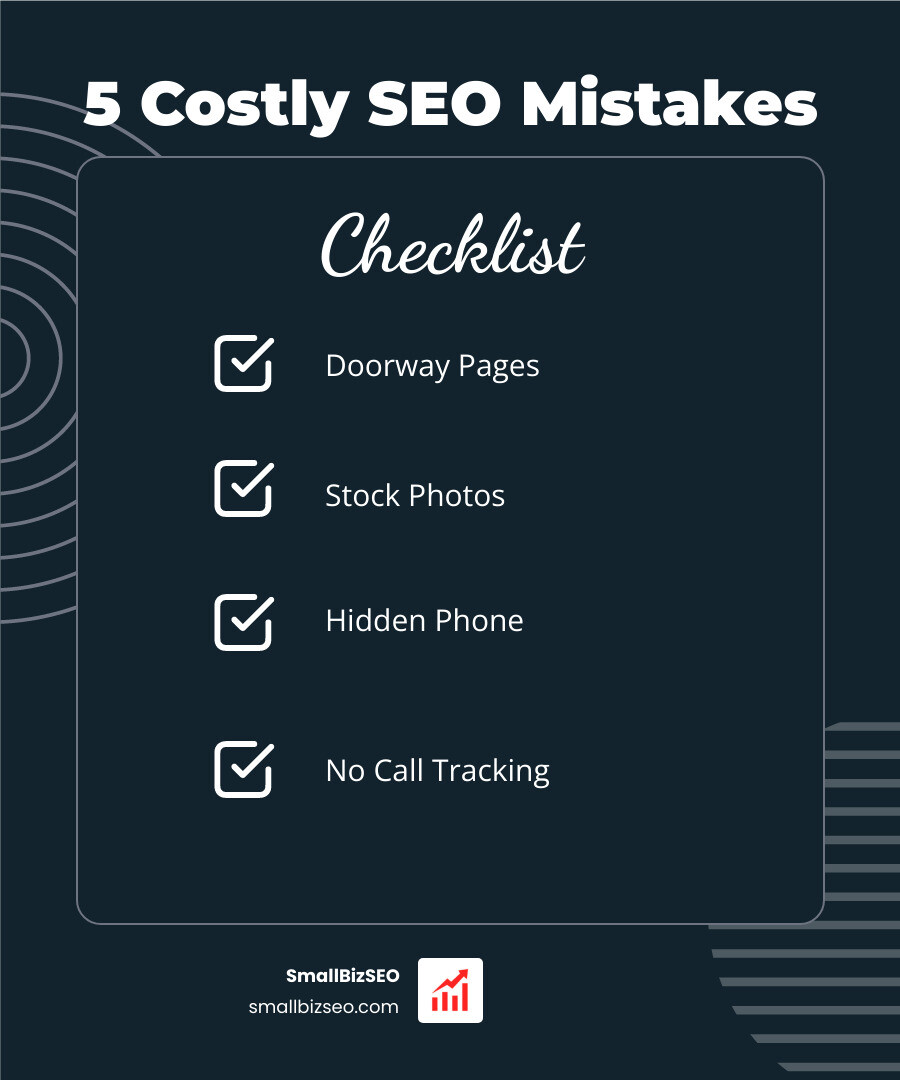
Key mistakes highlighted in our guide on local SEO mistakes include:
- Publishing Empty Doorway Pages: Creating dozens of location pages that only switch out the city name without providing real proof.
- Using Overused Stock Photos: Filling your website with generic catalog images instead of authentic photos of your technicians, branded vehicles, and completed work.
- Hiding the Direct Phone Number: Forcing urgent mobile visitors to search through multiple paragraphs just to locate your phone number.
- Failing to Track Call Sources: Lacking dynamic call tracking, which leaves you unable to tell which specific pages generate revenue.
- Ignoring Review Inquiries: Neglecting customer reviews or leaving negative feedback unanswered on your profiles.
Measuring ROI: Tracking Calls, Leads, and Cost Per Acquisition
Measure SEO success by tracking organic phone call volume, verified job forms, and your true customer acquisition cost rather than relying solely on keyword rankings. Because the majority of trade revenue begins with a direct phone conversation, connecting search data to booked revenue provides a clear picture of marketing performance.
How Should You Set Up Analytics, Call Tracking, and Conversion Goals?
Set up your tracking by combining Google Analytics 4 with dynamic call tracking software to identify the exact search terms and landing pages that drive phone inquiries. Assigning distinct tracking numbers to your website visitors, organic listings, and map profiles makes accurate revenue attribution straightforward.
Essential metrics to monitor monthly include:
- Total First-Time Inbound Calls: Measure unique callers generated via organic search and map listings.
- Average Cost Per Lead (CPL): While paid channels often average $45 to $220 per lead, mature organic campaigns can lower this cost to $8 to $22 per qualified lead over time.
- Lead-to-Job Close Rate: Connect your call tracking data with your dispatch software to identify which service pages generate the highest-margin installation jobs.
Should You Do SEO Yourself or Hire a Specialized Agency?
Handle your SEO in-house if you operate in a smaller, low-competition market with available weekly bandwidth; hire a specialized agency if you compete in a crowded metropolitan market. Managing on-page optimization, content creation, technical fixes, and link acquisition requires sustained time and specialized tools.
| Evaluation Factor | In-House / DIY SEO Management | Specialized Search Agency Execution |
|---|---|---|
| Time Investment | 10 to 15 hours per week required from staff | Fully managed with monthly strategy reviews |
| Technical Capability | Basic profile setup and simple blogging | Advanced schema markup, core speed fixes, and content workflows |
| Competitive Edge | Suitable for rural or low-competition markets | Necessary for high-density, competitive markets |
| Overall Cost | Low software cost; higher internal labor time | Predictable monthly service investment |
For growing businesses seeking cost-effective growth, our options for affordable SEO for small business provide dependable execution. If you are comparing providers, read our guide on choosing a local SEO company to identify trusted partners and avoid long-term lock-in contracts.
Frequently Asked Questions about Home Services SEO
Home service SEO investments generally deliver meaningful map pack improvements within 60 to 90 days, while broader organic rankings build steadily over three to six months. Below are answers to the most common questions contractors ask about local search strategies.
How Long Does It Take for Home Service SEO to Generate Qualified Leads?
Local map pack gains typically begin showing within 60 to 90 days of profile optimization, while competitive organic keyword growth generally takes three to six months. Timelines depend on the age of your website, existing backlink authority, and local competition.
How Much Should a Contractor or Trade Business Invest in SEO?
Most independent service businesses invest between $1,500 and $4,000 per month for professional local search management. Your budget should reflect your market size, target service area, and the average revenue value of your booked jobs.
Can Small Independent Contractors Outrank Large National Franchise Aggregators?
Yes, independent contractors regularly outrank national franchise aggregators on local queries by leveraging closer physical proximity, strong customer review profiles, and authentic, hyper-local website content. Search engines prioritize verified local businesses over distant corporate directories for local-intent searches.
Accelerate Your Local Search Growth and Outrank Competitors
Consistent local search optimization creates a durable competitive advantage that drives steady phone calls and high-value jobs to your business. By keeping your business profiles fully updated, building dedicated service pages backed by real customer proof, maintaining technical site health, and routinely collecting reviews, you can establish lasting market authority.
At SmallBizSEO, we implement our data-driven "Velocity" framework to deliver search visibility and clear revenue reporting for trade businesses nationwide. If you are ready to expand your market footprint and keep your service dispatch schedule full, explore our scalable search marketing solutions to start outranking nearby competitors today.