Mastering Ahrefs Keyword Research Without Losing Your Mind

Mastering Ahrefs Keyword Research Without Losing Your Mind
Why Keyword Research Ahrefs Tools Give Small Businesses a Real Edge
Keyword research in Ahrefs is the process of finding, analyzing, and prioritizing the search terms your potential customers type into Google — so you can create content that actually gets found.
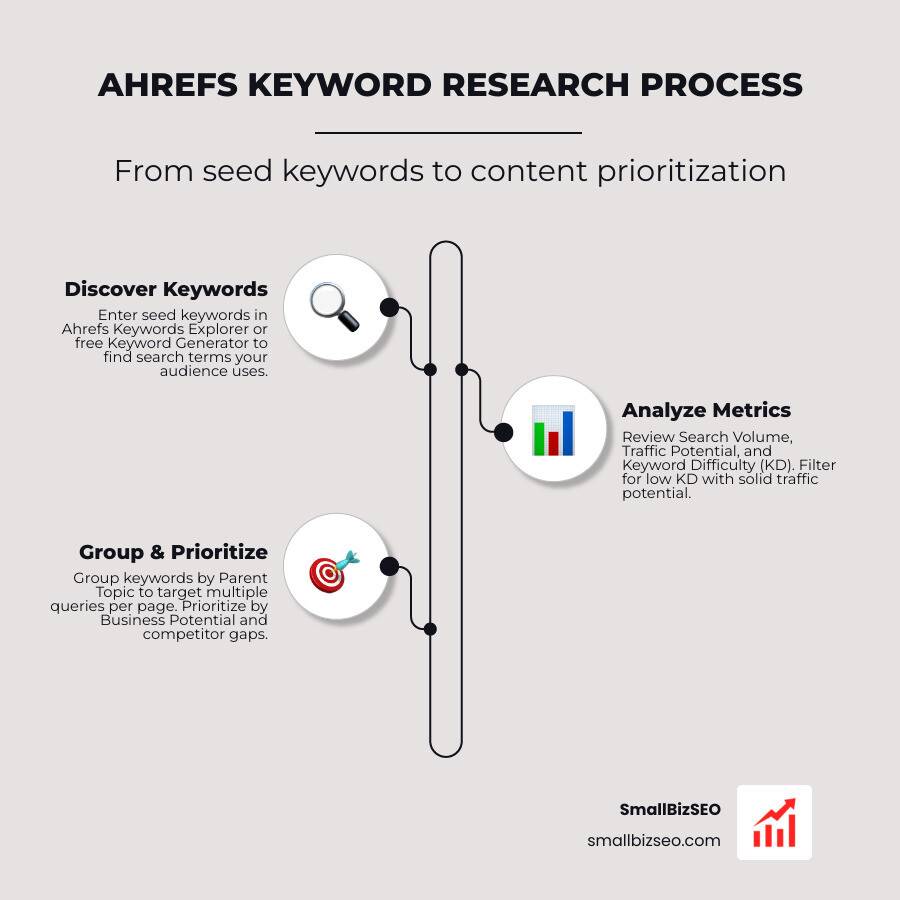
Here is a quick overview of how it works:
- Enter seed keywords into Ahrefs' Keywords Explorer or free Keyword Generator
- Review core metrics — Search Volume, Traffic Potential, and Keyword Difficulty (KD)
- Filter for opportunity — low KD scores with solid Traffic Potential
- Group keywords by Parent Topic to target multiple queries with one page
- Analyze competitors using Site Explorer and the Content Gap report
- Prioritize by Business Potential — focus on keywords where your product fits naturally
Here is a hard truth: 90% of pages on the internet get zero organic traffic from Google. Zero. All that time writing, formatting, and publishing — for nothing.
The reason is almost always the same. The content targets topics that nobody is searching for, or it goes after keywords that are far too competitive for a new or small site to rank for.
That is exactly why keyword research matters so much. It is not about guessing. It is about using real data to find the gaps where your business can actually show up.
Ahrefs makes this process faster and more precise than almost any other tool available — with a database of over 28.7 billion keywords and metrics that go well beyond basic search volume.
I'm Clayton Johnson, and I've spent years using digital PR and SEO strategy to help businesses improve their search visibility — including hands-on work with keyword research and Ahrefs-driven content planning for clients across competitive markets. In the sections below, I'll walk you through everything you need to go from zero to a working keyword strategy, without the overwhelm.
Why Keyword Research Ahrefs Workflows are the Foundation of Modern SEO
Every successful SEO campaign starts with understanding search demand. If we do not know what our target audience is looking for, we are essentially throwing content at the wall and hoping something sticks.
By building a systematic keyword research ahrefs workflow, we remove the guesswork. We can instantly see how many people search for a term, what kind of organic traffic the top-ranking pages actually get, and whether those searchers have commercial or informational intent.
Understanding search intent is critical. If someone searches for "how to clean a coffee maker," they want an informational guide. If they search for "best espresso machine under $500," they are looking to buy. Aligning your content with this intent is the first step toward ranking, as we outline in our beginners guide to keyword content optimization.
Furthermore, we must evaluate the business potential of every target keyword. It is easy to get distracted by high search volumes, but if a keyword does not help you sell your services or products, it is a vanity metric. We want to find terms where we can naturally present our business as the solution.
Getting Started with Keywords Explorer and Decoding Core Metrics
To build a reliable SEO strategy, we need to get comfortable with Ahrefs' core interface. While Ahrefs offers a Free Keyword Generator Tool: Find 100+ Keyword Ideas in Seconds to help beginners get their feet wet, upgrading to the full paid Keywords Explorer unlocks a database of over 28.7 billion filtered keywords across hundreds of locations.
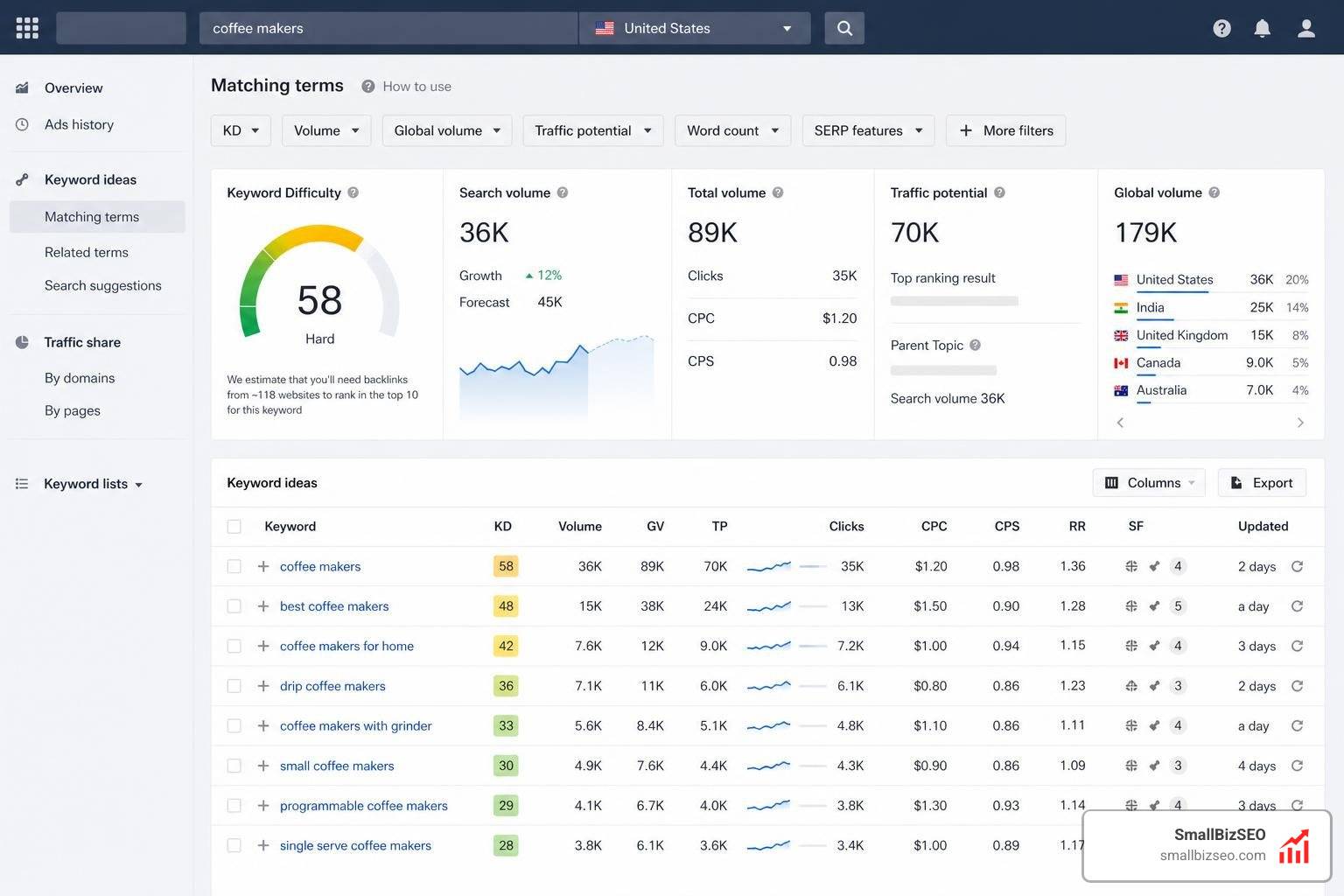
When we analyze any keyword inside Keywords Explorer, we are greeted with several key metrics. Understanding how these metrics interact is the difference between a wasted budget and a highly profitable campaign.
| Metric | What It Actually Means | Why It Matters for Small Businesses |
|---|---|---|
| Search Volume | The average number of times a keyword is searched per month. | Helps gauge general interest, but can be highly seasonal or misleading. |
| Traffic Potential | The total organic search traffic the top-ranking page gets for all the keywords it ranks for. | Shows the true traffic you could capture if you reach the top spot. |
| Keyword Difficulty (KD) | An estimation of how hard it will be to rank in the top 10 organic results. | Helps you filter out highly competitive terms and find quick wins. |
How to Kickstart Your Keyword Research Ahrefs Strategy
To start, we need to brainstorm "seed keywords." These are broad terms related to your industry. For example, if you sell boutique coffee equipment, your seed keywords might be "espresso," "coffee maker," or "french press."
Once we plug these seeds into Keywords Explorer by Ahrefs: Find Winning Keyword Ideas. At Scale. , we can use different search filters to expand our list:
- Matching terms: This report shows search queries that contain your exact seed keywords.
- Related terms: This report surfaces queries that are contextually related to your seed terms, even if they do not contain the exact words.
- Questions: This filters for informational queries (e.g., "how," "what," "why") which are perfect for blog posts.
Understanding Traffic Potential and Parent Topics
One of the most common rookie mistakes in SEO is relying solely on search volume. A keyword might have a search volume of only 500 searches a month, but its Parent Topic might have a Traffic Potential of 5,000.
This happens because the average top-ranking page does not just rank for one search term — it also ranks for about a thousand similar secondary keywords. By targeting the broader Parent Topic, your single page can capture traffic across hundreds of long-tail variations.
Demystifying Keyword Difficulty (KD) and Backlink Requirements
Ahrefs calculates its Keyword Difficulty (KD) score on a scale from 0 to 100. This calculation is based solely on the average number of unique websites (referring domains) linking to the top 10 ranking pages.
- A KD of 0 to 10 means you need very few backlinks to compete.
- A KD of 50+ means you will likely need a focused link-building campaign to break into the top 10.
While KD is an incredibly useful initial filter, we should never rely on it blindly. A manual SERP analysis is always required. We must look at the actual search results to see if the top pages are high-authority giants or smaller niche sites we can realistically outrank.
Advanced Competitor Intelligence and Content Gap Analysis
Sometimes the easiest way to find high-performing keywords is to let your competitors do the hard work for you. By analyzing established sites in your niche, you can find the exact terms driving their organic traffic.
Using Ahrefs Site Explorer, we can enter a competitor's domain and view their "Organic Keywords" report. This shows us exactly which pages are bringing them the most visits and which keywords they rank for. For a deeper, more systematic approach, we highly recommend reading our guide on keyword gap analysis what it is and how to do it right.
Uncovering Low-Hanging Fruit with Site Explorer
If you already have an established website, you do not always need to write new content from scratch. Often, your best opportunities are already ranking on page two of Google.
By filtering your own site's organic keywords for rankings in positions 11 through 20, you can identify "low-hanging fruit." These are pages that already have search engine trust but need a little content optimization, internal linking, or basic technical updates to jump to page one. You can learn more about managing this workflow in our detailed guide on how to use ahrefs for keyword research without losing your mind.
Executing a Flawless Keyword Research Ahrefs Content Gap Audit
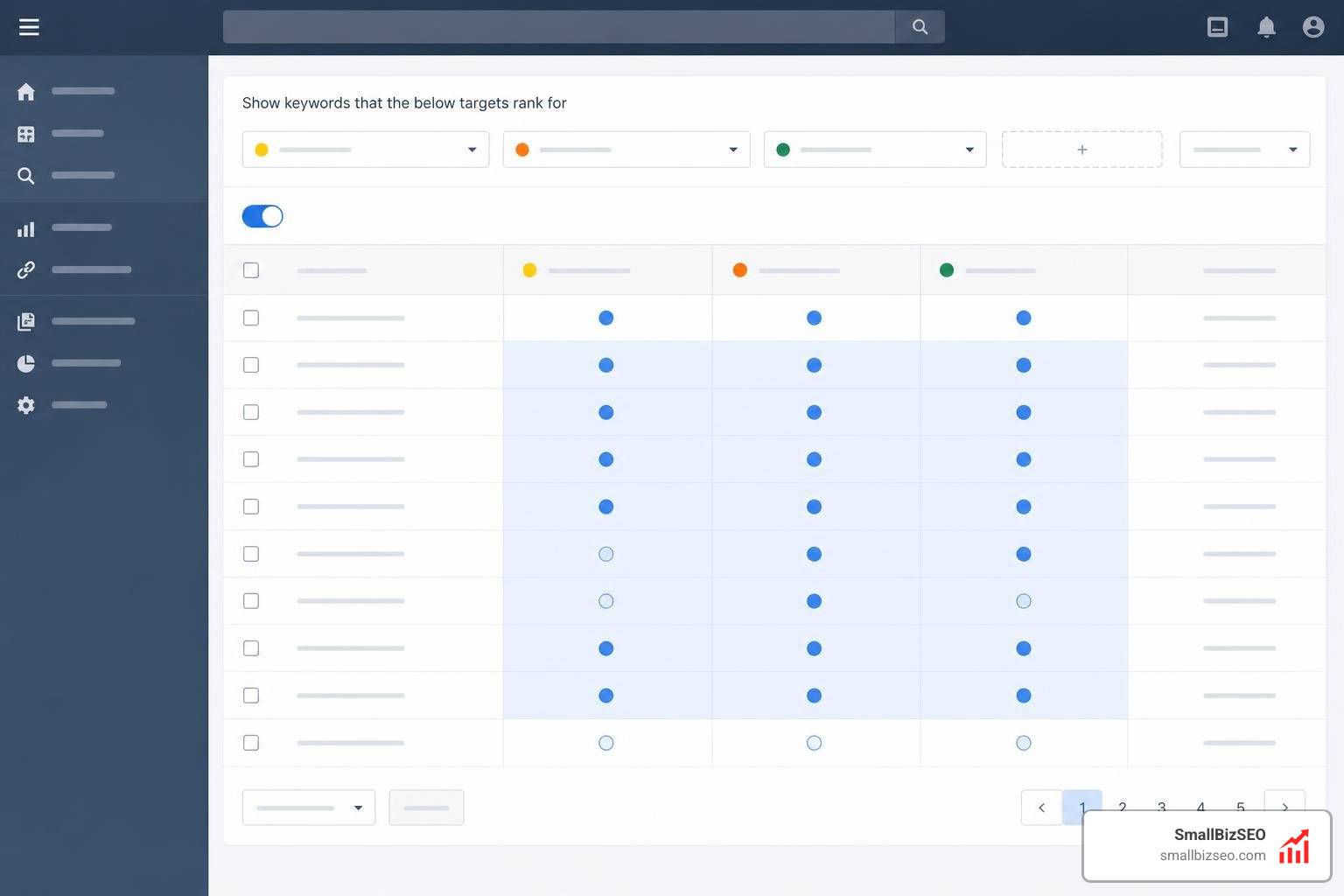
The Content Gap tool in Ahrefs is a secret weapon for content planning. It allows us to input up to three competitor websites and compare them against our own.
The tool then highlights keywords that multiple competitors rank for, but our site does not rank for at all. This instantly gives us a list of highly relevant topic ideas that are proven to drive traffic in our niche, ensuring we never waste time on unproven search terms.
Mapping Search Intent and Prioritizing Your Keywords
Once you have a list of hundreds of potential keywords, you must prioritize them. We categorize keywords into four primary types of search intent:
- Informational: The user wants to learn something (e.g., "how to brew espresso").
- Navigational: The user is looking for a specific brand or website (e.g., "Ahrefs login").
- Commercial: The user is researching products or services but isn't quite ready to buy (e.g., "best espresso machine brands").
- Transactional: The user is ready to make a purchase (e.g., "buy Breville espresso machine online").
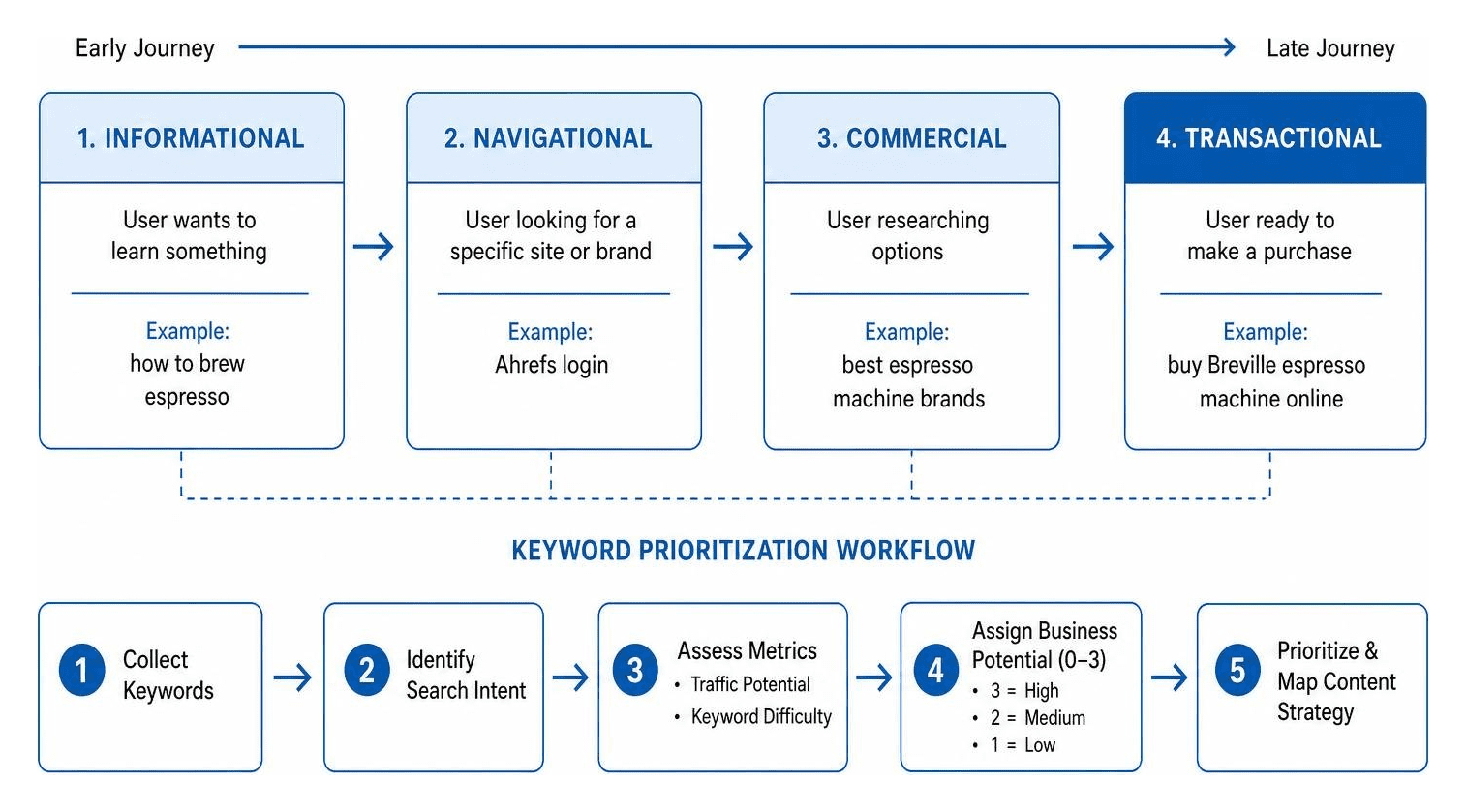
When prioritizing, we balance Traffic Potential, Keyword Difficulty, and Business Potential. We assign every keyword a Business Potential score from 0 to 3:
- 3 (High): Your product or service is the absolute best solution to the user's problem, and you can pitch it directly.
- 2 (Medium): Your product fits naturally into the content, but it is not the sole focus.
- 1 (Low): Your product can only be mentioned tangentially.
- 0 (None): There is no logical way to mention what you sell.
By focusing your initial efforts on keywords with low KD, high Traffic Potential, and a Business Potential score of 2 or 3, you ensure that your SEO efforts translate directly into business growth. This careful mapping also prevents keyword cannibalization, where multiple pages on your site compete for the exact same search terms.
Frequently Asked Questions About Ahrefs Keyword Research
How does Ahrefs calculate Keyword Difficulty (KD)?
Ahrefs calculates Keyword Difficulty by looking at the number of unique referring domains (backlinks) pointing to the top 10 ranking pages for a search query. It does not look at on-page SEO factors, content quality, or domain rating, which is why a manual SERP analysis is always recommended before finalizing your target list.
Why does Traffic Potential differ from Search Volume?
Search volume only measures how often a single, specific search query is typed into Google. Traffic Potential, however, looks at the top-ranking page for that term and sums up the traffic it receives from all the different keyword variations it ranks for. Because a single page can rank for thousands of long-tail terms, Traffic Potential is often much higher than individual search volume.
Can I use AI tools like ChatGPT for keyword research?
Yes, but with caution. Standard AI models do not have live connections to search engine databases, meaning they often fabricate search volumes and difficulty scores. However, you can use AI to brainstorm seed keywords, cluster topics, or analyze search intent. For a complete guide on combining AI with live data, check out Ahrefs' guide on AI Keyword Research: How It Works and 9 Prompts to Start .
Accelerate Your Organic Growth with Smart Keyword Strategy
Building a sustainable, high-traffic website does not require an enterprise budget — it requires strategic focus. By mastering keyword research in Ahrefs, you can stop guessing what your audience wants and start publishing content that is mathematically positioned to rank.
At SmallBizSEO, we help small businesses scale their search traffic using our data-driven "Velocity" framework. We combine technical SEO expertise, high-quality content strategy, and white-hat link building to deliver transparent, automated reporting and measurable organic growth.
If you are ready to stop wasting time on content that gets zero traffic, explore our tailored SmallBizSEO services and let us design a high-yielding search strategy for your business.