Organic Lead Valuation: How to Track Cost Per Qualified Inbound Opportunity
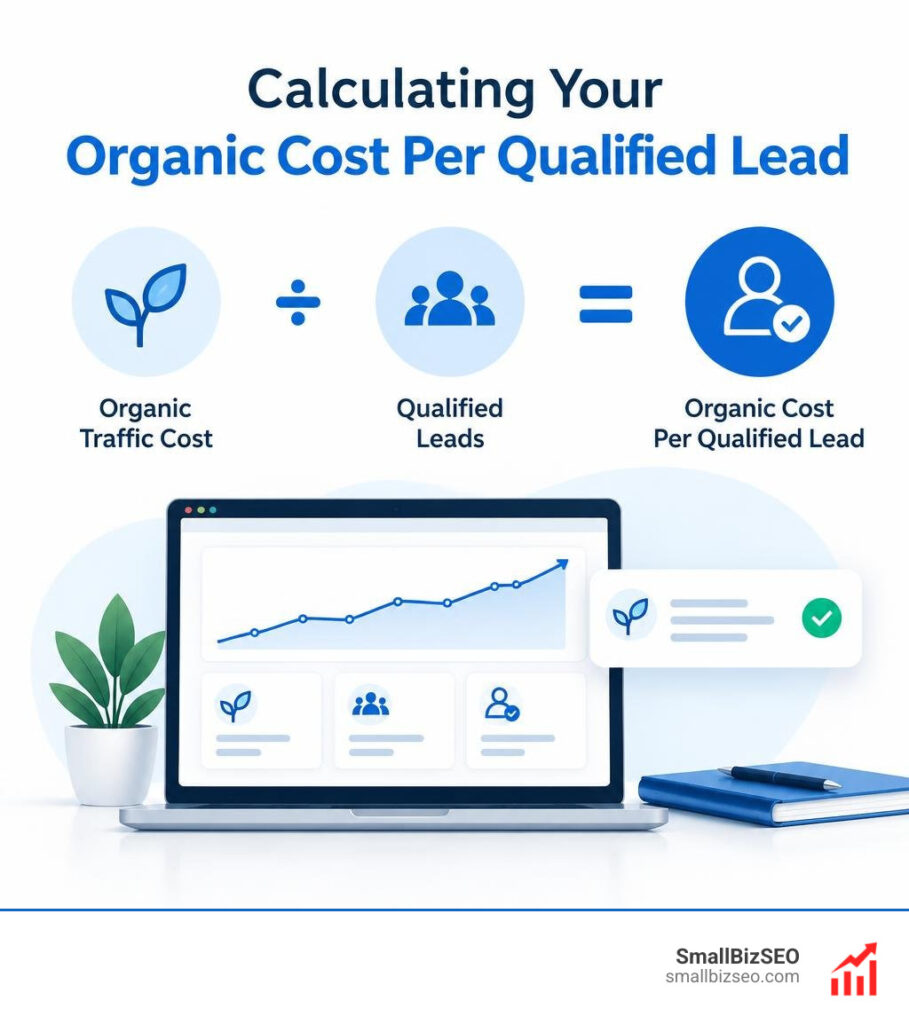
How do you calculate organic cost per qualified lead?
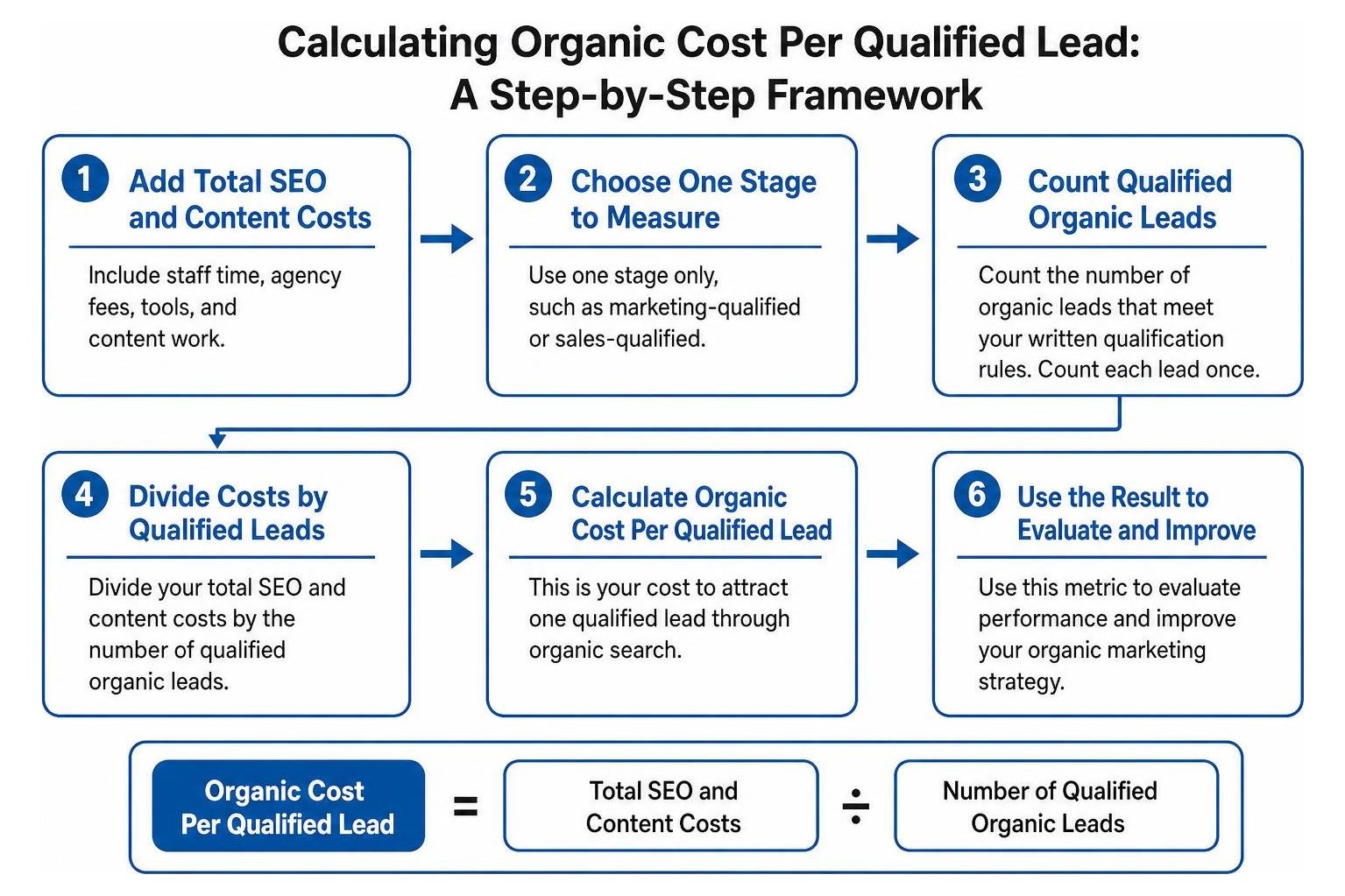
Calculating organic cost per qualified lead starts with two numbers: your total SEO and content costs, and the number of organic leads that meet your written qualification rules. Divide the costs by those qualified leads. Include staff time, agency fees, tools, and content work. Count each lead once, and choose one stage to measure, such as marketing-qualified or sales-qualified.
A form submission alone does not make someone a good prospect. Tracking qualified leads helps you see whether organic search is bringing in people your business can actually serve, not just more inquiries.
I'm Clayton Johnson, founder of SmallBizSEO. My work connects SEO, content, and lead quality, and I use that perspective when calculating organic cost per qualified lead.
Calculating Organic Cost Per Qualified Lead: A Step-by-Step Framework
Organic cost per qualified lead (CPQL) measures the exact marketing dollars required to attract a prospect who matches your target customer profile through non-paid search channels. Unlike standard cost per lead (CPL), which divides expenses across every raw contact form submission, spam entry, or job inquiry, CPQL isolates vetted opportunities that have a realistic path to revenue.
To track this accurately, you must separate marketing qualified leads (MQLs) from sales qualified leads (SQLs) and divide your fully loaded organic marketing investment by those verified counts. This gives small business owners an honest look at pipeline health and forms the foundation for measuring true SEO ROI.
Why Is Calculating Organic Cost Per Qualified Lead Critical for Accurate ROI?
Relying on raw lead volume creates an illusion of marketing efficiency. When your inbox fills with inquiries that do not match your business, shoppers looking for budget services you do not provide, or automated spam, your raw CPL appears deceptively low.
However, filtering these unqualified inquiries burns valuable sales capacity. Every hour spent reviewing non-viable contacts adds hidden labor overhead to your customer acquisition cost. Evaluating your pipeline through qualified metrics ensures marketing strategies focus on revenue rather than vanity metrics. It aligns sales and marketing around sustainable unit economics and clarifies whether tracking organic conversion paths delivers profitable client engagements.
What Formula and Expenses Belong in Calculating Organic Cost Per Qualified Lead?
Calculating your organic CPQL requires capturing all direct and indirect expenses dedicated to organic search visibility.
The basic formula is straightforward:
Organic CPQL = Total Fully Loaded Organic Marketing Spend / Total Deduplicated Organic Qualified Leads
To capture your true spend, ensure your calculations include:
- In-house staff hours dedicated to SEO management, website maintenance, and content creation.
- External agency retainers, consulting fees, and freelance copywriting expenses.
- Dedicated software subscriptions for analytics, keyword tracking, and technical auditing.
- Direct technical optimization costs, including developer hours for page speed and schema architecture.
Before dividing, always deduplicate your inbound data and filter out spam submissions. Inflated contact lists distort channel efficiency. By regularly monitoring organic sessions alongside these fully loaded costs, you can establish accurate baseline unit metrics.
What Lead Stages and Qualification Filters Separate True Prospects from Raw Clicks?
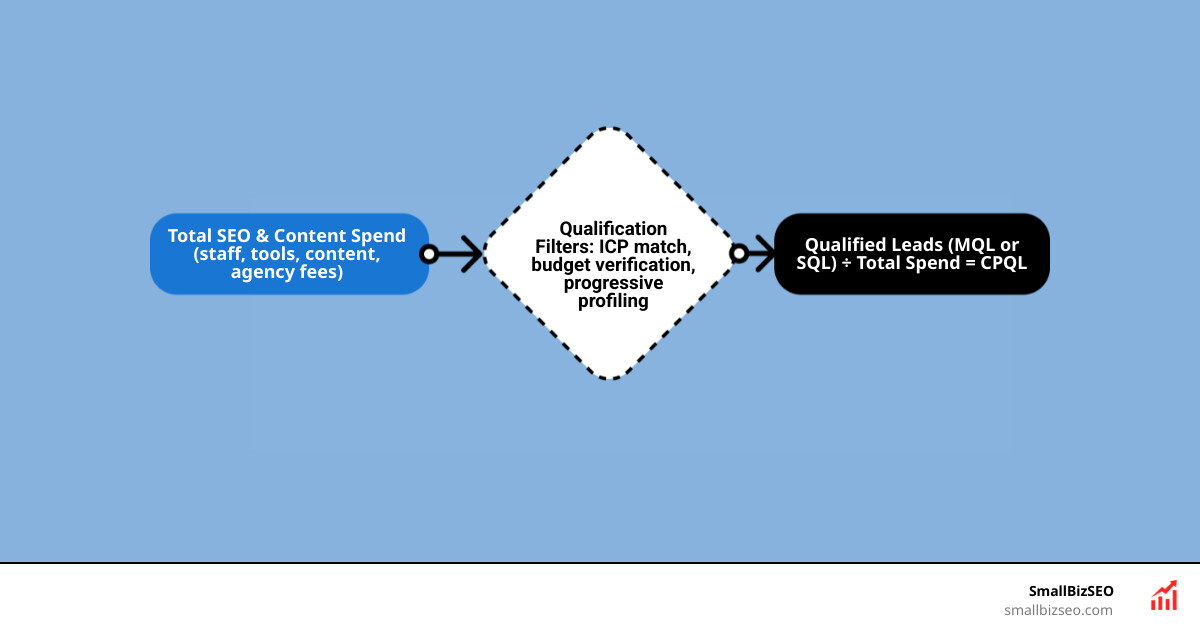
A standardized lead qualification framework prevents unqualified traffic from skewing acquisition data. Establish strict criteria for each stage of your conversion funnel before evaluating campaign performance:
| Lead Stage | Definition & Core Filters | Conversion Rate to Customer | Typical Cost Range | Downstream Impact |
|---|---|---|---|---|
| Raw Lead | Any web form fill, newsletter sign-up, or general contact message without verification. | Less than 1% | $10 - $40 | Consumes sales time; high disqualification rate. |
| Marketing Qualified Lead (MQL) | Inquiries meeting core Ideal Customer Profile (ICP) criteria: location, industry, and project scope. | 5% - 10% | $40 - $200 | Demonstrates commercial intent; ready for nurturing. |
| Sales Qualified Lead (SQL) | Prospects with confirmed budget, immediate purchase timeline, and direct decision-maker authority. | 15% - 25% | $150 - $500 | Enters direct sales pipeline; drives core revenue. |
Implementing progressive profiling and qualification filtering on landing pages prevents non-ideal prospects from entering sales queues. Standardizing pipeline disposition stages within your CRM helps in improving inbound lead quality while ensuring reporting reflects true commercial demand. For broader context on basic inbound math, reference this How to Calculate & Apply Cost per Lead (CPL) overview.
Strategies to Lower Inbound Acquisition Costs and Scale Sustainable Growth
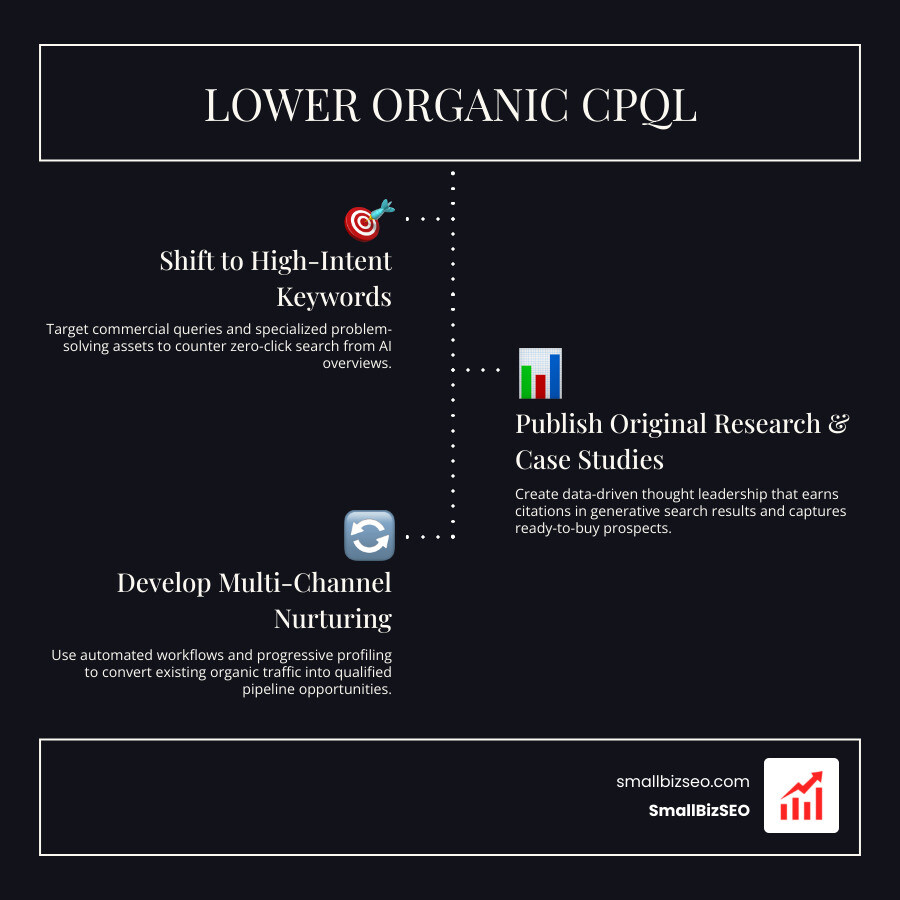
Lowering your organic CPQL does not require slashing your marketing budget. Instead, it relies on improving conversion rates, refining organic targeting to high-intent topics, and developing multi-channel touchpoints that turn existing search traffic into qualified pipeline opportunities.
What Factors Drive Organic Lead Costs and How Do Search AI Summaries Impact Inbound Traffic?
Search engine mechanics have shifted. The rise of AI-generated search overviews has created zero-click search behavior across broad informational queries. When users receive direct answers inside search results, top-of-funnel traffic volumes naturally decline.
To maintain a low CPQL, small businesses must shift content strategies from generic definitions toward high-intent commercial keywords and specialized problem-solving assets. Publishing original data, expert thought leadership, and detailed case studies earns citations within generative search engines and captures high-intent prospects ready to purchase.
Protecting your crawl budget and topical authority by pruning thin content in modern SEO ensures search engines index only high-value pages. Simultaneously, identifying competitor keyword gap data helps you uncover underserved commercial queries that competitors overlook.
How Can Small Businesses Optimize Conversion Rates and Multi-Touch Funnels to Lower Lead Costs?
Conversion rate optimization directly lowers acquisition costs by maximizing the value of current traffic. A small lift in conversion efficiency dramatically expands your allowable lead acquisition ceiling without requiring additional search traffic.

Implement these targeted qualification tactics across your digital touchpoints:
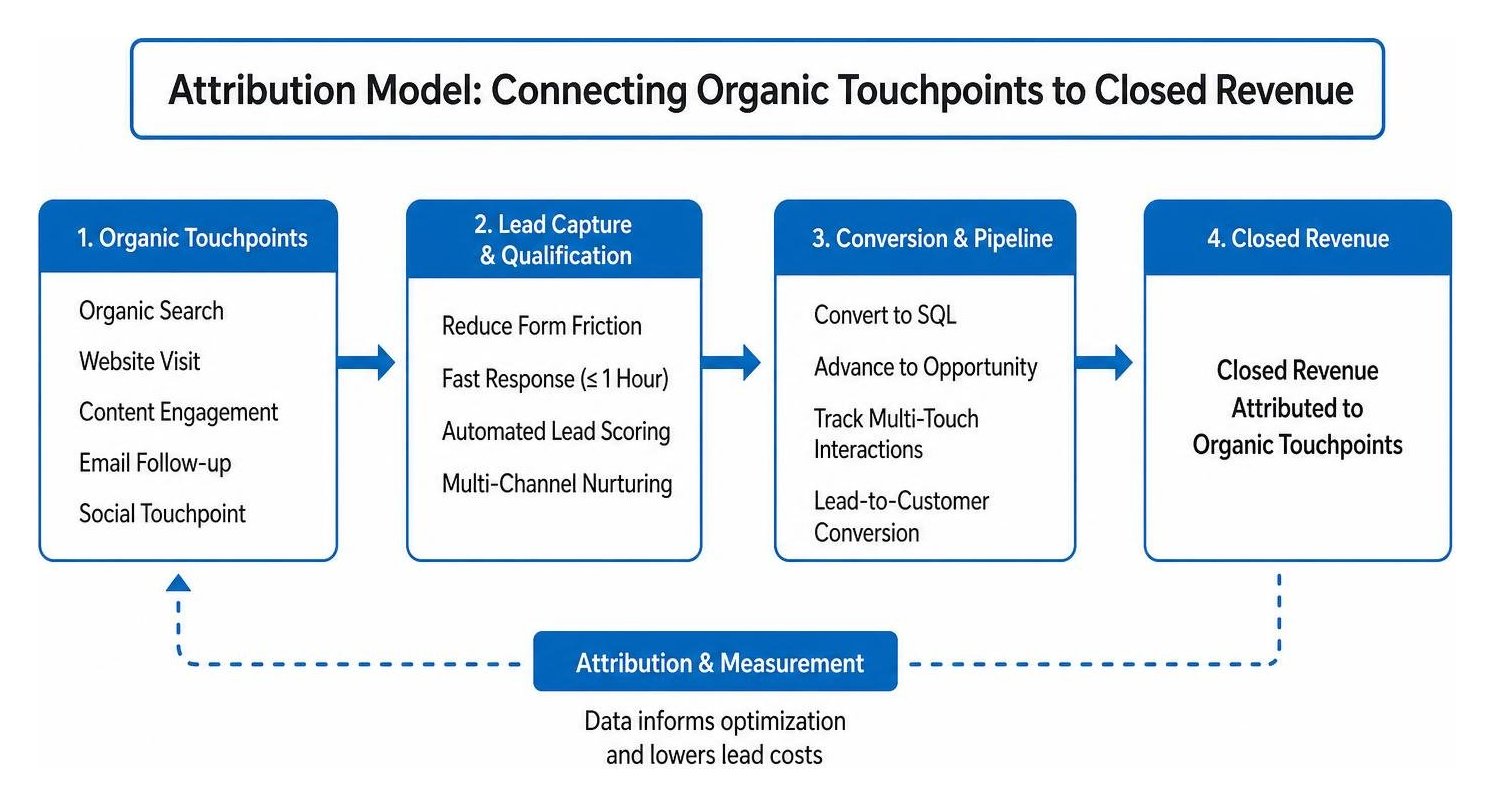
- Reduce form friction: Streamline web forms to capture only critical qualifying data (such as project scope, budget range, and timeline), eliminating unnecessary fields.
- Accelerate response times: Reaching out to an inbound organic lead within one hour significantly increases the likelihood of advancing them to an SQL.
- Deploy automated lead scoring: Route incoming leads through automated CRM rules to instantly assign priority based on company size or indicated budget.
- Implement multi-channel nurturing: Re-engage organic visitors through email follow-ups and professional social touchpoints. Prospects who interact across multiple touchpoints convert at substantially higher rates than single-visit users.
Focusing on improving website conversion rate mechanics while systematically optimizing lead-to-customer rate funnels ensures marketing investments reliably produce sales-ready pipeline.
How Do Organic Lead Costs Compare to Paid Acquisition Benchmarks Across Industries?
Across almost every commercial sector, organic search delivers a 20% to 40% lower cost per lead compared to paid advertising channels. While paid search requires continuous ad spend that stops generating leads the moment funding ceases, organic search builds compounding digital assets that continue capturing leads over time.
Consider how acquisition costs compare across key sectors:
- B2B SaaS: Organic CPL averages $35 to $55, compared to paid search costs of $75 to $110.
- Legal Services: Organic acquisition ranges between $65 and $110, while paid search costs reach $120 to $200.
- Financial Services: Organic leads cost between $45 and $80, compared to paid search campaigns at $85 to $150.
- Enterprise Software: Organic acquisition averages $90 to $140, whereas paid search costs range from $180 to $250.
To maintain healthy margins, target a maximum acquisition cost using this standard benchmark:
Target CPQL = (Customer Lifetime Value × Lead-to-Customer Conversion Rate) / 2
This target provides a sustainable 50% gross margin. Aligning your customer acquisition strategy around increasing long-term customer lifetime value enables your business to generate scalable, predictable organic revenue.
Turn Inbound Opportunity Into Predictable Revenue
Calculating your organic cost per qualified lead provides the clarity required to scale your business sustainably. By isolating high-intent traffic from surface-level metrics and tracking fully loaded marketing expenses, you can make informed budget decisions that protect profit margins.
At SmallBizSEO, we help small businesses build sustainable search visibility using our data-driven "Velocity" framework. Our approach delivers transparent technical optimization, strategic content planning, and authority building to turn organic search into a predictable growth channel. Our SEO, content strategy, and link-building services help turn website traffic into measurable, qualified business opportunities.