SEO for Answering Services: Turn Search Visits Into Qualified Sales Calls

How Can Answering Services Turn Search Visits Into Sales Calls?
SEO for answering services starts with the pages buyers need to make a decision. Create distinct pages for after-hours coverage, live receptionists, AI receptionists, overflow support, and the industries you serve. On each page, explain how calls are handled, what happens when a caller needs help beyond the script, and how pricing works. Then track qualified sales inquiries rather than counting every call as a lead.
If you serve clients nationwide, describe your actual coverage instead of creating near-identical city pages. Use local pages only where you can show a genuine local presence or relevant local service details.
I'm Clayton Johnson, founder of SmallBizSEO. My work in technical SEO, content strategy, and building search authority shapes this guide to SEO for answering services: make your services easy to find, understand, and evaluate.
Core Pillars of High-Converting SEO for Answering Services
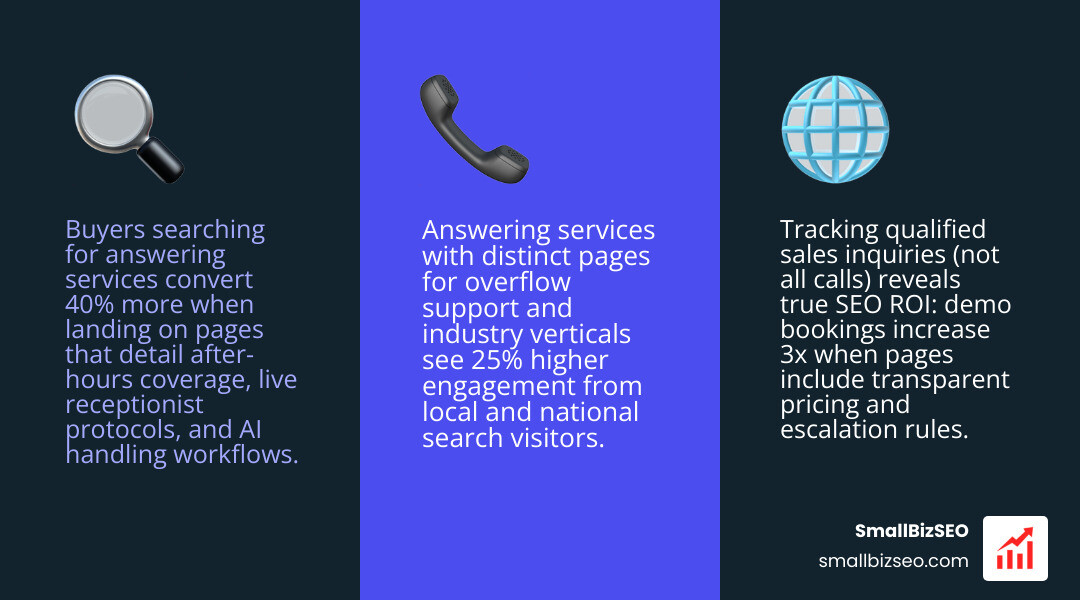
SEO for answering services succeeds when technical crawlability meets commercial search intent. Unlike generic business marketing, answering service buyers search with acute operational needs: an overflowing phone queue, missed revenue, or after-hours coverage gaps. Driving sustainable pipeline requires structuring your website around clear operational facts, transparent pricing, and verifiable workflows that satisfy Google helpful content systems.
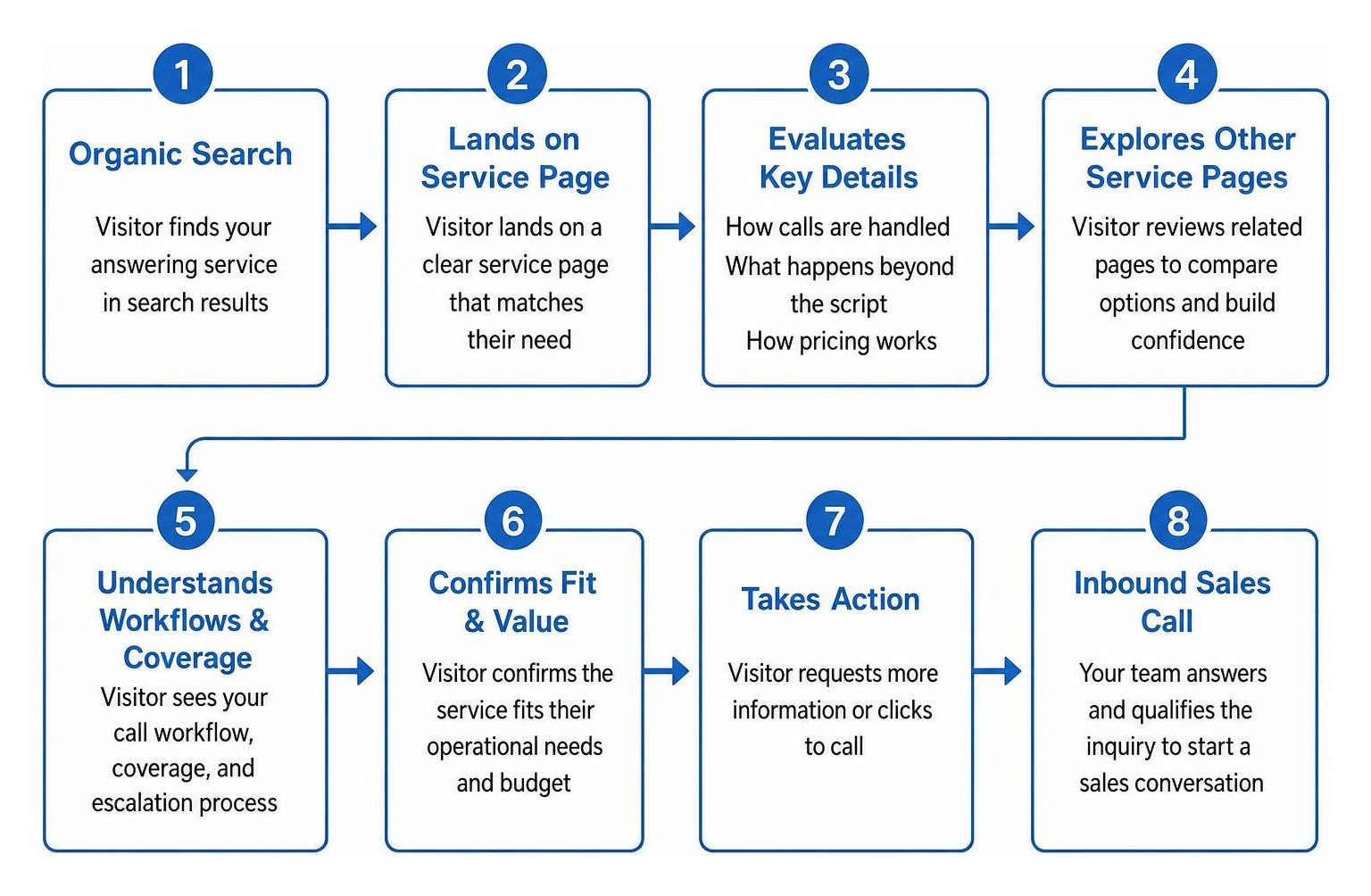
Connecting organic visibility directly to revenue means converting search clicks into booked consultations. By connecting from organic search calls to qualified deals, providers filter out low-intent consumer inquiries and capture high-value business contracts.
How Does Technical SEO for Answering Services Differ Between National and Local Coverage?
National answering services should build centralized authority around their core capabilities. Local visibility depends on the provider's real operating model and eligibility, not a schema label alone.
If your answering service operates nationally through distributed call centers or remote agents, focus the site architecture on clear category hubs and comprehensive pages for services you actually offer. Avoid hundreds of doorway-style city pages that swap only location names; thin, repetitive pages do not show unique local operations or help buyers evaluate the service.
A provider may be eligible for a Google Business Profile only when customers can visit its physical location or it travels to customers in person. Online-only services are generally not eligible. For eligible businesses, the appropriate storefront or service-area setup depends on the real customer-contact model and Google’s current Business Profile guidelines, not on adding LocalBusiness schema. Use regional pages only when they describe genuine local operations and service details; a local SEO strategy should reflect that operating model.
What Search Intent Mappings Capture Live, AI, and After-Hours Inquiries?
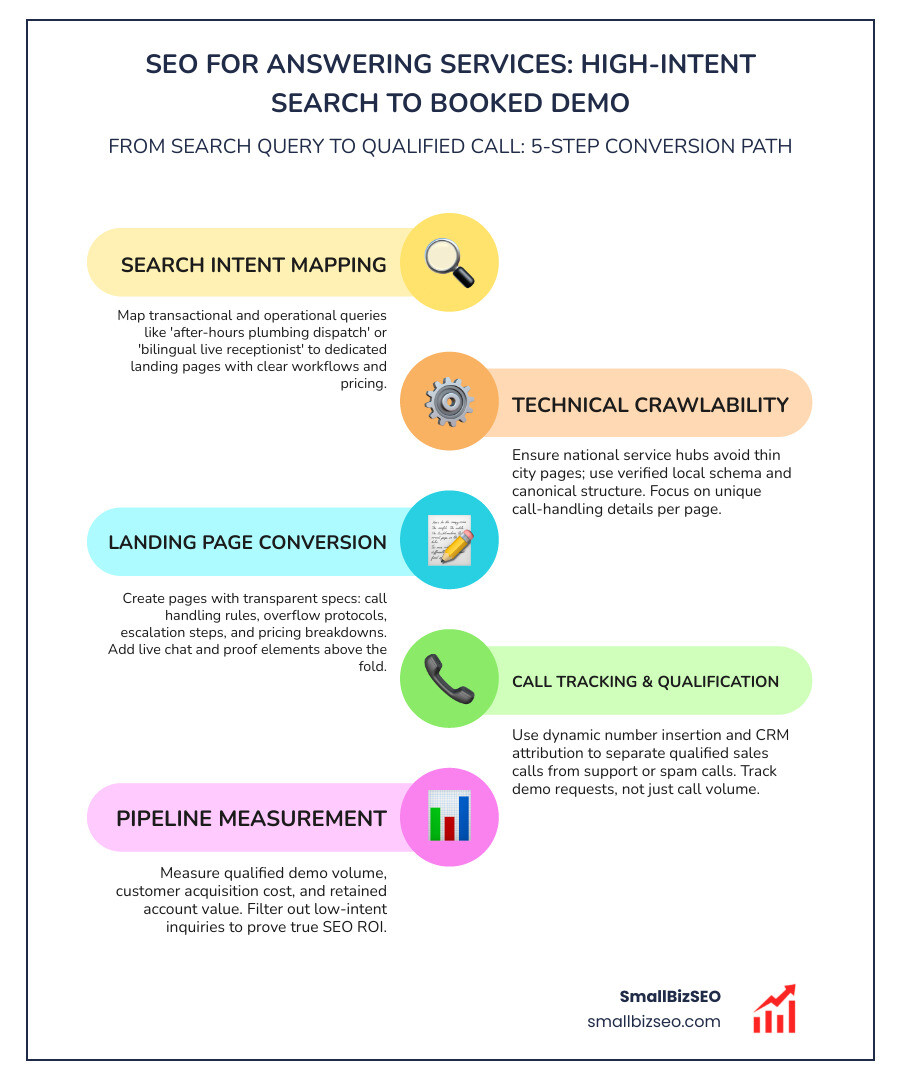
High-converting search intent in the call answering sector centers on transactional and operational modifiers. Decision-makers rarely search for abstract theories; they look for exact solutions like "after-hours plumbing dispatch" or "bilingual live receptionist."
Map each primary keyword cluster to a dedicated landing page with the operational details buyers need to compare providers:
| Target Query Cluster | Core Buyer Intent | Required Page Information | Escalation & Exception Protocols |
|---|---|---|---|
| After-Hours Answering | Night, weekend, and holiday call coverage | Exact operational hours, time zone coverage, holiday surcharge policies | Fallback paths for unanswered on-call transfers; SMS/email alert rules |
| Live Receptionist | Professional human representation for front-desk calls | Agent screening standards, script customization, warm call transfer options | Protocol when staff cannot reach the client; message logging specifications |
| AI Receptionist | Automated instant booking and call triage | Supported software integrations, voice naturalness, direct calendar booking | Live human fallback rules, misrecognized intent handling, urgent triage |
| Overflow Support | Peak-volume call capture and queue reduction | Rollover rules, simultaneous call handling limits, queue wait-time limits | Automated spillover rules during seasonal spikes or severe weather events |
Structuring High-Intent Landing Pages That Turn Search Visits Into Booked Demos
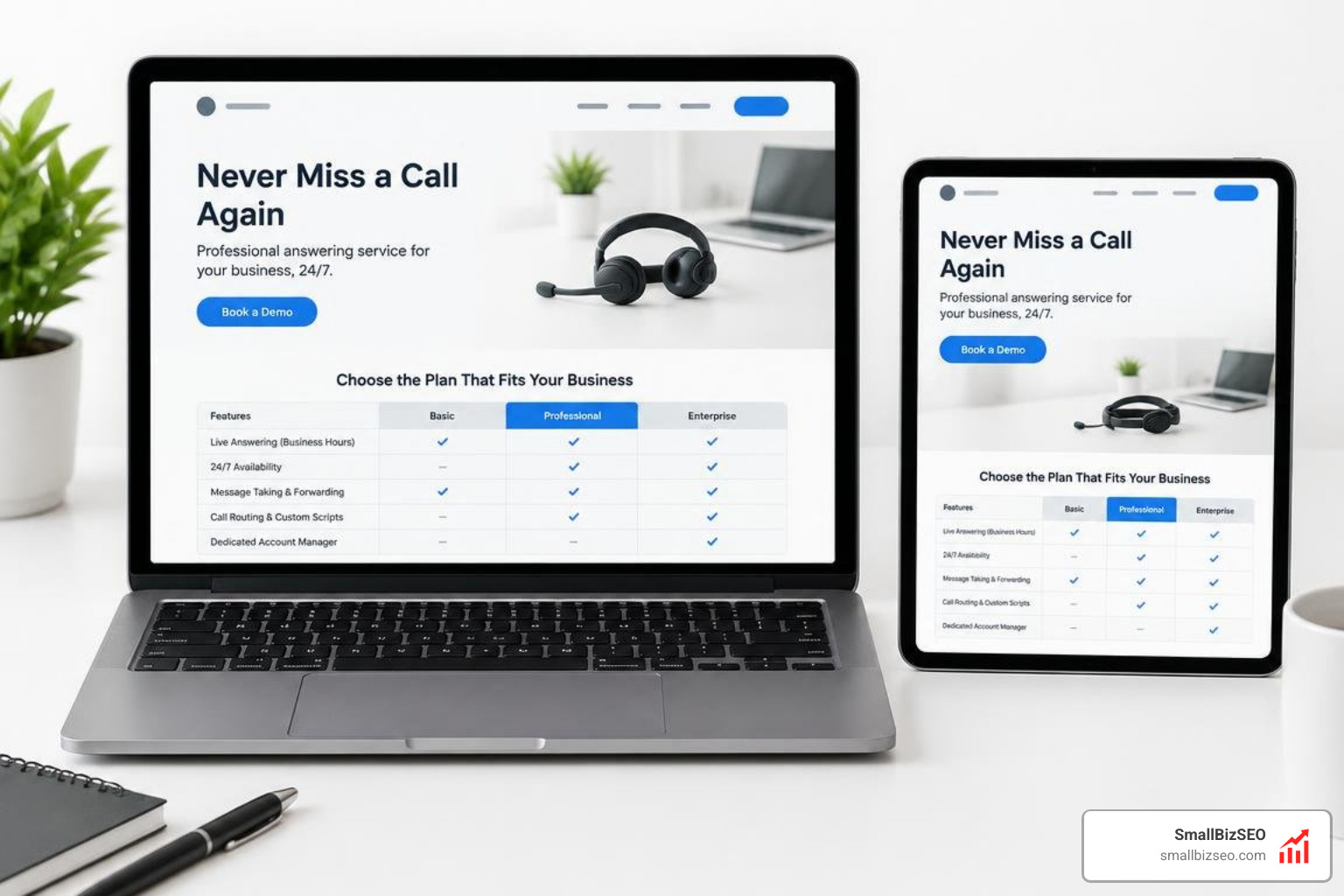
A successful landing page answers pre-purchase questions immediately within the first two screen folds. Instead of vague claims like "never miss a call," outline exact technical capabilities, software integrations, and onboarding timelines.
Adopting a comprehensive, high-converting B2B SEO strategy ensures your pages provide direct answers, scannable specifications, transparent pricing models, and clear next steps for prospective buyers.
How Can Vertical Landing Pages Address Compliance, Scripting, and Intake Workflows?
Generic service pages often fail to convert specialized buyers because each industry has distinct intake, privacy, and escalation requirements. Describe only the scripts, integrations, safeguards, and service boundaries the provider can verify and support.
When writing for healthcare clients, use accurate regulatory language. Depending on the service provider’s role and access to protected health information, healthcare call handling may create business-associate obligations. A Business Associate Agreement alone does not establish compliance. Claims about scripts, training, privacy, and safeguards should match verified practices and client-approved protocols; review HHS guidance on covered entities and business associates.
Similarly, legal intake pages must clarify that operators collect initial inquiry details and never provide legal advice. Field service dispatch pages should specify that operators triage requests according to customer-defined criteria rather than guaranteeing emergency arrival times.
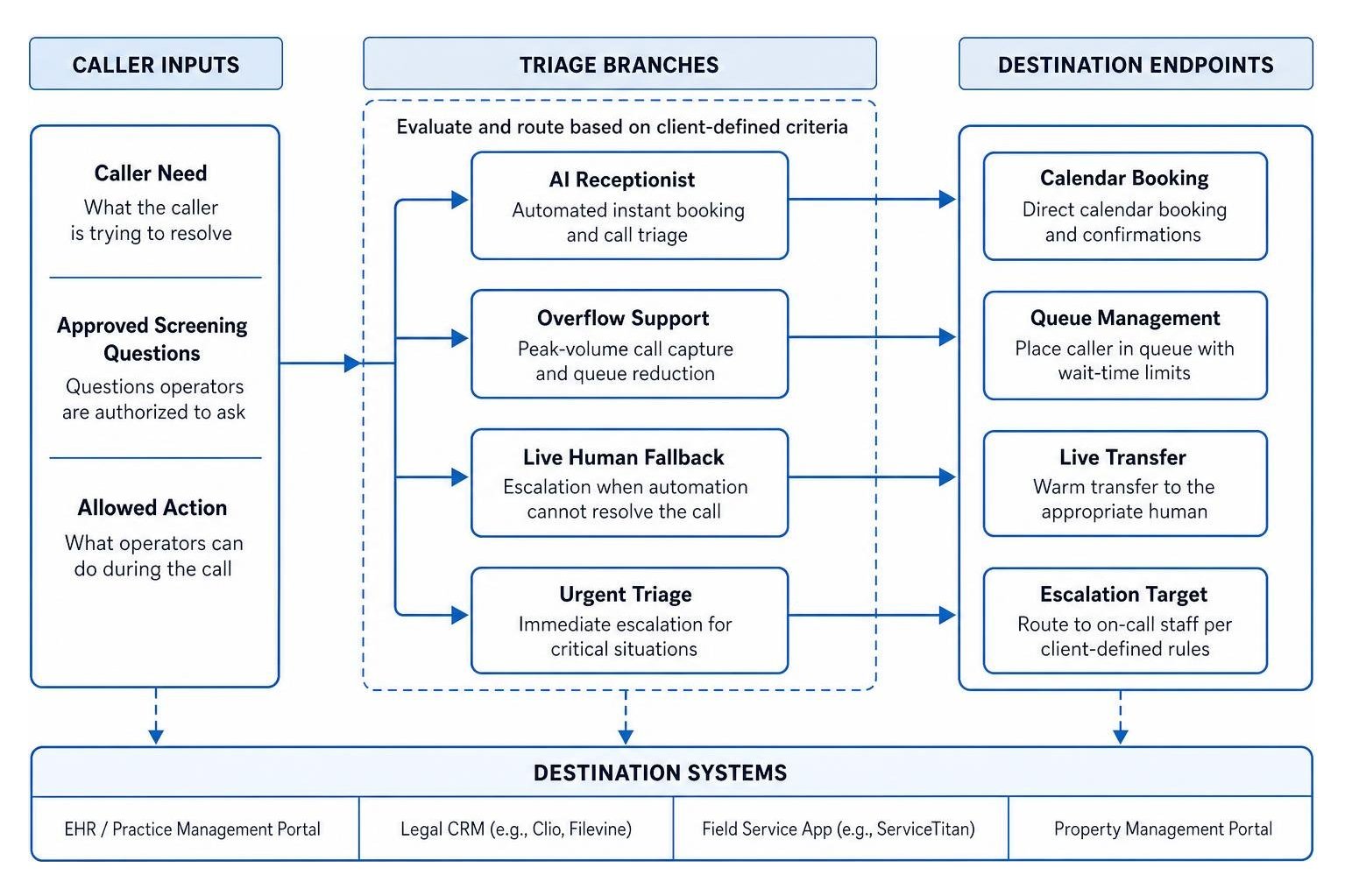
The table below illustrates how to present call handling specifications on industry landing pages:
Hypothetical non-sensitive call-handling example for an office equipment repair business:
| Caller situation | Approved questions | Allowed action | Escalation target | Destination system |
|---|---|---|---|---|
| Request service | Equipment type, postcode, and preferred callback time | Record the request only | Approved service coordinator | Approved ticket system |
| Existing booking | Booking reference | Transfer to authorized staff; if unavailable, record a callback request | Authorized staff member | Approved ticket system |
| Out-of-scope emergency | Only the details permitted by the client’s approved escalation policy | Do not diagnose or promise dispatch | Client-approved escalation contact | Approved ticket system or escalation record |
Why Is Transparent Pricing Structure Critical for B2B Buyer Conversion?
B2B buyers actively search for pricing terms before scheduling sales demos. If your pricing is hidden behind an obligatory contact form, decision-makers often bounce to competitors with transparent fee structures.
Use a clear worksheet to record how each provider packages billing, overages, and account setup. Ruby’s plans and pricing and FAQ overview are examples of the buyer questions and packaging details to review, not universal provider terms.
Use a clear pricing comparison matrix on your website to outline cost variables:
| Question to verify | Provider answer to record |
|---|---|
| Billing unit | |
| Included allowance | |
| Rounding, hold, and transfer time | |
| Overage charges | |
| Setup, scripting, and integrations | |
| Holiday charges | |
| Minimum term, renewal, and cancellation |
Working with our dedicated answering service SEO team can help turn verified commercial details into clearer pages for prospective buyers.
Measuring Pipeline Impact and Launching Your SEO Action Plan
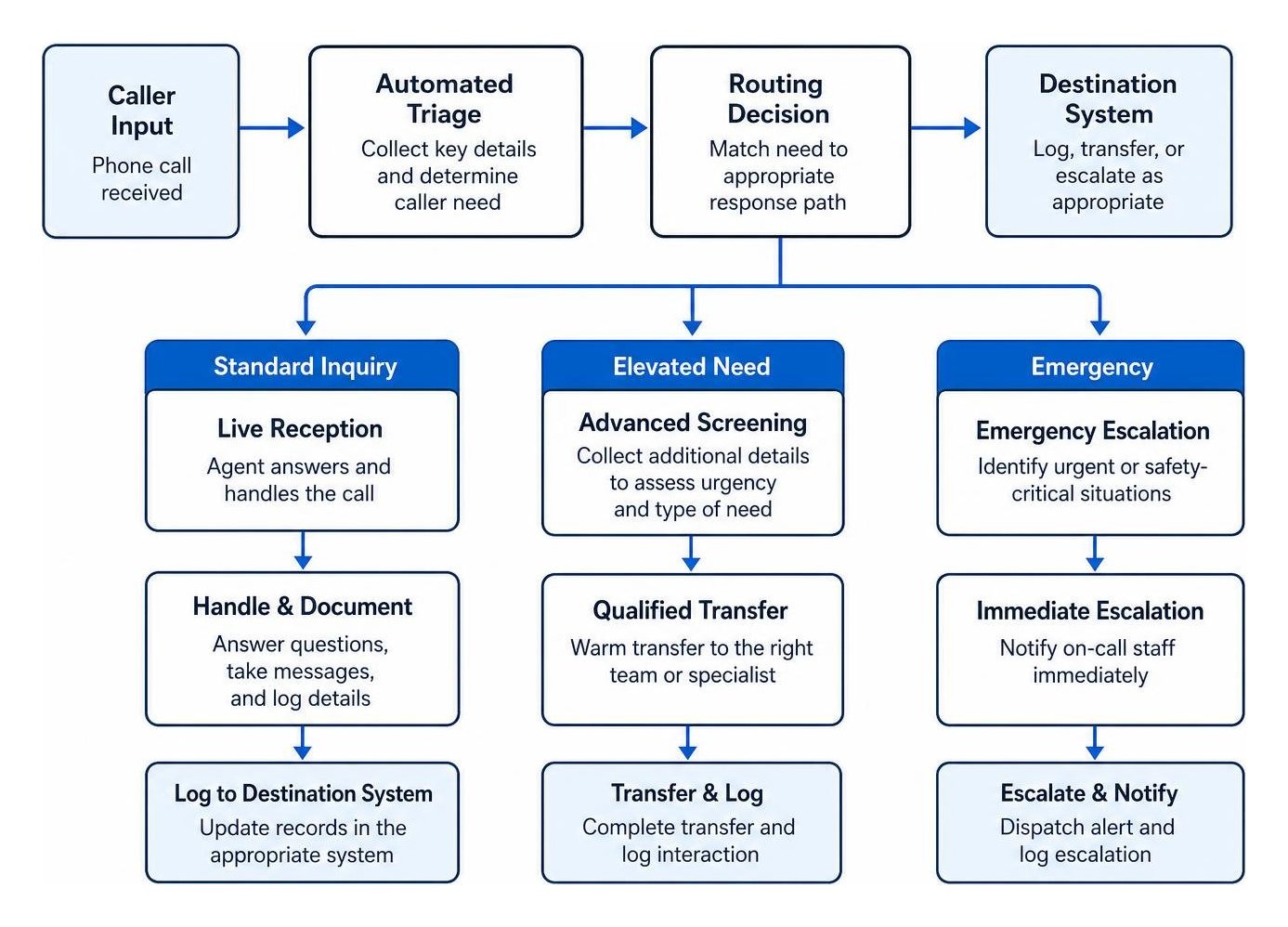
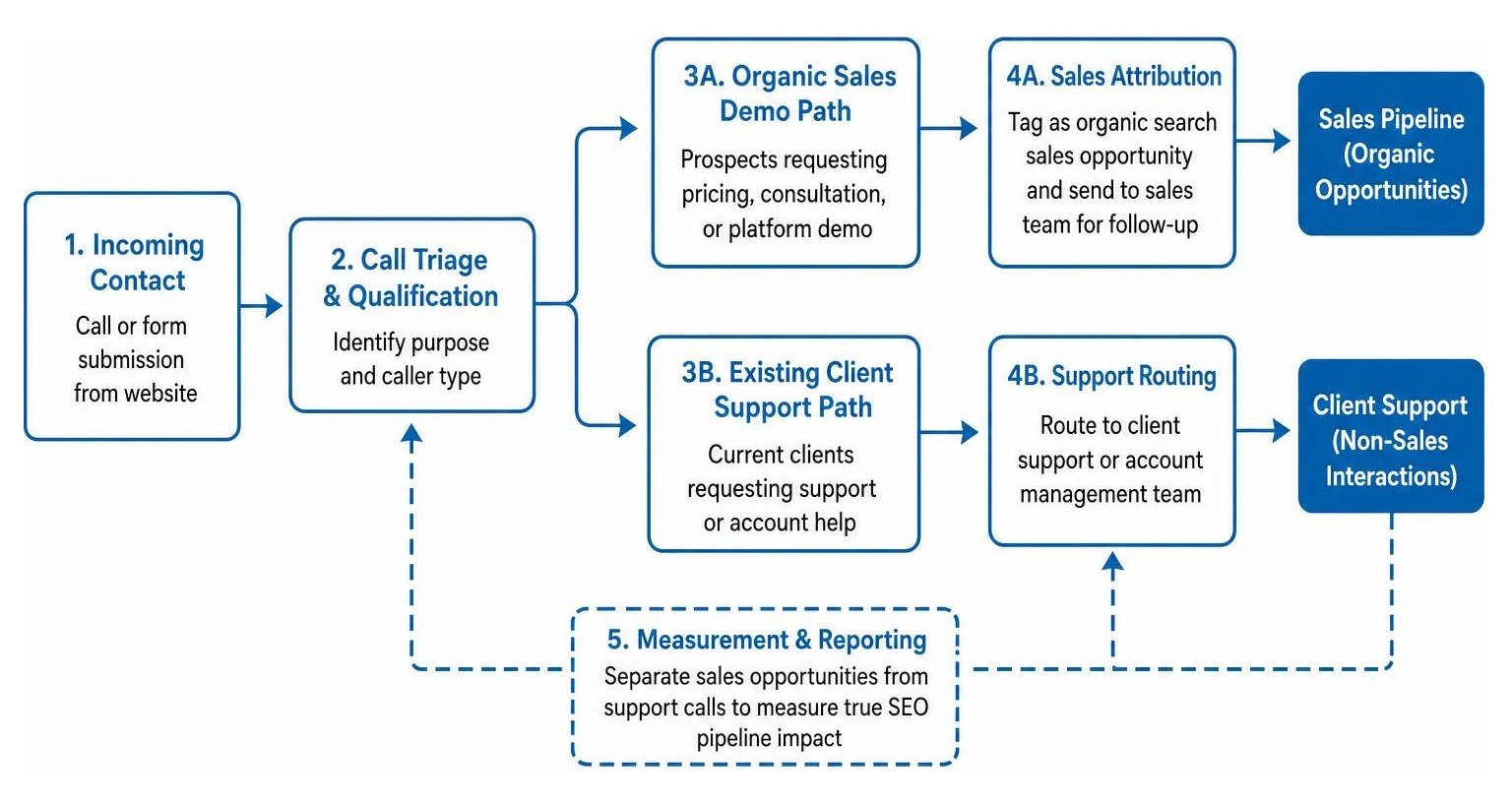
Measuring search success for answering services requires separating customer service inquiries and vendor spam from genuine sales opportunities. Tracking raw phone calls or form completions provides an incomplete picture if current clients use your main number for routine support.
Use call analytics and CRM fields to record the landing page, referral source, qualification outcome, and sales status for each inquiry. Attribution should be treated as directional unless the tracking setup can reliably connect the interaction to an organic visit. Obtain appropriate consent and follow applicable privacy requirements before recording calls or storing personal information.
Which metrics help evaluate results?
To prove the commercial return of your search campaigns, focus on pipeline health metrics:
- Qualified Sales Demo Volume: The number of decision-makers who meet target-account criteria and complete a consultation or platform demo.
- Customer Acquisition Cost (CAC): Relevant organic acquisition costs divided by customers attributed to organic search, with clear attribution limits documented.
- Revenue From Organic-Attributed Customers: Revenue associated with customers attributed to organic search. Revenue is not profit, so evaluate margin and retention separately where possible.
- Inbound Call Qualification Rate: The share of tracked search-generated phone calls that become genuine sales leads, measured separately from existing-client support and spam.
What Is the Prioritized Implementation Checklist to Get Started?
Transforming your answering service website into an organic lead engine requires a structured execution roadmap:
- Audit Technical Crawlability: Ensure search engine bots can access all core service URLs without script blocking or redirect loops.
- Consolidate Redundant Pages: Remove thin, duplicate city pages; replace them with authoritative regional hubs or national service pages.
- Build Core Service Clusters: Publish dedicated landing pages for live answering, AI receptionists, after-hours coverage, and overflow support.
- Publish Specialized Industry Pages: Detail real screening scripts, CRM integrations, and intake protocols for legal, medical, and trade sectors.
- Add Transparent Pricing Details: Provide clear information regarding billing increments, overages, onboarding fees, and cancellation terms.
- Implement Dynamic Call Tracking: Separate organic sales leads from existing customer service calls in your CRM reporting.
Scale Your Inbound Pipeline With Targeted Search Visibility
Capturing high-value answering service accounts requires transparent workflows, structured industry pages, and clear commercial pricing. Direct answers to prospective buyers can make pages more useful for evaluation and support qualified sales inquiries when the service, page, and tracking setup align.
Review our proven tailored SEO packages to see how we build high-converting search strategies, or schedule a technical discovery session to analyze your answering service website today.