SEO for Precast Concrete 101

How Does SEO for Precast Concrete Bring in Qualified Leads?
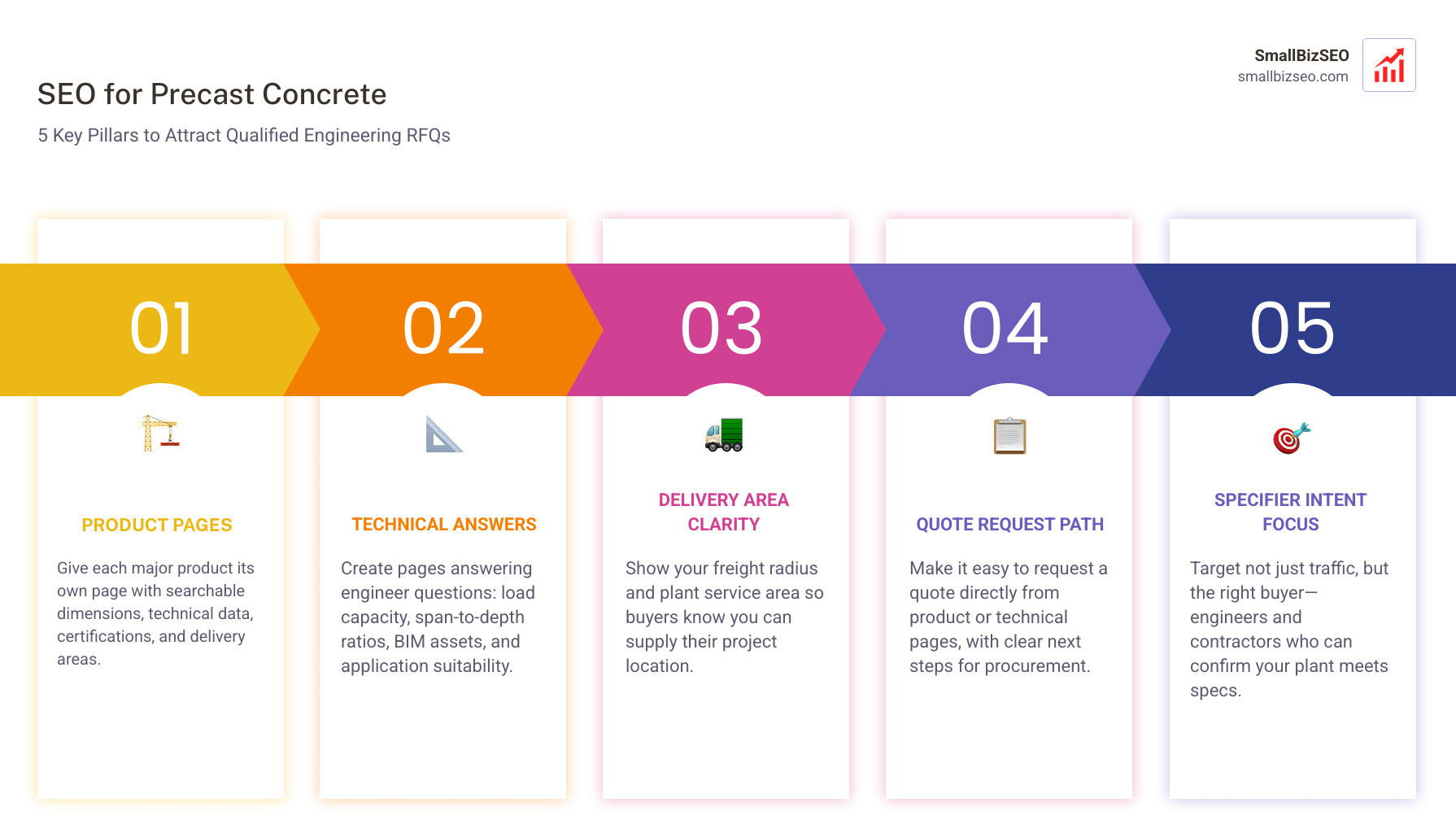
SEO for precast concrete starts with the products you make and the projects you can supply. Give each major product its own page with searchable dimensions, technical data, certifications, delivery areas, and a clear way to request a quote. Then create useful pages for the questions engineers and contractors ask, such as load capacity, applications, and available drawings.
This approach matters because a visitor looking for a specific component may be more valuable than hundreds of people browsing general concrete information. The goal is not just more traffic. It is to help the right buyer confirm that your plant can meet the project requirements and take the next step.
I'm Clayton Johnson, founder of SmallBizSEO. My work in technical SEO, content strategy, and link building shapes this guide to SEO for precast concrete, with a focus on making useful expertise easier to find and turning visibility into qualified inquiries.
SEO for precast concrete terms to learn:
Core Strategies in SEO for Precast Concrete Manufacturers
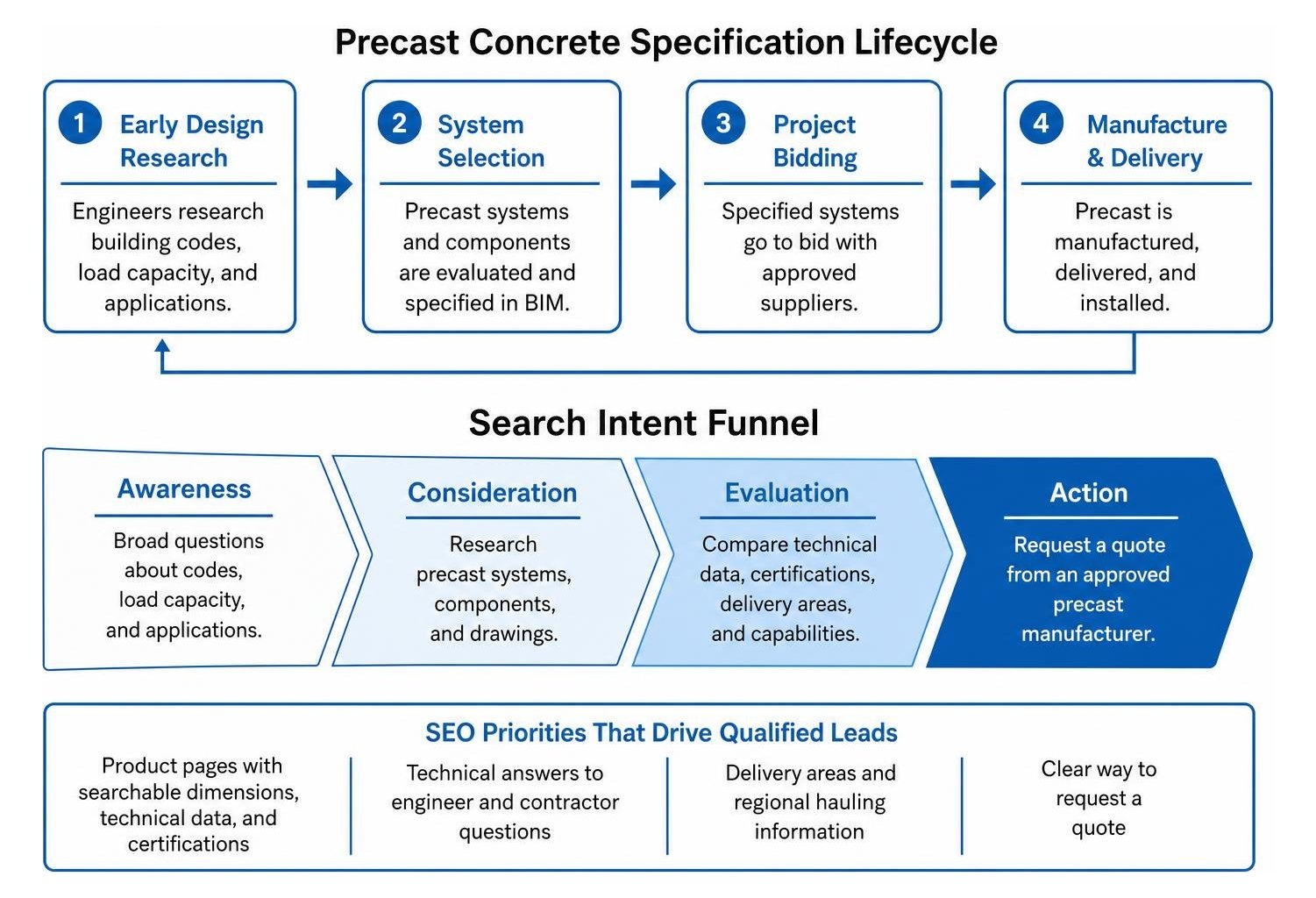
Direct answer: Precast concrete SEO requires intercepting two distinct audiences: structural specifiers researching technical building codes months before bid day, and general contractors sourcing approved components for immediate procurement. Success relies on structuring individual product pages, converting technical datasheets into indexable HTML, and optimizing for regional hauling limits.
Unlike consumer marketing, precast procurement features low search volume paired with six-to-seven-figure contract values. A query with only 40 monthly searches can generate substantial annual plant revenue if it reaches a commercial estimator or civil engineer. To capture this demand, precast manufacturers need comprehensive SEO services that connect technical production capability with commercial search intent.
Why Is Technical SEO for Precast Concrete Different from Standard B2B Marketing?
Direct answer: Technical SEO for precast concrete targets engineering decisions during the design development phase—often 12 to 24 months before concrete is poured—rather than immediate purchase orders.
In commercial construction, decisions follow a complex specification chain involving structural engineers, architects, general contractors, and precast specialty engineers. Once an engineer embeds a specific precast system into their Building Information Modeling (BIM) software, substituting that product at the tender stage becomes difficult.

When general contractors attempt value engineering during bidding, specifiers often reject changes that lack proven structural parity. Effective concrete marketing strategies support this process by publishing downloadable substitution defense guides and technical compliance sheets.
Additionally, optimizing request for quote (RFQ) forms with direct CAD and technical drawing upload fields can cut quotation turnaround times by multiple days, eliminating friction for busy estimators.
How Can You Optimize Product Catalogs, Load Tables, and BIM Assets for Specifiers?
Direct answer: Precast manufacturers must render technical data, span-to-depth ratios, and load tables directly in searchable HTML rather than locking them inside unindexed PDF files.
When structural engineers search for specific performance criteria—such as double tee load tables or hollow core slab spans—search engines cannot reliably extract structured tabular metrics from static PDF downloads. Converting this information into clean, mobile-responsive HTML tables allows search engines to index exact dimensions and load capacities.
| Content Asset Type | Traditional PDF Spec Sheet | Indexable HTML Technical Hub |
|---|---|---|
| Search Indexation | Poor; text buried in static document | Complete; readable text and table markup |
| Specifier Discoverability | Low organic visibility for long-tail sizes | High visibility for dimensional queries |
| BIM/CAD Integration | Detached manual downloads | Direct links to Revit, Tekla, and IFC models |
| Conversion Rate | Low (passive reading) | High (direct RFQ and engineering downloads) |
Manufacturers with BIM-ready precast families are specified 3.4x more often than those without digital assets. Aligning your product pages with recognized standards—such as ACI 318, PCI MNL-116, BS EN 1168, and Eurocode 2, along with state DOT approved precast concrete standards—validates structural compliance. Partnering with a specialized precast concrete SEO company ensures these technical assets are structured correctly for both specifiers and search engine algorithms.
What Keyword Patterns and Technical Architecture Drive Engineering RFQs?
Direct answer: Engineering RFQs are driven by long-tail keyword combinations that combine specific precast product names, technical dimensions, manufacturing processes, and structural building codes.
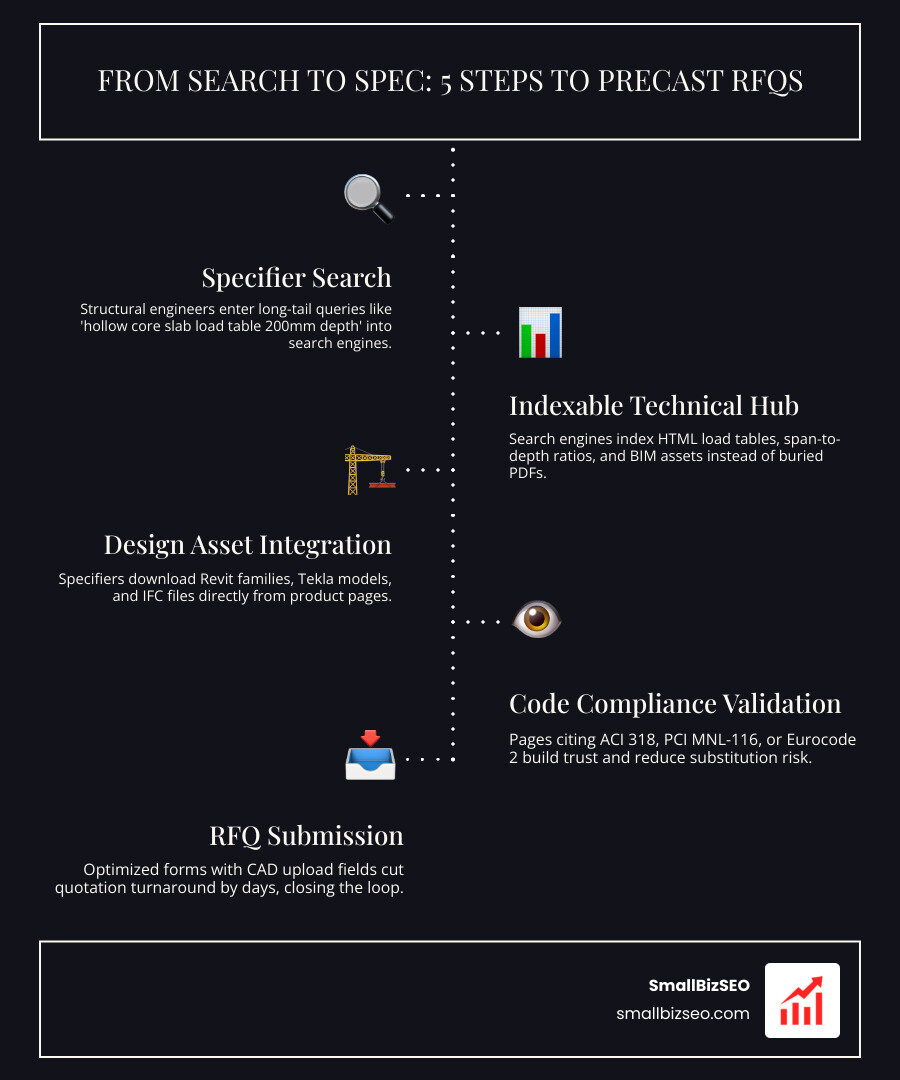
High-intent commercial queries typically follow structured patterns:
- Product and Dimension: [Product] + load table + [dimension] (e.g., hollow core slab load table 200mm depth)
- Design Asset Intent: [Product] + BIM Revit family / CAD detail
- Specification and Code: [Product] + ACI 318 compliance / ASTM C913
- Procurement and Supply: Precast utility vault manufacturer + [service area]
To maximize topical authority, organize your website using a hub-and-spoke architecture. The central hub represents the core product family (such as structural drainage systems), linking out to dedicated child pages for catch basins, box culverts, and manholes.
Implement advanced JSON-LD structured data—specifically Product, TechArticle, and Organization schema—to help search engines interpret production capabilities. When working alongside a concrete contractor SEO company or updating existing product catalogs, ensure 1-to-1 301 redirect mapping is executed to protect accumulated search equity.
How Do You Master Regional and Local SEO for Precast Concrete Plants?
Direct answer: Precast regional SEO focuses on capturing commercial demand within a plant's profitable hauling radius while optimizing for municipal infrastructure requirements.
Because precast concrete elements are heavy physical goods, freight logistics and transportation costs define a plant's geographic market. A standard local SEO program for precast manufacturers requires dedicated service area pages that reflect genuine plant delivery capabilities, dispatch logistics, and verified regional project case studies.
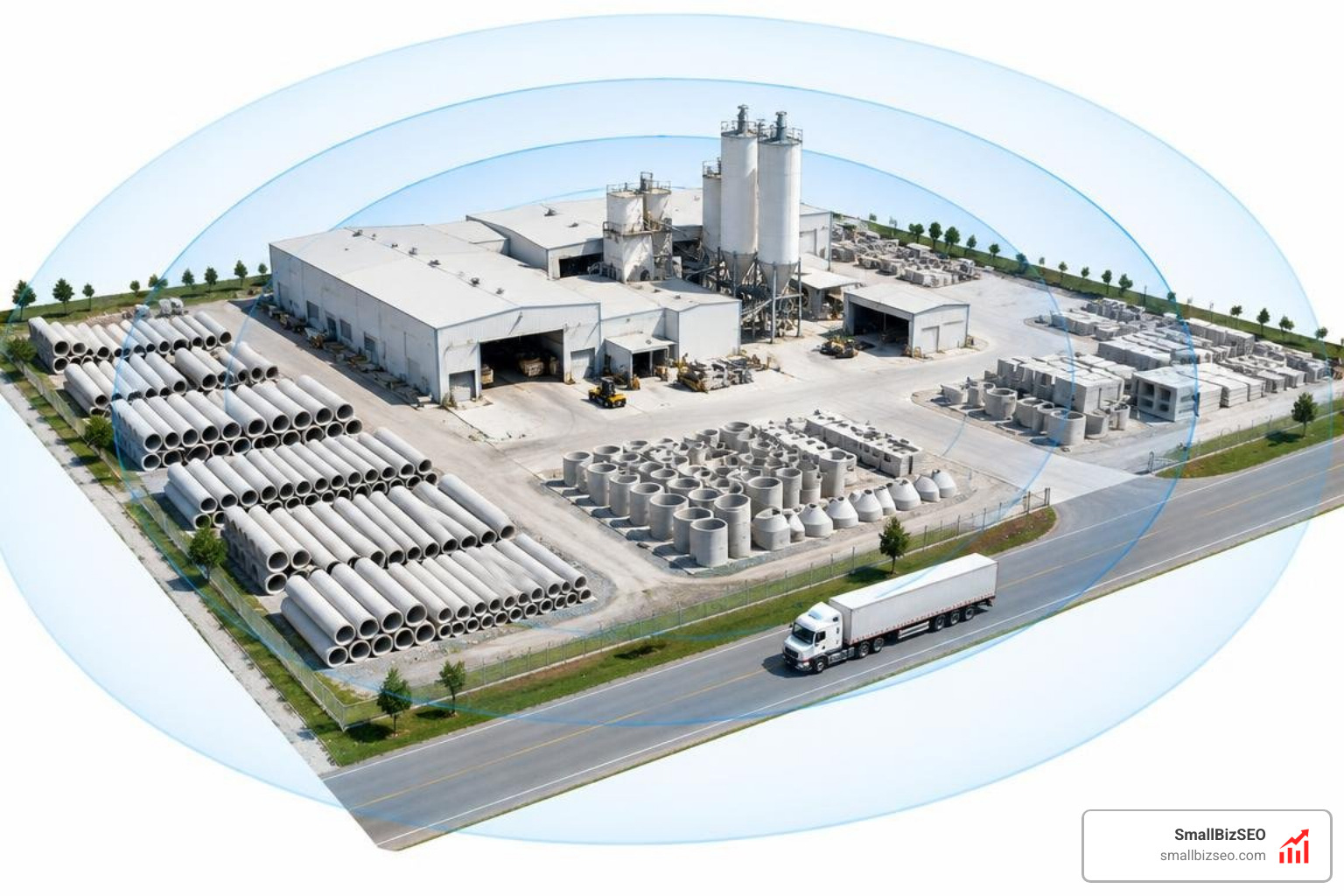
Optimize Google Business Profiles for every physical casting yard, ensuring categories accurately reflect manufacturing operations rather than retail supply. Align location landing pages with municipal utility specifications and regional civil standards to capture commercial contractors bidding on local infrastructure projects.
How Can Precast Manufacturers Capture AI Search and Answer Engines?
Direct answer: Precast plants capture AI search visibility by publishing unambiguous technical facts, explicit structural tolerances, and verified quality certifications in structured formats.
Modern answer engines and AI search overviews extract concise, authoritative data to answer complex engineering queries. To appear in AI-generated answers:
- Define clear product capabilities, concrete compressive strengths (PSI or MPa), and batch capacities directly in on-page text.
- Feature plant-level accreditations prominently, including National Precast Concrete Association (NPCA) and Precast/Prestressed Concrete Institute (PCI) certifications.
- Conduct subject matter expert interviews with plant managers and quality control engineers to publish real-world installation tolerances and technical answers that standard keyword tools overlook.
Transform Your Plant's Inbound Project Pipeline
Direct answer: Scaling an inbound precast pipeline requires moving away from generic vanity traffic metrics and measuring success through qualified engineering RFQs, submittal downloads, and closed supply contracts.
A data-driven SEO strategy ensures your precast components are discovered during early design modeling and final contractor bidding. At SmallBizSEO, our data-driven "Velocity" framework combines technical site architecture, standards-aligned content development, and high-authority link acquisition to secure sustainable organic growth.
If your plant is ready to capture high-value infrastructure and commercial specifications, claim your free SEO visibility audit to identify your top organic growth opportunities.