Concrete Marketing Strategies to Pour More Organic Leads into Your Pipeline

How Can SEO Help Concrete Contractors Get More Leads?
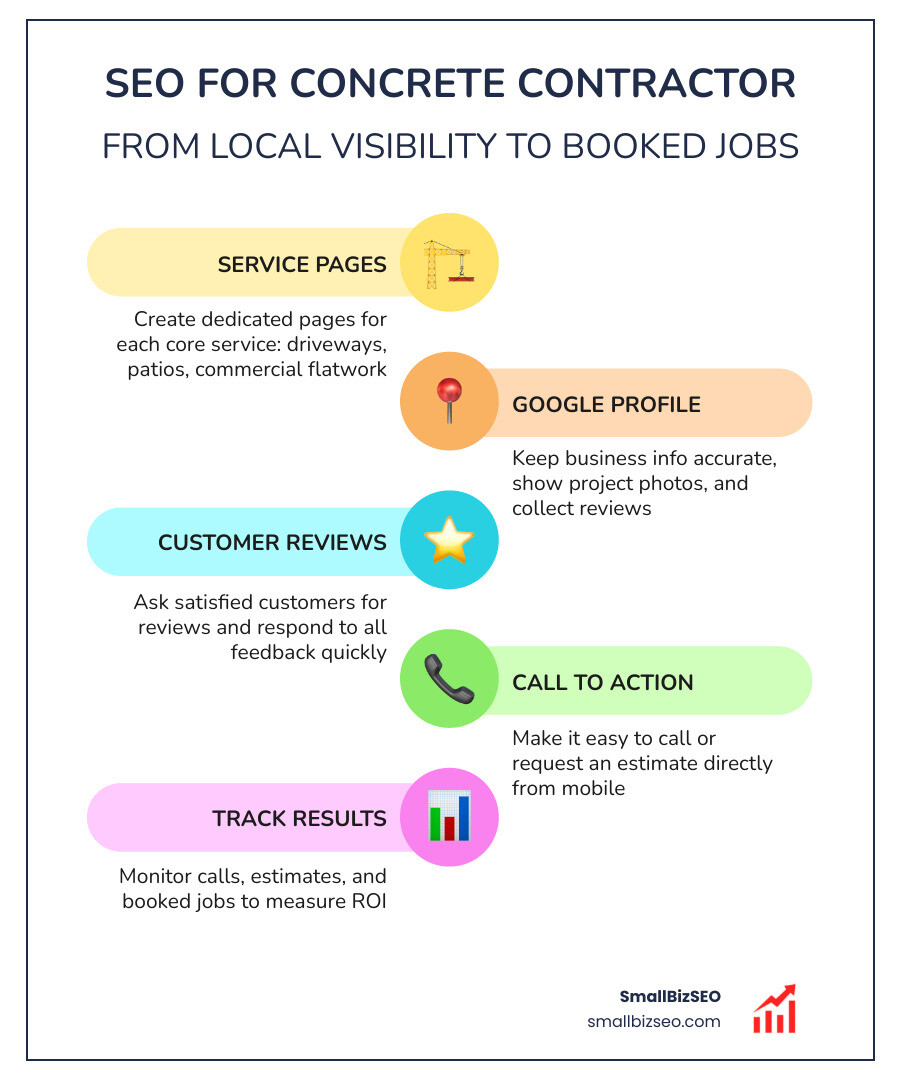
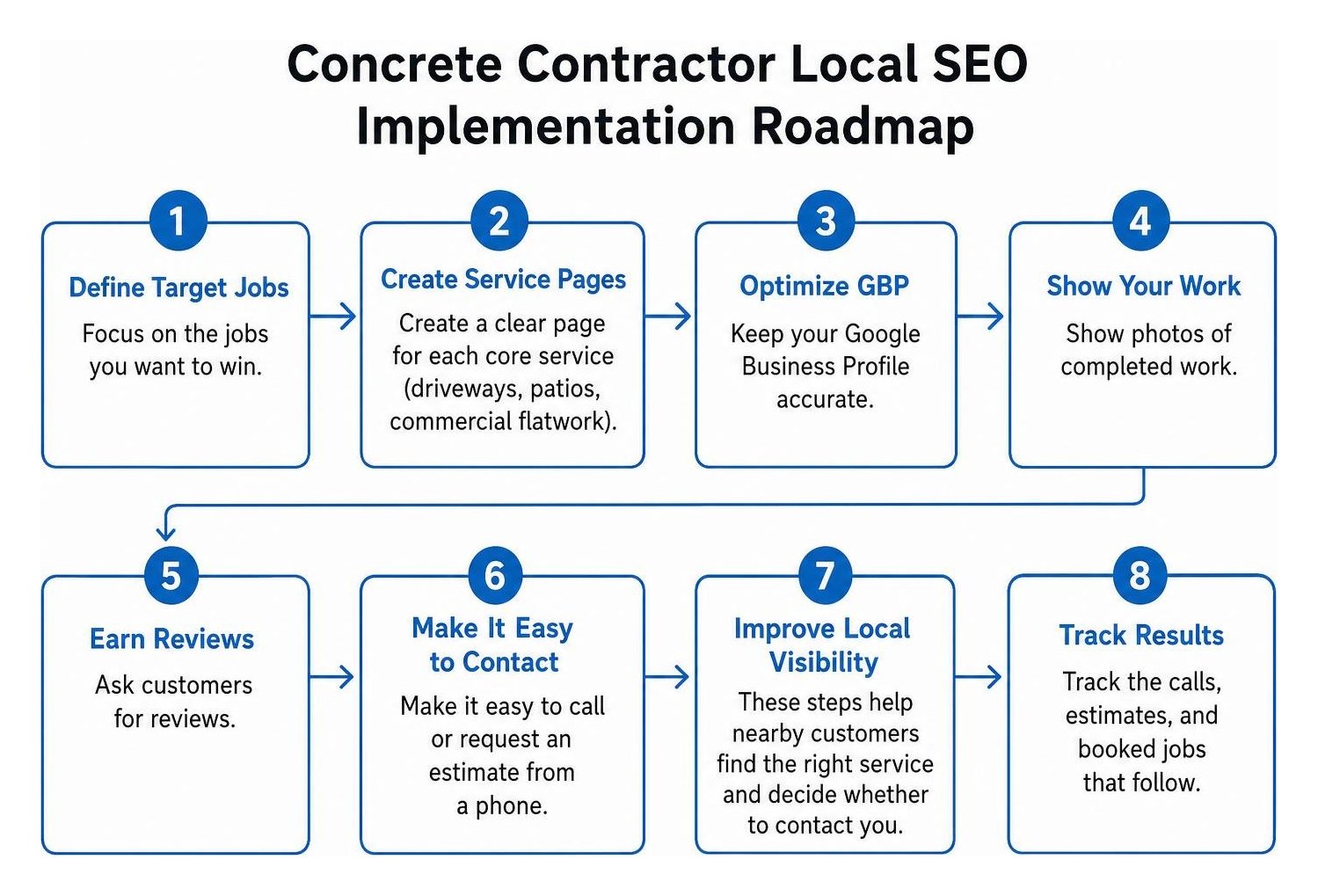
SEO for a concrete contractor starts with the jobs you want to win. Create a clear page for each core service, such as driveways, patios, or commercial flatwork. Keep your Google Business Profile accurate, show photos of completed work, ask customers for reviews, and make it easy to call or request an estimate from a phone.
These steps help nearby customers find the right service and decide whether to contact you. This guide shows how to improve your local visibility and track the calls, estimates, and booked jobs that follow.
I’m Clayton Johnson, founder of SmallBizSEO. My work in technical SEO, content strategy, and link building shapes this practical approach to SEO for concrete contractor websites.
Basic SEO for concrete contractor vocab:
- SEO for basement waterproofing & foundation repair
- SEO for drywall & plastering specialists
- SEO for steel buildings
Proven Blueprint: SEO for Concrete Contractor Growth

SEO for a concrete contractor works by capturing property owners the moment they look for masonry, flatwork, foundation, or paving services. While 84% of homeowners use search engines before choosing a local tradesperson, only 15% of construction firms have fully adopted a modern digital marketing strategy. This gap gives proactive contractors a clear path to market leadership.
Search engines connect search intent with the most relevant local providers. Because 93% of search queries with local intent show a 3-Pack at the top of the page, your web presence must satisfy both organic algorithms and map listings. When you align technical performance with localized authority, your search visibility turns into actual pour jobs.
How Can Contractors Optimize Google Business Profile for the Local 3-Pack?
To dominate the Google Map Pack, concrete companies must treat their Google Business Profile (GBP) as a dynamic lead generation engine. Google Business Profile signals represent approximately 32% of local pack ranking weight, making accurate profile optimization essential.
- Choose the Right Primary Category: Set your primary category to "Concrete Contractor." Add relevant secondary categories such as "Driveway Contractor," "Paving Contractor," or "Foundation Contractor."
- Maintain Strict NAP Consistency: Ensure your business Name, Address, and Phone number match exactly across the web. Businesses maintaining consistent contact details are 40% more likely to rank high in map results.
- Upload Real Job Photos Regularly: Publish high-resolution images of active job sites, stamping textures, and cured concrete slabs. Geo-tagged project photos confirm your actual service boundaries to search engines.
- Drive Consistent Review Velocity: Businesses appearing in the top 3-pack capture 93% more customer actions such as calls and direction requests. Systematic review requests sent right after project completion build trust and authority.
- Respond to Every Customer Review: Approximately 88% of consumers prefer companies that answer all customer reviews. Responding with specific service names and project details reinforces your keyword relevance.
To master these map signals, review our actionable strategies for local SEO map visibility alongside our structured optimizing for local search blueprint.
What Are the Essential On-Page Strategies in SEO for a Concrete Contractor?
On-page SEO structures your website so search crawlers and prospective clients immediately understand your exact services and service areas.
- Build Dedicated Service Pages: Never group all your offerings onto a single generic page. Build separate, comprehensive pages for concrete driveways, decorative stamped patios, foundation pours, commercial flatwork, and concrete resurfacing.
- Implement Clear Heading Hierarchies: Use a single H1 tag matching the page target, supported by H2 and H3 tags answering common customer questions regarding materials, timelines, and costs.
- Apply Location-Specific Content: Create unique landing pages for the towns where you pour concrete. Avoid duplicate templates; include authentic neighborhood details, local building requirements, and specific project examples.
- Add Descriptive Image Alt Text: Search engines cannot interpret raw image files without guidance. Label every project photo with descriptive alt tags, such as "stamped concrete patio installation with slate finish."
- Implement Structured Data: Use LocalBusiness, Service, and FAQ schema to help search engines extract your service types, operational hours, and ratings directly into search snippets.
Applying proven on-page SEO techniques paired with a step-by-step schema markup implementation ensures every page on your site earns maximum organic visibility.
How Do Local Citations and Authoritative Backlinks Outrank Competing Directories?
Large national directories often claim the top positions for broad terms because of their high domain authority. However, an independent concrete contractor can outrank these directories for local, high-intent searches by building targeted local backlinks and citations.
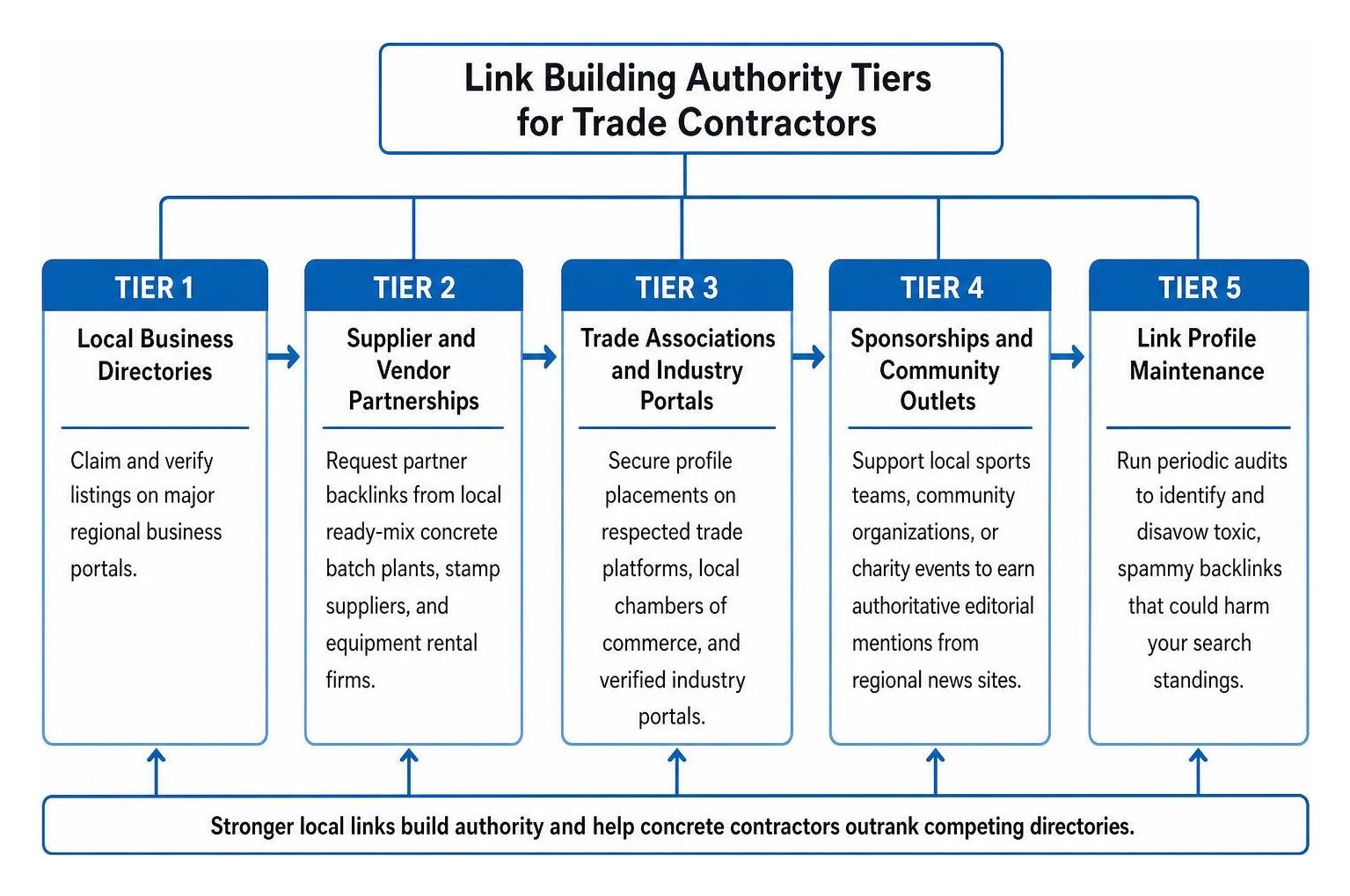
- Local Business Directories: Claim and verify listings on major regional business portals, maintaining identical NAP information across every entry.
- Supplier and Vendor Partnerships: Request partner backlinks from local ready-mix concrete batch plants, decorative stamp suppliers, and equipment rental firms.
- Trade Associations and Industry Portals: Secure profile placements on respected trade platforms, local chambers of commerce, and verified construction industry agency directories.
- Sponsorships and Community Outlets: Support local sports teams, community organizations, or charity events to earn authoritative editorial mentions from regional news sites.
- Link Profile Maintenance: Run periodic audits to identify and disavow toxic, spammy backlinks that could harm your search standings.
By leveraging targeted backlink building strategies, your website builds real, sustainable authority that search engines reward with top organic placements.
High-Converting Content, Search Technology, and Performance Tracking

Generating website traffic is only valuable if that traffic converts into calls and scheduled estimates. Because 76% of people conducting a local search on a smartphone visit a related business within 24 hours, your website must be fast, mobile-responsive, and simple to navigate. Since 53% of mobile visitors leave pages that take longer than three seconds to load, technical optimization directly preserves your marketing budget.
What Is the Difference Between Commodity and Non-Commodity Content for Concrete Work?
Content marketing builds topical authority, but the type of content you publish determines your conversion rate. Commodity content answers broad informational questions, while non-commodity content proves your craftsmanship and directly closes deals.
| Feature | Commodity Content | Non-Commodity Content |
|---|---|---|
| Primary Focus | General educational answers (e.g., concrete curing times) | Tangible proof of work (e.g., neighborhood case studies) |
| Search Intent | Informational research | Commercial and transactional intent |
| Asset Types | Blog articles, basic DIY explanations, generic FAQs | Before-and-after galleries, detailed job pricing breakdowns |
| Conversion Rate | Moderate to low immediate conversions | High direct estimate and consultation requests |
| Key Benefit | Establishes broad search authority and topical reach | Eliminates buyer hesitation and validates craftsmanship |
Small businesses that publish strategic content regularly achieve 126% higher lead growth than non-publishing competitors. Contractors using dedicated content marketing report average gross margins of 26%, compared to 20% for those who rely entirely on word of mouth or paid ads. Explore our complete home services SEO growth tactics to structure your content assets for maximum return.
How Do Voice Queries and AI Search Change SEO for Concrete Contractors?
AI search engines and conversational voice assistants are changing how homeowners locate tradespeople. Search platforms now synthesize direct answers from across the web rather than simply providing a list of links.
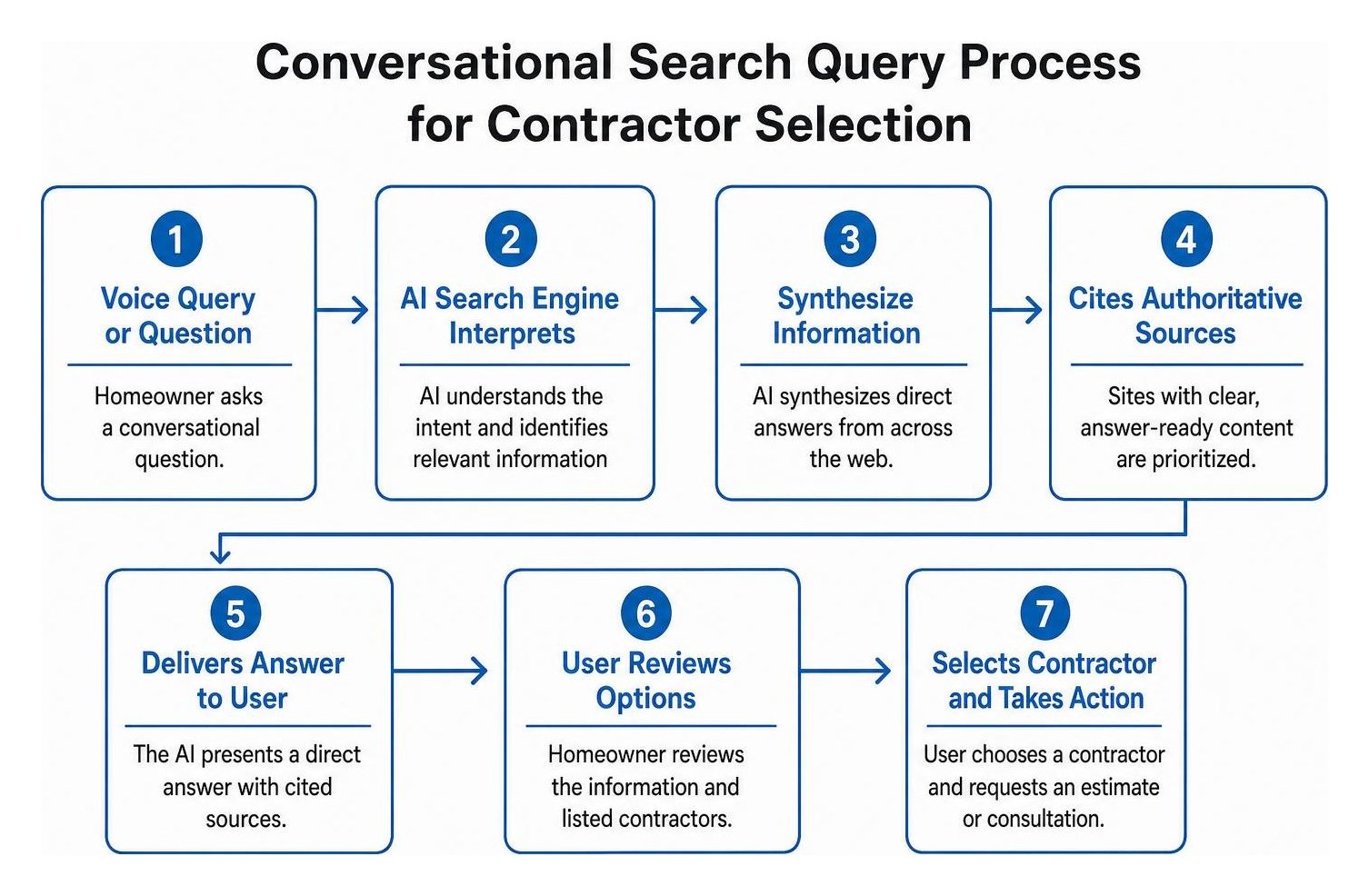
- Answer-Ready Formats: Provide clear, direct answers within the first two sentences of each service section. AI engines prioritize straightforward summaries when answering user questions.
- Target Long-Tail Conversational Queries: Voice searches sound conversational, such as "Who is the best contractor to replace a cracked driveway near me?" Targeting these longer phrases captures high-converting searchers, as long-tail queries convert at 36%—roughly 2.5 times higher than broad terms.
- Publish Clear Pricing Guidance: When property owners ask conversational assistants for typical concrete installation costs, sites with transparent pricing tables and cost calculators get cited as authoritative sources.
- Conduct AI-Focused Audits: Apply advanced AI SEO audit strategies to ensure your technical foundation and schema structures feed clean data to generative search platforms.
How Should Concrete Companies Track SEO ROI and Manage Monthly Marketing Costs?
Managing SEO performance requires measuring business results rather than vanity metrics. Instead of focusing solely on impressions or broad keyword rankings, monitor the direct commercial metrics that impact your business.
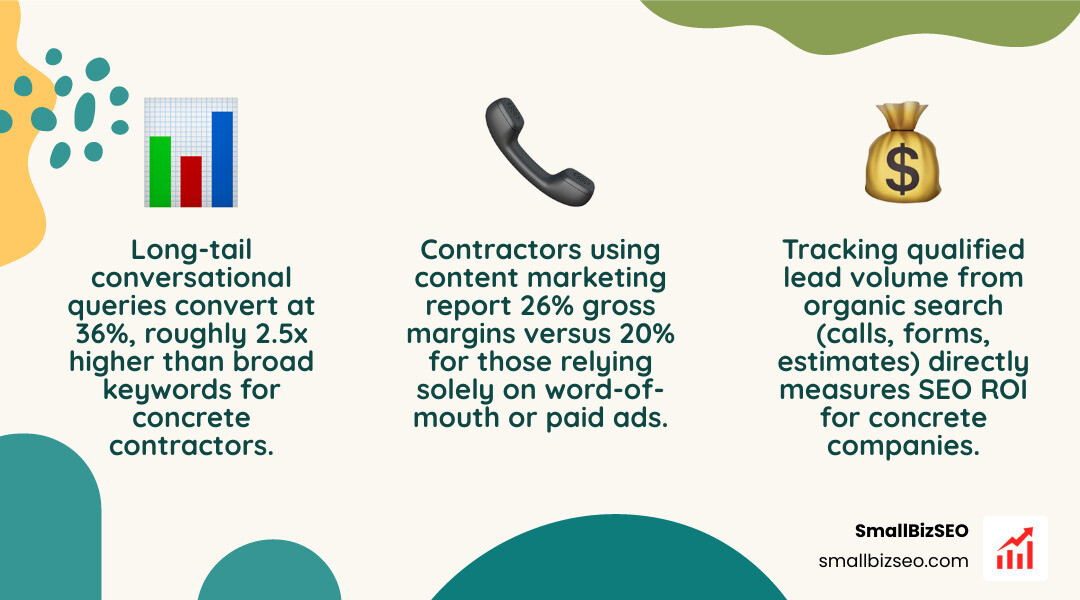
- Qualified Lead Volume: Track incoming phone calls, completed consultation forms, and instant estimate submissions generated through organic search.
- Cost Per Qualified Lead (CPL): Calculate total marketing spend divided by total organic inquiries to compare organic efficiency against paid advertising.
- Search Console Performance: Evaluate click-through rates and high-intent impressions across your individual service and town pages.
- Conversion Tracking: Monitor user actions on high-value landing pages using web analytics goals.
Contractors can track their pipeline by monitoring essential monthly SEO metrics and calculating returns with our SEO ROI calculator.
Typical monthly professional SEO retainers for trade contractors generally range from $1,500 to $4,000 per month depending on market competition and geographic scope. At SmallBizSEO, we use our proprietary, data-driven Velocity framework to deliver rapid search visibility, E-E-A-T compliance, and transparent automated reporting. Explore our tailored SEO packages to build a sustainable pipeline of high-margin concrete projects.
Turn Search Visibility into Booked Pours
Winning high-value concrete jobs requires a complete digital foundation. By pairing an optimized Google Business Profile with structured service pages, authentic visual project galleries, and verified local backlinks, your company establishes clear market authority. Consistent local optimization keeps your crews booked with profitable driveway, patio, flatwork, and commercial concrete projects throughout the entire pouring season.