Small Biz SEO 101: Learn Local SEO Basics
Small Biz SEO 101: Learn Local SEO Basics
Why Small Biz SEO Is Essential for Local Search Visibility
Here is the rest of the guide:
Search engine optimization allows your company to capture nearby commercial intent right when prospective buyers are ready to make a purchase. Instead of paying for every single click through digital ads, organic visibility creates a predictable, 24/7 lead generation engine that runs quietly in the background.
With Google processing over 9.5 million searches every minute, showing up in relevant search queries directly impacts your bottom line. Investing in search visibility builds compounding digital equity—unlike paid ad campaigns that stop delivering leads the second you turn off your daily budget. Combining on-page targeting with local SEO optimization and small business growth ensures your brand remains visible whenever nearby consumers search for the exact solutions you offer.
What Is the Difference Between Local SEO and Small Biz SEO?
Local SEO focuses on ranking within a specific geographic territory and appearing in map results, whereas general small business SEO targets broader organic queries that may span regional or national audiences.
If your enterprise relies on customers visiting an office or needs technicians dispatched to local homes, local search optimization is your primary growth channel. If you ship physical goods nationwide or offer purely digital consulting services, broader organic SEO targets informational and non-geocoded transactional keywords.
| Strategy Dimension | Local SEO | Broader Small Biz SEO |
|---|---|---|
| Primary Goal | Rank in Google Map Packs and local map searches | Rank in standard global or national organic results |
| Geographic Scope | Strict radius around physical location or service area | Regional, national, or global |
| Core Ranking Asset | Google Business Profile, citations, and geo-signals | Comprehensive content, site architecture, and backlinks |
| Keyword Profile | "Service + City" or "Near me" queries | Broad industry questions, guides, and commercial terms |
| Conversion Focus | Phone calls, driving directions, and local quote requests | Online sales, lead magnet downloads, and consultation forms |
How Does Google Decide Which Local Businesses to Rank?
Google determines local search rankings by analyzing three foundational pillars: relevance, distance, and prominence.
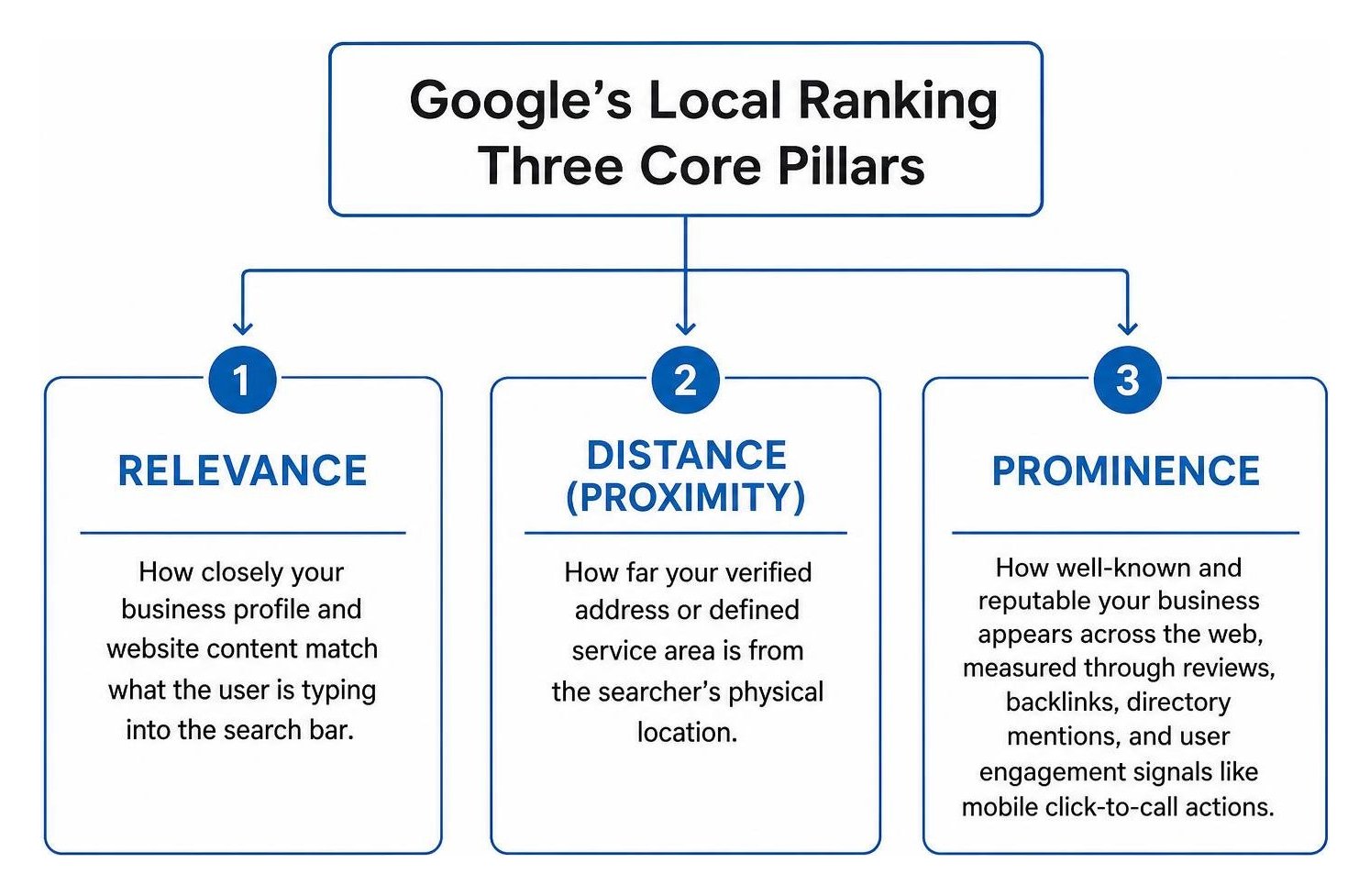
- Relevance: How closely your business profile and website content match what the user is typing into the search bar.
- Distance (Proximity): How far your verified address or defined service area is from the searcher's physical location.
- Prominence: How well-known and reputable your business appears across the web, measured through review volume, backlink authority, directory mentions, and user engagement signals like mobile click-to-call actions.
How Do You Set Up and Optimize Your Google Business Profile?
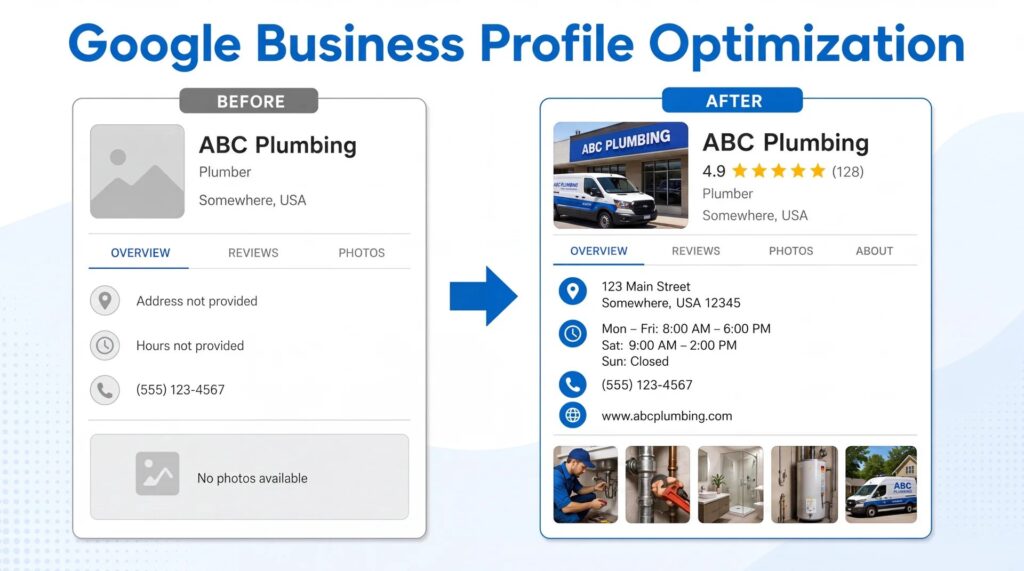
Claiming and completely filling out your Google Business Profile (GBP) is the single fastest way to gain visibility in local map results. Businesses with complete Google Business Profiles are 70% more likely to attract physical location visits from prospective customers.
To optimize your profile for maximum map visibility:
- Choose the exact primary category: Pick the primary category that most precisely describes your core offering, then add relevant secondary categories.
- Define your service areas: Specify the exact neighborhoods, towns, or postal codes you serve.
- Write a compelling business description: Use your top search terms naturally while clearly stating what makes your services stand out.
- Upload authentic imagery: Add high-resolution photos of your workspace, team, and recent projects rather than generic stock imagery.
- Keep operational details current: Ensure your hours, holiday schedules, and website URLs are always accurate.
How Should You Coordinate Local NAP Citations Across the Web?
Your business Name, Address, and Phone number (NAP) must be identical across every online directory, social profile, and industry registry. Inconsistent contact details confuse search engine algorithms and weaken your local ranking signals.
Start by auditing your core data on major aggregators and premier platforms like Yelp, Apple Maps, Bing Places, and the Better Business Bureau. Identify and merge duplicate listings, update old phone numbers or suite details, and ensure trade-specific directories showcase the exact same address format used on your verified map profile.
How Do Customer Reviews and Q&A Impact Map Rankings?
Customer reviews provide search engines with fresh user-generated content and strong credibility signals, while directly influencing potential clients. A steady stream of genuine, keyword-rich customer feedback improves your map pack rankings and increases click-through rates.
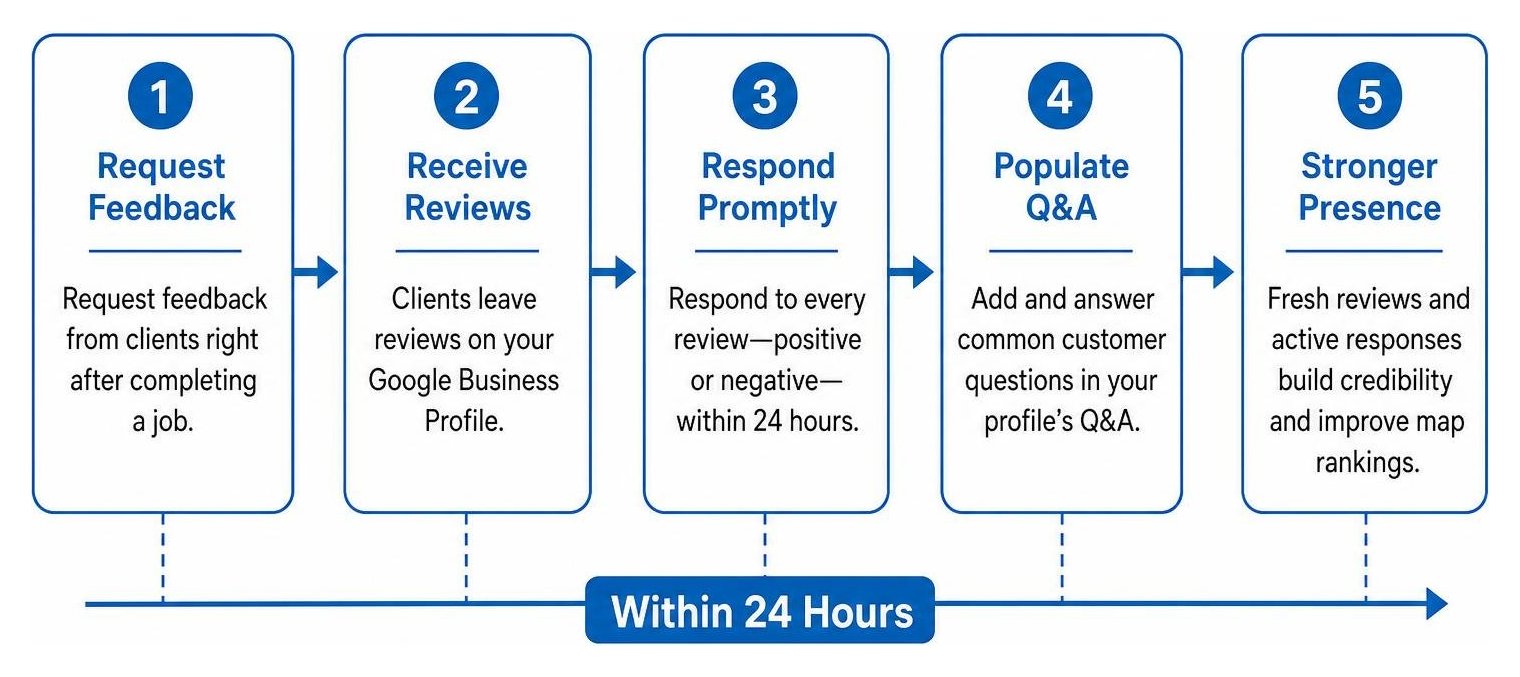
Request feedback from clients right after completing a job. Make it a routine practice to respond to every review—positive or negative—within 24 hours. Additionally, populate your profile's public Q&A section with answers to common customer questions to remove friction before a prospect picks up the phone.
What Website and On-Page Elements Should You Prioritize First?
Your website serves as the anchor for all your local optimization efforts, requiring a fast, error-free technical foundation before you start publishing new pages.
Prioritize these core technical and on-page fixes:
- Mobile-First Experience: Ensure pages load in under 3 seconds on mobile devices with easy-to-tap phone numbers.
- Structured Data (Schema): Implement
LocalBusinessJSON-LD schema markup on your homepage and service pages to explicitly define your business type, address, hours, and service radius to search engines. - Indexation Health: Check that canonical tags point to primary URLs and submit an error-free XML sitemap through Google Search Console.
- Internal Linking: Use clear, descriptive anchor text to connect related service offerings and service-area pages back to your main navigation.
What Content Should You Produce to Drive Local Conversions?
Create dedicated landing pages for each primary service you offer rather than listing all your capabilities on a single generic page. When you stop posting and start ranking with this small business content strategy, you focus on producing conversion-focused commercial pages instead of publishing endless unfocused blog posts.
Demonstrate real-world Experience, Expertise, Authoritativeness, and Trustworthiness (E-E-A-T) by embedding original project photographs, case summaries, licensing information, and direct customer reviews onto every commercial landing page.
Which Link-Building Tactics Are Worth a Small Business's Time?
Small businesses should focus on earning high-quality, geographically relevant backlinks from community partners rather than pursuing generic directory links or risky link networks. Research shows the number one ranking page in search results often has nearly four times more backlinks than competitors lower on the page, making quality link acquisition a key differentiator.
Valuable local link-building tactics include:
- Earning links from your local suppliers, vendors, and trade distributors.
- Joining your local chamber of commerce or regional business associations.
- Sponsoring community sports teams, charity events, or civic initiatives.
- Providing expert quotes to local news outlets and regional journalists.
How Should You Execute Your Strategy and Track Progress?
Measure search progress by tracking tangible business metrics—such as phone calls, completed consultation forms, and revenue from organic visitors—rather than obsessing solely over fluctuating keyword positions.
Set up Google Search Console to monitor search impressions, average rankings, and technical site health. In Google Analytics (GA4), configure conversion events for phone number clicks and form submissions. If you are operating on a budget, exploring affordable SEO for small business allows you to balance essential tool investments with high-impact organic optimization.
Should You Hire an Agency or Do SEO Yourself?
Small business owners can handle foundational SEO tasks internally, but delegating to a specialist makes sense when technical hurdles, advanced link acquisition, and content production demand more time than your team can spare.
When comparing the best small business SEO company, avoid low-cost retainers that promise guaranteed overnight page-one rankings or rely on automated spam tactics. Reputable partners provide clear scopes of work, transparent tracking dashboards, and strategies aligned directly with your business goals.
How to Build a 30-Day Small Biz SEO Action Plan
A structured 30-day plan helps you make rapid improvements without getting overwhelmed by technical jargon.
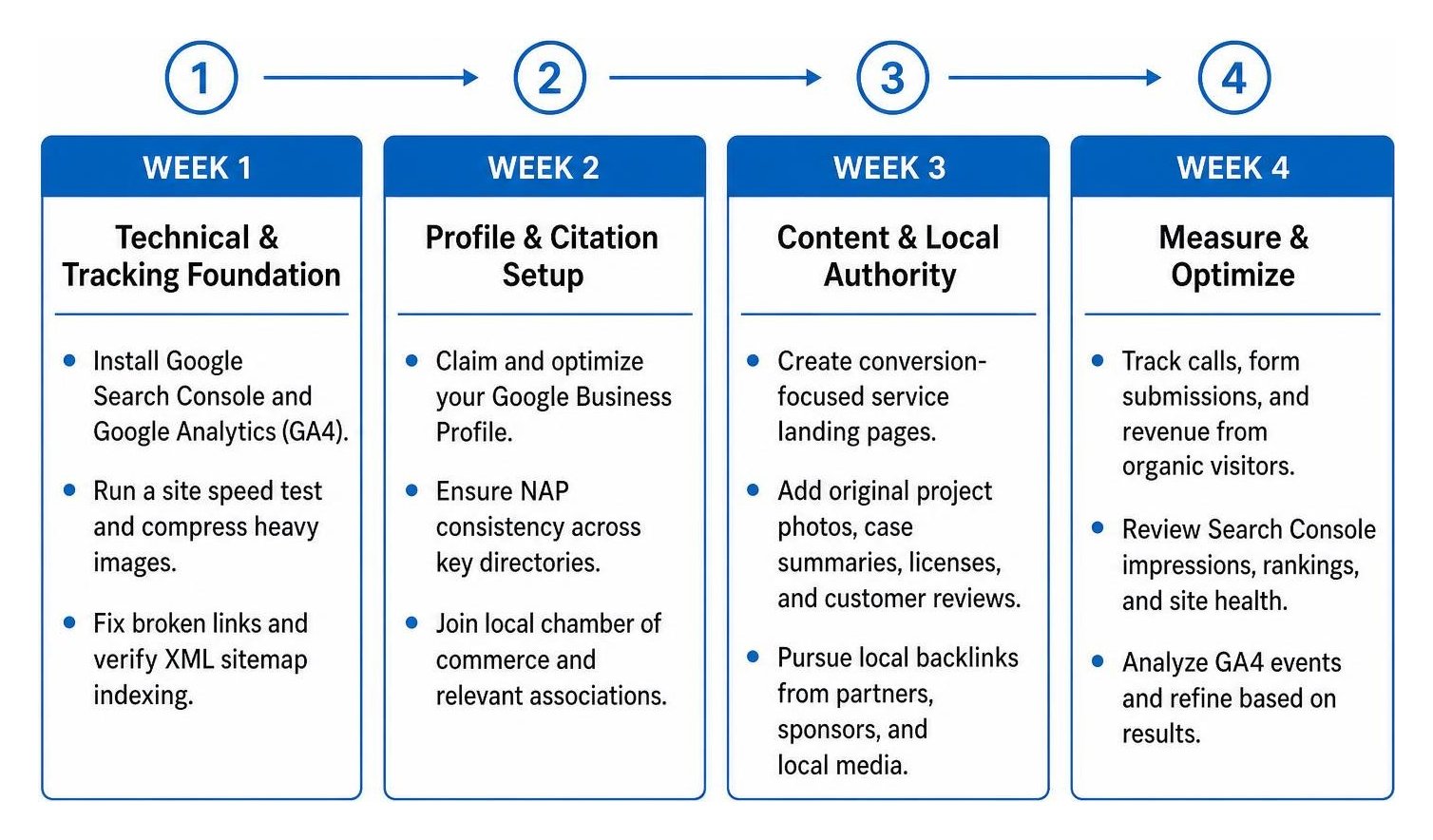
- Week 1: Technical & Tracking Foundation
- Install Google Search Console and Google Analytics (GA4).
- Run a site speed test and compress heavy images.
- Fix broken links and verify XML sitemap indexing.
- Week 2: Profile & Citation Setup
- Claim and fully complete your Google Business Profile.
- Verify primary and secondary business categories.
- Audit and standardize NAP data across major directories.
- Week 3: On-Page & Content Creation
- Build individual, dedicated landing pages for each core service.
- Add
LocalBusinessstructured data schema to the site. - Apply our Answer-Ready SEO methodology by answering common buyer questions directly at the top of your pages.
- Week 4: Authority & Review Systems
- Launch an automated email or SMS review collection workflow.
- Reach out to local suppliers, vendors, and business partners for link opportunities.
- Establish a monthly review cadence to track organic phone calls and quote requests.
Frequently Asked Questions About Small Business Local SEO
How long does it take for a small business to see local SEO results?
Most businesses see early movement in map views and search impressions within 30 to 60 days. Substantial ranking improvements, qualified lead growth, and measurable revenue gains typically develop over 3 to 6 months of steady effort, depending on local competition.
What is the biggest SEO mistake small businesses make?
The most damaging mistake is maintaining inconsistent contact information (NAP) across online profiles while targeting overly broad national keywords. When your business information is inconsistent, search engines lose confidence in your location data, which keeps your business out of local map packs.
How much should a small business budget for SEO?
A typical small business investment ranges between $300 and $2,500 per month, depending on geographic competition and whether you need ongoing content creation, link building, or a focused one-time technical sprint.
Turn Local Searches into Long-Term Growth
Dominating local search comes down to nailing the basics: maintaining a spotless Google Business Profile, ensuring your business citations match everywhere online, and publishing clear, helpful service pages that load quickly on mobile devices.
By executing a structured optimization plan, you build lasting visibility that brings in nearby customers day after day. If you want to accelerate your growth using our data-driven Velocity framework and transparent tracking, explore our tailored small business SEO services today.