SEO for Snow Removal Service: Local Visibility and Lead Tracking

How can snow removal businesses get found when customers need them?
To improve SEO for a snow removal service, start with a complete Google Business Profile, ask customers for honest reviews, and build separate website pages for the services and areas you actually cover. Make each page easy to use on a phone, with a clear way to call or request a quote.
Snow removal searches come in two waves. Property managers may look for seasonal contracts before winter, while homeowners often search during a storm and need a fast answer. Your website should serve both without promising dispatch you cannot provide.
For additional support, explore local SEO services, SEO content services, or request an SEO visibility audit. Related service-industry examples include Local SEO for Cleaning Services: A Beginner's Guide, A Practical Guide to SEO for Pressure Washing Leads, and Cheat Sheet to SEO for Landscaping: Get More Leads.
Core Strategies: Implementing Local SEO for Snow Removal Service Success
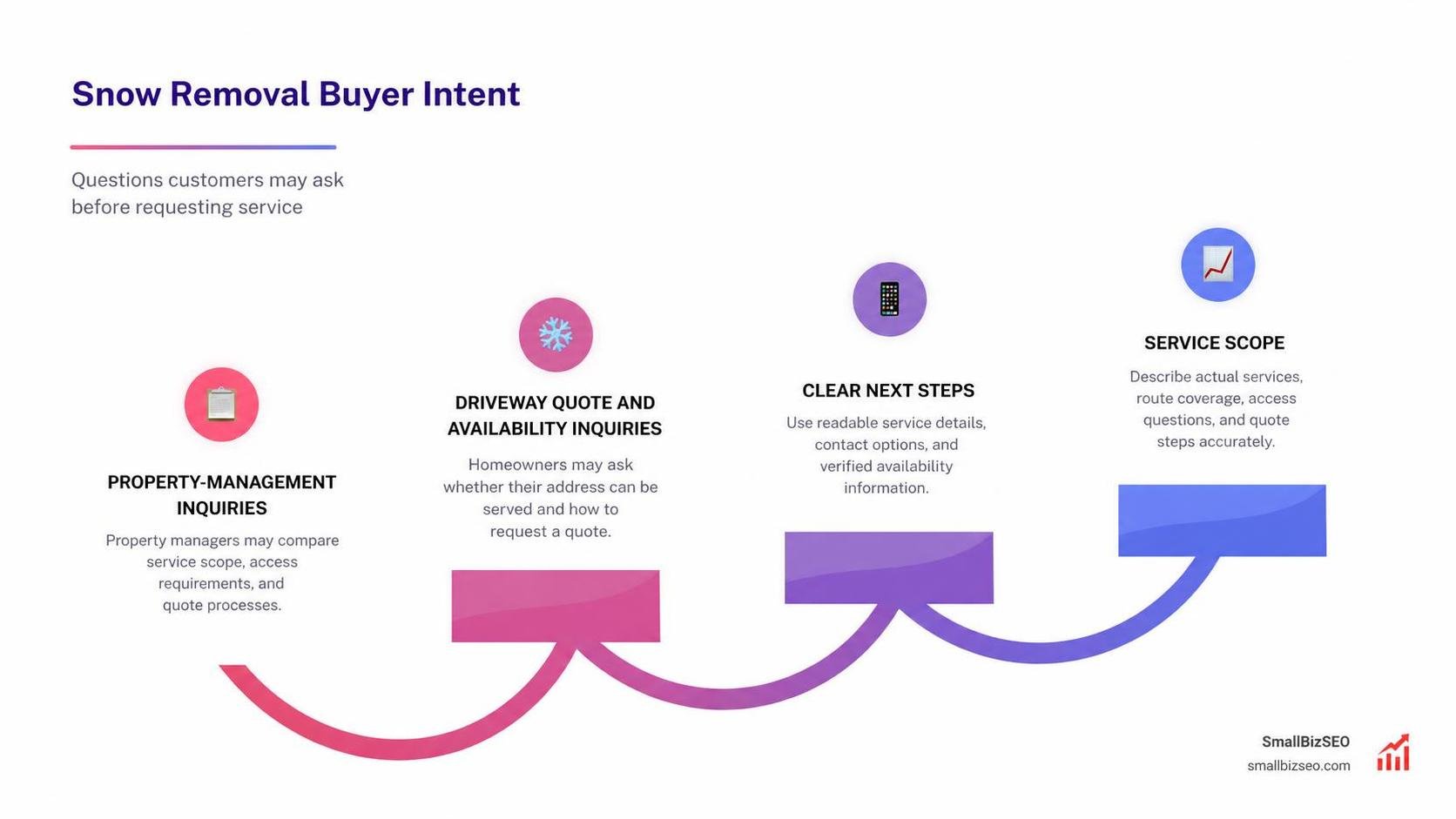
Snow removal customers tend to arrive with different needs: a homeowner may be looking for a driveway quote, a property manager may be comparing ongoing service options, and a storm-time searcher may be checking whether a provider is available. Local SEO should help each visitor find accurate service details, coverage information, and a clear next step without overstating availability.
Build local visibility around accurate business information and useful service pages. A local SEO company can help organize technical SEO, content, and reporting, but no approach can guarantee rankings, indexing speed, or Google Business Profile outcomes.
How to Configure Google Business Profile and Service Area Listings
Set up your Google Business Profile to match how customers are actually served. If customers are not served at your business address, remove the address and use a precise service area. A staffed location that serves walk-in customers can be shown as a storefront or hybrid business. Use the cities, ZIP codes, or areas you genuinely cover; service-area settings do not create extra town profiles or expand a ranking radius.
Choose the category that best describes the business’s real core offering, then add only relevant secondary categories and services that are genuinely available. Do not swap categories simply to chase seasonal demand.
- List only the residential, commercial, or property-management services your team actually provides.
- Describe route boundaries, access requirements, quote steps, and any availability policy accurately.
- Do not add roof work, ice work, hauling, or other specialized services unless they are truly offered.
Use authentic, current photos that help customers recognize your equipment, team, and completed work. Only use images you are authorized to publish, and keep captions and descriptions factual.
Keep the business name, contact details, hours, service information, and service area consistent wherever customers find the business. Follow Google’s business representation guidelines and its service-area and hybrid-business guidance.
How Should Snow Removal Businesses Request Reviews?
Reviews help prospective customers evaluate a provider, but they should be requested honestly and without attempts to control the result. Make it simple for customers to share a genuine experience after a completed interaction.
If you use email or text messages for follow-up, obtain the appropriate consent and follow your messaging policies. A review request should be a neutral invitation, not a promise of a benefit or a condition of further service.
Do not offer incentives, selectively ask only happy customers, pressure customers to post on-site, or ask for specific wording. Google’s Maps contribution policy requires reviews to reflect genuine, unbiased experiences. Respond professionally to feedback and keep any claims about services or availability accurate. See master local home services SEO for related local-search guidance.
How to Structure Website Pages for SEO for a Snow Removal Service
A clear, mobile-friendly website makes it easier for customers to understand what you offer and request a quote. Prioritize readable service details, accessible contact options, and pages that load reliably on common devices and connections.
Structure pages around the questions each buyer needs answered:
- Residential driveway page: Explain the quote process, what access details are needed, and which services are actually available.
- Commercial or property-management page: Explain the scope information needed for an inquiry, documentation available only when actually maintained, and the next step for discussing service.
- Availability page or notice: State current availability only when verified, and explain how customers can confirm whether their location can be served.
- Business-information page: Keep contact details, service-area information, hours, and structured data aligned with the real business.
What Is the Difference Between Residential and Commercial Snow Search Intent?
Commercial and residential visitors often need different information. Property managers may need to assess whether a provider fits a site’s requirements, while homeowners may need a straightforward quote process and confirmation of service availability.
| Buyer need | Commercial or property-management page | Residential driveway page |
|---|---|---|
| Primary visitor | Property manager, facilities contact, HOA representative, or site operator | Homeowner, landlord, or resident |
| Intent to address | Whether the provider can discuss the property’s scope and service requirements | Whether the provider serves the address and how to request a quote |
| Useful page details | Site type, access questions, service scope, quote process, and only documentation the business actually holds | Driveway or property details needed for a quote, access questions, service scope, and verified availability process |
| Evidence to show | Accurate descriptions, genuine work examples, and permits or insurance proof only when actually held | Accurate descriptions, genuine work examples, and clear contact options |
| CTA | Request a scope discussion or quote | Request a driveway quote or confirm service availability |
Separate pages can make the site more useful because each page answers the visitor’s specific questions. Avoid copying the same page for every town or making claims that the business cannot verify.
How Should You Plan Seasonal Content?
Seasonal planning should follow the business’s actual demand patterns, capacity, and Search Console data rather than a universal calendar or a fixed lead-time claim.
Use Google Search Console to identify the queries and pages that earn impressions, then update service pages when demand, offerings, or customer questions change. Publishing and revising useful pages supports discovery, but it does not guarantee a ranking or indexing timeline.
Maintain service content over time: refresh factual details, add relevant internal links, and pursue earned outreach from sources that are genuinely relevant to the business. If the business also offers landscaping services, this cheat sheet to SEO for landscaping can support related content planning. For help creating and maintaining useful pages, see SEO content services, request an SEO visibility audit, or book a consultation.
Tracking Performance, Lead Costs, and Long-Term Growth
Local SEO measurement should focus on whether search visibility is producing qualified business opportunities, not on universal cost or lead-volume benchmarks.
Track performance with metrics that connect search activity to real business outcomes:
- Qualified inquiries by service: Separate residential, commercial, and property-management inquiries when that distinction is captured accurately.
- Accepted quotes: Record which quotes were accepted and connect them to the original page, call, form, or campaign when attribution is reliable.
- Booked work: Track booked work by actual service type and preserve the source data needed to explain the attribution.
- Search Console coverage: Review the queries and pages earning impressions and clicks, then use the findings to improve relevant service content.
- Data quality: Keep unknown sources separate from known sources rather than treating missing attribution as a result.
A comprehensive SEO visibility audit can help identify technical, content, and reporting priorities. When you are ready to discuss the next step, book a consultation.
Keep Snow Service Information Accurate and Useful
Build local visibility with accurate business details, clear residential and commercial pages, honest reviews, and measurement tied to qualified inquiries, accepted quotes, and booked work. Keep service scope and availability claims current so customers can make informed decisions.