Testing SEO Title Changes Accurately During Seasonal Traffic Swings

How Can You Tell Whether a Title Change Increased CTR?
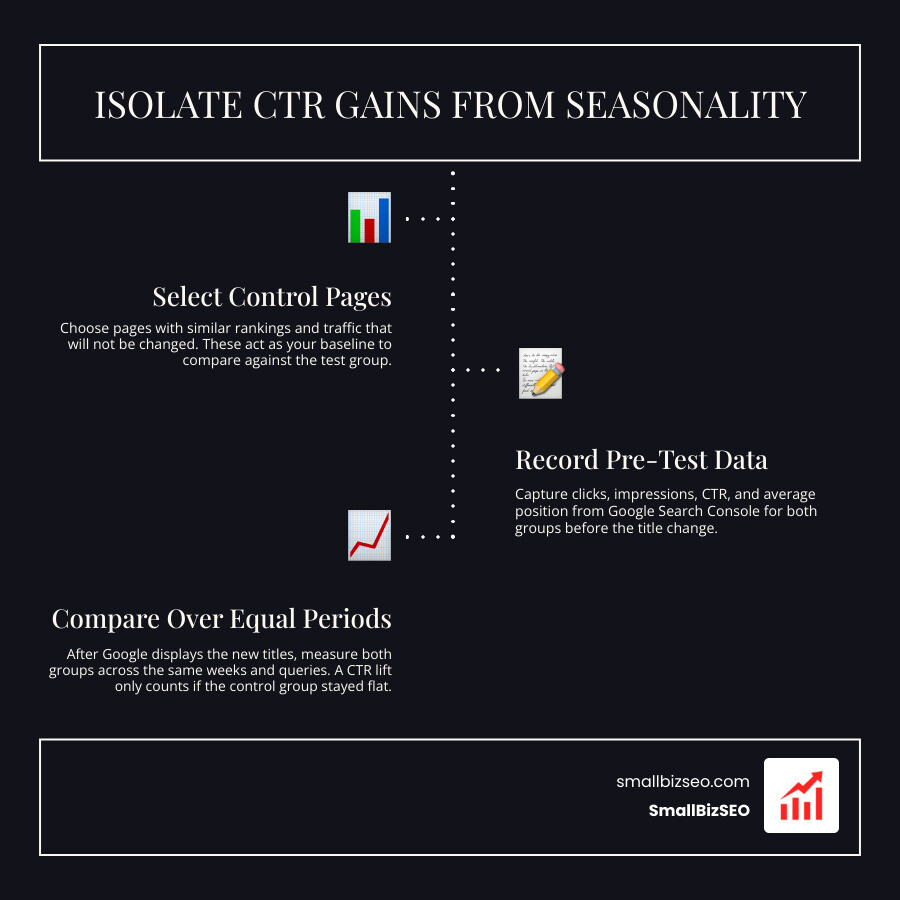
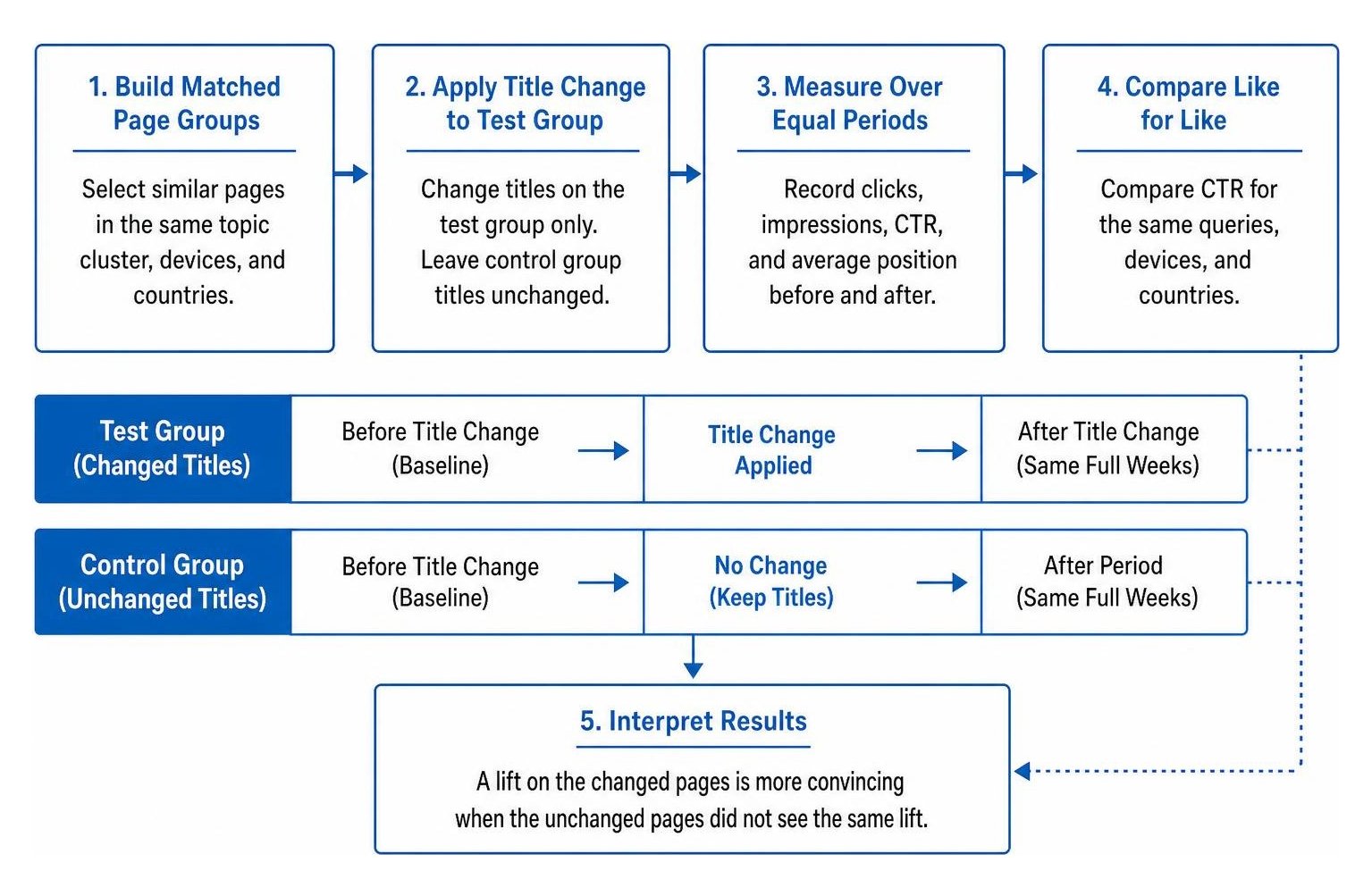
If you're wondering how to test title changes without confusing seasonality with ctr gains, compare changed pages with similar pages whose titles stay the same. Record clicks, impressions, CTR, and average position in Google Search Console before the edit. Then measure both groups over the same full weeks after Google displays the new titles. Compare CTR for the same queries, devices, and countries, and check whether rankings changed. A lift on the changed pages is more convincing when the unchanged pages did not see the same lift.
I'm Clayton Johnson, founder of SmallBizSEO. My work in data-driven SEO and content strategy shapes how to test title changes without confusing seasonality with ctr gains: set a fair baseline, check what Google shows, and report what the data can support.
How to Test Title Changes Without Confusing Seasonality with CTR Gains
To accurately separate true Click-Through Rate gains from broader search shifts, you must isolate your metadata edits from background market movements. Seasonal swings alter search volume, intent, and buying behavior across entire topic clusters. If you update a Title Tag right as user interest rises, a simple before-and-after traffic comparison will falsely credit the new phrasing for gains created by market demand.
When managing Seasonal Content, search demand changes dramatically over predictable cycles. A title change deployed during an upward swing might show a 25% click increase even if the new copy is less appealing than the old version. Conversely, an outstanding optimization launched during an annual traffic dip could look like a failure. Establishing true causal impact requires testing frameworks that evaluate your edits against concurrent market conditions.
How to Test Title Changes Without Confusing Seasonality with CTR Gains Using Control Groups
The most reliable way to isolate seasonal demand is to run a controlled cohort test across templated page groups rather than evaluating individual pages in isolation.
In SEO, traditional A/B Testing cannot serve two different titles on the same URL to different searchers without creating search engine cloaking issues. Instead, cohort testing divides a large pool of similar pages (such as product categories, service offerings, or location pages) into two balanced buckets:
- The Test Group: The subset of pages where you update the title tag pattern.
- The Control Group: A matching subset of pages where the title tags remain completely untouched.
For this methodology to work, both cohorts must share traffic parity. Ensure the pre-test daily click gap between the two groups is within 20% to 30%. Because external variables like holiday demand, local weather, and macro-trends hit both groups at the same time, any statistical divergence in performance between the cohorts indicates true title impact.
| Testing Method | Single-Page Before/After Test | Cohort Split Testing (Grouped) |
|---|---|---|
| Setup Complexity | Low (Single URL tracking) | Moderate (Bucket segmentation) |
| Seasonality Control | None (Blends trend with title performance) | High (Neutralized by control baseline) |
| Algorithm Shift Protection | None (Vulnerable to ranking shifts) | High (Core updates affect both groups) |
| Statistical Reliability | Low (High risk of false positives) | High (Achieves 95% confidence intervals) |
| Best Application | Low-traffic, unique single pages | Templated category or product pages |
Reviewing modern SEO split testing methodologies highlights why counterfactual baselines are necessary: comparing variant performance against an unedited control forecast prevents confusing seasonal market momentum with genuine copy optimization.
How to Test Title Changes Without Confusing Seasonality with CTR Gains in Google Search Console
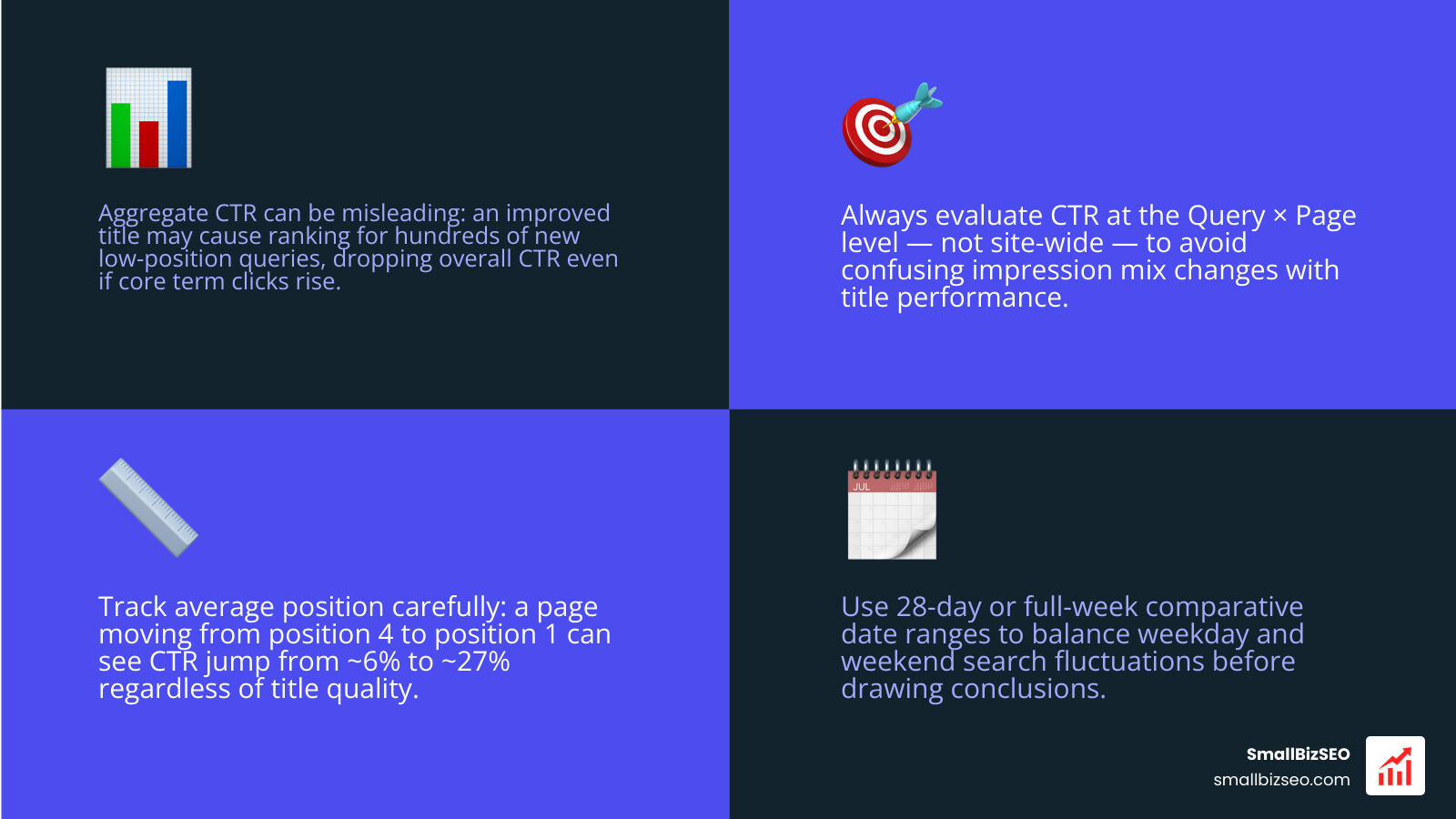
When using Google Search Console, you must evaluate performance at the specific Query × Page level rather than relying on aggregate site-wide numbers.
Aggregate page CTR can be misleading. For instance, if an improved title causes your page to rank for hundreds of new, broader search queries in positions 8 through 15, your overall recorded CTR percentage might fall. This happens because impression volume expanded rapidly in lower positions, even though your clicks on high-intent core terms climbed.
To avoid this trap:
- Track Average Position Carefully: An increase in CTR is only meaningful if ranking position remained stable. A page moving from position 4 to position 1 will naturally see its CTR jump from roughly 6% to over 27% regardless of title quality.
- Implement Position Banding: Group your queries into discrete position tiers (e.g., positions 1–3, positions 4–10) and evaluate CTR changes strictly within identical ranking tiers.
- Compare Full Weekly Blocks: Use 28-day or full-week comparative date ranges to balance weekday and weekend search fluctuations.
- Calculate from Raw Totals: Always calculate CTR by dividing total clicks by total impressions. Never average individual CTR percentages together, as this skews the math across high- and low-volume queries.
For teams managing large catalogs, testing title tags at scale requires pulling Search Console data into structured datasets to isolate ranking decay curves from genuine CTR lift.
What External Confounders Distort Title Tag Experiments?
Beyond annual seasonality, several external variables can alter search result performance during an active test:
- Broad Algorithm Updates: Core ranking updates reshuffle search layouts, alter competitive density, and adjust how snippets appear.
- Competitor Adjustments: Competitors changing pricing, adding structured data, or updating their own titles can draw clicks away from your listing.
- Snippet and Description Changes: A modified Meta Description or newly awarded Search Snippet rich feature can dramatically raise click rates without any change to the title tag itself.
- Off-Page Marketing Initiatives: Concurrent brand campaigns, email blasts, or PR coverage spike branded search volume, which carries disproportionately high click-through rates.
Keep a detailed test log recording deployment timestamps, algorithm announcements, and promotional campaign dates to ensure these outside influences are not misread as title optimization wins.
How Does NavBoost and Title Rewriting Impact Your CTR Measurement?
Search engines utilize behavioral ranking components like NavBoost, which processes user click interactions over rolling multi-month windows. NavBoost separates satisfying clicks from "badClicks"—instances where a user clicks a result and quickly returns to the search page (pogo-sticking) because the page failed to fulfill their expectations.
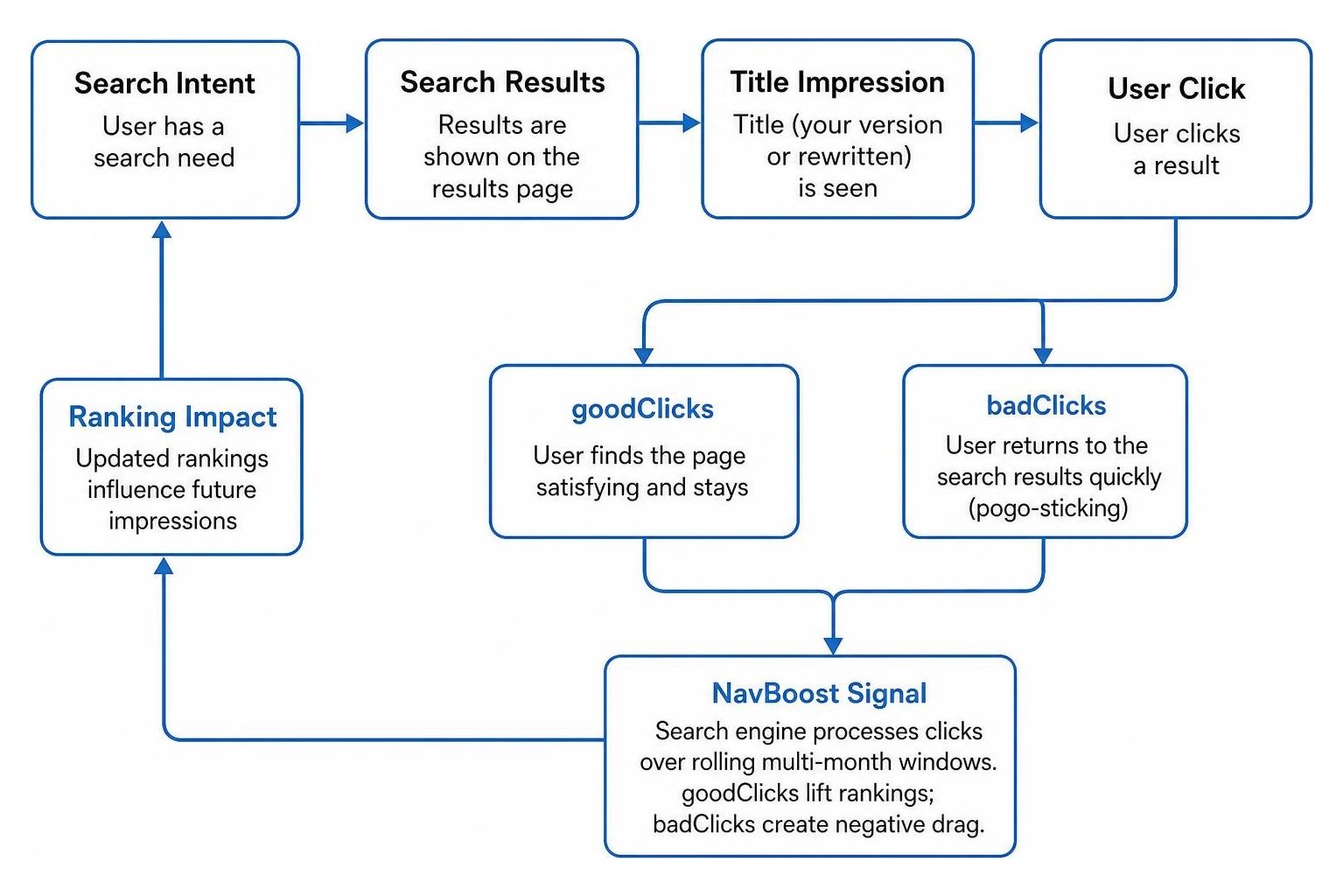
Writing aggressive clickbait titles might artificially inflate your initial CTR, but if the content does not match the searcher's Search Intent, the resulting badClicks create negative ranking drag.
Furthermore, search engines frequently rewrite title tags on live results. In fact, research shows search engines rewrite approximately 61% of title tags to better match queries or prevent truncation. If your test title is replaced by an automated snippet drawn from an H1 or body paragraph, your data reflects the search engine's generated wording rather than your experimental copy.
To minimize rewrites:
- Maintain title lengths between 50 and 60 characters (or under 600 pixels). Titles in the 51-to-60-character range experience the lowest rewrite rates (roughly 39% to 42%).
- Use dashes instead of pipes to separate brands, as pipes trigger automated replacements more than twice as often.
- Visually verify live search results across desktop and mobile devices before beginning your measurement clock.
Final Best Practices for Accurate Title Optimization
At SmallBizSEO, our data-driven Velocity framework relies on strict experimental protocols to turn title optimization into a predictable growth channel. If you want expert help engineering high-converting search metadata without data distortion, explore our SmallBizSEO CTR optimization services.
Before rolling out new title patterns across your entire website:
- Set Up a Pre-Test Brief: Define your core hypothesis, target metrics, baseline performance, and guardrail metrics (such as bounce rate or conversion rate).
- Verify Indexation First: Do not start your test timeline on the day you edit your CMS. Start counting only after search engine crawlers have indexed and rendered the new title in live results.
- Require Repeatability: If a title pattern wins across your initial test group, validate it on a second cohort before deploying it across thousands of URLs.
How Long Should a Title Experiment Run for Reliable Data?
A title experiment should run for 6 to 8 weeks to reach 95% statistical significance and smooth out weekly traffic cycles.
Websites with lower traffic volumes should avoid concluding tests within days. A sample of 1,000 impressions with a small percentage-point increase carries low statistical power, meaning normal daily variance can easily be mistaken for a trend. For enterprise split tests, aim for cohorts that accumulate at least 30,000 monthly organic sessions across the test set.
Pre-Test Launch Criteria Checklist:
- Target pages maintain stable rankings in positions 1 through 20.
- Treatment and control groups share comparable historical traffic volumes.
- No structural site updates or design overhauls are scheduled during the test window.
- The title tag matches the visible page heading to prevent automated search engine rewrites.
- Clear success criteria are established using weighted clicks and position-controlled CTR.
Building a Repeatable Framework for Search Metadata Wins
Accurately measuring title tag performance during traffic shifts requires patience, clean baseline data, and disciplined cohort testing. By using balanced control groups, tracking position bands within Google Search Console, and verifying live search snippets, you ensure that every recorded click gain reflects real user interest rather than seasonal noise. Treating title optimization as a structured, scientific process allows you to compound small click-through gains into sustained organic traffic growth.