The Complete Guide to SEO Business Growth
The Complete Guide to SEO Business Growth
Build SEO Business Growth With a Revenue-First Plan
SEO business growth comes from helping the right customers find useful pages when they are already searching for what you sell. Start by fixing pages that cannot be crawled or used easily on mobile, target search terms with real buying or local intent, publish expert content that answers customer questions, and measure leads and revenue - not rankings alone.
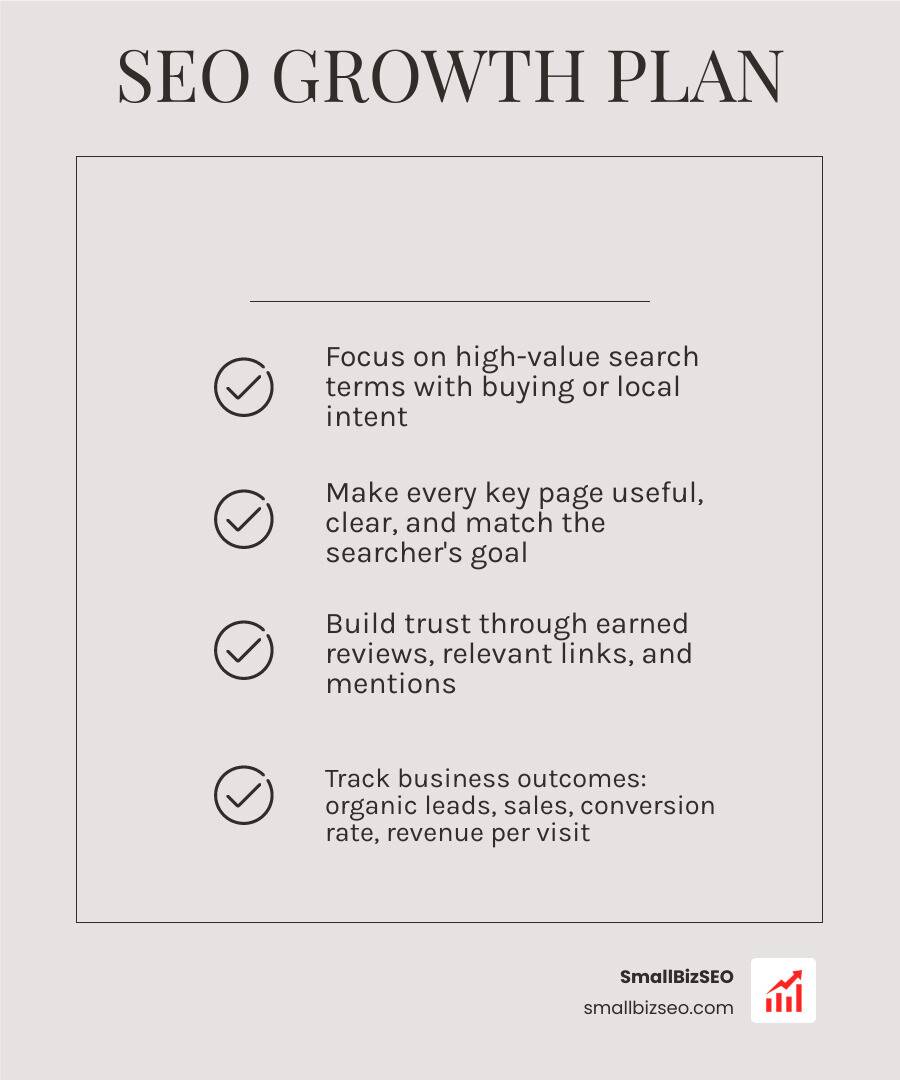
A practical starting plan is:
- Choose high-value search opportunities. Focus on services, products, and locations that bring qualified leads.
- Make every key page useful and clear. Match the page to the searcher's goal, use descriptive titles, and add strong calls to action.
- Build trust over time. Earn real reviews, relevant links, and mentions by doing work worth recommending.
- Track business outcomes. Watch organic leads, sales, conversion rate, and revenue per visit alongside impressions and clicks.
Organic search drives a large share of web traffic, but traffic is only valuable when it supports profit. SEO is not a quick fix or a one-time checklist. It is a compounding system: better site health, better content, stronger reputation, and better measurement make it easier to earn visibility and turn that visibility into sustainable demand.
I’m Clayton Johnson, a digital marketing professional focused on using digital PR and search visibility to build meaningful audience engagement. In this guide, I’ll show how SEO business growth connects technical optimization, useful content, and trusted authority to measurable business results.
Terms related to SEO business growth:
Why SEO Business Growth Outperforms Paid Acquisition
Organic search accounts for 53% of all trackable web traffic and drives 44% of global revenue share across commercial industries. While paid advertising offers instant visibility, it operates entirely on rented real estate: the moment ad spend halts, lead flow collapses immediately. Furthermore, paid acquisition costs continue to rise across competitive search landscapes, driving up customer acquisition costs and eroding profit margins.
By contrast, search engine optimization transforms your website into an owned digital asset that compounds in value over time. Operating with a revenue-focused SEO framework ensures you target bottom-of-the-funnel buyer intent rather than empty vanity impressions. When high-value pages achieve top rankings, they continue to generate qualified leads month after month without requiring ongoing per-click fees.
| Channel Dimension | Organic SEO Growth | Paid Search (PPC) |
|---|---|---|
| Cost Structure | Upfront production; zero per-click cost | Continuous cost-per-click fee |
| Asset Type | Permanent, compounding company asset | Rented, temporary placement |
| Average Close Rate | 14.6% close rate for organic leads | 1.7% to 2.5% for outbound/paid leads |
| Traffic Longevity | Sustained multi-year discovery | Immediate drop when budget ends |
| Trust Factor | High credibility via earned rankings | Lower trust due to sponsored tags |
Understanding Search Engine Mechanics and Ranking Signals
Search engine algorithms evaluate hundreds of signals across three sequential operational phases to match searchers with the most relevant, helpful resources:
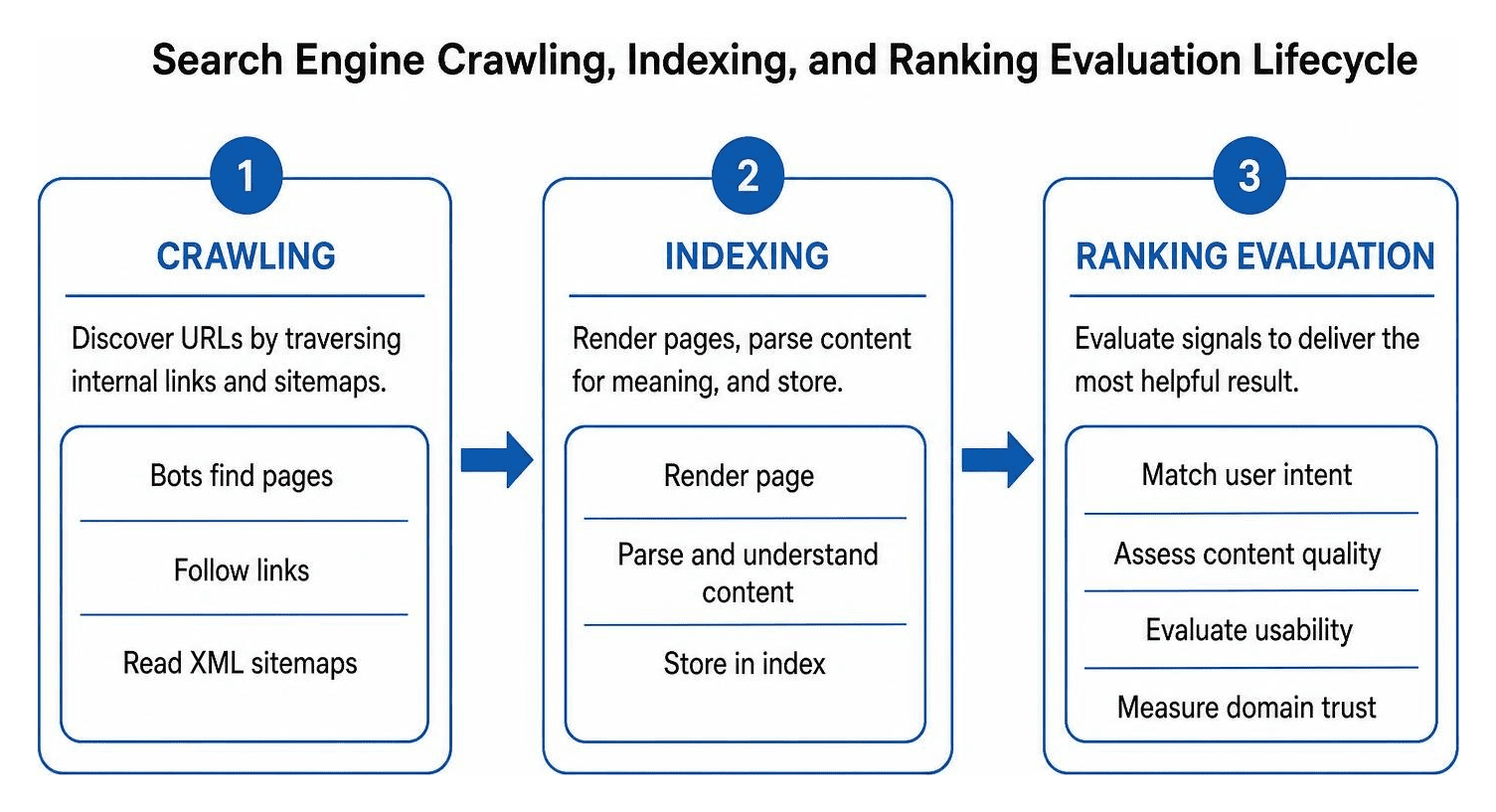
- Crawling: Automated bots discover URLs by traversing internal links, backlink profiles, and XML sitemaps across the web.
- Indexing: Discovered pages are rendered, parsed for meaning and topical relevance, and stored in a massive searchable database.
- Ranking: Complex algorithms measure intent relevance, content depth, technical usability, user satisfaction signals, and domain trustworthiness to deliver the most helpful answer for a user's query.
Measuring SEO vs SEM for Long-Term Return on Investment
Paid search remains useful for rapid message testing and seasonal promotions, but escalating cost-per-click rates create severe acquisition fatigue over time. Organic leads convert at an impressive 14.6% because users actively seek solutions and view organic search results as unbiased recommendations. Exploring a practical guide to organic traffic growth strategies helps teams transition away from paid dependency and build sustainable, high-margin revenue streams that endure across shifts in ad platforms.
Core On-Page and Content Strategies for Organic Scaling
High-performing content matches search intent perfectly while establishing definitive topical authority across an entire subject area. To scale organic customer acquisition, businesses must focus on structured content architectures that guide searchers smoothly from initial curiosity to commercial conversion:
- Commercial Service Landing Pages: Clean, high-converting pages built for transactional queries that clearly outline deliverables, pricing transparency, and next steps.
- Topical Pillar Guides: Comprehensive, in-depth resources answering broad informational queries that establish subject-matter leadership.
- Detailed Comparison Pages: Objective evaluations comparing direct solutions, software tools, and service alternatives to capture high-intent evaluators.
- Conversion-Driven Case Studies: Real customer transformations providing proof, data points, and trust to overcome buyer hesitation.
Keyword Research and Content Architecture for SEO Business Growth
Effective keyword targeting begins by mapping commercial value rather than sheer search volume. High search volume often correlates with vague informational intent, whereas long-tail keywords with lower volume frequently deliver significantly higher conversion rates. By identifying low-competition, high-intent phrases, an emerging brand can quickly capture qualified demand. Many businesses partner with a specialized startup growth SEO company to structure keyword clusters that funnel qualified buyers directly to money pages through logical internal linking hierarchies.
Building Topical Authority and E-E-A-T Credibility
Search algorithms reward demonstrated Experience, Expertise, Authoritativeness, and Trustworthiness (E-E-A-T). While not a single direct algorithmic score, E-E-A-T signals demonstrate that real, verified practitioners created your content rather than generic automated systems. Implementing author schema markup, displaying verified professional credentials, citing original case study data, and referencing from zero to hero practical guide frameworks allow smaller sites to outrank larger competitors lacking hands-on depth.
Technical SEO, Mobile Usability, and Local Search Optimization
A technically sound site ensures search engines crawl, render, and index your content without friction or wasted crawl budget. Technical debt, broken canonical tags, duplicate content parameters, and slow mobile load times destroy organic conversion potential before visitors even read your copy.
Enhancing Technical Performance and Mobile Usability
Search engines evaluate the mobile version of your website as the primary baseline for indexing and ranking. Ensuring responsive mobile design, clean site architecture, and fast load speeds is essential for retaining search visibility. Core Web Vitals define strict performance benchmarks that directly influence user satisfaction and search performance:
- Largest Contentful Paint (LCP): Main visual content must load in under 2.5 seconds to prevent user drop-off.
- Interaction to Next Paint (INP): User input response time must stay under 200 milliseconds to deliver smooth interactivity.
- Cumulative Layout Shift (CLS): Unexpected visual layout movement must score below 0.1 to maintain visual stability while assets load.
Maintaining clean XML sitemaps, structured schema data, SSL encryption, and flat site architectures ensures bot crawlers can navigate every commercial URL effortlessly.
Capturing High-Intent Customers Through Local Search
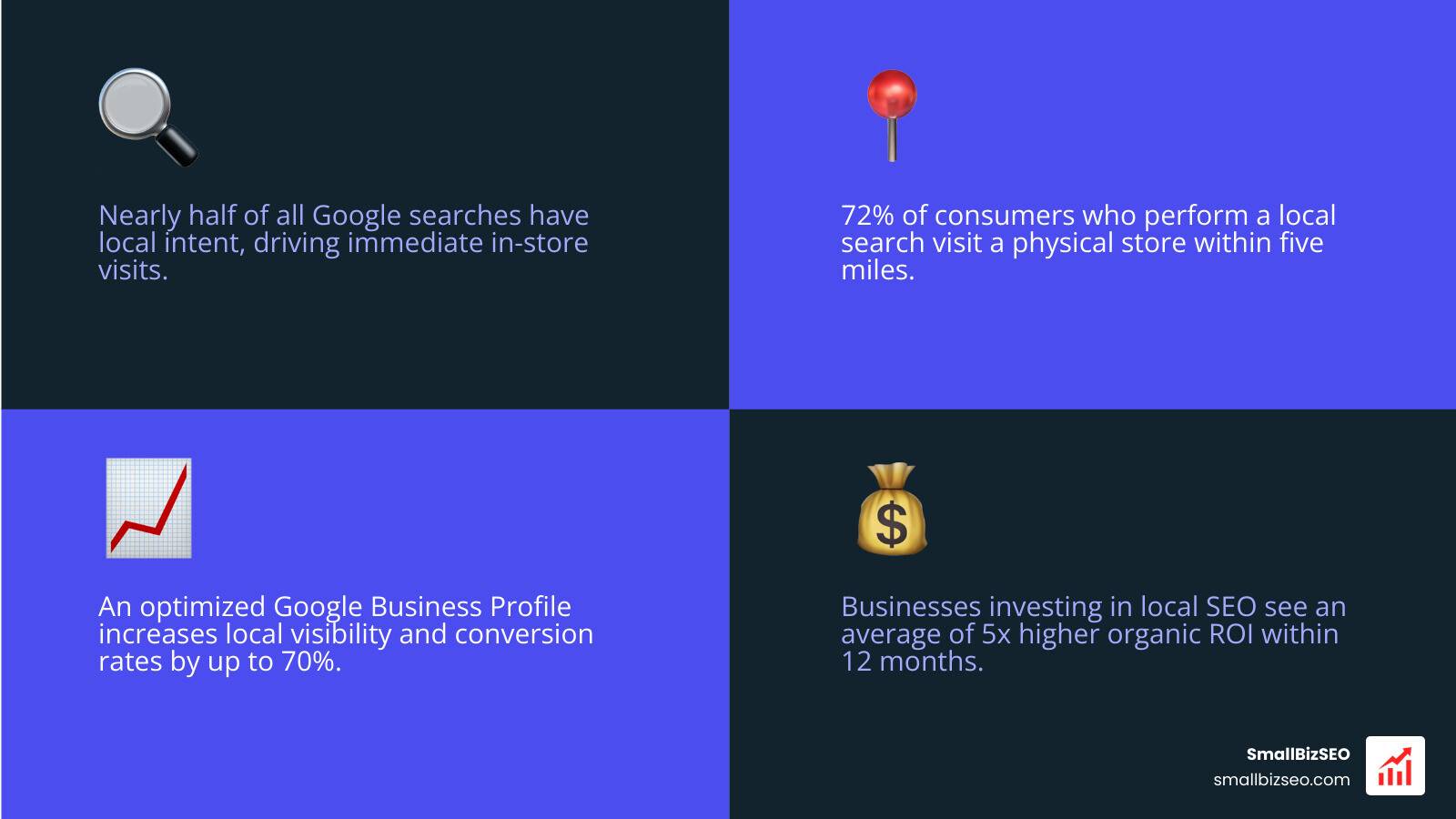
Almost half of all searches have local intent, and 72% of consumers performing a local search visit a physical store or contact a local business within a short radius. Maintaining an optimized Google Business Profile, securing regular client reviews, standardizing name, address, and phone citations across business directories, and implementing local SEO optimization and small business growth strategies turn nearby searches into immediate commercial revenue.
Modern Organic Expansion: AI Visibility, Authority Building, and Performance Tracking
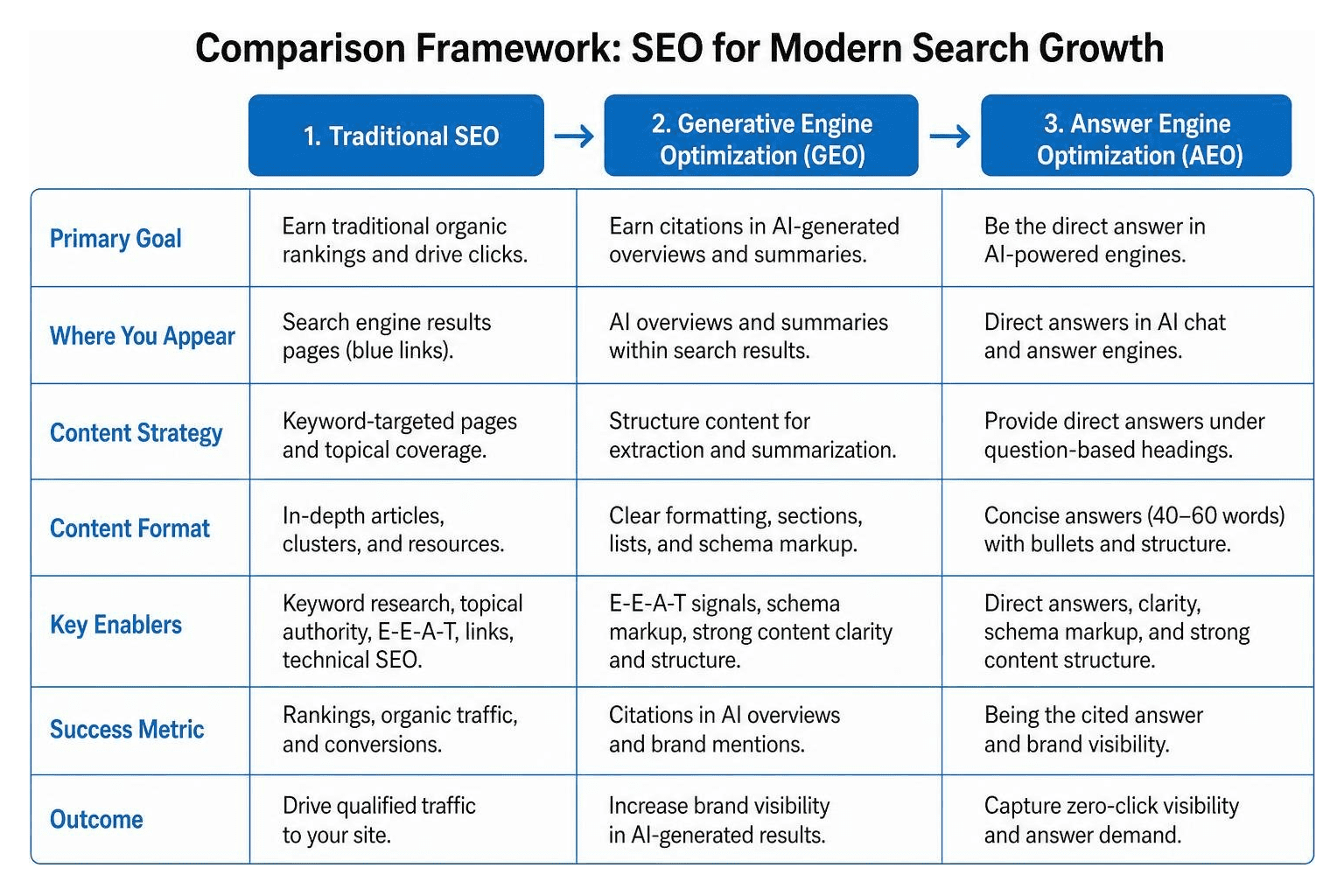
Search engines increasingly present AI-generated summaries directly within search results. Thriving in this modern environment requires a dual strategy: earning direct LLM citations while securing traditional organic rankings.
Navigating AI Overviews and Modern Search Engines for SEO Business Growth
Generative Engine Optimization (GEO) and Answer Engine Optimization (AEO) require structuring content for extraction. Provide direct 40-to-60-word answers immediately beneath question-based subheadings. Clear formatting, bulleted lists, and schema markup allow AI models like ChatGPT and Perplexity to source and cite your brand.
Authority Building, Off-Page Reputation, and Modern Link Acquisition
High-authority backlinks remain one of the strongest organic trust signals. Rather than resorting to low-quality directory spam or risky link schemes, focus on acquiring authoritative links through proprietary research data, digital PR campaigns, and thought leadership. When selecting external partners, focus on finding the best SEO company for real organic growth that emphasizes editorial link acquisition.
Tracking Commercial KPIs and Essential Tools
Beginners can monitor performance using Google Search Console and Google Analytics 4, while paid tools like Ahrefs and Semrush provide deep competitor intelligence. Track business-critical metrics such as:
- Organic Profit Per Sale: Total organic profit divided by total organic sales.
- Assisted Organic Conversions: Revenue touchpoints influenced by organic content.
- Search Impression Share: Visibility across high-intent commercial keywords.
Partnering with an experienced growth SEO company ensures your analytics connect directly to bottom-line profitability.
Frequently Asked Questions About SEO Business Growth
How long does it take to see tangible revenue results from SEO?
Most campaigns show measurable impression and ranking movement within 3 to 6 months, while compounding revenue growth typically materializes between 6 and 12 months as authority builds.
What are the most common SEO mistakes businesses should avoid?
The most damaging mistakes include keyword stuffing, buying low-quality backlink packages, ignoring technical site speed, and focusing on vanity traffic rather than high-intent commercial conversions.
What is the difference between traditional SEO, GEO, and AEO?
Traditional SEO optimizes for standard search engine rankings; GEO (Generative Engine Optimization) optimizes content to earn citations in AI summaries; and AEO (Answer Engine Optimization) structures succinct content for direct voice and featured snippet answers.
Scaling Your Organic Revenue Engine
Sustainable business growth relies on building owned marketing channels that compound over time. By combining rigorous technical performance, customer-first content creation, and authoritative digital PR, your organization builds an enduring competitive advantage that reduces customer acquisition costs.
At SmallBizSEO, our data-driven "Velocity" framework delivers rapid rankings and E-E-A-T-compliant organic growth backed by transparent reporting. Explore our comprehensive suite of tailored SEO services to start scaling your organic revenue engine today.