Traffic and Conversion Benchmarks for AI Search Versus Google
Traffic and Conversion Benchmarks for AI Search Versus Google
How do AI search traffic and Google organic traffic compare?
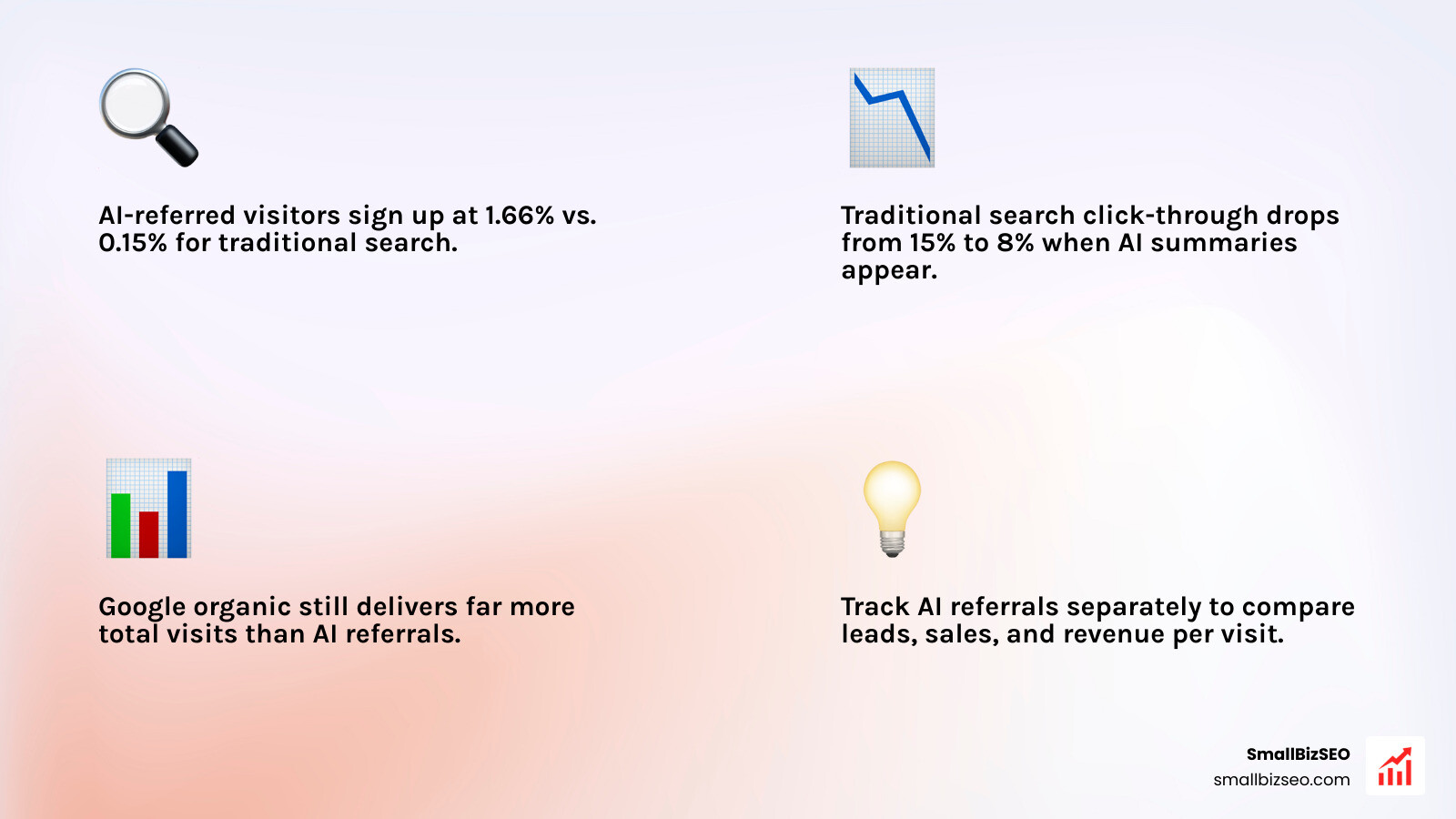
The numbers behind AI Search vs. Traditional Search: Traffic, Clicks, and Conversion Benchmarks tell a clear story: Google organic search still sends far more visits, but visitors referred by AI tools often convert at higher rates. In one study, AI-referred visitors signed up at 1.66%, versus 0.15% for search visitors. That is a useful benchmark, not a rate every business should expect.
Clicks are changing, too. A Pew study found that people clicked a traditional search result in 8% of visits with an AI summary, compared with 15% without one. For a small business, the practical move is to track AI referrals separately from Google organic traffic and compare leads, sales, and revenue alongside visits.
I'm Clayton Johnson, founder of SmallBizSEO. My work on AI Search vs. Traditional Search: Traffic, Clicks, and Conversion Benchmarks builds on helping small businesses connect SEO, content, and digital PR to qualified leads.
Simple guide to AI Search vs. Traditional Search: Traffic, Clicks, and Conversion Benchmarks:
- AI Search Visibility by Industry: Which Businesses Appear Most Frequently in AI Answers?
- How Frequently Do AI Search Engines Change Their Recommendations? Citation Consistency Statistics
- Human vs. AI-Generated Content: Traffic, Engagement, and Conversion Statistics
AI Search vs. Traditional Search: Traffic, Clicks, and Conversion Benchmarks Across Channels
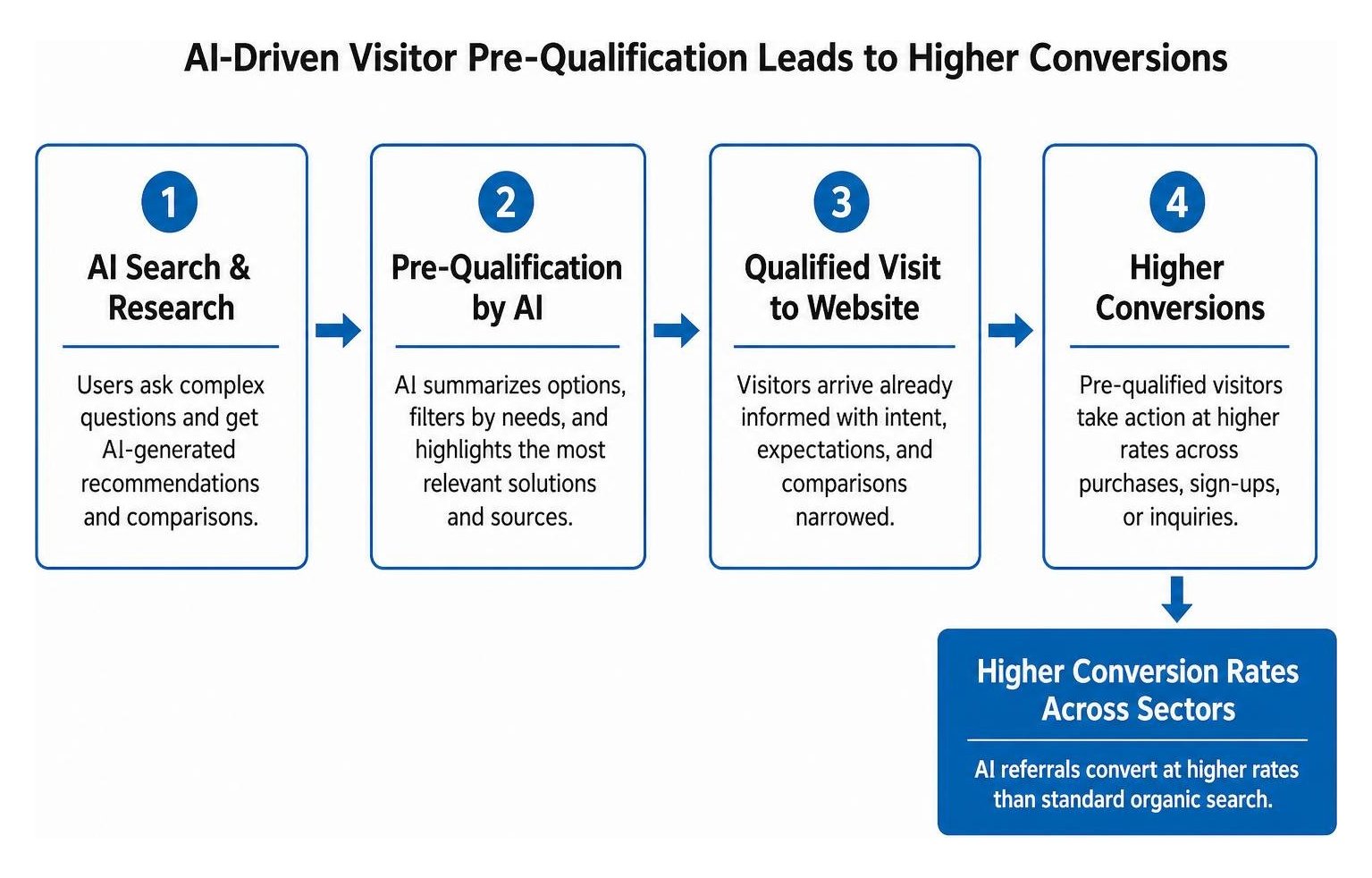
AI search visitors convert at significantly higher rates and spend more time on site than standard organic visitors because generative engines pre-qualify user intent before sending a click. While traditional organic search still supplies the vast majority of web traffic volume, AI referral channels deliver bottom-funnel buyers who have already evaluated summaries, features, and brand comparisons inside conversational interfaces.
When evaluating digital acquisition across channels, web analytics data shows distinct behavioral patterns. AI search referrals act as warm introductions, whereas traditional search traffic spans everything from casual top-of-funnel browsing to direct navigational lookups.
| Performance Metric | AI Search Referral Traffic | Traditional Google Organic Search |
|---|---|---|
| Average Conversion Rate | 5.97% – 11.40% | 0.72% – 5.30% |
| Sign-Up Conversion Rate | 1.66% | 0.15% |
| Revenue Per Visitor | $18.04 | $2.56 |
| Average Time on Site | +41% longer dwell time | Baseline standard |
| Average Bounce Rate | -23% lower bounce | Baseline standard |
| Sales Cycle Duration | 3 days average | 8 days average |
What Key Trends Define AI Search vs. Traditional Search: Traffic, Clicks, and Conversion Benchmarks?
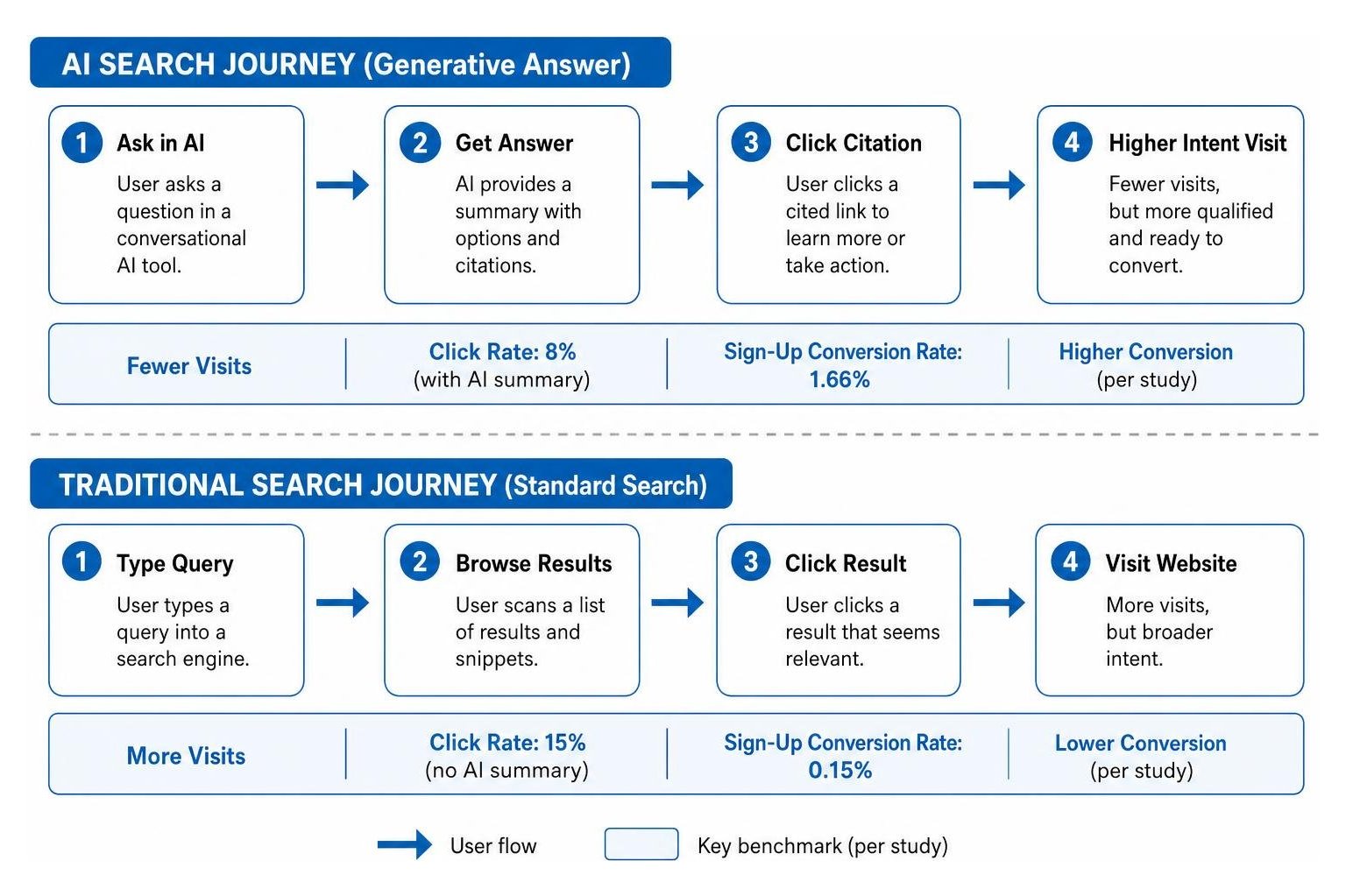
AI search referrals deliver an average 4.4x conversion multiplier over traditional search traffic because users complete their preliminary research before clicking an outbound citation.
Instead of opening ten tabs to compare product specifications or service providers, a user chatting with an assistant asks targeted follow-up questions. By the time that user clicks a cited brand link, they have resolved basic doubts and are ready to take action. Industry datasets show that an average LLM visitor is worth 4.4x organic search visitors, demonstrating how conversational summaries filter out low-intent clicks.
Key data benchmarks highlight this performance gap:
- Sign-Up Rates: AI visitors convert to sign-ups at 1.66%, compared with 0.15% from standard search engines—an 11x advantage.
- Direct Sales Conversions: In head-to-head tracking, AI referrals converted at 5.97% versus 0.72% for standard organic traffic.
- Revenue Impact: AI-driven visits produce an average of $18.04 in revenue per visitor compared to $2.56 from traditional organic channels.
- Accelerated Decisions: Buyer journeys assisted by generative tools are 33% shorter, closing deals in an average of 3 days compared to 8 days for standard web search paths.
To understand the broader technological shift driving these behaviors, review our breakdown of 50 generative AI statistics every business owner should know.
How Zero-Click Overviews Impact AI Search vs. Traditional Search: Traffic, Clicks, and Conversion Benchmarks
AI summaries directly on search result pages increase zero-click behavior, reducing raw traffic for informational queries while raising the commercial value of earned brand citations.
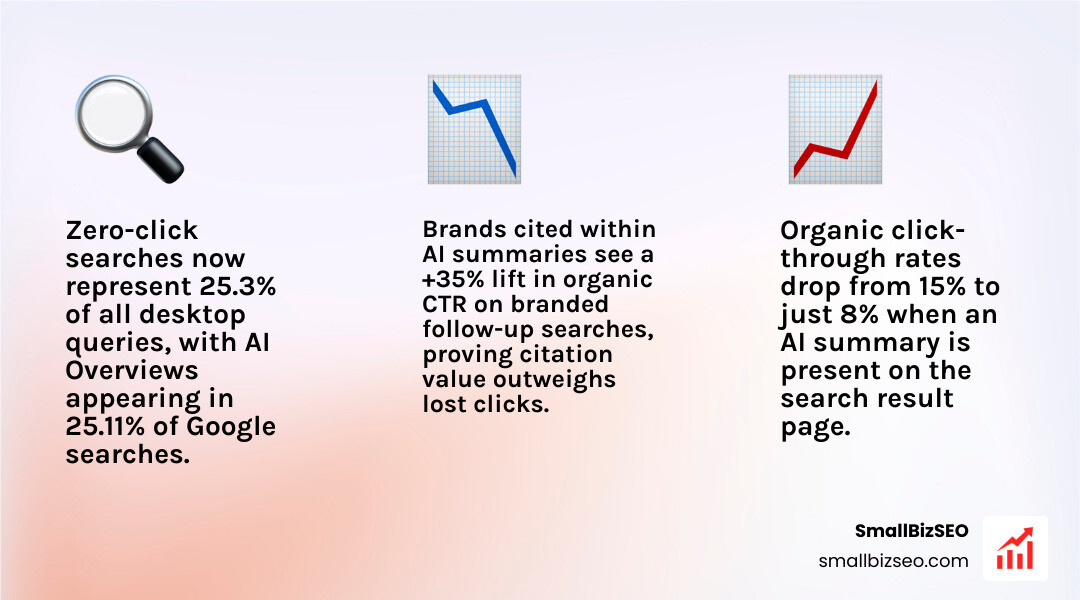
Zero-click searches account for approximately 25.3% of desktop searches, while overall organic click-through rates have compressed to roughly 40.0%. With AI Overviews appearing in roughly 25.11% of Google queries, top-of-funnel informational queries see organic click-through rate reductions of up to 61%. Users reading an immediate answer rarely click blue links for basic definitions or simple facts.
However, appearing as a trusted source inside these overviews creates powerful downstream value. An empirical experiment across 300 companies evaluating AI search vs traditional SEO demonstrated that earning prominent visibility in AI-assisted discovery environments yields significant cross-channel brand equity.
Specific visibility impacts include:
- Traditional organic link clicks drop from 15% down to 8% when an AI summary is present.
- Brands cited within AI summaries experience a 35% lift in organic CTR on branded follow-up searches.
- Cited businesses see a 91% lift in paid CTR, as users recognize the brand from the AI-generated recommendation.
For teams looking to monitor these extraction points, exploring the future of search and LLM visibility tools provides a structured way to gauge model sentiment.
How Do Sector Conversion Benchmarks Differ Between AI Referrals and Google Organic?
Commercial sectors that rely heavily on comparison shopping and deep research see the greatest conversion lift from AI-driven search referrals.
According to recent data on AI search referrals versus traditional clicks, generative channels excel at matching complex consumer requirements with exact product variants. In global retail, traffic from generative AI sources grew by 1,200%, establishing AI engines as high-efficiency shopping assistants.
Sector-specific performance highlights include:
- E-Commerce & Digital Retail: AI referrals convert at 11.4%, compared to 5.3% for standard organic search. Shoppers arriving via conversational engines already know compatibility, pricing, and feature trade-offs. Discover more in our analysis of AI shopping statistics redefining digital retail.
- B2B SaaS & Technology: Software buyers using assistants to compare feature matrices convert at over 7.05% on high-traffic sites, shortening enterprise demo booking funnels.
- Professional Services: Inquiries coming from synthesized local answers yield lower initial volume but produce higher appointment show rates, as prospects have already vetted service offerings.
How Should Marketers Measure AI Referral Traffic and Optimize for LLM Citations?
To accurately capture AI conversion value, marketers must isolate chatbot referral strings in analytics and structure on-page content with extractable data blocks.
A significant portion of AI traffic is misclassified as "direct" because many large language model interfaces strip standard HTTP referrer data. Without custom configuration, standard dashboards hide high-value conversions inside general baseline traffic.
Follow these steps to track and capture AI traffic:
- Configure Dedicated Channel Groups in GA4: Build custom regex filters for known AI assistant domains (including
chatgpt.com,perplexity.ai,claude.ai, andcopilot.microsoft.com) to separate them from standard organic search. - Monitor Search Console AI Modules: Use Google Search Console performance filters to evaluate queries triggering conversational summaries.
- Publish Clear Comparison Tables: Generative models rely heavily on clean Markdown tables, bulleted technical specifications, and structured pricing arrays when compiling recommendations.
- Lead with Answer Capsules: Place direct, definitive answers within the first 200 words of every section to ensure model crawlers can extract factual summaries cleanly.
- Maintain Content Freshness: Over 90% of pages cited by generative engines feature recently updated data and timestamps.
Conducting a formal AI SEO audit to track LLM signals helps ensure your technical markup remains accessible, while updating your search engine optimization for the AI era ensures legacy content remains competitive.
How Can Businesses Capitalize on AI Search Conversions?
Winning in modern search requires moving beyond raw pageview counts and focusing on conversion-qualified visibility. Traditional SEO builds broad authority, but pairing it with generative engine optimization captures the smaller, highly lucrative audience ready to buy.
At SmallBizSEO, we designed our proprietary Velocity framework to help businesses build authoritative digital footprints that rank in Google search results and earn citations inside generative engines. By combining technical site architecture, high-intent content structuring, and trusted digital PR, we ensure your business gets recommended at the exact moment prospects evaluate solutions.
Explore our specialized AI SEO services to audit your current visibility and start capturing high-converting search traffic today.