What Drives AI Product Endorsements in Modern Search Engines?

Why an AI Brand Recommendation Needs a Closer Look
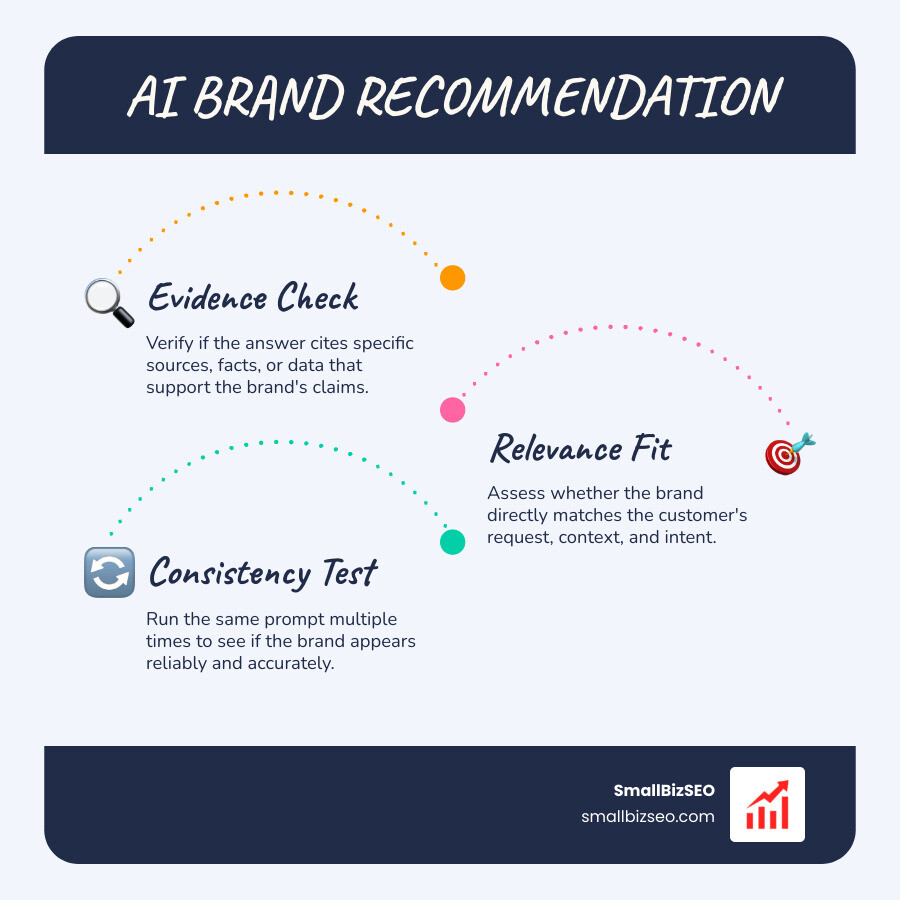
Here is how to evaluate the reasons behind an AI brand recommendation: check what the answer says, what evidence supports it, and whether the brand fits the customer’s need. Then verify the facts and any link. A brand can be named or cited without being recommended.
AI search can give customers an answer without a click. It may recognize a brand by name yet rely on outdated or incorrect details. That makes a recommendation less useful, even when the brand appears in the answer.
I’m Clayton Johnson, founder of SmallBizSEO. My work in SEO, content strategy, and digital PR informs how to evaluate the reasons behind an AI brand recommendation by looking past visibility to accuracy, evidence, and customer fit.
How to Evaluate the Reasons Behind an AI Brand Recommendation Across Search Engines
To evaluate why an AI engine recommends a specific brand, examine the underlying evidence, relevance, and consistency behind the generated output rather than merely counting brand appearances.
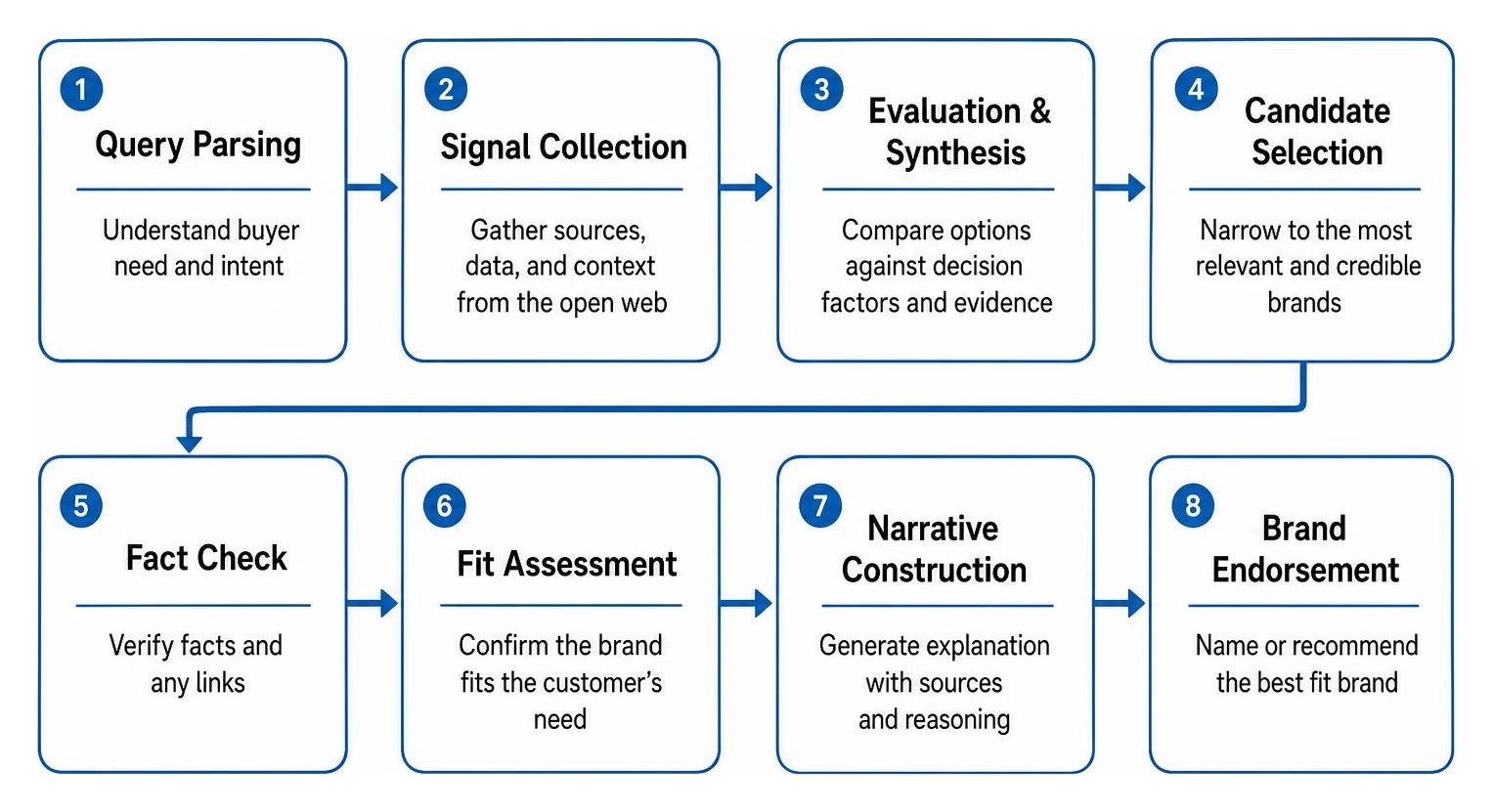
Modern generative search engines do not rely on traditional ten-blue-link page rankings. Instead, they act as probabilistic decision engines that synthesize information across the open web. According to McKinsey research on AI search adoption, conversational search has rapidly become a preferred information doorway, resulting in roughly 60% of web queries concluding without a standard organic click.

When evaluating AI responses across various engines, we observe that models construct decision narratives based on entity grounding and structured criteria. Across multiple industries, AI models evaluate options against a core set of canonical decision factors—including pricing transparency, ease of integration, real-world proof, and domain expertise. If a business lacks clear, machine-readable proof for these criteria, the engine drops it during synthesis.
What Signals Reveal How to Evaluate the Reasons Behind an AI Brand Recommendation?
To determine what drives an AI brand recommendation, distinguish whether the model is simply mentioning an entity, utilizing it as a factual source citation, or explicitly endorsing it as the best solution for the user's intent.
Many marketers celebrate when their company name appears in a generative summary. However, an appearance does not equal an endorsement. A model might mention a company as a cautionary case, cite its pricing guide to validate a competitor's claim, or list it neutrally alongside a dozen alternatives. Distinguishing a basic brand mention from a true recommendation requires analyzing the surrounding syntax, claim accuracy, and sentiment.
- Brand Mention: The model lists or names the company without expressing judgment or guidance (e.g., "Vendors in this space include Brand A, Brand B, and Brand C").
- Source Citation: The engine uses the brand's published data or URLs to back up a fact, often linking directly to the site while recommending an entirely different product.
- Ungrounded Win: The AI recommends the brand as a top choice, but provides no live reference link or third-party citation to support the verdict.
- Grounded Recommendation: The model explicitly names the business as the optimal choice for a specific use case and cites authoritative third-party evidence to substantiate the claim.
| Visibility Signal | Definition | Commercial Intent | Trust Requirement |
|---|---|---|---|
| Brand Mention | Named in passing or listed in a directory table | Low to Neutral | Entity Recognition |
| Source Citation | Referenced as the data source for a factual claim | Informational | Structured Content & Crawlability |
| Ungrounded Recommendation | Endorsed without linked supporting citations | Moderate (Volatile) | Parametric Memory Associations |
| Grounded Recommendation | Explicitly endorsed with supporting citations | High (Defensible) | Third-Party Proof & Consensus |
Why AI Models Eliminate Brands Between Discovery and Decision Stages
AI models eliminate brands between initial exploration and final selection when a company lacks transparent pricing, definitive technical specifications, or credible third-party verification to resolve buyer hesitation.
In multi-turn buyer journeys, a brand might appear in up to 58% of top-of-funnel exploration prompts, only to collapse to just 3% when the user asks for a final buying recommendation. This occurs because AI agents apply elimination filtering. When transitioning from broad research to a definitive choice, the engine applies stricter evidence thresholds.
As explored in Search Engine Journal's analysis on AI trust architecture, AI agents face a transferred liability risk. If an agent recommends an unsuitable, overpriced, or defunct option, the user loses trust in the AI. Consequently, models favor options that exhibit high consistency across external validation sources. Understanding why generative search engines change brand selections often comes down to identifying hesitation signals—such as hidden implementation costs, missing compliance certifications, or inconsistent customer feedback—which trigger automatic elimination filters.
How Position Bias and Prompt Order Distort Model Verdicts
A brand's position in a comparison prompt strongly influences AI endorsements due to natural primacy bias, meaning accurate evaluation requires testing queries with brand names in reversed order.
When evaluating head-to-head comparisons (e.g., "Brand X vs. Brand Y"), large language models exhibit measurable position bias. When an engine lacks an overwhelming evidentiary preference between two solutions, the brand named first in the user prompt wins the recommendation roughly 63.3% of the time. Being listed first multiplies a brand's odds of winning the head-to-head recommendation by approximately 2.98. In fact, testing reveals that in 16% of direct matchups, simply flipping the order of the prompt alters which brand the engine names as the winner.
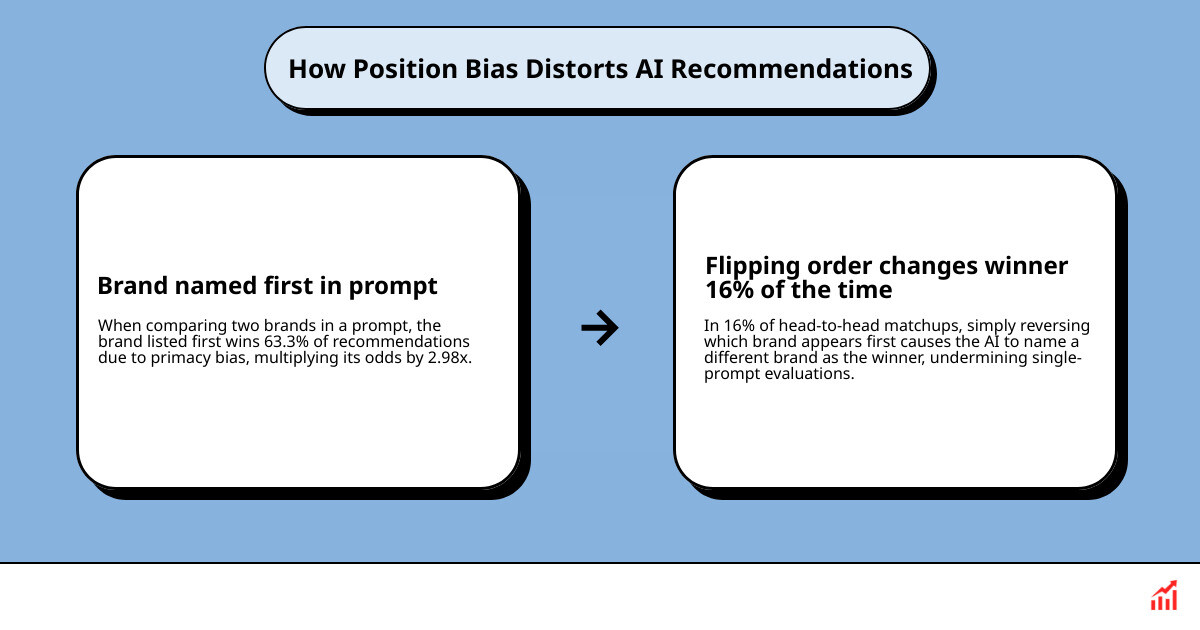
When analyzing real user prompts, search queries naturally mirror varying levels of branded search demand. To accurately evaluate your brand's standing without being misled by position bias, always conduct dual-order prompt validation. A recommendation should only be considered a genuine win if your brand prevails regardless of whether it is positioned first or second in the prompt.
A Step-by-Step Audit Framework: How to Evaluate the Reasons Behind an AI Brand Recommendation
Conducting a reliable evaluation of an AI brand recommendation requires a structured four-stage audit covering presence, accuracy, contextual fit, and link destination routing.

- Verify Presence and Visibility: Test whether your brand appears across a representative prompt set. Track the frequency with which the engine includes your business across discovery, comparative, and decision prompts.
- Audit Commercial and Factual Accuracy: Verify that the AI accurately describes your business status, core features, pricing tiers, and capabilities. In one notable instance, an AI engine recommended a luxury hotel 108 days after it had permanently closed and been demolished. Prevent hallucinated or outdated claims by keeping primary data sources fresh.
- Evaluate Contextual Fit: Determine whether the engine matches your product to the correct customer persona and use case. If your software is designed for enterprise compliance but the AI recommends it for budget-conscious freelancers, the recommendation will produce poor lead conversion.
- Check URL Routing and Source Attribution: Confirm that citations direct users to your official web assets rather than third-party scrapers, unverified aggregators, or outdated affiliate links. This stage is critical when benchmarking competitors in generative search to identify which external nodes supply the model with its underlying evidence.
How Can You Turn Recommendation Logic Into Measurable Search Visibility?
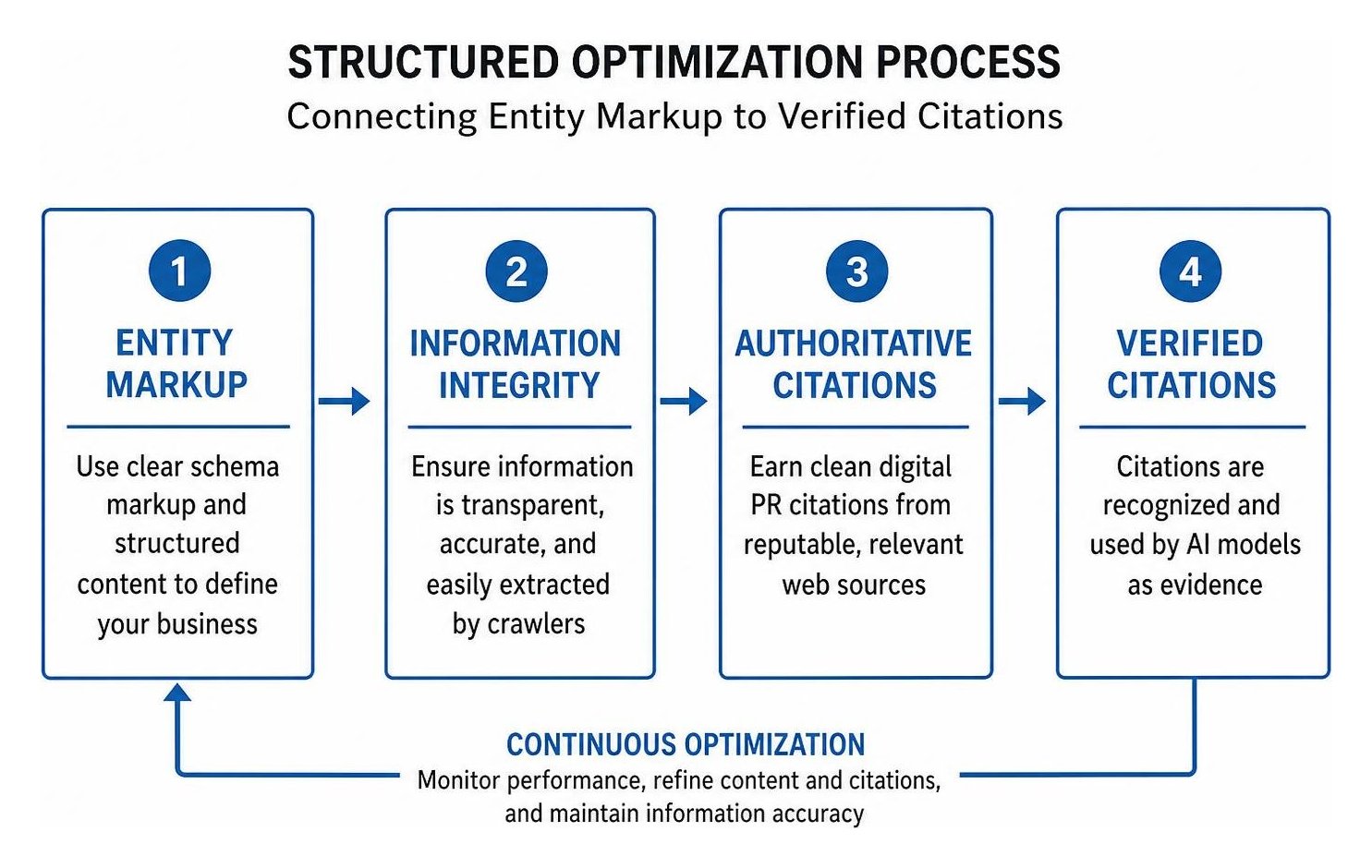
To convert recommendation mechanics into measurable organic growth, structure your online information to be transparent, authoritative, and easily extracted by machine crawlers.

AI models favor clarity over marketing ambiguity. To ensure generative engines select your business during evaluation stages, focus on information integrity across your entire digital presence. You can accelerate this process by optimizing content for AI answer engines using clear schema markup, direct question-and-answer formats, and transparent pricing structures. At SmallBizSEO, we use our proprietary "Velocity" framework to help small businesses implement technical SEO, clean digital PR citations, and structured content strategies that provide clear proof to generative answer engines.
How Can You Measure True Recommendation Rate Beyond Raw Mentions?
Measure your true recommendation rate by running repeated, multi-run prompt tests and calculating the percentage of queries that yield an explicit endorsement rather than a passive mention.
Generative engines are probabilistic systems; there is less than a 1 in 100 chance that an AI model will generate the identical list of brands across 100 repeated runs of the same query. Because single prompt tests provide unreliable snapshots, robust tracking requires running prompt sets across multiple iterations.
To calculate your true metric, use this basic formula:
Recommendation Rate = (Explicit Brand Endorsements ÷ Total Valid Test Runs) × 100
By separating passive mentions from explicit endorsements, businesses can build an effective, data-driven brand recommendation strategy that identifies exact evidence gaps, counters competitor positioning, and secures consistent placement in modern generative search.
Action Steps to Win the AI Recommendation
Securing product recommendations in modern AI search requires moving beyond standard keyword rankings to engineer verifiable evidence across the web.
- Audit Your Entity Presence: Test your core commercial queries across leading AI engines using dual-order prompt sets to eliminate position bias.
- Eliminate Hesitation Triggers: Publish clear pricing boundaries, technical integration guides, and explicit customer constraints to pass elimination filters.
- Build Third-Party Consensus: Strengthen external reviews, industry analyst coverage, and digital PR citations so AI retrieval agents discover consistent, verified facts.
- Monitor Grounded Endorsements: Track your recommendation rate monthly using multi-run testing, focusing on whether citations guide buyers directly to your official channels.