Why Generative Search Engines Keep Changing Their Top Brand Picks
Why Generative Search Engines Keep Changing Their Top Brand Picks
How often do AI search citations and brand picks change?
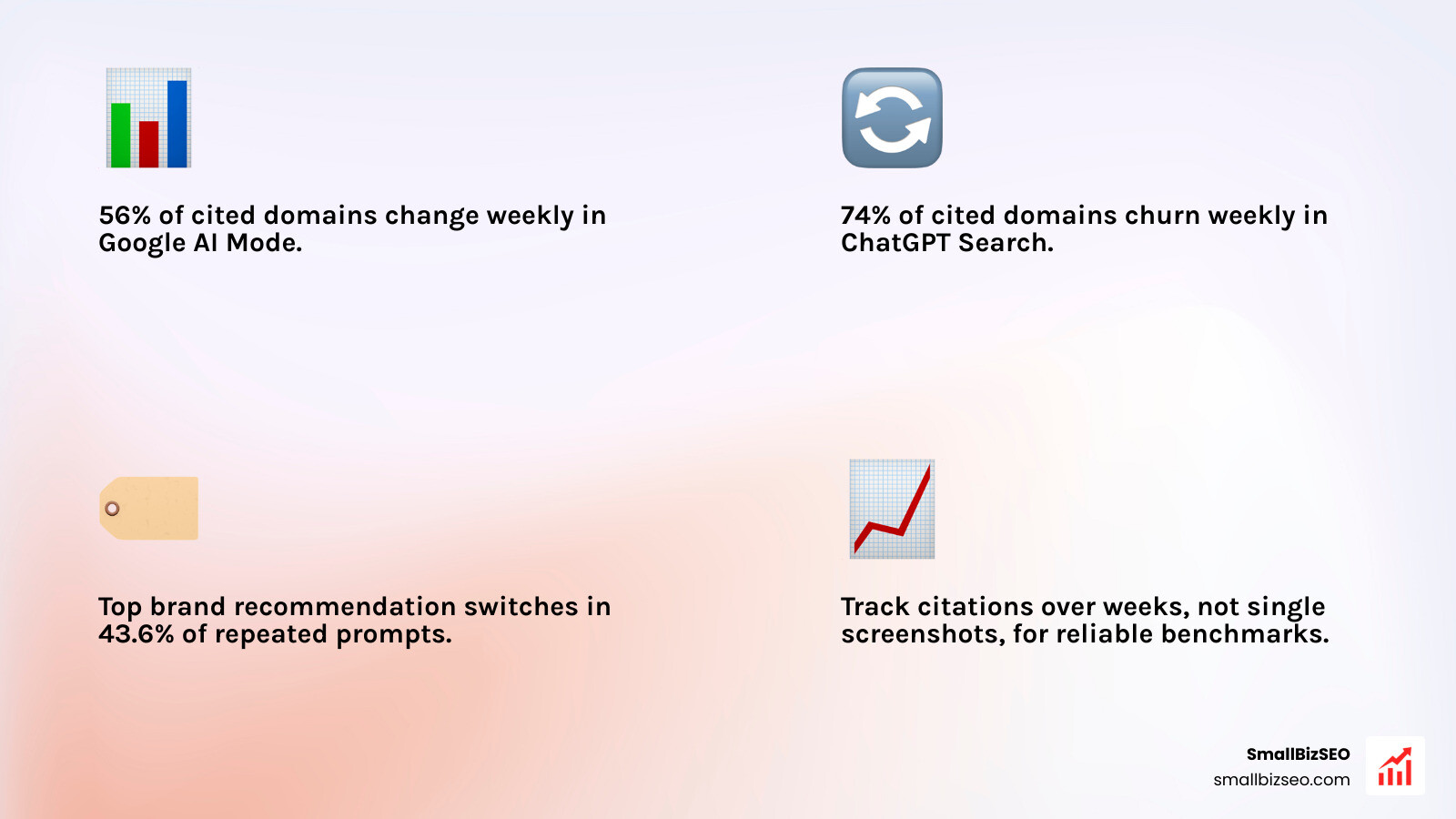
Often enough that one answer is not a reliable benchmark. In a 17-week analysis, about 56% of cited domains changed from week to week in Google AI Mode, compared with 74% in ChatGPT Search. Brand picks can shift too: a study of repeated answers found that the top brand changed in 43.6% of consecutive responses to the same prompt. These figures measure different things, but both show why a single spot-check can mislead you.
To measure consistency for your business, repeat the same buyer questions on each platform. Track which sources stay, which are new, and how often your brand appears. Look at the pattern over several weeks, not one screenshot.
I'm Clayton Johnson, founder of SmallBizSEO, where I help small businesses build search visibility through SEO, content, and digital PR. My work in AEO and GEO informs this guide to How Frequently Do AI Search Engines Change Their Recommendations? Citation Consistency Statistics.
How Frequently Do AI Search Engines Change Their Recommendations? Citation Consistency Statistics terms at a glance:
- Consumer Trust in Artificial Intelligence: Survey Statistics and Buying Behavior
- AI Brand Recommendation Statistics: How Often Do Small Businesses Appear Alongside Major Brands?
- AI-Generated Content Statistics: How Much of the Internet Is Created by AI?
How Frequently Do AI Search Engines Change Their Recommendations? Citation Consistency Statistics
AI search engines change their underlying sources constantly because they are probability engines rather than static link databases. While a traditional search engine index remains relatively stable day-to-day, generative models synthesize new responses on the fly.
Our research into generative search behavior reveals that citation turnover follows clear structural patterns across different platforms.
| Metric / Dimension | Google AI Overviews | Google AI Mode | ChatGPT Search |
|---|---|---|---|
| Weekly Domain Churn | 26.8% - 56% | 56% | 74% |
| URL-Level Weekly Drift | 45.5% | ~80% | 85% |
| Stable Core Existence | 53% of prompts retain fixed sources | 86.5% retain 1–5 core domains | <1% permanent core stability |
| Top Pick Switch Rate | ~35% | 42.6% | 44.7% |
| Brand Silence Rate | 9.1% | Low | 43.4% |
| Overlap with Organic Top 10 | 17%–38% | Moderate | Low |
How Frequently Do AI Search Engines Change Their Recommendations? Citation Consistency Statistics Across Platforms
Across major platforms, citation volatility is widespread. Google AI Mode replaces 56% of cited domains every seven days. In ChatGPT Search, domain turnover reaches 74% per week. At the specific URL level, volatility is even sharper: 85% of URLs cited by ChatGPT change weekly.
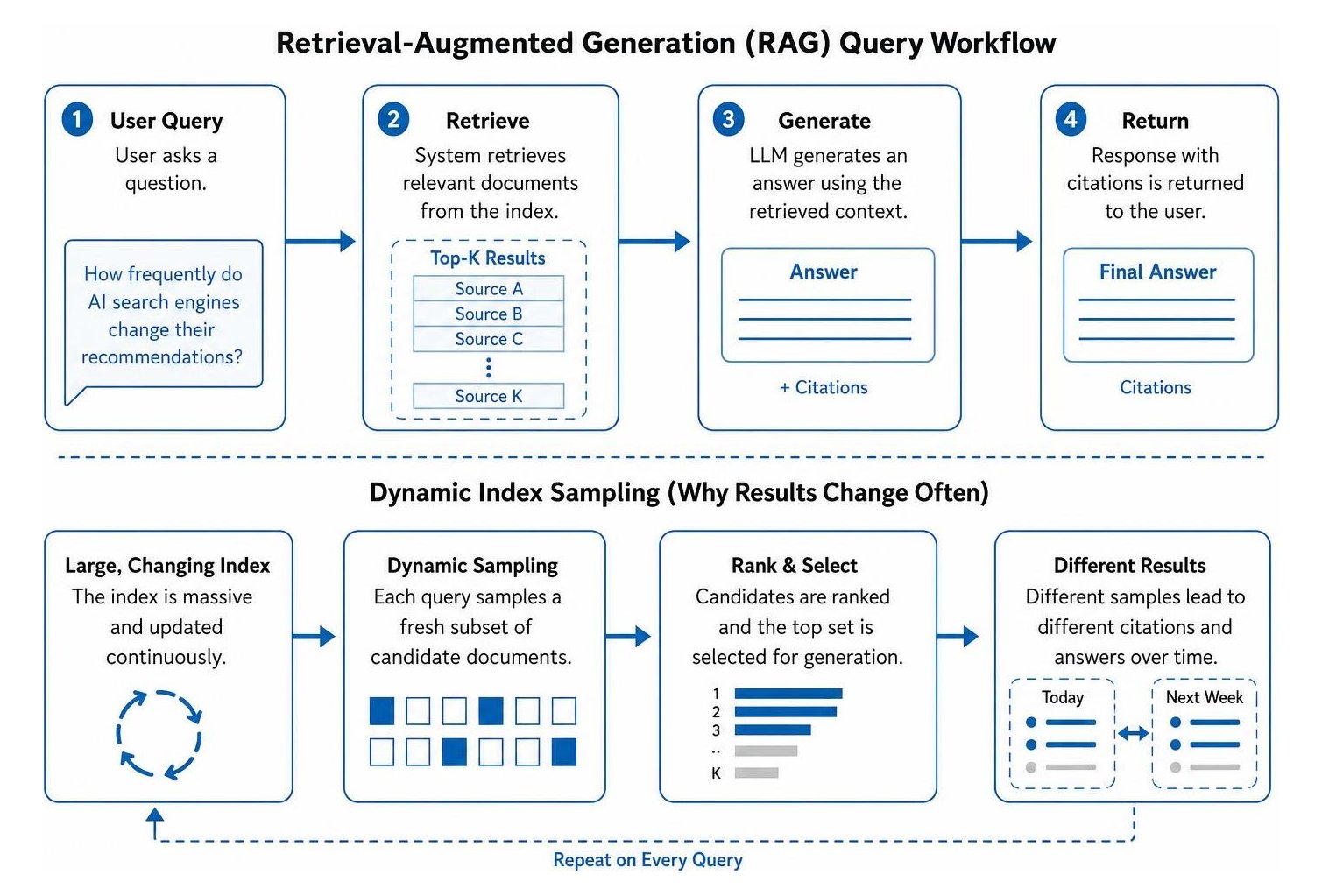
When we examine immediate repeats, the CiteLens research on AI answer consistency demonstrates that cited source sets remain fully identical only 81% of the time across three identical queries, with an average of 3.2 domains swapping out per repetition.
Furthermore, the Parse study on AI brand recommendation repeatability evaluated over 161,000 consecutive answer pairs and discovered that the number-one recommended brand changed 43.6% of the time. Even across identical prompts, Google AI Overviews and ChatGPT agree on recommended brands less than 39% of the time, highlighting an architectural divergence between engines.
What Root Causes Explain How Frequently Do AI Search Engines Change Their Recommendations? Citation Consistency Statistics
Three primary mechanics drive citation inconsistency:
- Probabilistic Sampling Temperature: Large language models calculate the probability of the next word rather than retrieving static text. Slight variance in sampling parameters creates divergent phrasing and triggers different web retrievals.
- Live Retrieval-Augmented Generation (RAG) Shifts: As detailed in the Visiby analysis of AI answer volatility, engines constantly pull fresh index data from live crawlers. A minor shift in index freshness swaps out supporting links.
- Consensus Drift on Community Forums: Generative systems rely heavily on discussions from platforms like Reddit and industry forums. As user comments shift, the AI's consensus summary adjusts accordingly.
Traditional organic rankings also do not guarantee citations. Only 17% to 38% of URLs cited in Google AI Overviews appear within the traditional top 10 organic results for the same query. Earned media and third-party reviews account for roughly 84% of AI citations, leaving brand-owned domains to compete for a smaller citation share.
Which Domain Types and Content Formats Achieve High Citation Retention?
Not all content types suffer equal volatility. Certain foundational domains secure consistent placement while temporal content rapidly disappears.
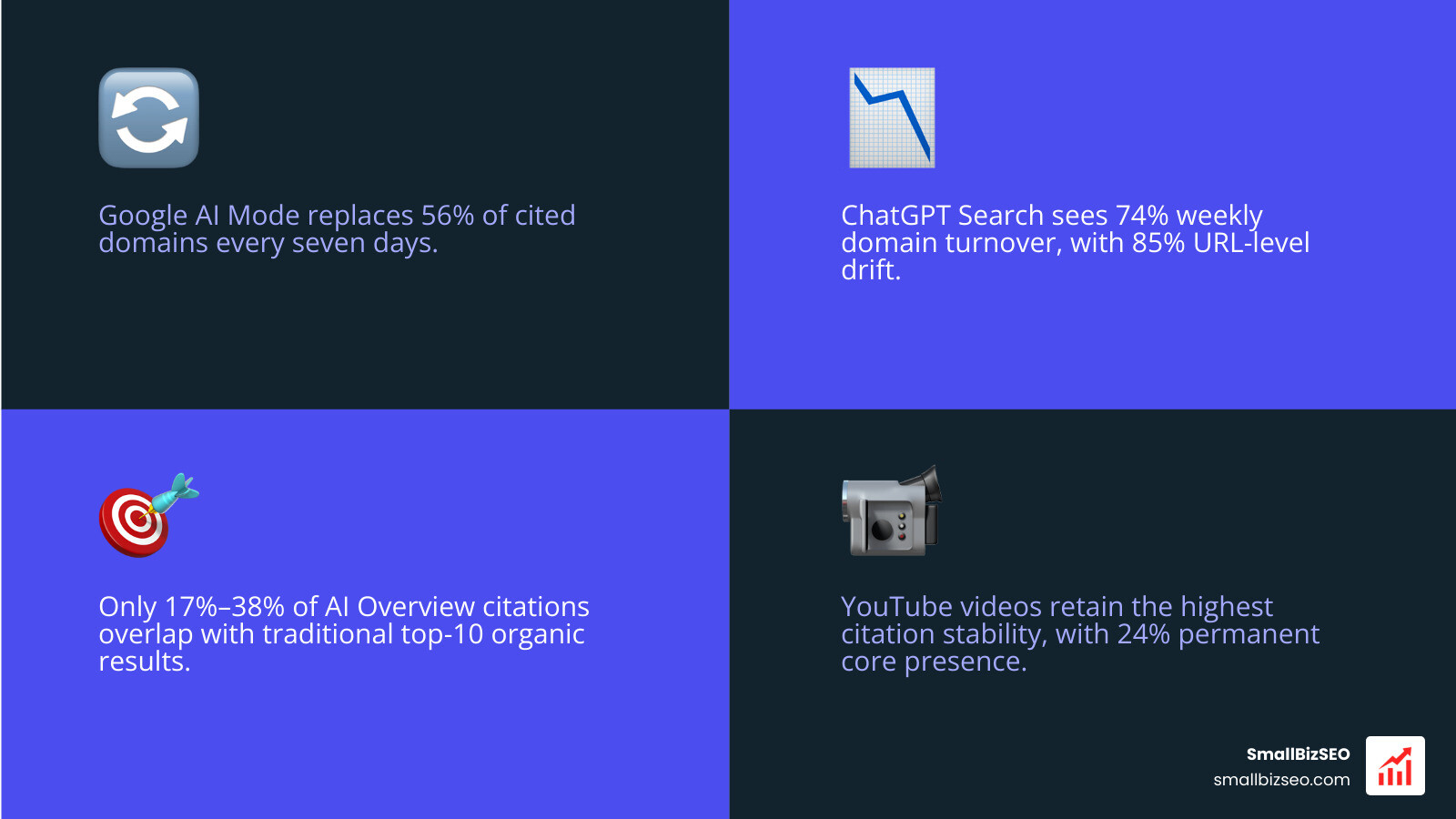
- Video Resources (YouTube): Retains the highest stability, appearing in 53% of Google AI Mode answers with a 24% permanent core presence.
- Brand-Owned Websites: In 43% of branded queries, the primary company website remains cited continuously over several months, though surrounding co-citations rotate at 70% weekly.
- Third-Party Review Hubs & Marketplaces: Maintained as trusted contextual references across category-level prompts.
- News and Editorial Articles: Highly perishable; only 1.4% of cited news URLs remain permanently in answer sets after initial publication cycles.
As highlighted in the McKinsey analysis on winning in AI search, establishing authority across evergreen, high-utility digital assets is critical for retaining long-term visibility as search shifts from clicks to synthesis.
How Businesses Can Measure and Stabilize Brand Recommendations in AI Search
Treating AI search as a deterministic leaderboard leads to flawed marketing decisions. Because generative engines produce probabilistic answers, businesses must adopt statistical Share of Voice tracking.
To build a reliable measurement framework, follow these strategic steps:
- Run Prompt Clusters: Test 10 to 50 buyer-intent queries repeatedly across all primary engines rather than logging single snapshots.
- Calculate Appearance Frequency: Measure the percentage of prompt runs where your brand appears instead of tracking an imaginary fixed rank.
- Audit Knowledge Signals: Conduct the AI SEO audit to track signals that matter to LLMs, verifying schema markup, factual accuracy, and structured data.
- Expand Earned Media Presence: Secure features in third-party publications and comparison roundups, which supply the vast majority of generative search citations.
- Monitor Co-Citation Velocity: Track which competitors appear alongside your brand and identify displaced links weekly.
Why Do Single Spot-Checks Fail for AI Visibility Tracking?
A single prompt check represents one draw from a complex probability distribution. The GuideX test on ChatGPT response variance demonstrated that identical prompts share as little as 32% to 43% of their cited sources within a 24-hour window. Spot-checking creates false confidence or unneeded panic.
Instead of manual checks, deploy multi-run telemetry across platforms to establish confidence intervals and calculate true generative visibility.
How Can Brands Optimize Content for Lasting Citation Stability?
Stabilizing your presence requires optimizing for machine extractability. Applying modern AI SEO best practices ensures that language models can easily parse, verify, and quote your information.
Craft standalone factual sentences that clearly answer core industry questions without relying on ambiguous context. Bolstering your entity profile with Schema.org markup allows crawlers to connect your brand to specific solutions. Explore advanced generative engine optimization strategies to turn your digital assets into preferred primary sources. Reviewing these 50 generative AI statistics every business owner should know will help your team navigate how generative discovery is reshaping organic growth.
Mastering Citation Consistency in the Generative Era
Generative engines are dynamic recommendation systems that re-evaluate sources with every user interaction. Expecting static rankings in this landscape is like expecting the ocean tide to stay in one place. By tracking mention percentages across multiple prompt runs and publishing structured, authoritative content, businesses can build durable search visibility that thrives despite weekly citation drift.