How to Benchmark Your Brand’s Presence Across Generative Engines
How to Benchmark Your Brand's Presence Across Generative Engines
AI Search Visibility by Industry: Which Businesses Appear Most Frequently in AI Answers?
AI models cite businesses most frequently when their content provides direct factual answers, structured data, and verifiable third-party validation. While overall trigger rates vary, platforms heavily favor brands that simplify information retrieval for large language models. Understanding AI search visibility by industry helps clarify which businesses appear most frequently in AI answers and why certain sectors earn outsized citation share.
Across search platforms, roughly 48% of tracked queries now trigger synthesized AI answers, climbing to 57.9% for direct questions. This shift has altered traditional traffic patterns: overall zero-click rates have reached 58%, and when users browse within dedicated AI modes, zero-click behavior rises to 93%. When an AI summary appears, standard organic click-through rates drop by an average of 61%. However, brands featured inside those summaries enjoy a 35% lift in clicks, and traffic referred directly by AI engines converts at 14.2% compared to traditional web search baselines of 2.8%.
| Industry Sector | AI Overview Trigger Rate | Zero-Click Exposure Rate | Primary Citation Driver | Dominant Content Format |
|---|---|---|---|---|
| Healthcare & Medical | 88% | High (91%+) | Clinical consensus & E-E-A-T | Direct Q&A & structured guides |
| SaaS & Technology | 52% | Moderate (64%) | Entity density & documentation | Comparison tables & listicles |
| Local Services | 59% (live search) | High (88%) | Directory trust & NAP profile | Location schema & reviews |
| Finance & Fintech | 46% | High (82%) | Organic search rank & regulatory proof | Feature matrices & use cases |
| E-Commerce & Retail | 39% | Moderate (55%) | Product schema & review volume | Buying guides & feed data |
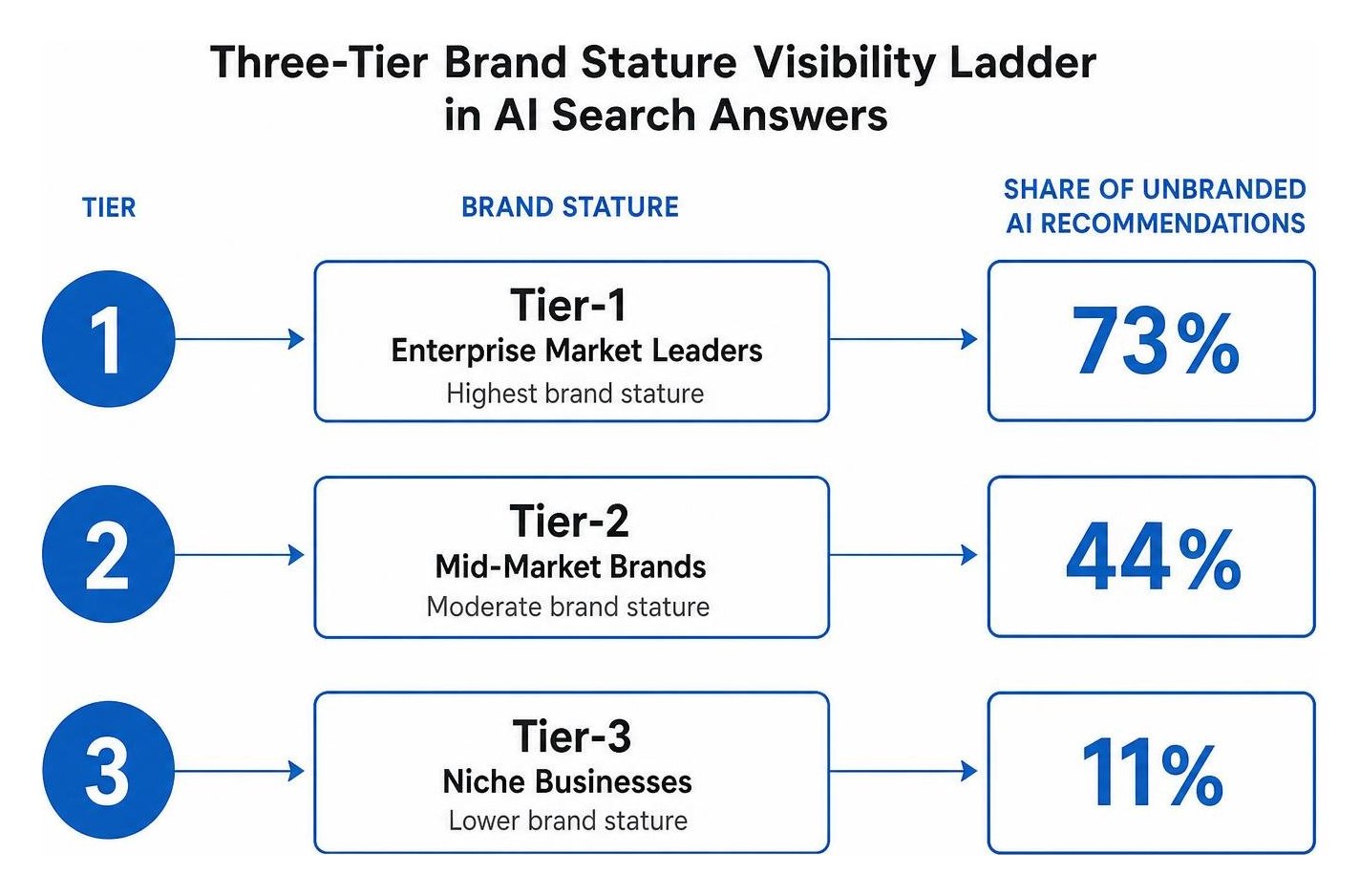
Empirical findings published in Generative Engine Optimization at Scale: Measuring Brand Visibility Across AI Search Engines reveal a distinct brand-stature ladder. Tier-1 enterprise market leaders appear in approximately 73% of unbranded AI recommendations, Tier-2 mid-market brands capture 44%, and Tier-3 niche businesses secure only 11%. Corporate websites represent 78% of all cited domains, while ranked "best-of" listicles alone drive 21% of citations across engines. Reviewing broader generative AI statistics shows that factual density and machine crawlability remain the bedrock of Generative Engine Optimization (GEO).
1. Healthcare and Medical: Why Do High-Trust Queries Drive an 88% Citation Trigger Rate?
Healthcare queries produce an 88% AI Overview trigger rate because search engines treat medical inquiries as Your Money or Your Life (YMYL) topics requiring authoritative consensus.
Because health advice carries high real-world stakes, language models rely heavily on vetted medical portals, peer-reviewed clinical summaries, and accredited medical institutions. AI engines rarely cite individual private clinics for general symptom searches unless the query explicitly contains local intent. Instead, systems synthesize clinical guidance and cite publishers that supply clear, answer-first medical explanations backed by medical schema markup.
To earn visibility in medical and wellness verticals, organizations must combine strict E-E-A-T standards with practical AEO optimization strategies. This involves formatting informational pages with clear direct definitions, author credentials from licensed medical practitioners, and citations pointing to recognized research databases.
2. SaaS and Technology: Which Businesses Appear Most Frequently in AI Answers?
SaaS and technology companies earn frequent AI citations by publishing clear technical documentation, integration directories, and detailed product matrices.
In software searches, AI assistants frequently answer prompt queries like "what is the best CRM for small teams?" In these unbranded comparisons, platforms surface tools that possess strong entity density and clear public product documentation. When software companies hide pricing, capabilities, and API details behind gated forms or complex scripts, AI crawlers struggle to extract the required facts.
Recent AI brand recommendation data illustrates that third-party software review directories, ranked listicles, and technical documentation serve as the main sources for LLM software summaries. To appear consistently, software brands must maintain public comparison pages, publish structured feature tables, and ensure their products are actively cataloged across reputable tech publications.
3. Local Services and Hospitality: Which Businesses Appear Most Frequently in AI Answers?
Local service businesses and hospitality providers dominate AI recommendations when they maintain unified directories, strong customer reviews, and local structured data.
When consumers ask chatbots for nearby service providers, roughly 31% of general conversational prompts trigger real-time web retrieval—and local intent drives 59% of those live queries. Over 80% of business recommendations generated by AI engines come from companies with verified footprints across multiple trusted platforms.
Local businesses that appear across industry blogs, local news articles, and structured directories are mentioned three times more often by AI models than those relying solely on their own website. Key ranking signals include:
- Consistent business name, address, and phone number (NAP) data across all major map platforms and local directories.
- Active customer reviews describing specific services and project outcomes.
- Complete LocalBusiness and Service schema markup implemented directly on location landing pages.
4. Finance, Fintech, and Insurance: How Do Entity Density and Incumbent Authority Affect Citations?
Financial and insurance brands secure AI mentions when they combine established organic search authority with structured, entity-dense product content.
According to the FintechSpecs LLM Citation Benchmark, payment infrastructure and banking incumbents dominate AI answers because their documentation defines explicit use cases and API parameters. In contrast, specialized compliance automation and fraud management tools face lower citation rates due to a lack of public, machine-readable comparison data.
Because finance is a YMYL vertical, AI engines establish an authority feedback loop: they prioritize brands already ranking well in standard search results and corroborate those details with independent financial news sources and regulatory filings. Brands in this space must publish transparent feature breakdowns, maintain clean knowledge-graph associations, and leverage structured comparison tables to secure citations.
5. E-Commerce and Retail: How Do Product Details and Commercial Intent Affect Citations?
Retail and e-commerce brands appear in AI answers by maintaining crawlable product feeds, comprehensive buying guides, and structured item markup.
Commercial intent on conversational platforms is growing rapidly, with shopping queries jumping from 7.8% to 9.8% of all prompt volume. According to McKinsey AI Search Research, conversational search is becoming a primary digital storefront for evaluating consumer goods.
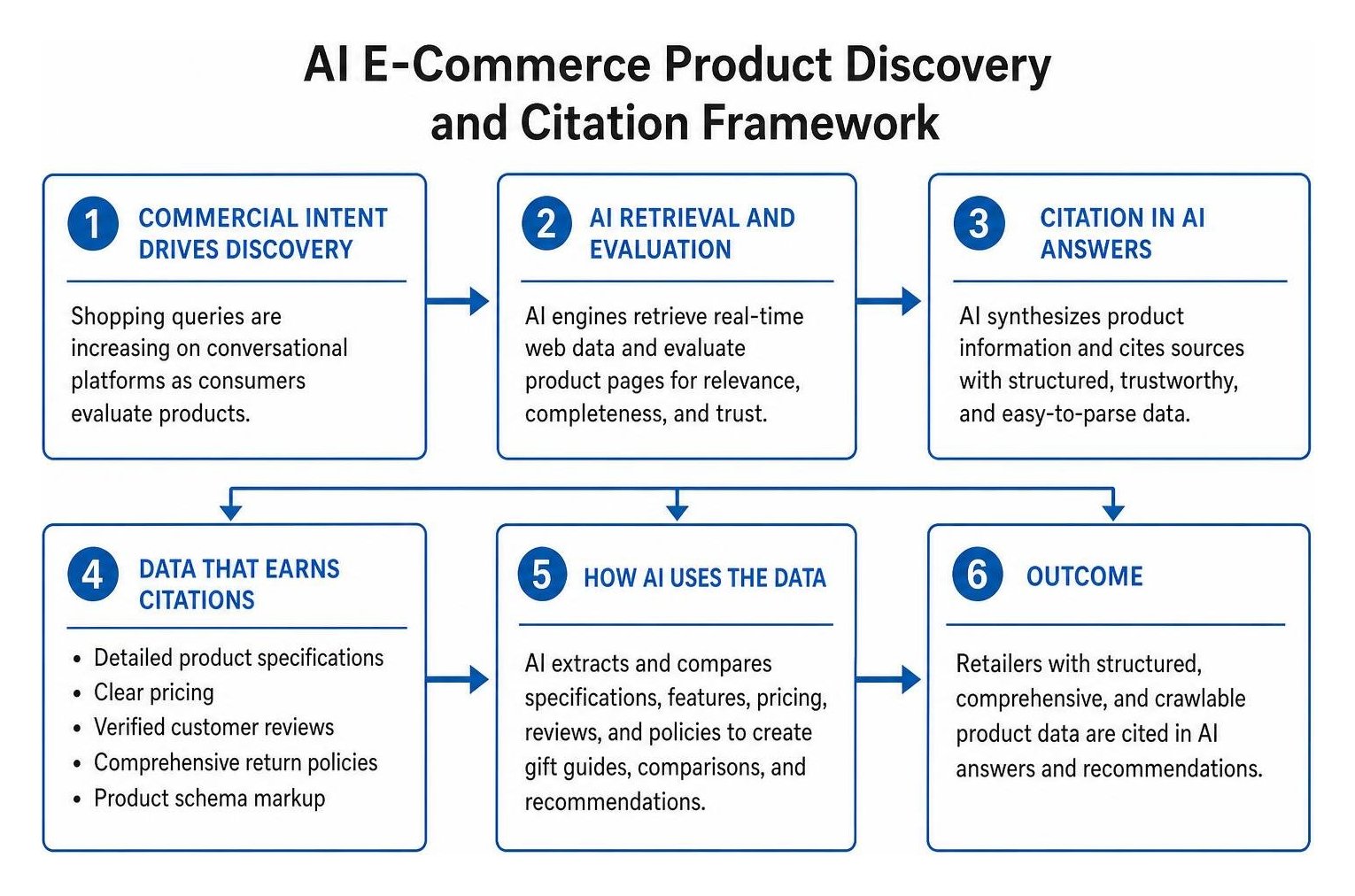
To win citations during product evaluations, retailers must provide detailed product specifications, clear pricing, verified customer reviews, and comprehensive return policies formatted with Product schema. When an AI synthesizes a gift guide or product comparison, it extracts data from sites that organize specifications into structured, easily digestible formats.
How Can Businesses Maximize Brand Citations Across Generative Search Engines?
Businesses can improve their AI visibility by adopting an Answer-Ready SEO strategy that combines crawlable site architecture, entity optimization, and third-party authority building.
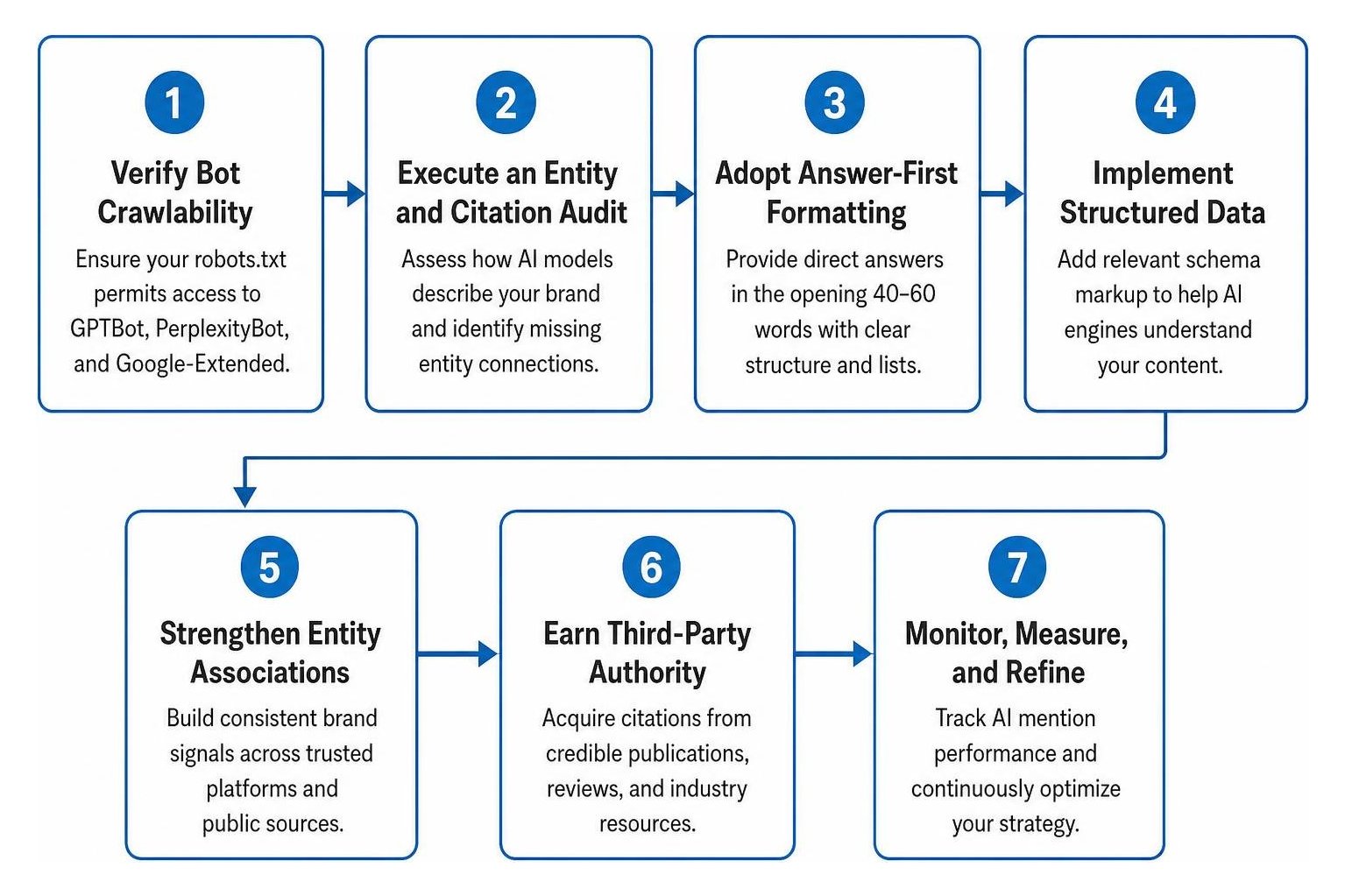
To systematically build AI search visibility across all platforms, our team at SmallBizSEO recommends following a multi-step Generative Engine Optimization framework:
- Verify Bot Crawlability: Ensure your
robots.txtfile permits access to major search bots like GPTBot, PerplexityBot, and Google-Extended. Currently, 85% of top news sites block AI bots, creating a major citation advantage for brands that remain accessible. - Execute an Entity and Citation Audit: Perform a comprehensive AI SEO audit to assess how AI models currently describe your brand and identify missing entity connections.
- Adopt Answer-First Formatting: Structure key informational pages with direct answers in the opening 40 to 60 words, followed by descriptive subheadings, bulleted lists, and factual comparison tables.
- Implement Structured Schema Markup: Deploy Organization, LocalBusiness, Service, Product, and FAQPage schema across your digital assets to help language models parse your core entities.
- Expand Third-Party Footprints: Secure coverage in authoritative industry publications, digital PR features, and reputable directories to build off-page source consensus.
- Publish Original Data and Quotable Facts: Supply proprietary research, clear statistics, and definitive industry insights that AI engines can extract and reference.
- Deploy Ongoing Tracking: Monitor your brand mentions, citation share of voice, and referral traffic using expert AI SEO services to continuously refine your digital presence.
By focusing on machine-readable structure, verified facts, and consistent authority across the web, any business can capture valuable AI search real estate and connect with high-intent buyers.