Why Intent Data Fails Without Ground-Truth Lead Validation

What does ground-truth lead validation reveal about intent data?
To understand how to validate buyer intent with actual lead outcomes, record each signal's source and date, match it to a lead or account in your CRM, and track whether that lead becomes a qualified opportunity or customer. Compare conversion rates for leads with and without the signal. Then use a random holdout test to check whether acting on the signal improves results.
A pricing-page visit or research spike shows possible interest, not proof of a sale. The gap matters because a signal can look promising while producing few qualified leads.
I'm Clayton Johnson, founder of SmallBizSEO, where my work connects SEO, content, and conversion paths to the goal of attracting qualified leads. That focus guides how I explain how to validate buyer intent with actual lead outcomes: start with the signal, but judge its value by what happens next.
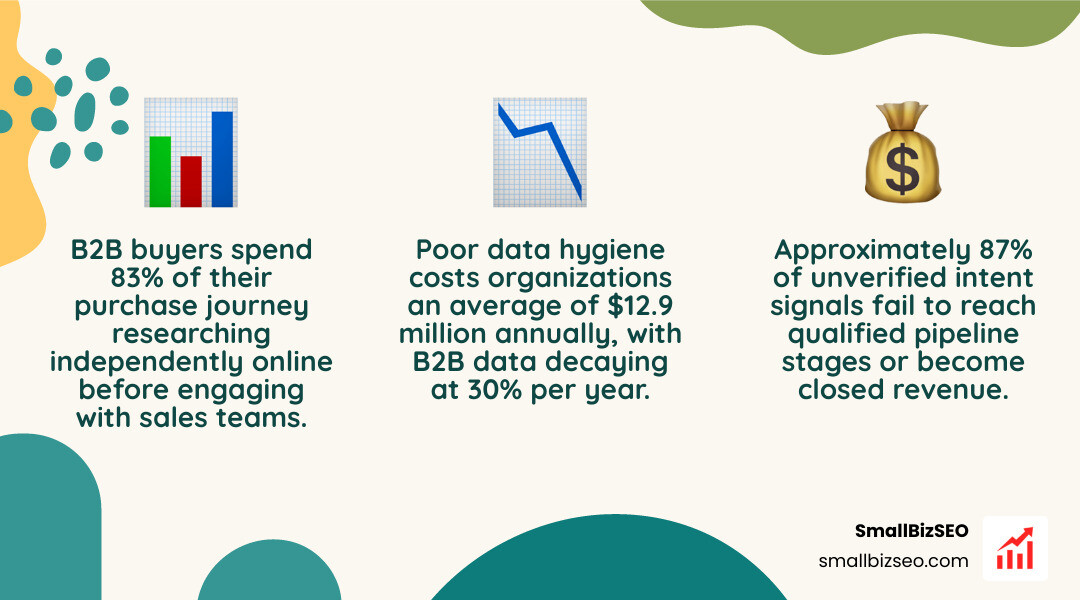
Ground-truth validation reveals that raw interest rarely matches bottom-line revenue. Research shows that B2B buyers spend 83% of their purchase journey researching independently online, reading reviews, and exploring options before ever speaking with a sales team. While 99% of businesses utilizing intent data report improved campaign return on investment, relying on unvalidated digital footprints creates substantial pipeline discrepancies. In fact, approximately 87% of unverified intent signals fail to reach qualified pipeline stages.
Without cross-referencing intent spikes against real sales data, marketing teams end up allocating budget toward false positives. B2B data decays at a rate of roughly 30% each year, and analyst reports indicate that poor data hygiene costs organizations an average of $12.9 million annually. Connecting upstream behavior to verified CRM outcomes ensures your team focuses energy on accounts genuinely ready to buy.
How do you validate buyer intent with actual lead outcomes?
To validate buyer intent with actual lead outcomes, map every inbound and outbound intent signal directly to your CRM milestones and evaluate which behaviors statistically correlate with closed-won revenue.
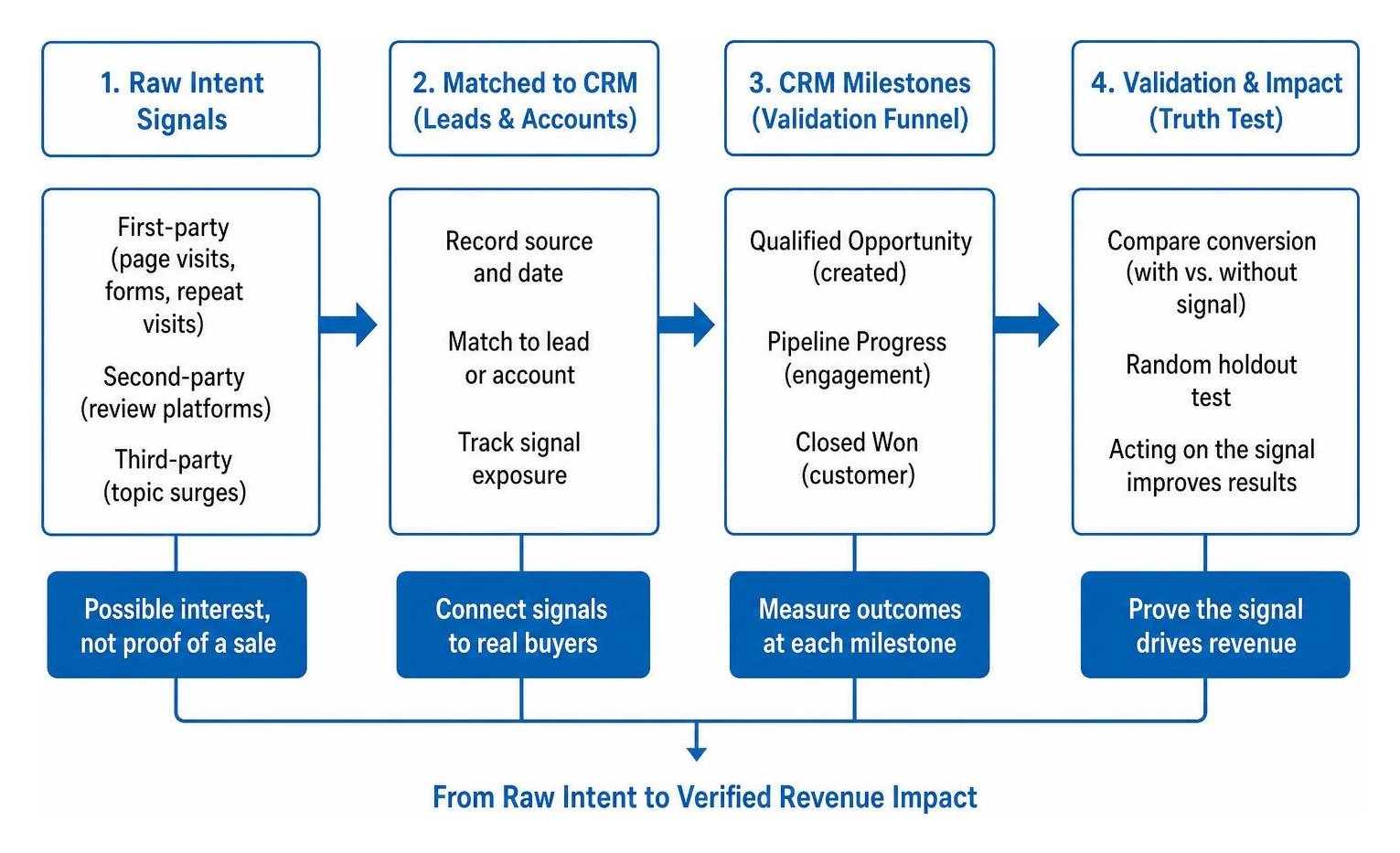
Validating intent begins with robust conversion tracking that captures both the origin and the context of a buyer's actions. Rather than treating all digital interactions equally, modern revenue operations require a tiered approach that evaluates first-party, second-party, and third-party intent against real pipeline milestones.
First-party data—such as high-intent page engagement, demo form submissions, and repeated visits from a target account—offers the highest predictive value. Second-party data from trusted review platforms highlights mid-funnel vendor evaluations, while third-party topic surges provide broad, early-stage awareness clues.
| Intent Signal Layer | Primary Data Sources | Validation Fidelity | Correlation to Closed Revenue |
|---|---|---|---|
| First-Party Intent | Website behavior, pricing visits, product documentation | High | Very High (Direct buying interest) |
| Second-Party Intent | Review sites, partner ecosystem engagement | Medium-High | High (Active vendor comparison) |
| Third-Party Intent | B2B publishing networks, content syndication topic surges | Medium-Low | Moderate (Needs fit and timing verification) |
Effective validation requires analyzing signal recency and buying committee engagement. High-intent surges from 0 to 7 days old carry the highest conversion potential, whereas unaddressed signals older than 30 days degrade significantly. Furthermore, because modern B2B buying committees involve multiple decision-makers, true purchase readiness emerges when multiple stakeholders from the same account interact with commercial assets within a tight timeframe.
Why do intent signals diverge from real pipeline outcomes?
Intent signals diverge from actual pipeline results because raw behavioral clicks often represent surface-level curiosity, academic research, or competitor monitoring rather than active commercial buying intent.
Relying on traditional single-touch attribution hides the complex, multi-touch journey buyers take before talking to sales. When marketing teams judge performance solely on initial form submissions or high-volume content downloads, they mask underlying issues with lead quality. Only about 25% of all inbound marketing leads qualify for direct sales outreach.
This disconnect also stems from circular validation risks. When an automated system flags an account as high-intent and reps immediately prioritize it, that account receives disproportionate attention, creating a self-fulfilling loop where historical data simply reflects sales activity rather than genuine buyer motivation. To measure real buying readiness, teams must evaluate hard performance indicators:
- Intent-to-Opportunity Rate: Benchmark conversion sits between 3% and 8% for validated accounts.
- Win-Rate Differential: Verified intent accounts typically convert at 1.5x to 2x higher win rates compared to non-intent accounts.
- Pipeline Influence: Tracking whether intent signals consistently lift stage-to-stage deal progression.
What steps validate buyer intent against actual lead outcomes?
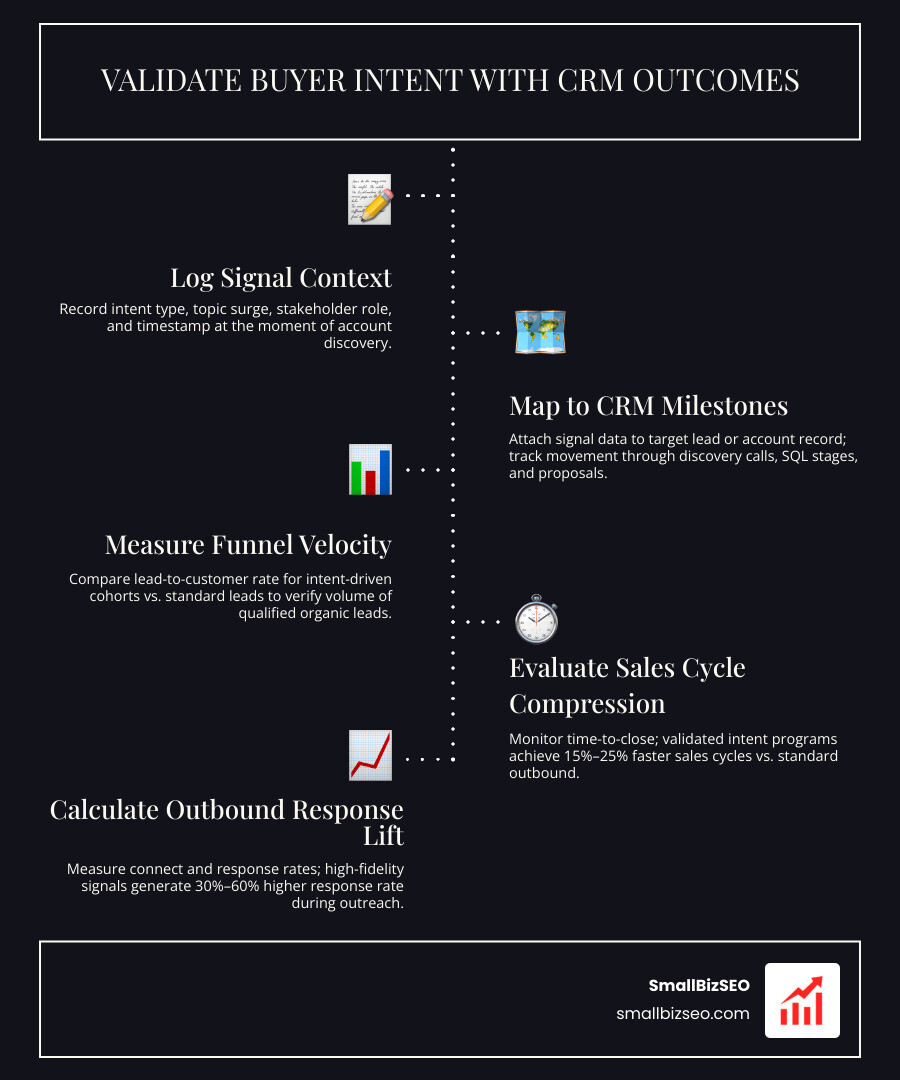
Validating buyer intent against CRM outcomes follows a structured five-step workflow that links digital footprints directly to revenue stages:
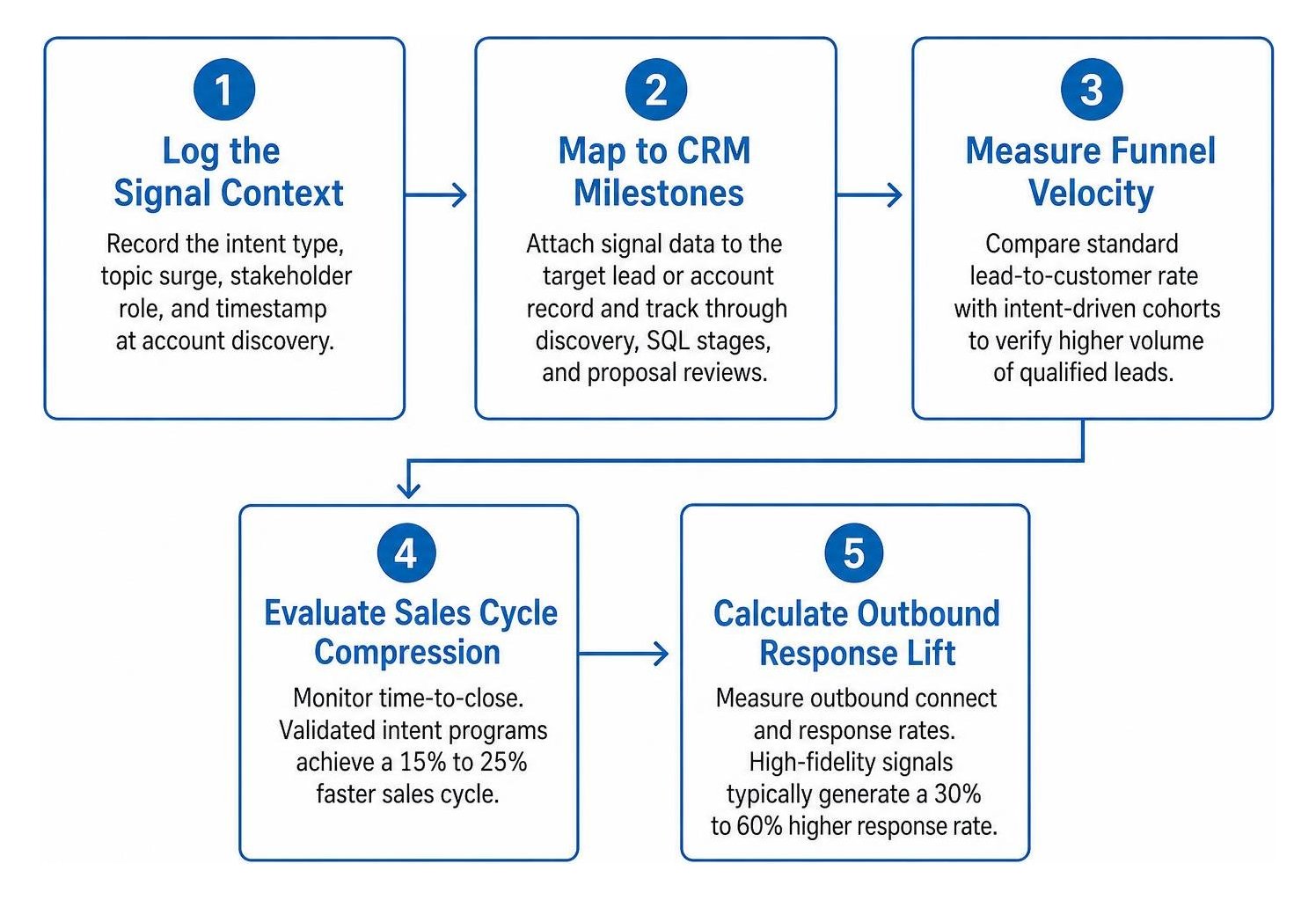
- Log the Signal Context: Record the exact intent type, topic surge, stakeholder role, and timestamp at the moment of account discovery.
- Map to CRM Milestones: Attach the signal data to the target lead or account record inside your CRM, tracking movement through discovery calls, sales-qualified stages, and proposal reviews.
- Measure Funnel Velocity: Compare your standard lead-to-customer rate against intent-driven cohorts to verify whether intent-sourced leads generate higher volume of qualified organic leads.
- Evaluate Sales Cycle Compression: Monitor the time-to-close metric. Validated intent programs achieve a 15% to 25% faster sales cycle compared to standard outbound lists.
- Calculate Outbound Response Lift: Measure outbound connect and response rates. High-fidelity signals typically generate a 30% to 60% higher response rate during sales outreach.
How can holdout tests measure true incrementality?
To prove that intent signals deliver real business impact rather than coincidental timing, revenue teams must execute randomized holdout experiments.
In a holdout test, target accounts showing similar intent scores are split into two groups: a test group (where sales reps receive real-time alerts and conduct signal-led outreach) and a control group (where intent alerts are withheld, and accounts receive standard marketing nurture or cold outreach).
Running this test over a 90- to 180-day cycle enables teams to isolate measuring incrementality with true statistical confidence. If the test cohort demonstrates significant gains in meeting booking rates, opportunity creation, and closed-won revenue compared to the control group, the intent signal is validated as a driver of sales velocity. If both cohorts convert at identical rates, the signal merely highlights accounts that would have purchased anyway, signaling a need to refine scoring parameters.
How do you use ground-truth feedback to improve scoring and operations?
To turn ground-truth insights into repeatable pipeline growth, feed downstream CRM results directly back into your scoring rules and RevOps workflows.
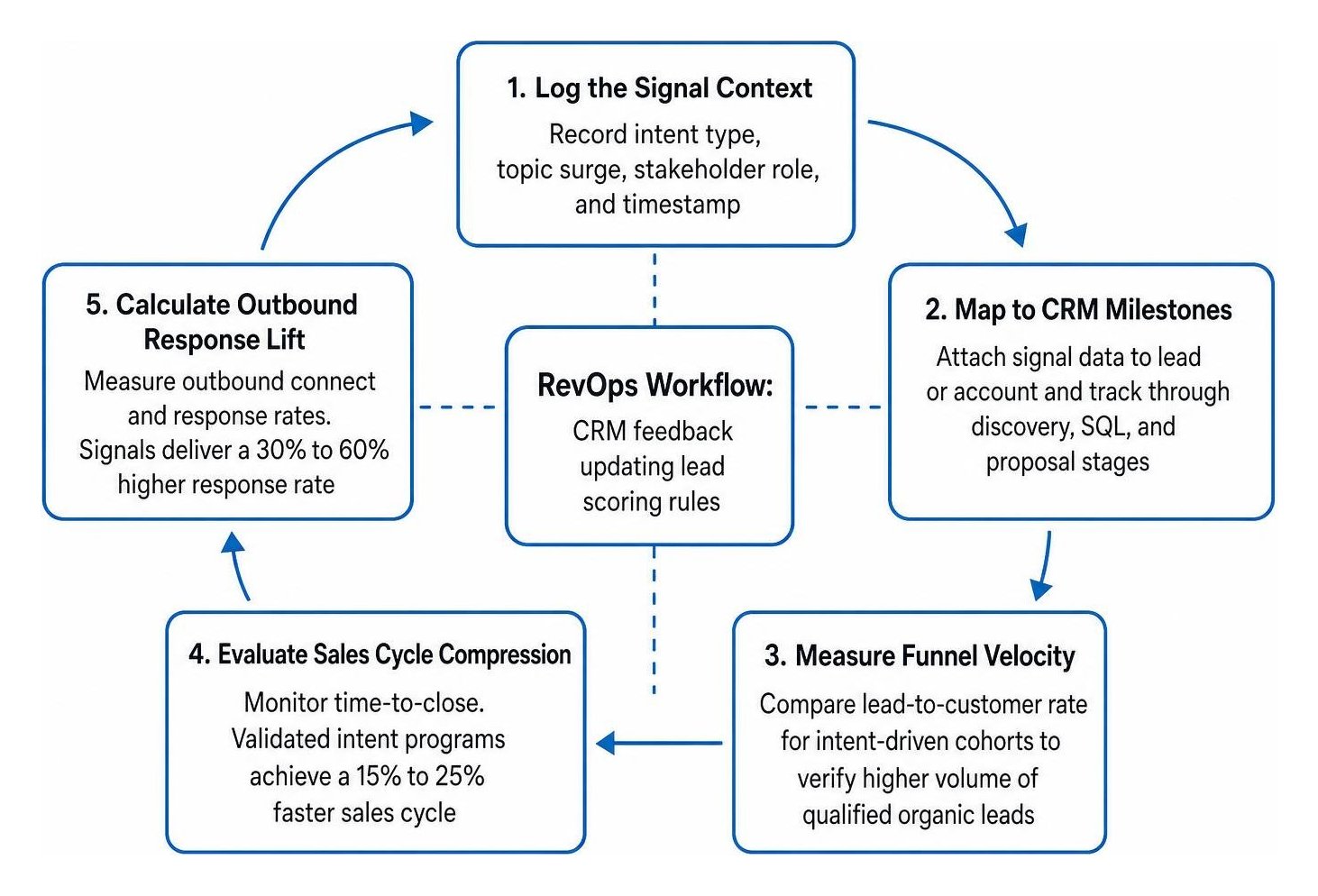
Using validated data allows teams to build composite scoring models that evaluate three distinct pillars: Account Fit (firmographics and technographics), First-Party Engagement (on-site actions), and Third-Party Intent (external research momentum).
Gating priority by fit ensures your reps do not spend time chasing accounts that cannot buy. Applying dynamic time-decay weighting prevents older, irrelevant research spikes from inflating scores, while establishing automated CRM routing ensures reps receive real-time notifications for accounts showing multi-touch commercial activity.
This systematic feedback loop lowers overall customer acquisition cost and ensures your go-to-market teams focus solely on high-yield opportunities.
How do you identify false positives in multi-touch intent data?
Teams can identify false positives by looking for multi-stakeholder participation and cross-channel behavioral evidence instead of reacting to isolated, single-contact events.
Single-user interactions—such as a student downloading a white paper or a competitor checking a pricing page—frequently trigger false alarms. Up to 38% of high-intent alerts produced by uncalibrated systems represent false positives.
To eliminate this noise:
- Apply the Three-Source Rule: Require confirmation across at least two independent channels (such as an external topic surge combined with an on-site visit) before escalating an account to sales.
- Evaluate Content Depth: Separate top-of-funnel educational reading from deep commercial evaluation. Teams must master understanding search intent and focus on analyzing keywords that reflect operational pain points and purchase criteria.
- Verify Buying Committee Coverage: Check whether multiple stakeholders across leadership, operations, or finance are engaging with your brand within the same evaluation window.
How should you recalibrate lead scoring and close the CRM feedback loop?
Lead scoring models fail when treated as static point systems. Arbitrary point assignments—like adding 10 points for every whitepaper download—inevitably flood sales pipelines with low-intent contacts.
Keep fit and intent scores completely separate:
Implement strict score-decay half-lives where behavioral scores drop by 50% after 14 days of inactivity and reset completely after 30 to 60 days.
Establish a quarterly recalibration cadence with your RevOps team. Review closed-lost disposition codes, disqualify patterns where sales reps reject more than 20% of passed leads, and adjust your algorithmic weights based on recent closed-won deals.
How do you measure revenue impact and long-term ROI?
Measuring the revenue impact of your intent validation program requires evaluating both leading pipeline indicators and trailing financial performance.
Track how intent-driven pipeline compresses deal cycles, increases SDR connect efficiency, and lifts average contract values. By implementing a systematic validation loop, teams eliminate wasted outbound capacity and build a predictable engine for pipeline creation. At SmallBizSEO, we help businesses capture authentic demand by pairing technical visibility with high-converting search strategies. Exploring a tailored SmallBizSEO buyer intent keyword strategy helps ensure your organic content targets high-fit decision-makers at the exact moment they are ready to evaluate solutions.
Turning Validated Intent Signals into Predictable Revenue
Validating buyer intent against real lead outcomes transforms raw data into a reliable revenue driver. By establishing objective CRM milestones, running holdout tests, eliminating single-contact false positives, and continually recalibrating your scoring models against closed deals, your team can focus resources where they matter most. Grounding your marketing and sales outreach in verified buyer behavior builds a resilient, highly efficient growth engine that consistently turns in-market interest into measurable revenue.