15 Vital Statistics on Consumer Trust in Artificial Intelligence

15 Vital Statistics on Consumer Trust in Artificial Intelligence
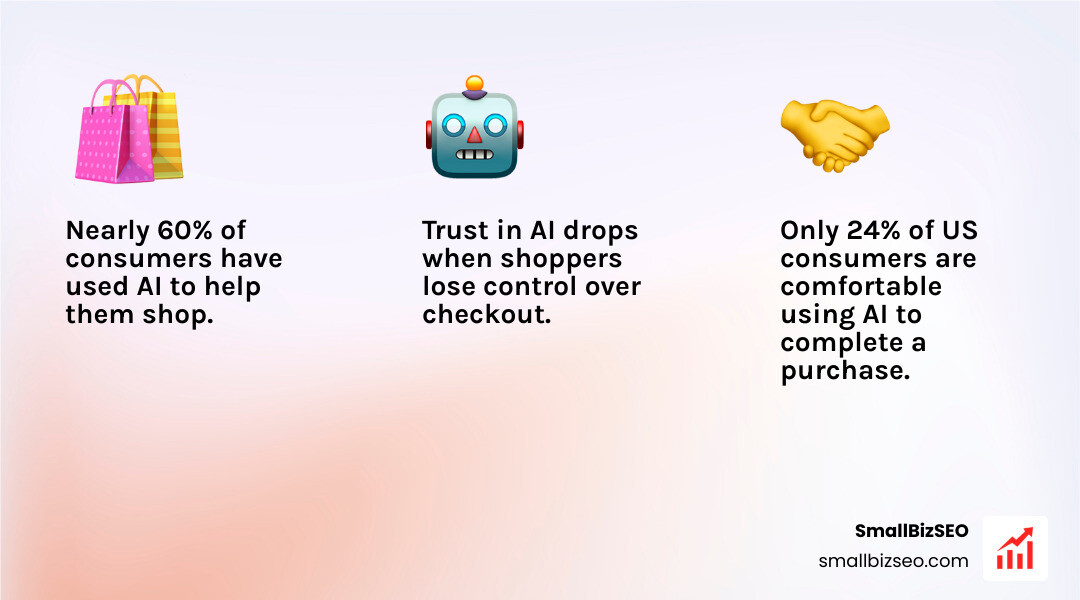
Shoppers are willing to use AI for advice, but many are not ready to let it buy for them. Nearly 60% of consumers in one survey said they had used AI to help them shop. In a separate US survey, just 24% said they were comfortable using AI to complete a purchase. These figures measure different groups and actions, but they show the key divide: getting a recommendation feels safer than handing over control of checkout.
Trust also depends on how businesses use AI. Shoppers want useful answers, clear data practices, and a way to reach a person when the decision matters.
I'm Clayton Johnson, founder of SmallBizSEO, where I help businesses make their expertise easier to find and trust through SEO and clear content. In this guide to Consumer Trust in Artificial Intelligence: Survey Statistics and Buying Behavior, I'll look at what the survey data means for shoppers and the businesses trying to earn their confidence.
Easy Consumer Trust in Artificial Intelligence: Survey Statistics and Buying Behavior word list:
- AI Brand Recommendation Statistics: How Often Do Small Businesses Appear Alongside Major Brands?
- AI Marketing Statistics: How Businesses Are Using Artificial Intelligence to Attract Customers
- Human vs. AI-Generated Content: Traffic, Engagement, and Conversion Statistics
What Do Surveys Show About Consumer Trust in AI and Buying Behavior?
Consumer surveys reveal that while shoppers appreciate AI for research and speed, trust declines sharply when automated tools ask for financial control or personal data. Shoppers use conversational tools to cut through digital clutter, yet they remain cautious about backend algorithms.
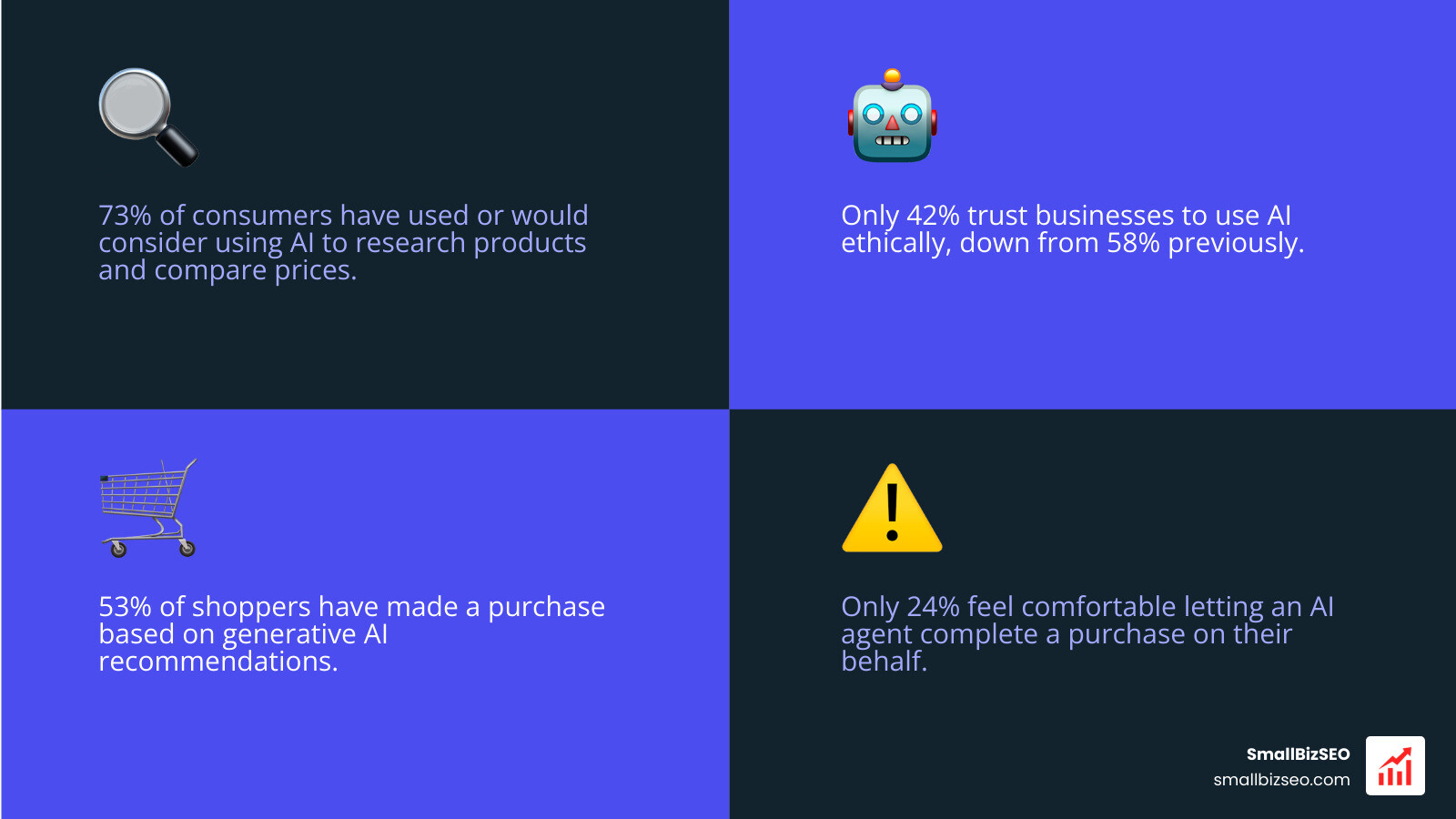
Recent studies show a distinct transition: artificial intelligence is no longer just a novelty; it is an active shopping partner. However, adoption rates outpace consumer confidence. While 73% of customers have used or would consider using AI to research products and compare prices, only 42% trust businesses to use these technologies ethically. This represents a significant decline from previous baselines of 58%, underscoring a growing trust deficit.
| Purchase Category | AI Assisted Research Rate | Comfort With Autonomous AI Checkout | Primary Consumer Concern |
|---|---|---|---|
| Fashion & Apparel | 62% | 34% | Fit accuracy, return friction |
| Consumer Electronics | 71% | 28% | Spec verification, price fairness |
| Everyday Groceries | 54% | 41% | Recurring charges, item freshness |
| High-Stakes Finance & Health | 29% | 8% | Data privacy, severe risk of error |
Shoppers use AI as a digital filter. According to research on consumer search behaviour in the LLM Era, modern buyers embrace a hybrid search journey. They rely on generative tools to summarize features and narrow down choices, but return to verified web pages and direct human reviews before pulling out their credit cards. Reviewing broader generative AI benchmark data shows that while computational accuracy drives initial clicks, personal trust determines final revenue.
Which AI Use and Buying Statistics Matter Most?
The most telling statistics show high everyday engagement alongside cautious checkout behavior. Although shoppers actively experiment with tools, actual delegation of transactions remains low.
- Daily Engagement: One-third of consumers spend more than an hour using AI tools every single day.
- Youth Adoption: 7 in 10 Gen Z consumers actively explore and use AI tools for daily tasks and product discovery.
- Direct Influence: 53% of shoppers have made a purchase based on generative AI recommendations, and 64% remain open to buying new products suggested by automated systems.
- Checkout Hesitation: A report on how agentic AI commerce hinges on consumer trust highlights that only 24% of consumers feel comfortable letting an AI agent complete a purchase on their behalf.
- Conversion Impact: Empirical modeling reveals that high-quality AI personalization increases consumer engagement and conversion likelihood by 42%.
These behavioral figures, reinforced by findings from Capgemini research on consumer AI adoption, confirm that automated recommendations provide immense discovery value even while autonomous buying functions face consumer friction.
When Do Consumers Trust AI More or Less?
Consumers trust AI heavily for objective, low-stakes lifestyle tasks, but distrust automated systems for high-stakes medical, financial, or legal decisions. Trust drops as personal risk rises.
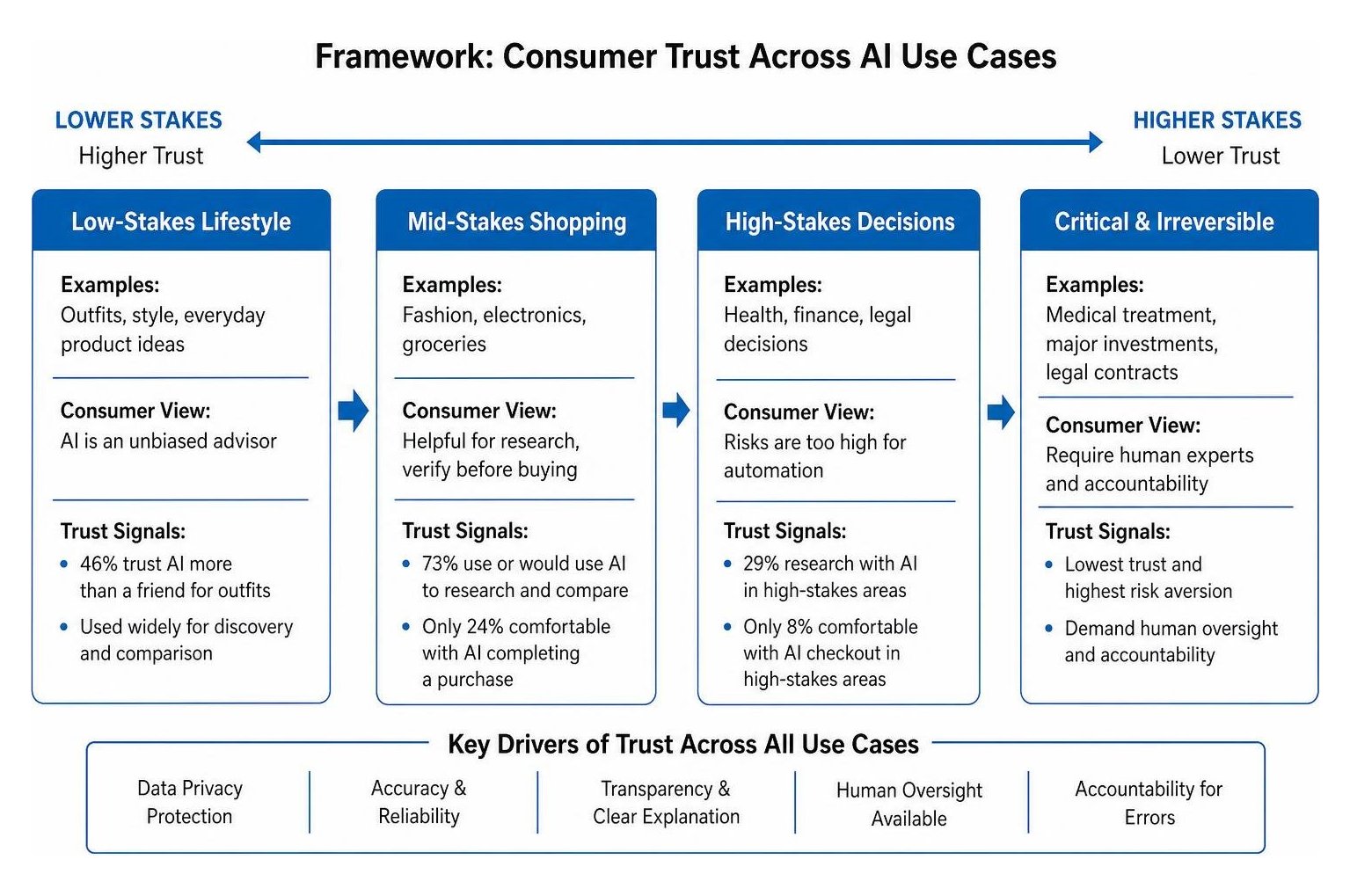
Shoppers often view algorithms as unbiased advisors because they lack human emotional baggage. For instance, 46% of consumers trust AI more than a friend when selecting an outfit, appreciating direct, unvarnished style suggestions. AI does not judge personal taste or harbor social motives.
When decisions involve health, investments, or high-value contracts, that objectivity is no longer enough. Consumers demand accountability, empathy, and professional licensure. Shoppers frequently use conversational AI to formulate basic questions, but cross-verify answers with accredited human professionals. Exploring autonomous agent workflow dynamics highlights that buyers require a human safety net whenever mistakes carry significant financial or personal consequences.
How Do AI Labels Affect Consumer Trust?
Labeling marketing materials or product advice as 'AI-generated' creates a measurable trust penalty, causing consumers to view the content more critically.
Academic research into how AI shapes consumer trust and online experience reveals that labeling an advertisement as AI-generated reduces perceived emotional impact, perceived naturalness, and immediate click-through intent. When consumers know an algorithm produced the copy, they scrutinize claims more harshly.
This effect creates a transparency challenge for brands balancing regulatory requirements with conversion goals. While informed buyers appreciate honest disclosures, poorly framed AI labels can depress conversions on traditional consumer goods. Comparing AI vs human engagement benchmarks shows that pairing transparent automation with human creative direction helps maintain strong user engagement.
How Do Privacy and Ethical Concerns Affect Trust in AI?
Data privacy fears and perceived corporate carelessness represent the single largest barrier to consumer AI adoption.
- Data Skepticism: 64% of consumers believe companies are reckless with customer data.
- Dwindling Reciprocity: Only 49% of customers feel brands use personal information in a beneficial way.
- Regulatory Demand: Nearly 60% of shoppers want stricter safety and fairness rules before AI systems advance further into commerce.
- Security Investment: 53% of consumers state they would gladly pay a premium for AI tools that guarantee absolute data safety.
- Negative Moderation: Statistical modeling indicates that over-automation and privacy concerns act as strong negative moderators, reducing trust sensitivity and depressing online conversion rates.
When users feel constantly tracked by automated algorithms, personalization feels intrusive rather than helpful.
How Can Businesses Build Customer Confidence in AI-Driven Commerce?
Businesses can build lasting consumer confidence by combining transparent disclosures, strong privacy controls, and seamless access to human support.
Winning consumer trust requires treating AI as an assistant rather than an autonomous replacement for human care. When businesses prioritize explainability and respect personal data boundaries, shoppers respond with higher conversion rates and greater brand loyalty.
What Steps Can Businesses Take to Use AI Responsibly?
To bridge the gap between algorithmic speed and shopper trust, organizations must put actionable safeguards in place across every digital touchpoint.
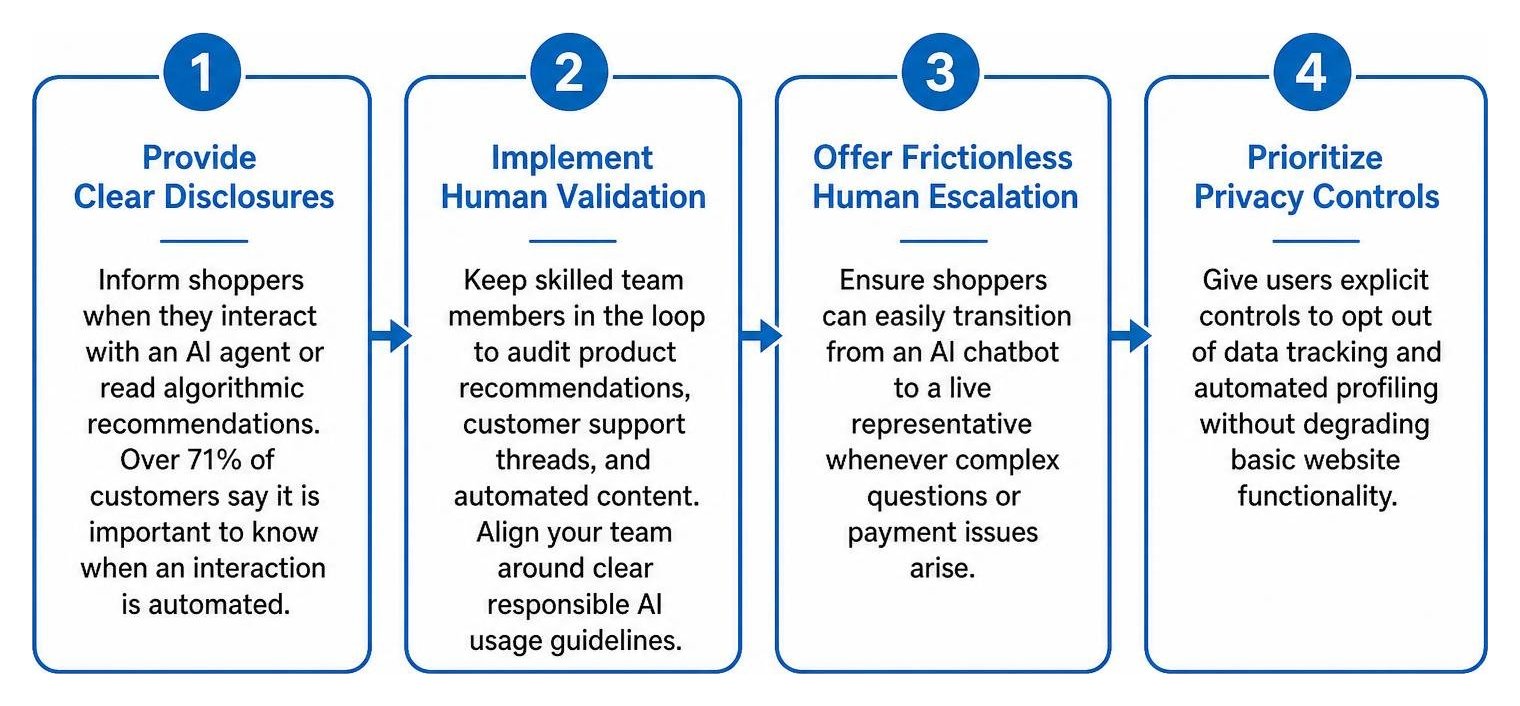
- Provide Clear Disclosures: Inform shoppers whenever they interact with an AI agent or read algorithmic recommendations. Over 71% of customers state it is important to know when an interaction is automated.
- Implement Human Validation: Keep skilled team members in the loop to audit product recommendations, customer support threads, and automated content. Align your team around clear responsible AI usage guidelines to ensure safety and quality standards remain uncompromised.
- Offer Frictionless Human Escalation: Ensure shoppers can easily transition from an AI chatbot to a live representative whenever complex questions or payment issues arise.
- Prioritize Privacy Controls: Give users explicit controls to opt out of data tracking and automated profiling without degrading basic website functionality.
- Optimize for Transparent Search Visibility: Partnering with SmallBizSEO for expert AI SEO solutions ensures your brand earns organic prominence across modern search engines while publishing credible, human-verified resources that build enduring consumer trust.
Earning Lasting Customer Loyalty in the Automated Era
Consumer trust in artificial intelligence is nuanced. Shoppers readily welcome automated recommendations that save time and reduce choice overload, but they remain cautious about privacy, ethics, and fully autonomous checkouts. Brands that succeed in this environment will not be those that automate every interaction, but those that balance digital speed with transparent practices, verifiable quality, and genuine human oversight.